 The Itinerary
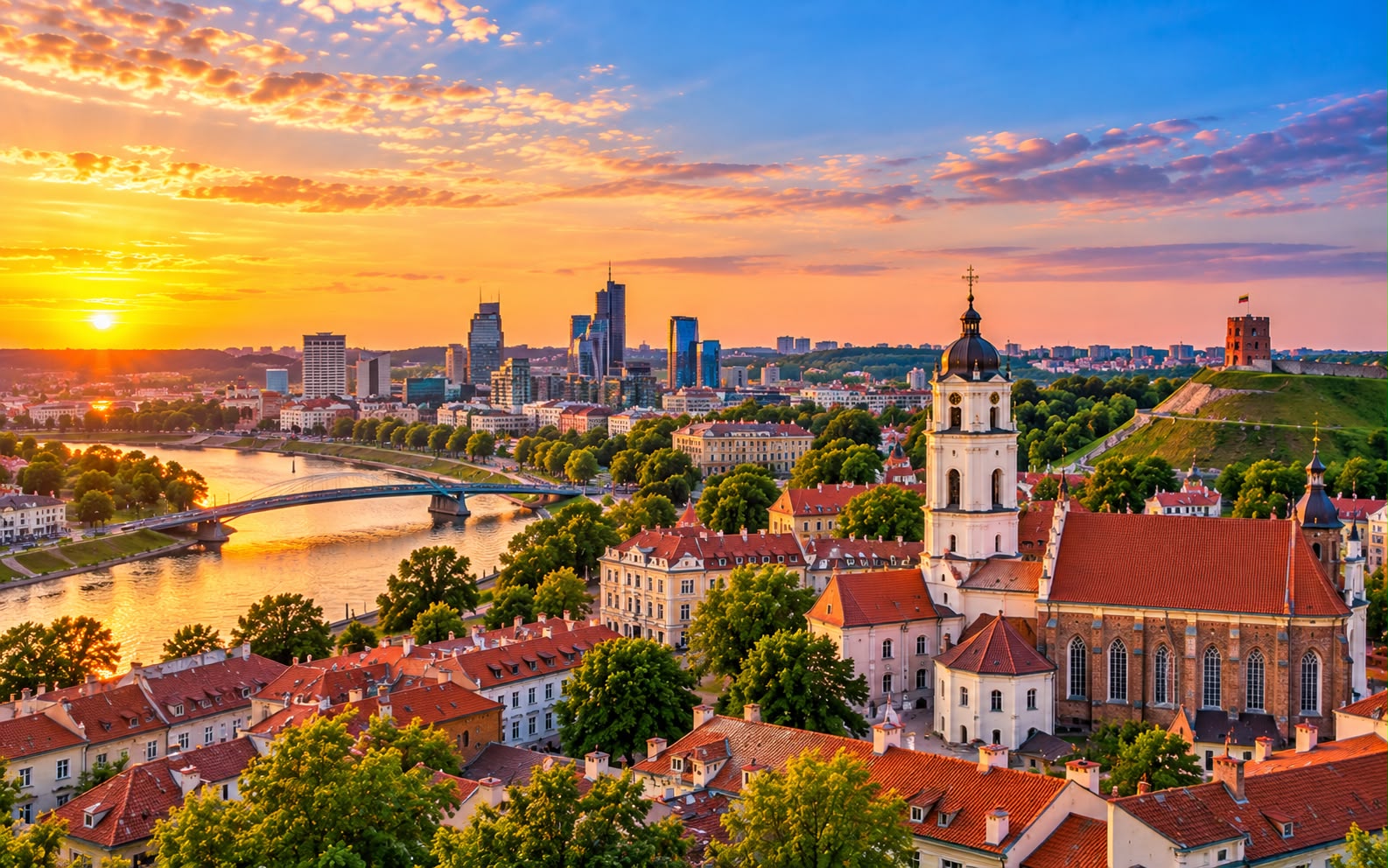
Lithuania in 7 days: Vilnius, Kaunas and the Curonian Spit
A baroque capital with a breakaway artists' republic inside it, an island castle on a lake, an interwar city that is now a UNESCO modernist listing, a hill carrying two hundred thousand crosses, and sand dunes you can climb on a spit between a lagoon and the sea.
- Northern Europe
- 7 days
- ≈ AED 3,700 / person
- Baroque, modernism and sand dunes
Before you go
Lithuania is the biggest of the three Baltic states and the one with the most range. Vilnius has the largest baroque old town in eastern Europe, and inside it a neighbourhood called Užupis that declared itself a republic in 1997, with a constitution bolted to a wall in forty languages. One article reads: everyone has the right to be happy. The next one: everyone has the right to be unhappy.
An hour away, Trakai castle sits on an island in a lake, rebuilt in red brick and reachable by footbridge. West, Kaunas spent the interwar years as the provisional capital and built itself a modernist city centre that UNESCO listed in 2023. Further on, the Hill of Crosses carries something over two hundred thousand of them, planted and replanted through two occupations. And at the coast, the Curonian Spit — a 98km sandbar between lagoon and sea, half of it Lithuanian, with dunes you climb on boardwalks.
The shape: Vilnius (3 nights) → Kaunas (1) → Curonian Spit (2). Figure EUR 905 (≈ AED 3,706) per person excluding flights. Go June–September for the coast; Vilnius alone is good year-round.
Before you go: the 15-minute admin
Visas
- Lithuania is in Schengen. One visa covers it and 28 other countries; many nationalities enter visa-free — check yours against the current list before booking.
- Pairs with Latvia and Estonia on one visa. The Baltics route links the three capitals in eight days.
Money
- Euro. Cards are accepted almost everywhere. Carry a little cash for the Hill of Crosses car park and small cafés on the Spit.
- The cheapest of the three Baltic capitals for food: mains €12–20 in Vilnius, less in Kaunas.
- Tipping is not expected; round up if you liked it.
SIM and data
- EU roaming at home rates. From outside the EU, a prepaid SIM or eSIM is a few euro for the week.
- Coverage on the Curonian Spit is good in Nida and patchy in the forest between villages.
Getting around
- Vilnius airport is 7 minutes from the centre by train (€0.70) or 15 by bus — one of the closest airports to a European capital.
- Trakai is 28km from Vilnius: train to Trakai station (35 min, €2) then a 25-minute walk, or drive.
- Vilnius–Kaunas is a train or coach, about 1h15, €5–9, running hourly.
- The Spit needs the ferry. Klaipėda to Smiltynė takes 10 minutes; cars pay more and in July you queue. Buses run Smiltynė–Nida.
- A car helps days 4–7 for the Hill of Crosses and the Spit villages. Hire from €40–55/day.
Travelling with kids?
- Trakai castle, the ferry and the dunes do the heavy lifting; none of it is strenuous.
- The Parnidis dune boardwalk at Nida is the one they will remember — and the lagoon side is shallow and warm enough to swim in August.
- Kaunas has the Devils’ Museum, three floors of devil figures, which is either delightful or a mistake depending on the child.
- Vilnius old town is cobbled and hilly; carrier beats pushchair.
Day by day
Day 1 — Land in Vilnius, baroque and the republic
- Afternoon — Land, train or bus into the centre, check in. The old town is UNESCO-listed and walkable end to end in half an hour.
- 16:30 — Start at the Gate of Dawn, the only surviving city gate, with its chapel and gilded Madonna, then walk north up Aušros Vartų and Didžioji into the old town proper.
- 17:30 — Vilnius Cathedral and its free-standing belfry on the square, then Gediminas Tower — the funicular if your legs have had enough, the path if not. The view takes in the whole old town and the Neris.
- 19:00 — Cross the footbridge into Užupis. The constitution is on mirrored plaques on Paupio street; read a few, then eat in one of the courtyards. The angel statue on the square is the local landmark.
Where to stay in Vilnius (three nights — the old town is the obvious choice and not expensive by EU standards)
- Luxury: Stikliai Hotel in the old Jewish quarter, or Narutis on Pilies, the main pedestrian street.
- Mid-range: hotels around Vokiečių and Pilies streets — central, walkable, and well under western European prices.
- Value: apartments in Užupis or just south of the Gate of Dawn, five minutes from everything.
Day 2 — The old town properly, and the Jewish quarter
- 09:30 — St Anne’s Church, the flamboyant gothic one Napoleon reportedly wanted to carry back to Paris in the palm of his hand, with the Bernardine church behind it.
- 11:00 — Vilnius University, founded 1579: thirteen courtyards, the St Johns’ church belfry for another view, and the frescoed Littera bookshop.
- 13:00 — Lunch, then the Jewish quarter. Vilnius was called the Jerusalem of the North, with over ninety synagogues before 1941; the Choral Synagogue is the only one left working, and the Green House museum tells what happened.
- 16:00 — Museum of Occupations and Freedom Fights in the former KGB building, including the cells in the basement. Heavy, and the reason the rest of the country reads the way it does.
- 18:30 — Dinner. Cold beetroot soup in summer — bright pink, served with a hot potato — and cepelinai, the potato dumplings, all year.
Day 3 — Trakai and the island castle
- 09:30 — Train or drive to Trakai, 28km west.
- 10:30 — Trakai Island Castle, on Lake Galvė, reached by two footbridges. Built from the 14th century, ruined, and rebuilt through the 20th — the red brick against the water is the image on half the country’s postcards.
- 13:00 — Lunch on kibinai, the folded pastries of the Karaim community, a Turkic people brought here in 1397 and still present on the town’s main street in their three-windowed wooden houses.
- 14:30 — Row a boat on the lake, or walk the shore path around it.
- 17:00 — Back to Vilnius. Evening free.
Day 4 — Kaunas and the interwar city
- 09:30 — Train or coach to Kaunas, about 1h15.
- 11:00 — Laisvės alėja, the 1.6km pedestrian avenue, and the modernist architecture that UNESCO listed in 2023 — the Christ’s Resurrection Basilica, the Central Post Office, the Officers’ Club. It is what a small country built when it suddenly had to be a capital.
- 13:30 — Lunch, then the old town at the far end: the castle remains, the town hall locals call the White Swan, and the confluence of the Nemunas and Neris.
- 16:00 — The Ninth Fort, 7km out: a tsarist fortification used as a killing site in the occupation, with a vast concrete memorial. Allow an hour and expect it to be quiet.
- Evening — Stay in Kaunas, or drive on toward Šiauliai to shorten day 5.
Day 5 — The Hill of Crosses, then the coast
- 09:00 — Drive north to the Hill of Crosses near Šiauliai, about 1h30 from Kaunas.
- 10:30 — The hill itself. Crosses have been planted here since the 1830s; the Soviet authorities bulldozed it at least three times and it was rebuilt each time, overnight. Estimates now run past 200,000. Twenty minutes is enough, and it stays with you longer than that.
- 12:00 — Drive west to Klaipėda, about two hours.
- 14:30 — Lunch in Klaipėda’s old town — the German timber-framed quarter, this was Memel until 1923 — then the ferry to Smiltynė and down the Spit.
- 16:30 — Nida, 50km down the Spit. Check in.
- 18:30 — Walk the lagoon front: blue-and-white fishing boats, weathervanes, and the amber museum.
Where to stay on the Spit (two nights — Nida is the village to pick, and books out in July and August)
- Mid-range: guesthouses along the Nida lagoon front, many in restored fishermen’s cottages.
- Value: rooms in Juodkrantė, halfway up the Spit and quieter, with the Hill of Witches sculpture trail.
Day 6 — Dunes, and the quiet half of the Spit
- 09:30 — The Parnidis dune boardwalk above Nida: 52 metres up, a sundial obelisk on top, and the Russian border visible down the sand to the south.
- 11:30 — Thomas Mann’s summer house, where he wrote part of the Joseph tetralogy in the early 1930s, now a small museum.
- 13:30 — Lunch, then the sea side: cross the Spit on foot through pine — it is about 1.5km wide here — to a beach that runs the full length of the peninsula.
- 16:00 — Drive or bus north to Juodkrantė for the Hill of Witches, a forest trail of carved wooden figures from Lithuanian folklore, and the grey heron and cormorant colony above it.
- 19:00 — Last dinner on the lagoon. Smoked fish is the thing here.
Day 7 — Back to Vilnius, fly home
- 09:00 — Spit to Klaipėda by bus and ferry, then the coach or train east. Klaipėda–Vilnius is about four hours, so this is a travel day.
- Alternative — Fly out of Palanga, 30km north of Klaipėda, if the schedule suits. It saves the four hours and is worth checking before you book the inbound.
Costs and practicalities
Best time to visit
June–September for warmth and daylight, with the Curonian Spit the main reason the summer matters.
- May–June — the best of spring. Long evenings, Vilnius Old Town in use, and Joninės on 23–24 June for the solstice.
- July–August — warmest and busiest. The Curonian Spit and Nida fill with Lithuanian and German holidaymakers, and accommodation there needs booking months ahead.
- September–October — autumn colour, prices down, and the Spit’s dunes without the crowds.
- November–March — cold, dark and snowy, with the Christmas market in Cathedral Square and the Hill of Crosses looking its most severe.
The Song and Dance Celebration, every four years in early July, brings tens of thousands of performers to Vilnius and is UNESCO-listed.
Travel tips
- The Curonian Spit is a UNESCO site and a national park — there is an entry fee for vehicles, the dunes are fenced for a reason, and walking on them is prohibited and fined.
- The Spit is reached by ferry from Klaipėda. Book the car ferry ahead in summer; the passenger one is frequent.
- The Hill of Crosses is near Šiauliai, not Vilnius — about two hours north. It is a working pilgrimage site; people leave crosses rather than photograph and leave.
- Lithuania is in Schengen and the eurozone and cards work everywhere.
- Užupis in Vilnius declares itself a republic with its own constitution on a wall in twenty-odd languages. It is a joke that has become a genuinely good arts quarter.
- Russian is widely spoken and politically sensitive. English first.
- Ticks in the forests from spring to autumn. Encephalitis is present; check yourself after walking in the Dzūkija or Aukštaitija forests.
What this trip actually costs
Two people, 6 nights, mid-range comfort, flights excluded:
| Item | Cost |
|---|---|
| Hotels, 6 nights (3 Vilnius + 1 Kaunas + 2 Nida) | EUR 760 (≈ AED 3,112) |
| Car hire, 3 days + fuel | EUR 210 (≈ AED 860) |
| Trains, coaches and the Spit ferry | EUR 80 (≈ AED 328) |
| Food and drink, 7 days | EUR 600 (≈ AED 2,457) |
| Castles, museums and the dune | EUR 160 (≈ AED 655) |
| Total for two | EUR 1,810 (≈ AED 7,411) |
- Roughly EUR 905 (≈ AED 3,706) per person. Vilnius apartments and skipping the car pull it under EUR 650 (≈ AED 2,661); Nida in August pushes it past EUR 1,300 (≈ AED 5,323) on accommodation alone.
- Nida is the expensive night and the one that sells out. Book the Spit first and build the rest around it.
- No car? Vilnius, Trakai, Kaunas and Klaipėda are all on rail or coach. The Hill of Crosses is the awkward one — it is a taxi from Šiauliai station.
- Hotel picks here are chosen on location, not on commission — always check prices and recent reviews before booking.
What to pack
- Layers and a rain shell. The coast is windier and colder than Vilnius in every season.
- Shoes for cobbles, forest and sand — Vilnius, the Hill of Witches and the dune in one trip.
- Swimwear June–August. The lagoon side warms up; the sea side does not, much.
- Mosquito repellent for the Spit forest in midsummer.
FAQ
Is the Curonian Spit worth two nights? Yes, because the Spit empties out after the day-trippers take the last ferry, and that is when it is best. One night works if you are short, but you will spend most of it travelling.
Vilnius or Riga? Vilnius for baroque, for value and for Užupis; Riga for art nouveau and food. Vilnius is the warmer, scruffier, more likeable of the two.
Can I cross into the Russian half of the Spit? No — Kaliningrad is a separate visa and a hard border. Treat the Lithuanian half as the trip.
Is the Hill of Crosses a detour or a destination? A detour, and worth it. Twenty minutes on site, but it is the clearest thing in the country about what the twentieth century was like here.
Prices and entry rules change, and what you need depends on your passport; last checked 8 October 2026, so confirm with the embassy or your airline before booking.


