 The Itinerary
Luxembourg in 4 days: a capital on a gorge, castles and free transport
The first country in the world to make all public transport free, wrapped around a capital built on a gorge with a kilometre of tunnels cut inside its cliffs — plus a castle in the north, a sandstone forest in the east, and the hotel-rate quirk that decides what your trip costs.
- Western Europe
- 4 days
- ≈ AED 1,850 / person
- A UNESCO fortress city, and the only country where every bus and train is free
Before you go
Luxembourg is 82 kilometres from top to bottom and is routinely written off as a banking district with a cathedral. That is a mistake made by people who have seen the office towers from the motorway and nothing else.
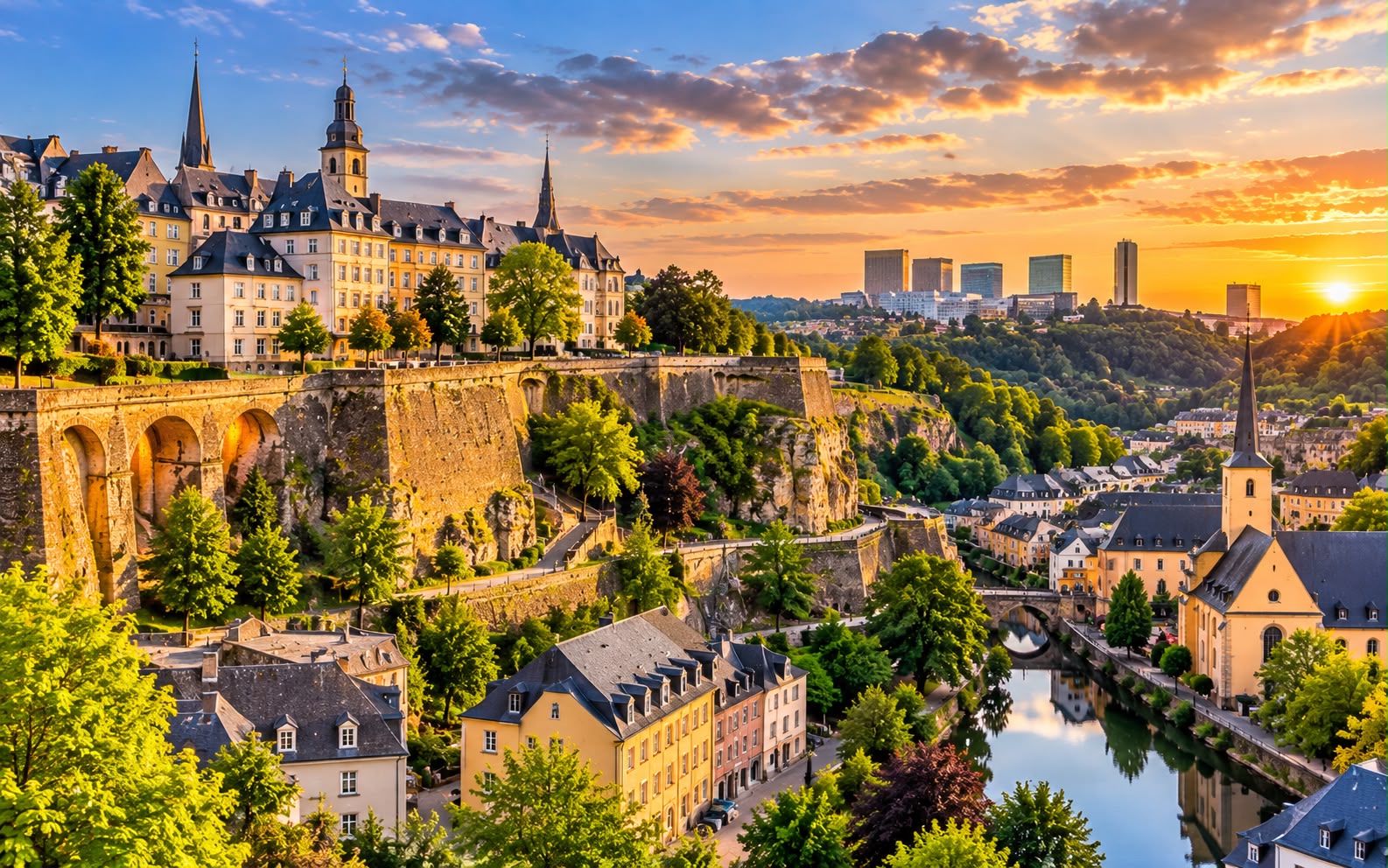
The old city is built on a gorge. The Alzette and the Pétrusse cut two ravines through the rock, the fortress was built on the cliffs between them, and the result is a capital where you look down from a terrace onto rooftops sixty metres below. The Chemin de la Corniche along the top has been called the most beautiful balcony in Europe for about a century, and nobody has produced a better description. The old quarters and the fortifications have been on the UNESCO list since 1994, and the Bock casemates — kilometres of defensive tunnels cut inside the cliff — are still open to walk through.
Outside the city: Vianden, a castle on a ridge above a river town, with a chairlift over it. Clervaux, where a castle in the Ardennes holds The Family of Man, Edward Steichen’s 1955 photographic exhibition, permanently installed and on the UNESCO Memory of the World register. And the Mullerthal, a sandstone forest of fissures, caves and waterfalls that the tourist board calls Little Switzerland and that is better than that makes it sound.
Then the detail that changes how you plan: since 2020, all public transport in Luxembourg has been free. Every bus, tram and second-class train, nationwide, for everyone, with no ticket. It was the first country in the world to do it, and it means the transport line in your budget is zero.
Four days is right. Figure EUR 450 (≈ AED 1,843) per person excluding flights — and book Friday to Monday, because this is a business city and weekend rooms cost a fraction of midweek ones. May–June and September are the best months.
Before you go: the 15-minute admin
Free transport, and what it actually covers
- All public transport nationwide has been free since 29 February 2020 — buses, trams and second-class train travel, for residents and visitors alike. No ticket, no tap, no pass.
- It covers the whole country, not just the capital. Vianden, Clervaux, Echternach and the Moselle villages are all reachable for nothing.
- First class on trains still costs, and so do cross-border journeys the moment you leave Luxembourg — a train into Trier or Metz is charged from the border.
- The Pfaffenthal panoramic lift and the Grund lift connect the upper city to the lower one, and are also free. They save a lot of climbing.
- Luxembourg City’s bus network is the practical one; trains cover the north and the Moselle. Both run to timetable and both are easy.
Visas and entry
- Luxembourg is in the EU and the Schengen area. Many nationalities enter visa-free for short stays; others need a Schengen visa, which is the same one that covers France, Germany and Belgium next door.
- Check your own case on the official government site. Nothing about Luxembourg is unusual here.
Money and what things cost
- The euro. Cards are taken everywhere, including for small amounts.
- It is an expensive country — one of the wealthiest in the world — and restaurant prices reflect that. Food is the line that will surprise you, not transport.
- The hotel quirk is worth real money. Rooms are priced for business travellers, so Tuesday night can cost double Saturday night in the same hotel. Shifting a trip by two days is the single biggest saving available.
SIM and data
- EU roaming rules apply, so an EU or UK plan works normally.
- Coverage is complete, including in the Mullerthal gorges.
Getting around
- Findel airport is six kilometres from the city and the bus into town is free, like everything else. Fifteen to twenty minutes.
- No car needed for this itinerary. That is unusual for a trip with castles in it and it is entirely true here: the train reaches Clervaux, the bus reaches Vianden, and both are free.
- A car helps only if you want the Mullerthal trailheads and the Moselle villages on the same day.
- The country is small enough that everything on this list is within an hour of the capital.
Travelling with kids?
- The casemates are tunnels in a cliff with arrow slits looking out over a gorge, which sells itself. Low ceilings, uneven steps, not for a pushchair.
- The Vianden chairlift runs over the town to a terrace looking down on the castle. Seasonal.
- The Pfaffenthal lift is a glass box on the side of a cliff, free, and takes thirty seconds.
- Mullerthal is a forest full of narrow rock passages and a waterfall with a bridge over it. Good shoes.
Day by day
Day 1 — Luxembourg City: the gorge
- Morning — Arrive, free bus into town, drop bags.
- 11:00 — Chemin de la Corniche, walked slowly. It runs along the old ramparts above the Alzette with the lower town below; it takes ten minutes and you will take forty.
- 12:00 — The Bock casemates, cut into the rock the fortress stood on. Seventeen kilometres of tunnels survive out of a far larger network; a fraction is open and it is enough.
- 14:00 — Down into the Grund by lift, lunch on the river, and back up through Pfaffenthal.
- 16:30 — Notre-Dame Cathedral, the Grand Ducal Palace from the outside, and Place d’Armes for a drink where the city sits out.
- 19:30 — Dinner in the Rives de Clausen, a brewery complex turned restaurant quarter down in the valley.
Where to stay in Luxembourg City (three nights, no repacking)
- Mid-range: the Ville Haute, inside the UNESCO quarter and walkable to all of the above.
- Value: near the station, ten minutes by free bus and consistently cheaper.
Day 2 — Kirchberg, and the Moselle
- 09:30 — The Pfaffenthal panoramic lift, then the funicular up to Kirchberg.
- 10:00 — Mudam, I. M. Pei’s modern art museum built on the ruins of Fort Thüngen, with the fort’s museum next door. The building is the exhibit as much as anything in it.
- 12:30 — Luxembourg American Cemetery at Hamm, twenty minutes by bus. More than five thousand graves from the Battle of the Bulge, including General Patton’s, at the head of them. Quiet and worth the detour.
- 15:00 — Train or bus to the Moselle. Remich or Grevenmacher for a crémant tasting — the sparkling wine the valley does properly — and a walk along the river with Germany on the far bank.
- 17:00 — If you have the time, Schengen is twenty minutes further south: the village the agreement was signed at in 1985, with a small museum explaining why Europe’s borders work the way they do.
Day 3 — The north: Vianden and Clervaux
- 08:30 — Train north. The Ardennes start almost immediately and the valleys narrow.
- 10:00 — Vianden. The castle sits on a ridge above the town, was left to fall down in the nineteenth century, and was rebuilt from the 1970s onwards — it is now the best-restored castle in the country. Victor Hugo spent part of his 1871 exile in a house by the bridge, now a small museum.
- 12:30 — The chairlift up the far side of the valley for lunch with the castle opposite.
- 14:30 — On to Clervaux, where the castle holds The Family of Man: 503 photographs from 68 countries, assembled by Edward Steichen for MoMA in 1955, given to the country he was born in, and permanently installed here. It is on UNESCO’s Memory of the World register and it is the single best thing in Luxembourg.
- 17:30 — Train back. About an hour and a half.
Day 4 — Mullerthal, then out
- 09:00 — Bus east to Echternach, the country’s oldest town, built around a Benedictine abbey founded in 698. On Whit Tuesday it holds the hopping procession, a dancing procession through the streets that is on the UNESCO intangible heritage list.
- 10:30 — Into the Mullerthal. The classic short walk takes in the Schiessentümpel, a three-stream waterfall under a stone bridge, and the rock passages around Berdorf — corridors a shoulder wide cut between sandstone blocks.
- 14:00 — Back to the airport, which is on this side of the country anyway.
Costs and practicalities
Best time to visit
May–June and September. Luxembourg is small, green and temperate, and the shoulder months give the best balance of weather and quiet.
- May–June — the Grund and the casemates at their best, long evenings, and the Moselle vineyards green.
- 23 June — National Day, with a torchlight procession the evening before and the city celebrating properly.
- July–August — warm and busy, with the Schueberfouer funfair in late August and early September, a 700-year-old market that is now the largest fair in the region.
- September–October — the Moselle wine harvest, and the Müllerthal’s beech forests turning.
- November–March — cold and often grey, with the Christmas markets from late November across the Place d’Armes and the Place de la Constitution.
Travel tips
- All public transport in the country is free — buses, trams and trains, for everyone, since 2020. There is nothing to buy and no ticket to validate.
- Three languages run in parallel. Luxembourgish is the national language, French is used for administration and restaurants, German in the press. English is widely spoken.
- The country is small enough to be a base. Trier, Metz and the Belgian Ardennes are all within an hour or two.
- The Müllerthal Trail — “Little Switzerland” — is the best walking and is reachable by the free trains and buses.
- Petrol is cheaper than in the neighbouring countries, which is why the border stations are busy.
- Cards work everywhere and the euro is the currency.
- The Bock casemates close in winter, usually November to March. Check before planning around them.
What this trip actually costs
Two people, 3 nights, mid-range comfort, flights excluded:
| Item | Cost |
|---|---|
| Hotels, 3 nights (weekend rate) | EUR 420 (≈ AED 1,720) |
| All public transport, 4 days | EUR 0 (≈ AED 0.00) |
| Food and drink, 4 days | EUR 340 (≈ AED 1,392) |
| Casemates, Mudam, Vianden, Clervaux | EUR 90 (≈ AED 369) |
| Crémant tasting on the Moselle | EUR 50 (≈ AED 205) |
| Total for two | EUR 900 (≈ AED 3,685) |
- Roughly EUR 450 (≈ AED 1,843) per person, and the transport line is genuinely zero — the only country in the world where that is true.
- Midweek instead of weekend can add €300 to the hotel line on its own. This is the decision that matters.
- Food is the real cost. A main course in the capital commonly runs €25–35, and the wine list matches.
- Hotel picks here are chosen on location, not on commission — always check prices and recent reviews before booking.
What to pack
- Shoes with grip. The old city is cobbles and steep steps between two levels, and the Mullerthal is wet rock.
- A rain layer. This is northern Europe and the forecast changes hourly.
- A warm layer for the casemates — they are cut into rock and stay cold whatever the month.
- Nothing for transport. There is no ticket to carry.
FAQ
Is public transport really free for tourists too? Yes. There is no residency test, no pass to buy and no ticket to validate. You get on. First class on trains and anything crossing the border are the only exceptions.
Is four days too long for a country that small? No — it is about right, because the country is dense rather than large. Two days covers the capital properly; the other two buy you the Ardennes and the Mullerthal, which are what people are surprised by.
Can I do it as a day trip from Brussels or Trier? You can reach the city in two to three hours from either, and you will see the Corniche and the casemates and nothing else. The north and the Mullerthal need you to stay.
What language should I use? Luxembourgish is the national language; French and German are both administrative. In practice French gets you through everything in the city, and English is widely spoken in hotels and restaurants.
Is it worth visiting if I am not interested in castles? The gorge, the casemates and The Family of Man have nothing to do with castles, and any one of them justifies the trip.
Prices and entry rules change, and what you need depends on your passport; last checked 8 October 2026, so confirm with the embassy or your airline before booking.


