 The Itinerary
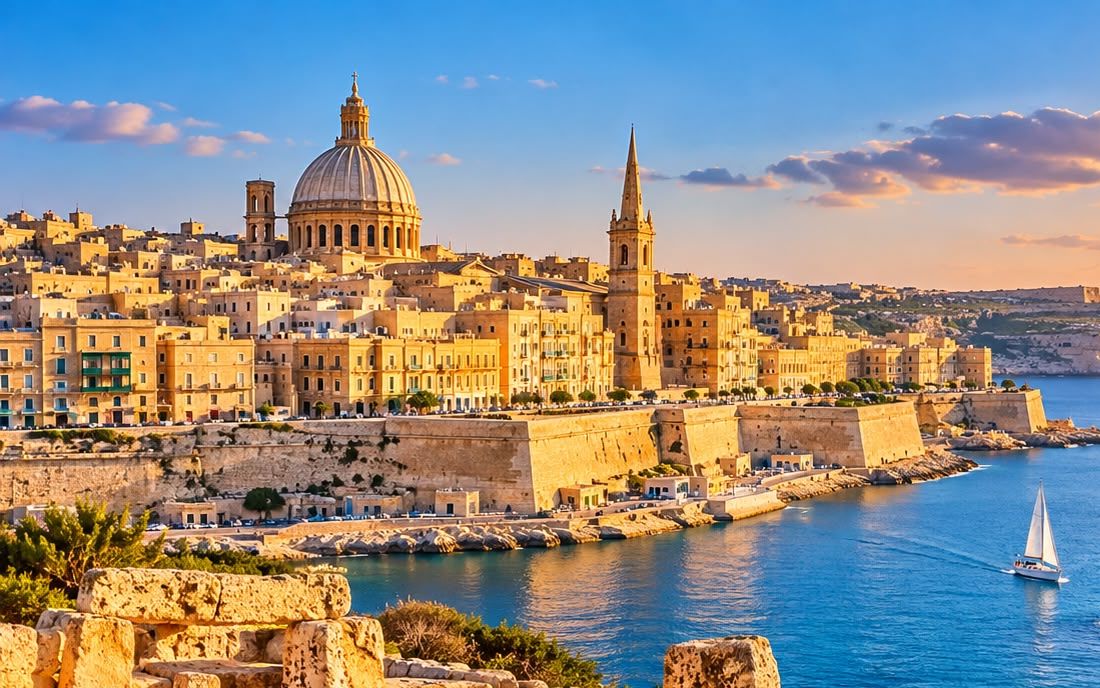
Malta in 7 days: Valletta, the megalithic temples and Gozo
A country 27 km long holding temples a thousand years older than the pyramids, a baroque capital built by knights after the siege of 1565, Caravaggio's only signed painting, and an underground necropolis that admits eighty people a day — with Gozo across the water for the slow half.
- Southern Europe
- 7 days
- ≈ AED 3,500 / person
- Deep history, short distances
Before you go
Malta is smaller than the Isle of Wight and holds more history per square kilometre than anywhere in Europe. The Ġgantija temples on Gozo were built around 3600 BC — older than Stonehenge, older than the pyramids at Giza, and the oldest free-standing structures on earth.
Three and a half thousand years later the Knights of St John survived the Great Siege of 1565 and built Valletta as a fortress city on the headland above the harbour, in grid-planned baroque, which is why it looks like nothing else in the Mediterranean.
Everything is within an hour of everything else. English is an official language. And the practical catch is one booking you need to make now rather than later.
Before you go: the Hypogeum, the buses and the season
Getting in, and getting around
- Malta International (MLA) is at Luqa, 8 km from Valletta — 20 minutes by bus or taxi.
- You do not need a car, and in Valletta and Mdina you cannot use one. Buses reach everywhere, cost a few euro with a Tallinja card, and are slow but frequent. Hire a car for one or two days if you want the south and the north coast quickly.
- Driving is on the left, a British inheritance along with the red post boxes and the plug sockets.
- Ferries matter more than roads: Valletta–Sliema and Valletta–Three Cities are 5–10 minutes and save a long loop; Ċirkewwa–Mġarr to Gozo is 25 minutes and runs every 45 minutes or so, more in summer.
Book the Hypogeum now, before anything else
- The Hypogeum of Ħal Saflieni is a 5,000-year-old underground burial complex cut into living rock across three levels. It is the only one of its kind anywhere.
- Only about 80 visitors are admitted per day, in groups of ten, to limit humidity damage. Tickets go on sale weeks to months ahead and sell out.
- Book it the moment your dates are fixed, then build the rest of the week around the slot you get. A small number of last-minute tickets are released at the National Museum of Archaeology, and queuing for them is a gamble.
When to go
- April to June and September to early November are the answer: warm sea, bearable sun, and the Blue Lagoon is not a car park.
- July and August are hot, crowded and expensive, and Comino becomes genuinely unpleasant.
- December to March is mild, green, very quiet, and the sea is too cold for most people. Valletta in winter is lovely and half the price.
- Note: many smaller sites close early — 16:30 or 17:00 — and some shut on Sundays. Check before you build an afternoon around one.
Money and practicalities
- Euro. Cards work everywhere; small kiosks and the fish market want cash.
- Maltese and English are both official. Everything is signed in both and everyone speaks English.
- Modest dress in churches — shoulders and knees — and St John’s Co-Cathedral bans stiletto heels, which would go through the marble tomb slabs you walk on.
Day by day
Day 1 — Land, and Valletta at dusk
- 14:00 — Land at MLA. The X4 bus or a 20-minute taxi puts you in Valletta.
- 15:30 — Drop bags. Stay in Valletta itself rather than Sliema or St Julian’s: the capital empties in the evening and having it to yourself after six is the best thing about being there.
- 16:30 — Walk in through City Gate and down Republic Street, the spine of the grid. Valletta is 1 km by 600 m and you can cross it in fifteen minutes.
- 17:30 — Upper Barrakka Gardens for the view over the Grand Harbour — the Three Cities opposite, Fort St Angelo on the point, and the dockyards below. The Saluting Battery fires at 12:00 and 16:00 daily.
- 19:00 — Strait Street, once the sailors’ bar strip and now the restaurant quarter, for dinner. Fenek — rabbit, stewed in wine and garlic — is the national dish and not a gimmick.
- 21:00 — Walk the empty streets. The day-trippers have gone back to Sliema and the limestone glows under the lamps.
Day 2 — Valletta properly
- 09:00 — St John’s Co-Cathedral at opening. The exterior is a plain fortress box; the interior is the most densely decorated baroque room in Europe — every surface carved and gilded, and the floor is 400 tomb slabs of inlaid marble marking the knights buried beneath.
- 09:45 — The Oratory holds Caravaggio’s The Beheading of Saint John the Baptist — his largest canvas, the only painting he ever signed, and signed in the blood running from the saint’s throat. He painted it as a knight of the Order and was expelled months later for brawling.
- 11:00 — The Grandmaster’s Palace and its armoury.
- 12:30 — Lunch, and a pastizz from a hole in the wall — ricotta or mushy peas in flaky pastry, about 50 cents, and the national snack.
- 14:00 — The ferry to the Three Cities, five minutes across the harbour. Birgu (Vittoriosa) is older than Valletta, was the Knights’ first base, and is quieter and more lived-in — narrow lanes, the Inquisitor’s Palace, and Fort St Angelo on the point where the Great Siege was decided.
- 17:00 — A dgħajsa — the traditional harbour boat — back, or the ferry.
- 19:30 — Dinner in Valletta.
Day 3 — The south: temples, and the underground
- Your Hypogeum slot governs this day. Build the rest around whatever time you were given.
- 09:00 — Ħaġar Qim and Mnajdra on the south cliffs, 20 minutes apart on one ticket. Megalithic temples from around 3600–3200 BC, now under protective canopies. Mnajdra’s lower temple is aligned so that the equinox sun strikes the main axis and the solstices light the edges of the doorway — built by people without metal tools.
- 11:00 — The Hypogeum if that is your slot: three levels cut down into rock with hand tools, the Oracle Room with its deliberate acoustic resonance, and an estimated 7,000 burials. You go in with nine other people and no cameras. An hour, and the strangest hour in Malta.
- 13:00 — Marsaxlokk for lunch: a working fishing village of luzzu boats painted with the Eye of Osiris on the bow, and the fish restaurants along the front. Sunday morning is the big market.
- 15:30 — The Blue Grotto at Wied iż-Żurrieq — small boats into sea caves where the water goes an improbable electric blue. Morning light is better; the boats stop running when the swell is up, so this is the flexible item.
- 18:00 — Back to Valletta.
Day 4 — Mdina, Rabat and the centre
- 09:00 — Mdina, the old capital, 20 minutes inland. Walled, hilltop, Norman and baroque, and about 250 people live inside — which is why it is called the Silent City. Cars are banned apart from residents’.
- 09:30 — Go in through the main gate (which you will recognise from Game of Thrones), then get lost. The lanes are narrow enough that two people pass sideways, and the limestone takes the light beautifully in the morning.
- 10:30 — St Paul’s Cathedral and the bastion walk, with the whole island laid out below and Valletta visible on the coast.
- 12:00 — Rabat immediately outside the walls, and lunch — this is where the restaurants are cheaper and the locals eat.
- 13:30 — St Paul’s Catacombs: four hectares of Roman and early Christian rock-cut tombs under the town, with carved dining platforms where families ate meals beside their dead.
- 15:30 — The Dingli Cliffs, Malta’s highest point at 253 m, for the drop straight into the sea and no development on it.
- 17:00 — Mosta and its rotunda, with one of the largest unsupported domes in Europe — and a replica of the bomb that fell through it during Mass in April 1942 and failed to explode.
- 19:30 — Back for dinner.
Day 5 — To Gozo
- 09:00 — Bus or drive to Ċirkewwa at the northern tip, 45 minutes, then the ferry to Mġarr — 25 minutes, and you pay only on the way back.
- 10:30 — Gozo is greener, slower and a third the population density. Collect a hire car or arrange a driver; the buses here are infrequent.
- 11:00 — Ġgantija at Xagħra: two temples inside one wall, built around 3600 BC, with blocks over five metres and fifty tonnes. These are the oldest free-standing structures in the world — a thousand years before the pyramids. The museum alongside makes the chronology land.
- 13:00 — Lunch at Victoria (Rabat), the island’s small capital.
- 14:30 — The Cittadella above it: a fortified hilltop you walk the ramparts of, with the whole of Gozo visible in every direction and the sea on three sides.
- 16:30 — Dwejra: the Azure Window collapsed into the sea in a storm in March 2017 and is simply gone — what remains is the Inland Sea, a lagoon joined to the open water by a cave tunnel that boats run through, and the Blue Hole, which is one of the best shore dives in the Mediterranean.
- 18:30 — Sunset there, then dinner in Xlendi or Marsalforn.
Day 6 — Gozo, and Comino
- 08:00 — Comino early, or not at all. The Blue Lagoon is a sandbar channel of genuinely turquoise water between two islands — and in July and August it holds several thousand people and a wall of deckchairs. The first boat of the day, or the shoulder season, is the whole difference.
- 10:30 — Walk away from the lagoon. Comino has about three permanent residents, no cars, and the path round to Santa Marija Bay and the Crystal Lagoon loses the crowd in fifteen minutes.
- 13:00 — Back to Gozo for lunch.
- 14:30 — Ramla Bay, the red-sand beach below Xagħra, with Calypso’s Cave in the cliff above it — where Homer’s nymph is supposed to have kept Odysseus for seven years.
- 16:30 — Ta’ Pinu basilica, isolated in open country, and its wall of crutches and letters left by people who believe they were healed there.
- 19:00 — Last Gozo dinner. Gozitan cheeselets — ġbejniet — and the island’s own wine.
Day 7 — Back, and fly home
- 09:00 — Ferry back to Malta, 25 minutes.
- 10:30 — Sliema or St Julian’s for the last couple of hours if your flight is late — the ferry across to Valletta from Sliema gives the classic photograph of the city rising out of the water, and it costs under two euro.
- 12:30 — Lunch, then the airport, 20 minutes from anywhere.
- Last buy — Kinnie, the bitter-orange soft drink nobody else makes, and a bag of ġbejniet if you can carry them.
Costs and practicalities
Best time to visit
April–June and September–early November. Malta in July and August is hot, crowded and expensive, and the islands are small enough that the crowding is felt everywhere.
- April–June — the best of the year. Wildflowers, comfortable for walking the Dingli cliffs, and the sea swimmable from late May.
- July–August — over 33°C with no shade on the limestone, and peak crowds. The village festas run through the summer, which is the one good reason to be here then — fireworks, band marches, and every village taking its turn.
- September–early November — the sea is at its warmest in September and October, and the sites are quiet again.
- December–March — mild, 15°C, wet and windy. Carnival in February and the Gozo ferry still runs, but swimming is for the hardy.
The Blue Lagoon at Comino is unbearable in August and lovely in May.
Travel tips
- Driving is on the left, the roads are narrow and the parking is genuinely difficult. The bus network covers the whole island cheaply and is the easier option.
- Tallinja bus cards are worth buying at the airport if you are staying a week.
- The Gozo ferry is frequent and you pay only on the return leg from Gozo.
- Book Hagar Qim, Mnajdra and especially the Hypogeum far ahead — the Hypogeum admits a very small number per day and sells out weeks in advance.
- Churches require covered shoulders and knees and there are a great many of them.
- The limestone gives no shade. Hat, water and timing matter more here than the temperature suggests.
- Cards work everywhere and Malta is in the eurozone and Schengen.
What this trip actually costs
Two people, 6 nights, mid-range, excluding international flights:
| Item | Cost |
|---|---|
| Hotels, 6 nights (4 Valletta + 2 Gozo) | EUR 780 (≈ AED 3,194) |
| Buses, ferries and two days of car hire | EUR 190 (≈ AED 778) |
| Hypogeum, temples, cathedral, Cittadella, catacombs | EUR 170 (≈ AED 696) |
| Comino boat and the Blue Grotto | EUR 60 (≈ AED 246) |
| Food and drink, 7 days | EUR 420 (≈ AED 1,720) |
| eSIM, extras | EUR 80 (≈ AED 328) |
| Total for two | EUR 1,700 (≈ AED 6,961) |
- Roughly EUR 850 (≈ AED 3,480) per person — mid-range for Europe, and the sites are cheap: most are under ten euro and the Hypogeum, the expensive one, is EUR 35 (≈ AED 143).
- Valletta accommodation costs more than Sliema and is worth it for the evenings.
- Out of season this drops by a third. November to March the same hotels are half price.
What to pack
- Shoulders and knees covered for churches, and no stiletto heels in St John’s — they damage the marble tomb floor.
- Proper shoes for the temple sites and the Cittadella walls, which are uneven limestone.
- Sun protection. There is very little shade anywhere on these islands, and the limestone reflects.
- Swimming things from May to October, and reef shoes — most of the best swimming is off rock, not sand.
- UK-style Type G plugs, 230V.
- A light layer for the ferry, which is windy in any season.
FAQ
Is seven days too long for somewhere this small? No, and the temples are why. Malta has three UNESCO listings and six megalithic temple complexes, plus Valletta and the Hypogeum. A long weekend covers the capital; a week lets you take Gozo slowly, which is the half most people wish they had given more time to.
Do I need to book anything else in advance? The Hypogeum, weeks ahead, without exception. Everything else can be bought on the day outside high summer.
Is the Blue Lagoon worth it? Early in the day or outside July and August, yes. In peak season at midday it is one of the most crowded beaches in the Mediterranean, and Gozo’s own bays are better.
Which island should I sleep on? Both. Four nights in Valletta and two on Gozo is the split this itinerary uses, and Gozo after the last ferry is a different country from Malta at midday.
Can I do it without a car? Yes. Buses reach every site in this guide. A car for the south coast day and the Gozo day saves perhaps three hours each time, and nothing else.
Prices and entry rules change, and what you need depends on your passport; last checked 8 October 2026, so confirm with the embassy or your airline before booking.


