 The Itinerary
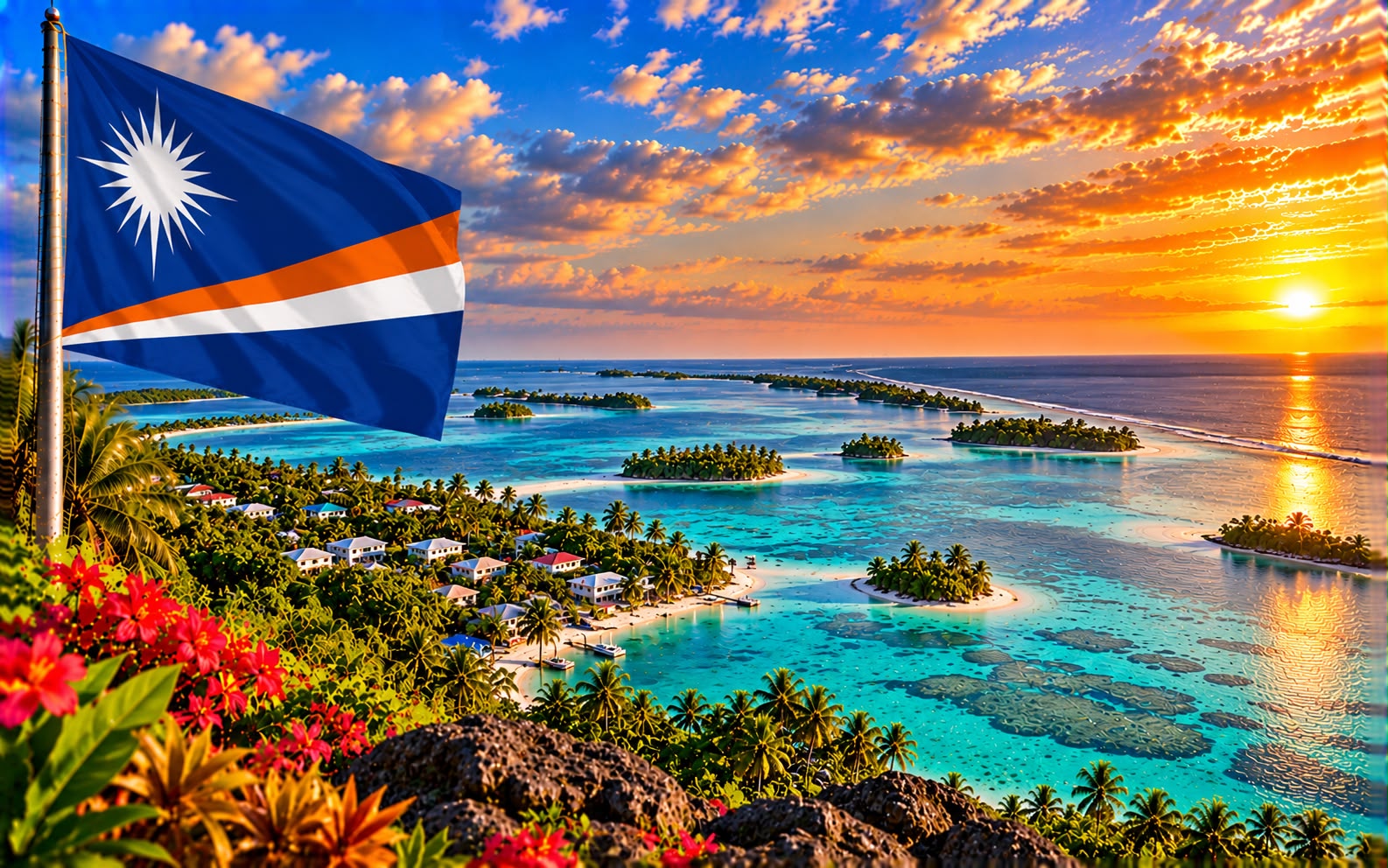
Marshall Islands in 7 days: Majuro, the Bikini wrecks and the nuclear legacy
Twenty-nine atolls averaging two metres above sea level, a stop on the Island Hopper that most people fly over, and the lagoon where the United States sank a captured fleet in 1946 to find out what a nuclear weapon does to warships.
- Pacific Islands
- 7 days
- ≈ AED 9,550 / person
- An atoll nation two metres above the sea, and the fleet sunk to test the bomb
Before you go
The Marshall Islands is 29 atolls and five islands spread across two million square kilometres of ocean, with a land area of about 180 square kilometres and an average elevation of around two metres.
It is a stop on the Island Hopper — the United service from Honolulu to Guam — and the honest framing is that most visitors are stopping over rather than coming here. That is a reasonable way to see it, and this guide is built around it.
Two things make it worth the stop.
The nuclear history, which is not a side note but the central fact of the modern country. Between 1946 and 1958 the United States conducted 67 nuclear tests in the Marshalls, at Bikini and Enewetak. The people of Bikini were moved off in 1946 and have never returned. Castle Bravo, in 1954, was about a thousand times the Hiroshima yield and contaminated inhabited atolls downwind. The Runit Dome on Enewetak — a concrete cap over a crater filled with radioactive debris — is cracking, and sits a couple of metres above a rising sea.
Bikini Atoll is UNESCO-listed for exactly this, and its lagoon holds the ships sunk in the 1946 Crossroads tests — the carrier USS Saratoga, the Japanese battleship Nagato that launched the Pearl Harbor attack, the USS Arkansas. It is among the great wreck dives on earth. Access has been intermittent for years and depends on whether an operation is running; check current status before building a trip around it.
Seven days. Figure USD 2,600 (≈ AED 9,549) per person excluding the international flight. Go December–April, the drier half.
Before you go: the 15-minute admin
Getting here, and why a stopover makes sense
- The Island Hopper — United, Honolulu to Guam — stops at Majuro and Kwajalein. Stopovers are permitted on the ticket, which is what makes a few days here cheap to add.
- Flights are a few times a week. Miss one and you wait.
- Nauru Airlines also connects Majuro with Tarawa, Nauru and Brisbane, which is the other way in.
- Kwajalein is a US Army installation — the missile defence test range — and you cannot stop there without sponsorship. The flight lands; you stay on it.
- Combine it with Micronesia. The Hopper makes Majuro, Kosrae, Pohnpei and Chuuk one routing, and that is the trip most people should take.
Bikini, honestly
- Diving Bikini has been on and off for years. The operation has started and stopped more than once, depending on boats, funding and the atoll council.
- Check whether anyone is running it before you plan. If they are, it is a liveaboard expedition of a week or more at serious cost, and the wrecks are deep — the Saratoga’s flight deck is at 50 metres.
- Radiation on the surface is monitored; the concern has been caesium in locally grown food rather than ambient exposure, which is why the atoll remains uninhabited.
- If Bikini is not running, Majuro and Arno have good reef and some wartime wrecks, and this itinerary assumes that.
Visas and money
- A Compact of Free Association with the United States means US citizens enter freely; most other nationalities get visa-free entry for 30 days. Check your own case.
- The currency is the US dollar.
- Bring cash. There are ATMs in Majuro and little else; cards work at a couple of hotels.
- Costs are high — almost everything is shipped in.
Climate, which is the live issue
- Average elevation is about two metres. King tides already flood parts of Majuro, and salt intrusion has damaged taro pits and groundwater.
- This is not an abstraction here, and Marshallese will talk about it directly if you ask. Listen rather than photograph.
Travelling with kids?
- The lagoon is calm and shallow and the atoll is safe.
- There is very little in the way of facilities, and the food is largely imported and limited.
- The flights are long with few connections.
Day by day
Day 1 — Majuro
- Arrive on the Hopper. Majuro atoll is a ribbon of land around a lagoon — in places a few dozen metres wide, with the ocean on one side and the lagoon on the other, and one road down the middle.
- Afternoon — Delap-Uliga-Djarrit, the urban strip, and the Alele Museum and Public Library, which holds the stick charts — navigational charts made of palm ribs and shells that encode wave refraction patterns between atolls. Marshallese navigators read the sea, not the sky, and the charts were memorised and then left ashore.
- Evening — The lagoon side at sunset.
Where to stay on Majuro (five nights)
- Mid-range: the handful of hotels along the lagoon in Delap and Uliga. There is not much choice.
Day 2 — Laura, and the width of the country
- 09:00 — Drive the length of Majuro to Laura, about 50 kilometres and an hour and a half, at the western end.
- The drive is the point. For most of it there is ocean on your left and lagoon on your right, and you can see both from the car. It is the clearest possible demonstration of what an atoll nation is.
- Laura Beach is the best swimming on the atoll and where Majuro goes at weekends.
- The Laura monument marks the highest point in the country — about three metres.
- Afternoon — Snorkel, and the breadfruit and pandanus plots that are the only real agriculture.
Day 3 — Arno atoll
- By boat across to Arno, the neighbouring atoll, about an hour and a half depending on conditions.
- Arno is rural Marshallese life — outer-island villages, copra, fishing, and no vehicles to speak of. Arrange it through your hotel; arriving unannounced is not the form.
- The diving and fishing here are excellent and almost unvisited.
- Take everything you need. There are no shops.
Day 4 — Diving and the war
- Majuro lagoon has reef, drop-offs and a scattering of Second World War aircraft and landing craft — the Marshalls were taken from Japan in 1944 and the detritus is still on the bottom.
- Kwajalein lagoon, the largest in the world, holds far more, but is off limits without sponsorship.
- Afternoon — The copra processing plant, which is still the country’s main local industry, and the fishing base — Majuro is one of the world’s biggest tuna transhipment ports, which is why the lagoon is full of purse seiners.
Day 5 — The nuclear story
- A day to understand the thing that shaped this country.
- The Alele Museum and the Nuclear Institute at the College of the Marshall Islands hold the material. Nuclear Remembrance Day is 1 March, marking Castle Bravo.
- The Bikinians were moved to Rongerik, then Kili, and have never gone home; the community is still displaced and still litigating.
- Rongelap was dusted with fallout from Bravo and evacuated three days later; its people returned, left again, and the atoll is largely empty.
- Ask, listen, and do not treat it as a sight. Marshallese are generally willing to talk about it and have strong views about being photographed as victims.
Day 6 — The lagoon
- A last day on the water — snorkelling off the lagoon side, sailing on a traditional outrigger if one of the canoe-house projects is running, or the long drive out to Rita at the eastern end.
- Waan Aelõñ in Majel — “Canoes of the Marshall Islands” — teaches traditional canoe building to young people, and visiting the workshop is the best hour on the atoll.
Day 7 — Out
- The Hopper leaves in the small hours on most schedules. Confirm the day before.
Costs and practicalities
Best time to visit
December–April is the drier, calmer season in the north of the chain, and the one that suits diving and the island-hopper connections best.
- December–April — the dry season on Majuro and Kwajalein, with steadier trade winds and better visibility.
- May–November — wetter, with the heaviest rain from July to October. The southern atolls are wetter than the northern ones year-round.
- Diving at Bikini Atoll runs roughly May to October when the operator sails, and is weather-dependent in every month.
- Typhoon risk is low but not nil, and the atolls are only a couple of metres above sea level — king tides cause flooding on Majuro several times a year.
The weather matters less than the flight schedule, which is the real constraint on any trip here.
Travel tips
- The United Island Hopper is the trip — Honolulu–Majuro–Kwajalein–Kosrae–Pohnpei–Chuuk–Guam, with stopovers allowed. It runs a few times a week and a missed connection can cost days.
- Kwajalein is a US Army installation and you cannot disembark without prior authorisation. Plan around it.
- Bikini Atoll diving requires a live-aboard and is logistically complex and expensive; the lagoon wrecks are among the best in the world and the island itself remains uninhabitable.
- The US dollar is the currency. ATMs exist on Majuro and nowhere much else; cards are accepted at a handful of places.
- Bring everything you need. Majuro’s shops are limited and the outer atolls have essentially none.
- Cover shoulders and knees in villages, and note that Sunday is strictly observed.
- Residual radiation is confined to specific northern atolls and is not a concern on Majuro.
What this trip actually costs
Two people, 6 nights, mid-range comfort, international flights excluded:
| Item | Cost |
|---|---|
| Hotels, 6 nights | USD 1,500 (≈ AED 5,509) |
| Island Hopper sector and transfers | USD 1,400 (≈ AED 5,142) |
| Arno boat and outer-island costs | USD 700 (≈ AED 2,571) |
| Diving and snorkelling, two | USD 900 (≈ AED 3,305) |
| Food and drink, 7 days | USD 700 (≈ AED 2,571) |
| Total for two | USD 5,200 (≈ AED 19,097) |
- Roughly USD 2,600 (≈ AED 9,549) per person, and imports make everything dearer than it looks — food in particular.
- Adding Majuro as a Hopper stopover rather than a separate trip is what makes this affordable at all.
- Bikini is not in this budget. If an operation is running it is a week-long liveaboard at several times this cost.
- Bring US dollars in cash.
- Hotel picks here are chosen on location, not on commission — always check prices and recent reviews before booking.
What to pack
- Everything you need. Majuro’s shops are limited and the outer atolls have none.
- Reef-safe sun cream, a hat and a rash vest — there is no shade on an atoll.
- Your own mask and snorkel.
- Modest clothing — the Marshalls are conservative and churchgoing; shoulders and thighs covered away from the beach.
- US dollars in small notes.
- Any medication you need. Medical facilities are very limited.
FAQ
Can I dive Bikini? Only if an operation is running, which has been intermittent for years. Check current status; if it is running it is a week-long liveaboard at serious cost, with deep wrecks including the Saratoga and the Nagato.
Is it safe, radiologically? Bikini and Enewetak remain uninhabited and food grown there is the concern rather than ambient exposure. Majuro, Arno and the inhabited atolls on this itinerary are not affected.
Can I stop at Kwajalein? No. It is a US Army missile range and requires sponsorship. The Hopper lands there and you stay aboard.
Is a stopover enough? For most people, yes — three to five days covers Majuro and Arno. The Hopper makes it easy to combine with Micronesia, which is the better trip.
What language do they speak? Marshallese and English, both official. English is widely spoken.
Prices and entry rules change, and what you need depends on your passport; last checked 8 October 2026, so confirm with the embassy or your airline before booking.


