 The Itinerary
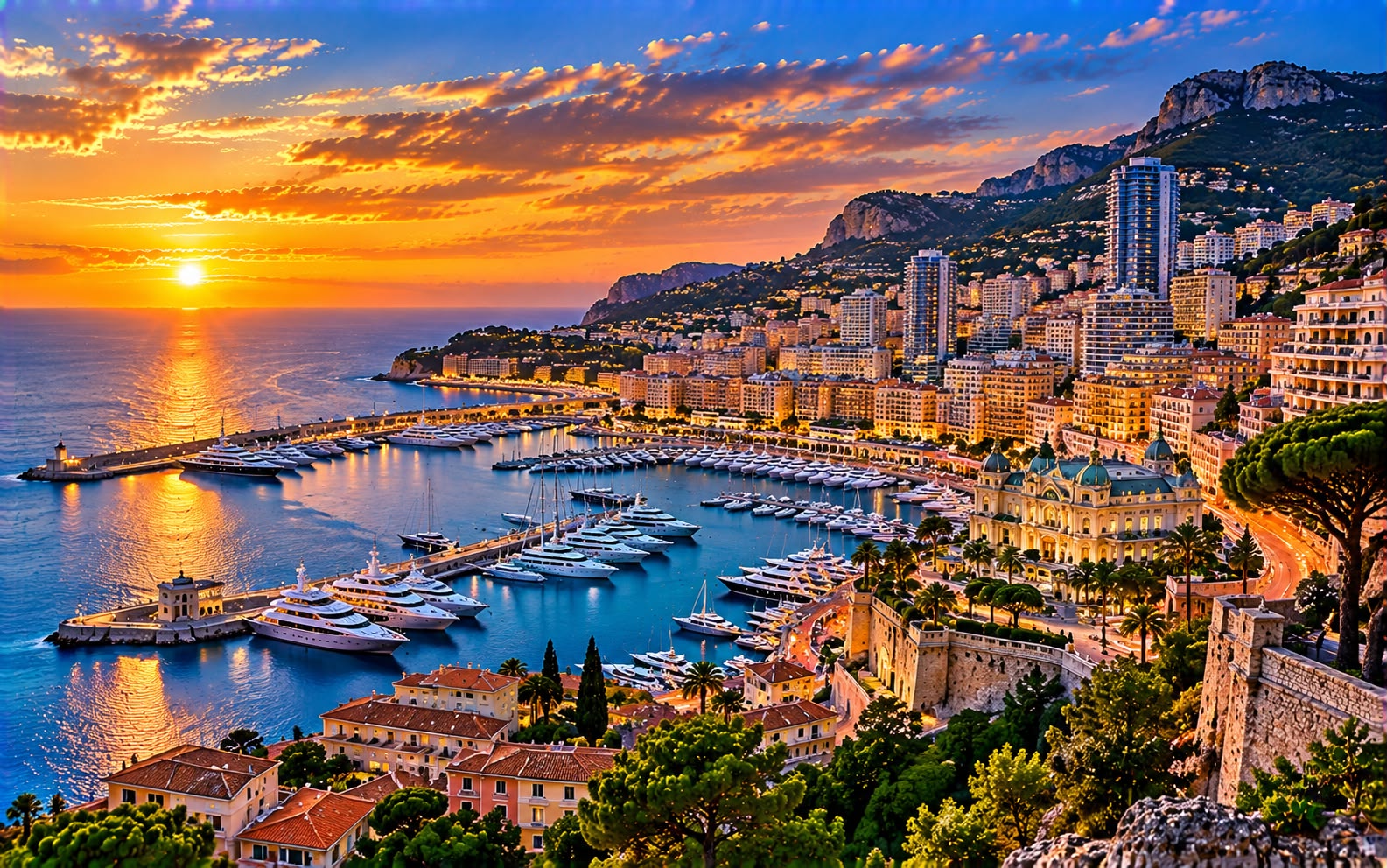
Monaco in 2 days: the Rock, the Casino and the Oceanographic Museum
The second-smallest country on earth — a medieval rock, a casino that saved the dynasty from bankruptcy, an aquarium Jacques Cousteau ran for thirty years, and a street circuit that is still the streets for fifty weeks a year.
- Western Europe
- 2 days
- ≈ AED 1,050 / person
- Two square kilometres with a Grand Prix circuit running through them
Before you go
Monaco is 2.08 square kilometres — the second-smallest country in the world after the Vatican — and you can walk across it in half an hour, though the hills mean you will take the public lifts instead.
You almost certainly sleep somewhere else. Nice is twenty minutes away by train, costs a fraction as much, and is where most visitors base themselves. This guide is two days, and says so honestly rather than inflating a very small place into a week.
The Grimaldis have held the Rock since 1297, when François Grimaldi took the fortress disguised as a Franciscan monk — which is why two monks with swords stand on the national coat of arms.
The casino is why the country still exists. In the 1850s Monaco was nearly bankrupt, having lost Menton and Roquebrune and with them most of its lemon revenue. Charles III licensed a gaming concession, François Blanc made it the most glamorous in Europe, and by 1869 the income was enough to abolish income tax, which is the policy the modern principality runs on.
The Oceanographic Museum is the serious attraction — built into the cliff face by Albert I, a prince who was a genuine oceanographer, and directed by Jacques Cousteau from 1957 to 1988.
And the Grand Prix has run on these streets since 1929. The circuit is public road; you can drive the tunnel, the hairpin and the harbour chicane any day of the year, slowly, behind a bus.
Two days. Figure EUR 260 (≈ AED 1,065) per person excluding getting to the Riviera. Go April–June or September–October; avoid Grand Prix week unless that is the point.
Before you go: the 15-minute admin
Where to actually stay
- Monaco is extremely expensive to sleep in and has very few hotels, almost all of them at the top of the market.
- Stay in Nice, 20 minutes by train for a few euros, or in Beausoleil, which is the French town immediately uphill — the border runs down the middle of some streets, and a room there costs a third of a Monaco one with a five-minute walk.
- Menton and Cap d’Ail are the other sensible bases.
Getting there and around
- The train from Nice-Ville takes about 20 minutes and arrives at Monaco-Monte-Carlo, a station carved entirely inside the rock with exits at opposite ends of the country.
- There is no border control and no passport stamp. Monaco is not in the EU but is in the Schengen area in practice through France.
- Use the public lifts and escalators. Monaco is built up a cliff and there are around eighty free public lifts linking the levels. They are not a curiosity; they are the transport system.
- Driving is a bad idea — parking is scarce, expensive and underground. If you do drive, use a public car park and walk.
- Buses run a handful of routes and are cheap.
Money and dress
- The euro, by monetary agreement. Monaco is not in the EU and mints its own euro coins, which are collectable.
- Cards work everywhere.
- The Casino de Monte-Carlo has a dress code and enforces it: no shorts, no sportswear, no flip-flops; jacket expected in the private rooms in the evening. Bring your passport — ID is required to enter the gaming rooms, and you must be 18.
- Monégasque citizens are forbidden from gambling in the casino, which has been the rule since it opened.
Grand Prix week
- Late May. The circuit is built over about six weeks and the race closes most of the country.
- Accommodation multiplies and books out a year ahead; many hotels impose minimum stays.
- If you are not coming for the race, avoid that fortnight entirely — half the sights are behind grandstands.
Travelling with kids?
- The Oceanographic Museum is excellent and will absorb a whole morning.
- The changing of the guard at 11:55 is short and reliable.
- The lifts and the tunnels amuse children more than the casino will.
- There is very little green space; Larvotto is the beach.
Day by day
Day 1 — The Rock
- 09:30 — Up to Monaco-Ville, “Le Rocher” — the medieval town on the promontory, which is the only part of Monaco that looks old because the rest has been rebuilt upwards.
- 10:00 — Saint Nicholas Cathedral, where the Grimaldis are buried. Grace Kelly’s tomb is behind the altar, simply marked Gratia Patricia, and usually has fresh flowers on it.
- 11:00 — The Oceanographic Museum, built out from the cliff in 1910 by Prince Albert I, who funded it from his own oceanographic expeditions. Ninety tanks, a shark lagoon on the roof terrace, Cousteau’s three decades as director, and the best view in the country from the top.
- 11:55 — The changing of the guard outside the Prince’s Palace, which takes about ten minutes and happens every day. The State Apartments are open to visitors in summer.
- 14:00 — Lunch in the old town’s lanes, which are the cheapest eating in Monaco and still not cheap.
- 15:30 — The Jardin Exotique and the Observatory Cave beneath it — a limestone cavern 60 metres down, reached on the garden ticket, and one of the few genuinely unexpected things here.
Where to stay (one night — in Nice or Beausoleil)
- Mid-range: Nice, 20 minutes by train, at a third of the price.
Day 2 — Monte-Carlo and the circuit
- 09:30 — Port Hercule, the harbour, which is where the yachts are and where the Grand Prix runs around the water.
- 10:30 — Walk the circuit. It is public road: up from the harbour to Casino Square, down the hill through Mirabeau, the Fairmont Hairpin — the slowest corner in Formula 1 — into the tunnel, out at the chicane and along the harbour front. It takes about an hour on foot and it is the best free thing in Monaco.
- 12:00 — Casino Square: the Casino de Monte-Carlo of 1863, the Hôtel de Paris and the Café de Paris around it. The atrium is free to enter; the gaming rooms charge admission and require ID. Morning visits are permitted in ordinary clothes; evening is when the dress code bites.
- 14:30 — The Japanese Garden or Larvotto Beach, which is the public beach and was rebuilt and enlarged in recent years.
- 16:00 — The Nouveau Musée National or the Automobile Collection of the Prince, if cars are your interest.
- 18:00 — The train back to Nice, which is the other good decision.
Costs and practicalities
Best time to visit
April–June and September–October. Monaco is on the Côte d’Azur and shares its calendar: hot and extremely crowded in summer, mild and pleasant either side.
- April–June — the best of the year, and the two events that define the principality fall here: the Monte-Carlo Masters tennis in April and the Formula One Grand Prix in late May. Both multiply prices and fill every room from Nice to Menton.
- July–August — hot, 28–30°C, and at full capacity with the yacht season.
- September–October — warm, the sea still swimmable, and the Monaco Yacht Show in late September.
- November–March — mild, around 13–15°C, quiet, and much cheaper. The Christmas market on Port Hercule, and the Monte-Carlo Rally in January.
During the Grand Prix the circuit closes public roads for days, which changes how the whole principality works.
Travel tips
- Stay in Nice or Menton and take the train. Monaco’s hotel prices are extraordinary, and the coastal train takes 20 minutes from Nice for a few euros.
- The public lifts and escalators are free and are how residents move between the levels. Monaco is vertical; use them rather than walking up.
- The Casino de Monte-Carlo has a dress code and an entry fee, requires ID, and does not admit Monégasque citizens to the gaming rooms.
- There is no passport check — Monaco is in the Schengen area via France and uses the euro.
- Smart dress is expected almost everywhere. Beachwear away from the beach will be refused in the casino, the Hôtel de Paris and most restaurants.
- The Oceanographic Museum is the best thing here that is not about money, and it is genuinely good.
- Parking is near-impossible and expensive. Do not drive in.
What this trip actually costs
Two people, 1 night, mid-range comfort, excluding travel to the Riviera:
| Item | Cost |
|---|---|
| Hotel in Nice or Beausoleil, 1 night | EUR 140 (≈ AED 573) |
| Trains and local transport | EUR 30 (≈ AED 123) |
| Oceanographic Museum, two | EUR 44 (≈ AED 180) |
| Palace, gardens, casino entry | EUR 76 (≈ AED 311) |
| Food and drink, 2 days | EUR 230 (≈ AED 942) |
| Total for two | EUR 520 (≈ AED 2,129) |
- Roughly EUR 260 (≈ AED 1,065) per person, and food is the biggest line. Monaco charges Monaco prices for a sandwich.
- Sleeping in Nice rather than Monaco is the single decision that halves this.
- Walking the circuit, the lifts, the harbour and Casino Square are all free, and they are most of what people remember.
- Eat lunch in Monaco-Ville or in Beausoleil, where the prices return to earth.
- Hotel picks here are chosen on location, not on commission — always check prices and recent reviews before booking.
What to pack
- Something smart. Not for the casino alone — Monaco dresses, and several restaurants will notice.
- Your passport, which is required to enter the gaming rooms.
- Comfortable shoes, because the country is vertical.
- Swimwear if Larvotto is on the plan.
FAQ
Can I just walk into the casino? The atrium, yes, free. The gaming rooms charge an entry fee, require photo ID, admit over-18s only, and enforce a dress code that tightens in the evening. Monégasque nationals are not allowed in at all.
Is Monaco worth more than a day? Honestly, a long day covers it. Two days lets you do the Oceanographic Museum properly and walk the circuit without hurrying. A week would be padding.
Should I stay in Monaco? Only if the budget is irrelevant. Nice is twenty minutes by train and a third of the price; Beausoleil is literally uphill across the border.
When is the Grand Prix? Late May. If you are going for it, book a year ahead. If you are not, avoid that fortnight — the grandstands block half the country.
What language do they speak? French is official. Monégasque survives and is taught in schools; Italian and English are widely spoken.
Prices and entry rules change, and what you need depends on your passport; last checked 8 October 2026, so confirm with the embassy or your airline before booking.


