 The Itinerary
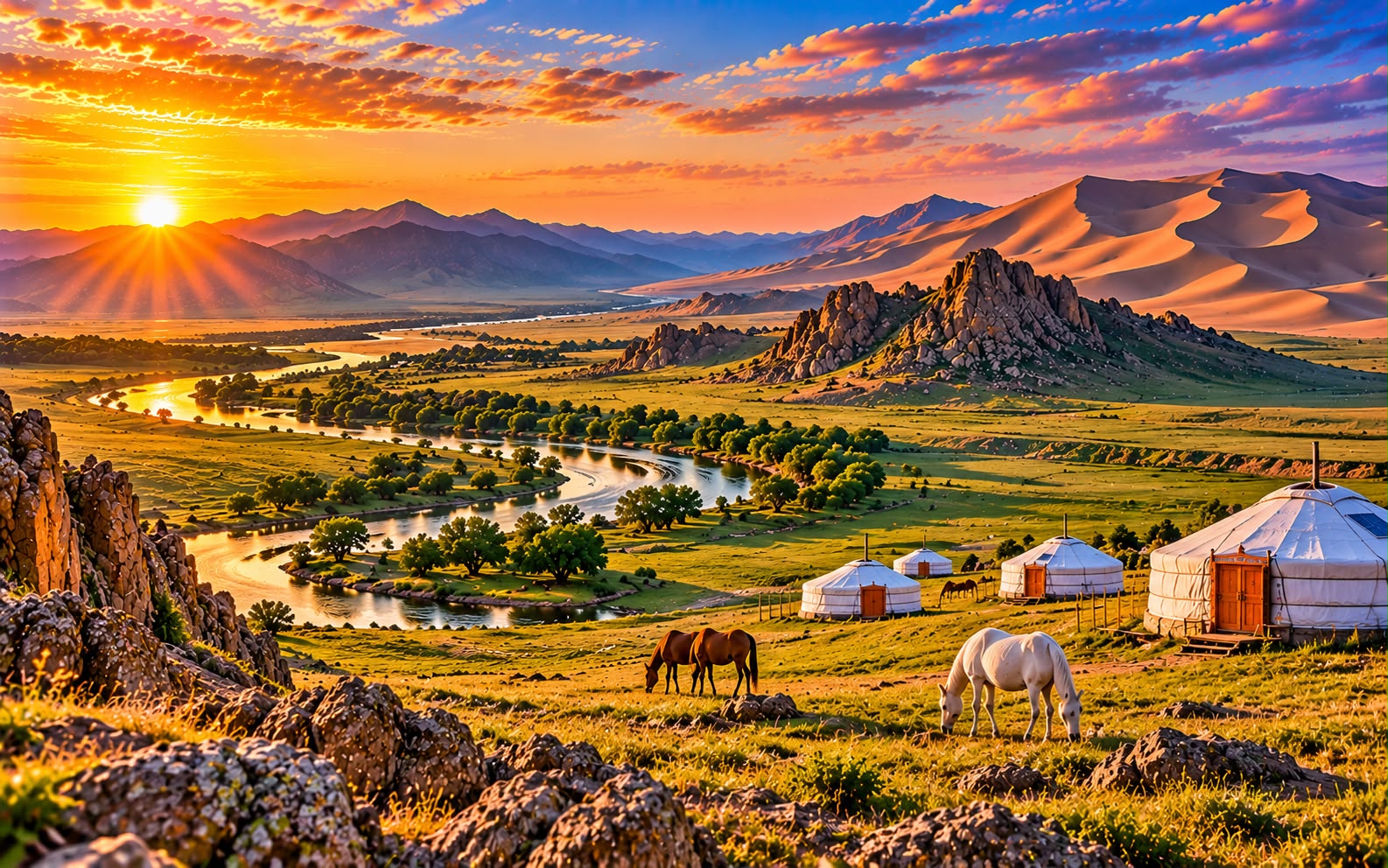
Mongolia in 10 days: the Gobi, Orkhon Valley and ger camps
The emptiest country on earth, and it feels it: singing sand dunes, cliffs where the first dinosaur eggs were found, a valley that was once the centre of the largest land empire in history, and nights in a felt ger with a family — with the driving reality, the short season and why there are almost no roads.
- East Asia
- 10 days
- ≈ AED 6,650 / person
- Steppe + desert
Before you go
Mongolia has three and a half million people in a country the size of western Europe, and half of them live in the capital. What is left is the least densely populated place on earth: steppe to the horizon in every direction, herders moving with the seasons, and almost no fences.
The trip is mostly driving, and that needs saying at the start. There are few paved roads outside the main corridors. You travel in a Russian van or a 4x4 across tracks that the driver knows and no map shows, for six or eight hours a day, and that is not a failure of planning — it is the country.
What you get for it: the Gobi, which is not sand but gravel plain with dunes at one end and red cliffs at another; the Orkhon Valley, the seat of the Mongol and earlier empires; and nights in gers with families who have been doing this for a very long time.
Before you go: the season, the driving and the ger
Entry
- Many nationalities enter visa-free for 30 days — the US, most of the EU, Canada, Japan, Korea and others — and Mongolia has been expanding the list. Others need an eVisa, which is straightforward.
- Check your own case; this list has changed repeatedly in recent years.
- Passport valid six months.
The season is short and the shoulders are harsh
- June to early September is the season, and July and August are the reliable months: warm days, cold nights, everything open.
- Naadam, the national festival of wrestling, archery and horse racing, falls in mid-July and is worth building a trip around — but book everything far ahead if you do.
- Winter is genuinely extreme. Ulaanbaatar is the coldest capital city in the world and the countryside reaches −40°C. The Golden Eagle Festival in the far west is in October and is a different, harder trip.
- Even in July, nights on the steppe are cold. The ger stove is lit at dusk and goes out by three in the morning.
The driving is the itinerary
- You hire a driver and a vehicle, almost always with a cook or guide, arranged through a Ulaanbaatar operator. Self-drive is possible and inadvisable without serious experience.
- Six to eight hours a day of off-road driving is normal on a Gobi loop. Distances look modest and take all day.
- A Russian UAZ van is the classic choice — slow, agricultural and repairable anywhere. A Land Cruiser is faster and more comfortable.
- There are no fuel stations for long stretches. Your driver will plan for this; trust them.
- Domestic flights to Dalanzadgad cut the Gobi drive substantially and are worth considering if your time is short.
Ger camps, and staying with families
- Tourist ger camps have beds, a restaurant and shared shower blocks. Family stays have none of that and are the better experience.
- There is no plumbing in most of the countryside. Long-drop toilets, a basin, and a shower every few days at best.
- Ger etiquette matters: enter on the left, move clockwise, do not step on the threshold, accept what you are offered with your right hand, and never turn down the first bowl of tea.
- Airag — fermented mare’s milk — will be offered. Take a sip at least; it is a courtesy, and it is sour rather than alcoholic in any serious sense.
Money and practicalities
- The tugrik (MNT), and the numbers are very large. Cards work in Ulaanbaatar and nowhere else on this route.
- Draw all your cash in Ulaanbaatar. There are no ATMs in the countryside.
- No mobile signal for long stretches. Tell people at home.
- Cyrillic script, Mongolian language; English is common among guides and rare otherwise.
Day by day
Day 1 — Land in Ulaanbaatar
- 13:00 — Land at Chinggis Khaan (UBN), an hour south of the city on the new road.
- 14:30 — Drop bags. Ulaanbaatar is a Soviet grid with glass towers dropped into it and ger districts climbing the hills around — a third of the country lives here and the contrast is the first thing you notice.
- 16:00 — Sükhbaatar Square: parliament, the seated Chinggis Khaan, and the scale of a capital built to be looked at.
- 17:30 — Draw cash. This is the last reliable ATM — outside the capital, card payment is rare and the countryside runs on tögrög notes. Take more than you think.
- 19:00 — Dinner — khuushuur, fried mutton pastries, and Chinggis beer — then confirm three things with your operator: the driver, the vehicle (a Russian UAZ van or a Land Cruiser), and whether the itinerary changes if it rains.
- 21:00 — Repack into one soft bag. Hard cases do not fit.
Day 2 — Ulaanbaatar, and south
- 09:00 — Gandantegchinlen Monastery, the working Buddhist centre that survived the 1937 purges when some 18,000 monks were killed. Morning prayers are open; the 26 m gilded Migjid Janraisig stands in the main temple.
- 11:00 — The National Museum of Mongolia, which is genuinely excellent on the empire and honest about the Soviet period. Two hours.
- 13:00 — Lunch, then leave the city.
- 14:30 — Drive south. The city ends abruptly — one moment apartment blocks, the next open steppe with nothing on it to the horizon in every direction. There are no fences.
- 18:00 — First ger camp. A ger is a felt tent with a stove in the middle, beds round the edge, and a door that always faces south. The stove goes out around 03:00 and it gets cold.
- 20:00 — Dinner in the camp’s dining ger. Mutton, noodles, and suutei tsai — salted milk tea, which you will either take to or not.
Day 3 — Into the Gobi
- 08:00 — Driving, and this is the day to make peace with it: Mongolia has almost no sealed roads outside the main corridors, so “road” means parallel tyre tracks across open ground and your driver picks a line.
- 11:00 — Baga Gazriin Chuluu, granite outcrops rising out of flat steppe with a ruined monastery among them, or Tsagaan Suvarga — a 60 m escarpment of eroded sediment in orange and white, depending on the route.
- 13:30 — Lunch out of the van.
- 16:00 — Arrive at camp. Walk out from it in any direction for twenty minutes and turn round; the absence of anything is the point of the Gobi and it does not photograph.
- 19:30 — Dinner, then the sunset, which on the steppe takes an hour and fills the whole sky rather than one corner of it.
- 21:30 — The stars. No light within 100 km.
Day 4 — Yolyn Am, the ice gorge
- 08:30 — Into the Gobi Gurvan Saikhan mountains for Yolyn Am — the Valley of the Lammergeier, a gorge that narrows to a few metres and holds ice into July. A glacier in a desert, which is not what anyone expects of the Gobi.
- 10:00 — Walk up the gorge, an easy two hours in and out. Pikas everywhere in the scree, lammergeiers overhead, and occasionally ibex on the walls.
- 13:00 — Lunch in Dalanzadgad or at camp.
- 15:00 — The small Gobi museum at Dalanzadgad, or rest.
- 17:00 — This is the one day the Gobi feels cold. Layers.
- 19:30 — Camp near Dalanzadgad. Charge everything — the next camps may run a generator for two hours only.
Day 5 — Khongoryn Els, the singing dunes
- 08:00 — Drive west to the dunes, four to five hours across gravel desert.
- 13:00 — Arrive Khongoryn Els: dunes up to 300 m high running for 100 km along the mountain foot, with a green stream and grazing camels at their base. They make a low booming sound as the sand shifts, which is where the name comes from.
- 15:00 — A Bactrian camel ride — two humps, a working animal, and the herder’s actual transport rather than a concession.
- 17:30 — Climb the dune. It is 200-odd metres of sand that gives way under each step, it takes most people 45 minutes, and it is far harder than it looks. Do it anyway: the ridge at sunset, with desert on one side and mountain on the other, is the best hour of the trip.
- 20:00 — Dinner, and sand in everything for the rest of the week.
Day 6 — The Flaming Cliffs
- 08:30 — Bayanzag, the Flaming Cliffs — red sandstone that turns orange in low sun, and where Roy Chapman Andrews found the first dinosaur eggs known to science in 1923. The site still produces fossils; it is illegal to remove anything, and people still try.
- 10:30 — Walk the cliff edge and down into the saxaul forest below.
- 12:00 — Lunch, then north out of the desert.
- 17:30 — The landscape greens as you climb — gravel gives way to grass, and there are suddenly horses and herds everywhere.
- 19:00 — Ger camp on the steppe.
Day 7 — North to the Orkhon Valley
- 08:00 — The long drive north. Six to eight hours depending on the ground, with stops wherever the driver decides.
- 12:00 — Lunch, often at a roadside guanz — a canteen ger where the menu is whatever is in the pot.
- 15:00 — Ongi monastery ruins if you route through them: destroyed in 1939, with a small rebuilt temple among the rubble and a monk who will explain what happened.
- 18:00 — The Orkhon Valley, a UNESCO cultural landscape and the seat of successive steppe empires — Xiongnu, Turkic, Uighur and Mongol — because this is where the grass and water are.
- 19:30 — Camp. Noticeably greener, wetter and colder than the Gobi.
Day 8 — The valley
- 08:30 — The Orkhon waterfall, 20 m over a basalt lip into a gorge you can climb down into. It is fed by snowmelt and is thin by late summer.
- 10:30 — Horses. This is the correct way to cover ground here and a Mongolian horse is small, half-wild and faster than you expect. A half-day with a herder costs very little; say honestly how much you have ridden.
- 13:30 — Lunch.
- 15:00 — A family ger visit: milking, the separating of curds, felt-making, and the airag — fermented mare’s milk — which you will be offered and should at least try. Take the bowl with your right hand.
- 18:00 — Stay with the family if your operator has arranged it. It is the single best night of the trip and it is not a performance; you are in someone’s home.
Day 9 — Kharkhorin, and back
- 08:30 — Kharkhorin, on the site of Karakorum, Chinggis Khaan’s capital from 1235. There is almost nothing left above ground — the Chinese razed it — which is itself worth standing in.
- 09:30 — Erdene Zuu, Mongolia’s oldest surviving monastery, built in 1585 from the stones of Karakorum and ringed by a wall of 108 stupas. Three temples survived the purges out of more than sixty.
- 12:00 — Lunch, then the six-hour drive back to Ulaanbaatar on mostly sealed road.
- 18:30 — Arrive. A shower, which after nine days will be memorable.
- 20:00 — Dinner in a restaurant with a menu. Modern Nomads or one of the Peace Avenue places.
Day 10 — Fly home
- Morning — The State Department Store on Peace Avenue for cashmere, which is genuinely cheap here and genuinely good — the sixth floor is the one you want.
- Afternoon — The airport is an hour south on a good road.
- Note — If you flew in on a narrow schedule, keep a spare day in Ulaanbaatar rather than at the end of the countryside leg. Rain turns tracks to mud and the return drive is the thing that slips.
Costs and practicalities
Best time to visit
June to early September is the only realistic window, and the Mongolian winter is not an exaggeration — minus 30°C is an ordinary January.
- June — the steppe is green, the foals and young livestock are out, and the gers are up. Fewer visitors than July.
- July — warmest and busiest. Naadam, 11–13 July, is the national festival — wrestling, archery and horse racing — and the single best reason to come. Ulaanbaatar fills and domestic transport sells out.
- August — warm, with the best grass and the most reliable Gobi weather.
- September — the best light of the year, cold nights, and the Golden Eagle Festival in Bayan-Ölgii in early October, which is the other date worth planning around.
- October–May — bitterly cold. Ger camps close, and the Gobi and the north are serious expedition territory.
Travel tips
- Distances are enormous and the roads are mostly tracks. 300km can take a full day. Domestic flights to the Gobi and Ölgii save days.
- Everything is arranged through a driver and a cook, usually in a Russian UAZ van or a Land Cruiser. This is the standard way to travel and it is not a luxury.
- Ger etiquette matters: enter clockwise, do not step on the threshold, accept what you are offered with the right hand, and do not point your feet at the stove or the altar.
- Accept the airag — fermented mare’s milk — at least a sip. Refusing is a discourtesy.
- Cash in tögrög. ATMs in Ulaanbaatar and provincial centres; nothing in the countryside. Cards work in the capital only.
- Nights are cold even in July at altitude and in the Gobi. A proper sleeping bag is worth carrying.
- Ulaanbaatar has pickpockets in the markets and on crowded buses — the Naran Tuul market in particular.
What this trip actually costs
Two people, 9 nights, mid-range, excluding international flights:
| Item | Cost |
|---|---|
| Vehicle, driver, guide and cook, 8 days | MNT 5,800,000 (≈ AED 5,944) |
| Ger camps and family stays, 7 nights | MNT 2,800,000 (≈ AED 2,870) |
| Ulaanbaatar hotel, 2 nights | MNT 900,000 (≈ AED 922) |
| Park fees, horses, camels, museums | MNT 1,200,000 (≈ AED 1,230) |
| Food, drink, tips and extras | MNT 2,300,000 (≈ AED 2,357) |
| Total for two | MNT 13,000,000 (≈ AED 13,323) |
- Roughly MNT 6,500,000 (≈ AED 6,661) per person. The vehicle and crew are the trip and the bill — there is no cheaper way to cross this country and no public transport to fall back on.
- Joining a group tour cuts the vehicle cost substantially, since it is shared across more people, and is how most independent travellers do it.
- Food and beds are cheap; the driving is not.
What to pack
- A proper warm layer and a hat, even in July. Steppe nights drop close to freezing and the ger stove goes out.
- Wet wipes and dry shampoo. Showers are occasional.
- A head torch. No electricity in most family gers.
- All your cash, in tugrik, drawn in Ulaanbaatar.
- Sun protection — high, dry, and no shade anywhere.
- Dust protection for cameras, which is not optional on Gobi tracks.
- Type C/E plugs, 220V, where there is power at all.
FAQ
Is it really all driving? A lot of it, yes — six to eight hours on many days. The landscape is the compensation and it does not repeat. Flying to Dalanzadgad cuts the Gobi section if that is too much.
Can I do it independently? Not easily. There is no intercity bus network to the places in this itinerary and few roads. Almost everyone hires a vehicle with a driver, alone or in a group.
How basic are the ger stays? Tourist camps have beds and shared showers. Family stays have a felt tent, a stove, a long-drop and great hospitality. Both are worth doing; neither is a hotel.
When should I go? July and August. Naadam in mid-July is the national festival and worth planning around, if you book well ahead.
Prices and entry rules change, and what you need depends on your passport; last checked 8 October 2026, so confirm with the embassy or your airline before booking.


