 The Itinerary
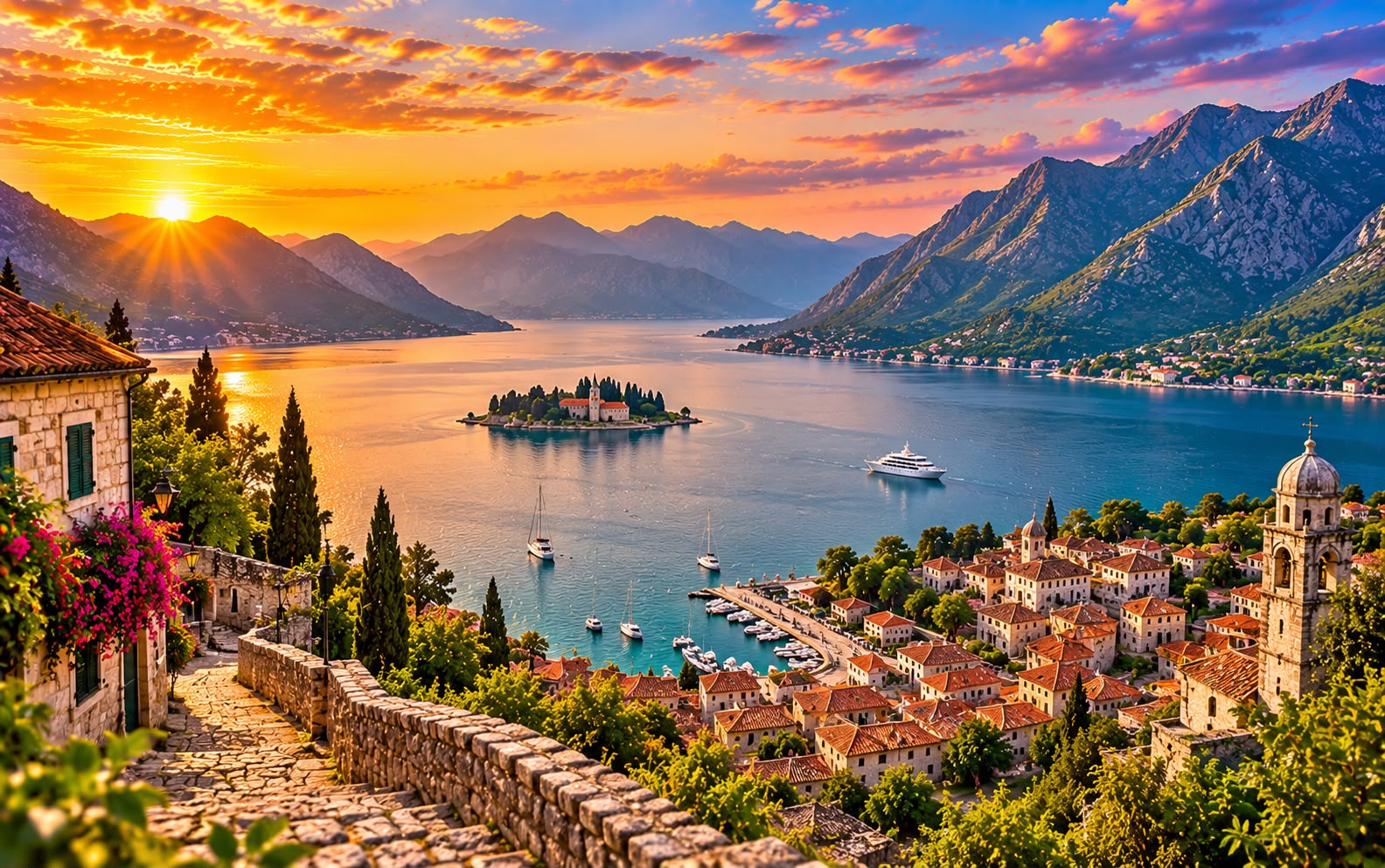
Montenegro in 7 days: Kotor Bay, Durmitor and the coast
A country the size of a large county that holds a Venetian bay, Europe's deepest canyon and a photogenic island hotel: walls climbing 1,350 steps above Kotor, a serpentine road with twenty-five hairpins, and a glacial lake in a national park — with the cruise-ship timing that decides your day and the honest driving brief.
- Southern Europe
- 7 days
- ≈ AED 3,700 / person
- Fjord bay + mountains
Before you go
Montenegro is smaller than Wales and holds more landscape than countries ten times its size. The Bay of Kotor is not a fjord — it is a submerged river canyon — but it looks like one, with mountains dropping straight into water and Venetian towns along the shore. Behind it, an hour inland, the Durmitor massif has Europe’s deepest canyon and a glacial lake ringed by pine.
The catch is timing. Kotor takes cruise ships, and on a day with two in port the old town is a slow-moving crowd. Before nine and after six it is one of the loveliest towns on the Adriatic.
Seven days covers the bay, the mountains and the coast, and you will drive most of it — which is where the other honest brief comes in.
Before you go: driving, cruise ships and the euro question
Entry, and the currency oddity
- Most nationalities enter visa-free for 90 days — the EU, UK, US, Canada, Australia and many others.
- Montenegro is not in the EU or Schengen, so your time here does not count against a Schengen allowance. Useful if you are combining with Croatia.
- It uses the euro anyway, unilaterally and without being in the eurozone. Prices are in euros and cards work widely.
The driving, honestly
- Hire a car. The bay, Durmitor and the coast are not usefully connected by public transport, and the roads are the point.
- The Kotor–Lovćen serpentine climbs the mountain behind Kotor in twenty-five numbered hairpins, with the bay unfolding below. It is narrow, it has passing places rather than two lanes in sections, and it is spectacular. Go up it, not down, and go early.
- The P-1 to Durmitor crosses the Đurđevića Tara bridge over a 150 m gorge, and is a good road.
- The Sozina tunnel is the fast way between the coast and Podgorica and costs a small toll.
- Parking in Kotor and Budva in summer is genuinely difficult. Stay somewhere with parking and walk in.
The cruise-ship rule
- Check the Kotor cruise schedule for your dates — it is published online — and plan your old-town time around it.
- Two ships in port means several thousand extra people in a town you can walk across in ten minutes.
- Climb the fortress walls at 7am. It is 1,350 steps to San Giovanni, it is hot by nine, and the light and the emptiness are both better early.
Season
- June and September are the answer — warm sea, open mountain roads, and manageable crowds.
- July and August on the coast are busy and considerably more expensive; Budva in August is a different country.
- Durmitor’s high roads can hold snow into May and close again from November. Check if you are going at the edges.
Day by day
Day 1 — Land, and into the bay
- 14:00 — Fly into Tivat (TIV), which is 20 minutes from Kotor, or Podgorica (TGD), which is 90. Tivat is worth paying for.
- 15:00 — Collect the car. Montenegro needs a car — the bus network exists but the mountain half of this trip does not work without one.
- 16:00 — Drive into Kotor, on the inner arm of the bay. The Bay of Kotor is often called a fjord and is not one — it is a drowned river canyon — but the effect is the same: 1,700 m walls dropping straight into salt water.
- 17:30 — The old town after the cruise ships have gone, which is the critical timing. Up to four ships a day disgorge into a walled town of 1,000 residents; by six they have sailed and it becomes itself again.
- 18:30 — Venetian squares, the Cathedral of St Tryphon from 1166, and the cats — a genuine civic institution, with their own museum and a square named after them.
- 20:00 — Dinner on a side square. Try njeguški pršut, the mountain ham, and a Vranac red.
Day 2 — The walls, and the bay towns
- 07:00 — The fortress walls to San Giovanni: 1,350 steps and 260 m of climb up the cliff behind the town. Start at seven — by ten it is both crowded and brutally hot, there is no shade, and people turn back. Take water.
- 09:00 — The view from the top is the one on every photograph of Montenegro, and you have earned it.
- 10:30 — Down, breakfast, and drive round to Perast, 20 minutes.
- 11:30 — Perast is a single street of baroque palaces built by sea captains, with no through traffic and 300 residents.
- 12:30 — The boat to Our Lady of the Rocks — an artificial island, built up over four centuries by sailors dropping a stone on each safe return, and still topped up every July in the fašinada. The church inside has 68 silver votive plaques and a tapestry a local woman embroidered with her own hair over 25 years.
- 14:30 — Lunch in Perast, then swim off the bay — calm, cold, startlingly clear, with the mountains straight above.
- 19:30 — Dinner in Perast or Dobrota, away from Kotor’s main square where the prices are set by the ships.
Day 3 — The serpentine and Lovćen
- 09:00 — The Kotor serpentine: 25 numbered hairpins climbing the wall behind the town on a road built in 1884. It is single-track in places with passing bays, and the drop is unprotected. Go up it, not down, and go early before the tour vans.
- 09:45 — The viewpoint around hairpin 17, with the whole bay below and Our Lady of the Rocks a white dot in it.
- 11:00 — Lovćen National Park and the Njegoš mausoleum at 1,657 m — the poet-prince-bishop’s tomb under the summit, reached by 461 steps through a tunnel in the mountain, with a black granite eagle and a view that on a clear day takes in most of the country.
- 13:30 — Cetinje, the old royal capital — small, faded, and more interesting than it first looks: the palace, the monastery, and a street of former embassies from when this was a recognised kingdom.
- 16:00 — Back down to the bay, or push on north to break tomorrow’s drive.
- 19:30 — Dinner.
Day 4 — North to Durmitor
- 08:30 — The drive north, about three hours, and it climbs steadily out of the coastal climate into alpine.
- 11:00 — The Đurđevića Tara bridge: five arches, 365 m long, 172 m above the river, built in 1940 and blown up by its own engineer in 1942 to stop the Italians — he was executed for it and there is a monument at the far end.
- 11:30 — Below it, the Tara Canyon — 1,300 m deep, the deepest in Europe and second in the world only to the Grand Canyon. There is a zipline across if you want it.
- 13:00 — Lunch, then on to Žabljak, at 1,450 m the highest town in the Balkans.
- 15:00 — Black Lake (Crno jezero), 20 minutes’ walk from town — two glacial lakes joined in high water, ringed by pine, under the Međed peak. The circuit is 3.5 km and flat.
- 19:00 — Mountain food, which is meat, cheese, kačamak and no apology for any of it.
Day 5 — Durmitor
- Option A — walking, 08:00. The Black Lake circuit first, then up toward Ćurevac for the canyon view, or the full climb to Bobotov Kuk at 2,523 m — seven hours return and the highest point in the park.
- Option B — rafting, 09:00. The Tara runs roughly May to October, with the high water in May and June. A half-day covers 18 km of grade II–III through the canyon; it is the classic Montenegrin activity and it is not frightening.
- Option C — driving, 10:00. The Durmitor Ring Road, 80 km through alpine meadow, past the Sedlo pass at 1,907 m, with shepherds’ huts and very little traffic. Half a day with stops.
- 19:00 — Last mountain dinner.
Day 6 — South to the coast
- 08:30 — The long drive south, three to four hours. The Moraća canyon route is the scenic one, with the 13th-century Morača monastery and its frescoes as the stop.
- 13:00 — Lunch, then the coast.
- 14:30 — Sveti Stefan: a fortified islet joined to the shore by a causeway, turned into a hotel in the 1950s and closed to non-guests. You photograph it from the road above — there is a dedicated viewpoint — and that is the whole experience, which is worth knowing before you drive down.
- 16:00 — Budva old town, walled and Venetian and considerably more crowded than Kotor.
- 18:00 — A beach near Petrovac, which is calmer than Budva and where you will actually want to swim.
- 20:00 — Last dinner on the coast.
Day 7 — Fly home
- Morning — Tivat and Podgorica are both within about 90 minutes of the southern coast.
- Return the car with time for the inspection. The serpentine and the mountain roads mark paintwork, and the rental excess here is high.
- Note — Montenegro uses the euro without being in the eurozone — it adopted it unilaterally — so there is nothing to change and nothing left over.
Costs and practicalities
Best time to visit
June and September are the answer — the Adriatic coast in July and August is at capacity, and Kotor in particular becomes a cruise-ship queue.
- May–June — the sea is swimmable from late May, the mountains are green, and the Bay of Kotor is navigable without the crowds.
- July–August — peak. Budva and Kotor are extremely busy, prices double, and the coastal road becomes a traffic jam. Durmitor and the north are the escape.
- September — the best month of the year. Warm sea, thinning crowds, and clear mountain weather.
- October–April — the coast closes down substantially, and Durmitor and Kolašin ski from December to March. The Tara canyon rafting season is roughly May to October.
Check the Kotor cruise schedule before planning a day there; with two ships in, the old town is impassable.
Travel tips
- The Bay of Kotor road is slow and narrow. The Lepetane–Kamenari ferry cuts an hour off the drive to Herceg Novi and costs little.
- Montenegro uses the euro without being in the eurozone, adopted unilaterally.
- Durmitor and the Tara canyon are three hours from the coast on mountain roads. They deserve two nights rather than a day trip.
- Beaches are mostly pebble. Water shoes, and sea urchins are common on the rocks.
- Sveti Stefan is a private resort and the island is not open to non-guests. The view from the road is what you get.
- Cards work in towns and at the coast; carry cash for the north and for village konobas.
- The Kotor city walls are a 1,350-step climb with no shade. Go early or late, and take water.
What this trip actually costs
Two people, 6 nights, mid-range, excluding international flights:
| Item | Cost |
|---|---|
| Hotels and apartments, 6 nights | EUR 720 (≈ AED 2,948) |
| Car hire, 6 days, fuel and tolls | EUR 430 (≈ AED 1,761) |
| Walls, Lovćen, Our Lady of the Rocks, park fees, rafting | EUR 200 (≈ AED 819) |
| Food and drink, 7 days | EUR 420 (≈ AED 1,720) |
| eSIM, parking, extras | EUR 30 (≈ AED 123) |
| Total for two | EUR 1,800 (≈ AED 7,370) |
- Roughly EUR 900 (≈ AED 3,685) per person — cheaper than Croatia next door for a very similar coastline, which is the main argument for coming here instead.
- August on the coast breaks this budget. June and September do not.
- Mountain guesthouses in Žabljak are a fraction of coastal prices.
What to pack
- Proper shoes for the walls — 1,350 uneven steps, and people do it in flip-flops and regret it.
- Layers for Durmitor, which is 1,450 m and cold at night even in July.
- Swimwear and water shoes — the beaches are pebble.
- European Type C/F plugs.
- A small amount of cash; cards are widely taken but not universally.
FAQ
Is Montenegro just cheaper Croatia? It is cheaper, and the bay is genuinely comparable to anything in Dalmatia. What it does not have is Croatia’s island network. What it does have is Durmitor an hour and a half inland, which Croatia has no answer to.
Do I need a car? For this itinerary, yes. Buses link the coastal towns but not Durmitor or Lovćen, and the serpentine is the best road in the country.
How bad are the cruise crowds? Bad enough to plan around, and easy to plan around. Check the schedule, climb the walls at seven, and see the old town before nine or after six.
When should I go? June or September. Warm sea, open mountain roads, and none of August’s crush on the coast.
Prices and entry rules change, and what you need depends on your passport; last checked 8 October 2026, so confirm with the embassy or your airline before booking.


