 The Itinerary
Muscat in 3 days: the mosque, the corniche and Nizwa
The Grand Mosque's narrow visiting window, Mutrah souq at the hour it is worth being there, and the Nizwa day that makes three days better than two. Plus the one building-height law that explains what Muscat looks like.
- Middle East
- 3 days
- ≈ AED 1,800 / person
- A Gulf capital with no skyline, and a fort-and-souq day trip inland
Before you go
Muscat is the Gulf capital that did not build upwards. A planning rule has long kept most buildings low and white, so the city reads as a string of settlements between bare brown mountains and the sea rather than a downtown. It changes what three days feel like.
The plan: one day for the city’s set pieces, one for Mutrah and Old Muscat on foot, and one inland to Nizwa — which is the day that makes three better than two.
Part of an Oman trip? See Oman in 8 days, which runs on from here to the Wahiba and the Hajar.
Figure OMR 190 (≈ AED 1,815) per person for three days. October to April.
Before you go: the short version
Entry
- Many nationalities enter visa-free for short stays; others use the official e-visa at Oman’s Royal Oman Police portal. The 10-day and 30-day tourist visas are cheap and issue quickly.
- A valid UAE visa or residence can simplify entry for some nationalities — worth checking your own case.
Getting in and around
- Muscat International (MCT) is 25 minutes from Mutrah. A taxi is OMR 8–12; agree it before getting in, because Omani taxis are largely unmetered.
- Mwasalat buses run a city network cheaply but infrequently.
- Hire a car if you can. Muscat is 40km end to end, the roads are excellent, and the inland day needs one anyway. Petrol is very cheap.
- Careem works in the city.
The one timing rule
- The Sultan Qaboos Grand Mosque admits non-Muslims mornings only — roughly 8am to 11am, Saturday to Thursday, closed Friday. Everything else on day one arranges itself around that window.
Day by day
Day 1 — The mosque, the opera house, the forts
Walking order: none of these connect on foot — this is a driving day. Mosque → Opera House 10 min; Opera House → Old Muscat 20 min. Inside each, a few hundred metres.
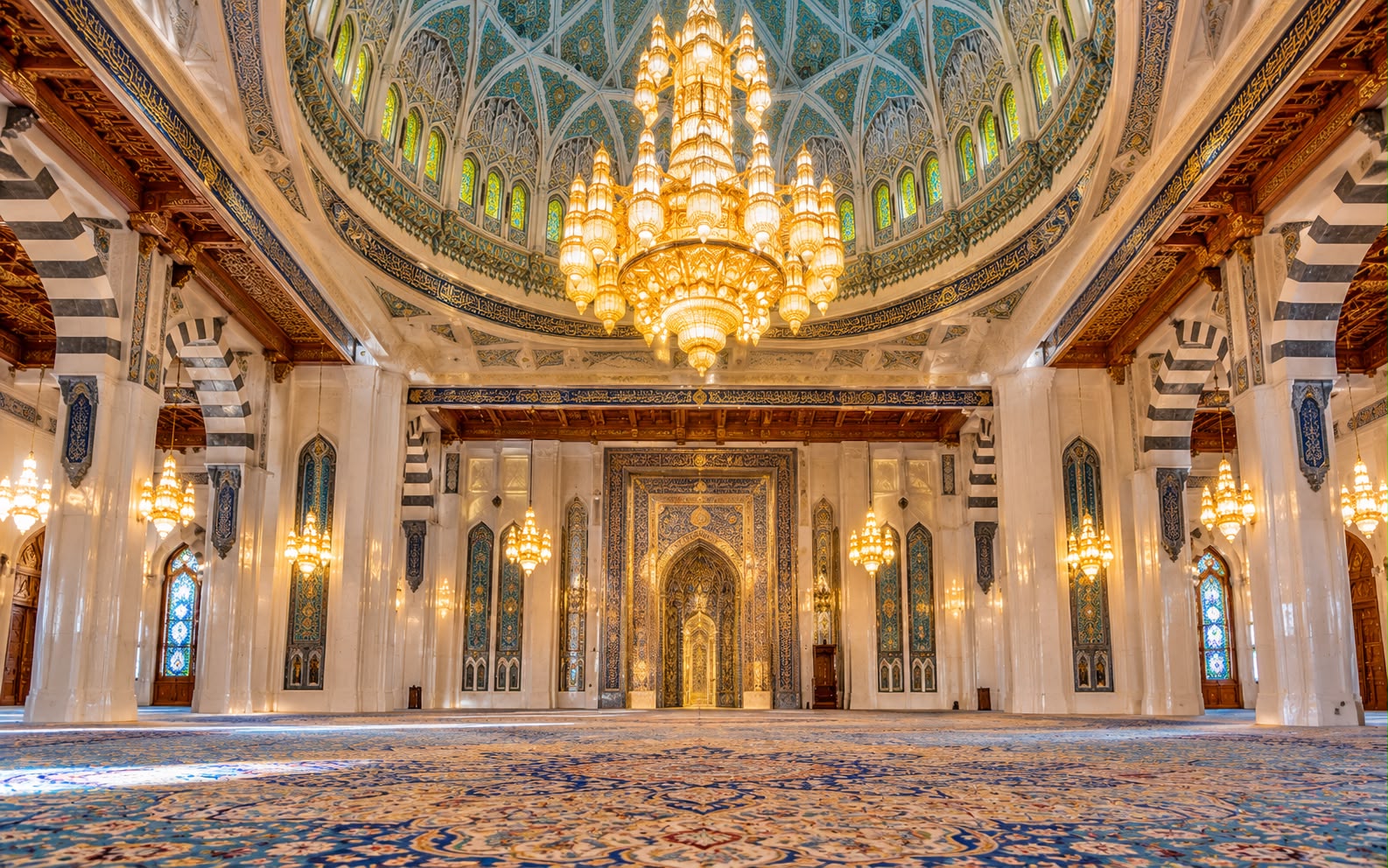
- 08:00 — The Sultan Qaboos Grand Mosque, in the only window it is open to visitors. The prayer hall holds a single Persian carpet of 1,700 square metres — it took 600 weavers four years — and a Swarovski chandelier 14 metres tall.
- Dress code is strict and enforced: ankles, wrists and hair covered for women; long trousers and sleeves for men. No robes are lent, unlike in the UAE — come dressed or you will not get in.
- 10:30 — The Royal Opera House Muscat, which is worth the daytime tour even with nothing on — Omani marble, Burmese teak, and an interior that is deliberately not European.
- 13:00 — Lunch, and out of the sun.
- 15:30 — Old Muscat: Al Alam Palace, the ceremonial palace with its blue and gold columns, flanked by Al Jalali and Al Mirani forts — both Portuguese, 1580s, and both viewed from outside; Jalali is a museum open only occasionally.
- 17:00 — Bait Al Zubair museum for the khanjar daggers, silver and household collections, which is the best single explanation of Omani material culture.
- 19:00 — Dinner in Qurum or Shatti.
Day 2 — Mutrah, the coast, and a dhow
Walking order: Mutrah Corniche → souq (on the corniche) → fish market (10 min north) → Riyam Park steps. About 2.5km flat along the water, plus the optional climb.
- 07:00 — Mutrah fish market early, which is a working market in a Zaha Hadid-adjacent modern hall, and is the best photograph in Muscat.
- 09:00 — The Mutrah Corniche, the curved waterfront of white merchant houses under the hills, with Mutrah Fort at one end.
- 10:00 — Riyam Park’s incense-burner monument up the steps for the whole harbour, or the C38 coastal path if you want an hour’s walk.
- 13:00 — Lunch, then the heat.
- 17:00 — Mutrah Souq. Go in the late afternoon — it is half shut at midday and comes alive at five. Frankincense, silver khanjars, halwa and Omani silver, and far less hard-sell than Deira or the Grand Bazaar.
- Agree a price before any frankincense purchase, and the good stuff is Boswellia sacra from Dhofar, graded by colour — the near-white is the top grade.
- 19:00 — A sunset dhow cruise from the corniche, an hour and a half, with the forts lit on the headlands.
Day 3 — Nizwa and Jebel Akhdar
The day that justifies three. It is 90 minutes inland and a completely different country.
- 07:00 — Leave early, especially for a Friday.
- 08:30 — Nizwa’s Friday cattle market if your dates allow — early morning, loud, and entirely unstaged, with livestock paraded in a ring and sold by shouted bid. It is the single best thing on this page, and it only happens on a Friday.
- 10:00 — Nizwa Fort, with its enormous round tower, built so the stair could be defended by murder holes pouring date syrup from above.
- 11:30 — Nizwa Souq beside it, for silver, pottery and dates.
- 13:00 — Jabreen Castle, 20 minutes on, which has the painted ceilings and is the most beautiful interior in Oman, and Bahla Fort, UNESCO-listed, for the walls.
- 15:30 — Up Jebel Akhdar, if you have a 4x4. A 4x4 is legally required at the police checkpoint and they check — a saloon will be turned back.
- The rose terraces, the abandoned villages and the Diana’s Point viewpoint, at 2,000m where it is 15°C cooler than the coast.
- 18:30 — Back to Muscat, about two hours.
Costs and practicalities
Getting around, and what it costs
| Airport taxi to Mutrah | OMR 8–12 |
| City taxi, typical hop | OMR 3–6 |
| Hire car, per day | OMR 15–25 |
| 4x4 hire, per day | OMR 30–45 |
| Petrol, per litre | about OMR 0.23 |
| Grand Mosque | free |
| Nizwa Fort | OMR 5 |
| Sunset dhow cruise | OMR 15–20 |
- Agree every taxi fare before the journey. Meters are the exception here, not the rule.
- A hire car pays for itself from day two, and makes day three possible at all.
Best time to visit
- October to April — 25–30°C, which is the season.
- December to February is the best of it, and the mountains are genuinely cold at night.
- Khareef, June to September, brings monsoon mist to Dhofar in the far south — green hills and waterfalls — but Muscat itself is 40°C and humid through those months.
- Ramadan shifts everything to the evening, and daytime eating in public is restricted.
Travel tips
- The Grand Mosque is mornings only, and closed Fridays. Plan the week around that one fact.
- Come to the mosque dressed. No robes are lent.
- The Nizwa cattle market is Friday morning only.
- A 4x4 is a legal requirement for Jebel Akhdar.
- Mutrah Souq is an evening place.
- Oman is conservative and very safe. Dress modestly in public and it is a non-issue.
- Alcohol is in licensed hotels only.
What this trip actually costs
Two people, 2 nights, mid-range comfort, international flights excluded:
| Item | Cost |
|---|---|
| Hotel, 2 nights | OMR 140 (≈ AED 1,337) |
| Food and drink, 3 days | OMR 100 (≈ AED 955) |
| Hire car for three days, plus petrol | OMR 80 (≈ AED 764) |
| Forts, museums, dhow cruise, two people | OMR 60 (≈ AED 573) |
| Total for two | OMR 380 (≈ AED 3,630) |
- Roughly OMR 190 (≈ AED 1,815) per person. The Grand Mosque is free, and petrol costs almost nothing.
- Swapping the hire car for taxis saves little and costs you day three.
- Hotel picks here are chosen on location, not on commission — always check prices and recent reviews before booking.
What to pack
- Mosque-compliant clothing, which here you must bring yourself.
- Closed shoes for forts with uneven stone stairs.
- A warm layer for Jebel Akhdar, which is 15°C cooler than the coast.
- A Type G adapter, 240V.
Part of a bigger trip?
- Oman in 8 days runs from here to the Wahiba Sands, Wadi Shab and Sur.
- UAE and Oman in 9 days pairs Muscat with Dubai and Abu Dhabi.
- Abu Dhabi in 2 days is the nearest Gulf city with a comparable mosque.
FAQ
Is three days enough for Muscat? For the city, two would do. The third day is Nizwa and the mountains, and it is the one that makes the trip worth taking.
When can I visit the Grand Mosque? Mornings only, roughly 8 to 11, Saturday to Thursday. It is closed to non-Muslims on Fridays.
Do I need a car? For the city, no. For Nizwa and Jebel Akhdar, yes — and the Jebel Akhdar road legally requires a 4x4.
Muscat or Dubai? Different propositions. Dubai for scale and nightlife; Muscat for forts, mountains and a city that looks like where it is. If you have seen the Gulf’s cities and not its interior, Muscat wins easily.
Is Mutrah Souq a tourist trap? Less than most. It is still a working souq, the prices are negotiable without theatre, and the frankincense is the real thing.
Prices and entry rules change, and what you need depends on your passport; last checked 27 October 2026, so confirm with the embassy or your airline before booking.


