 The Itinerary
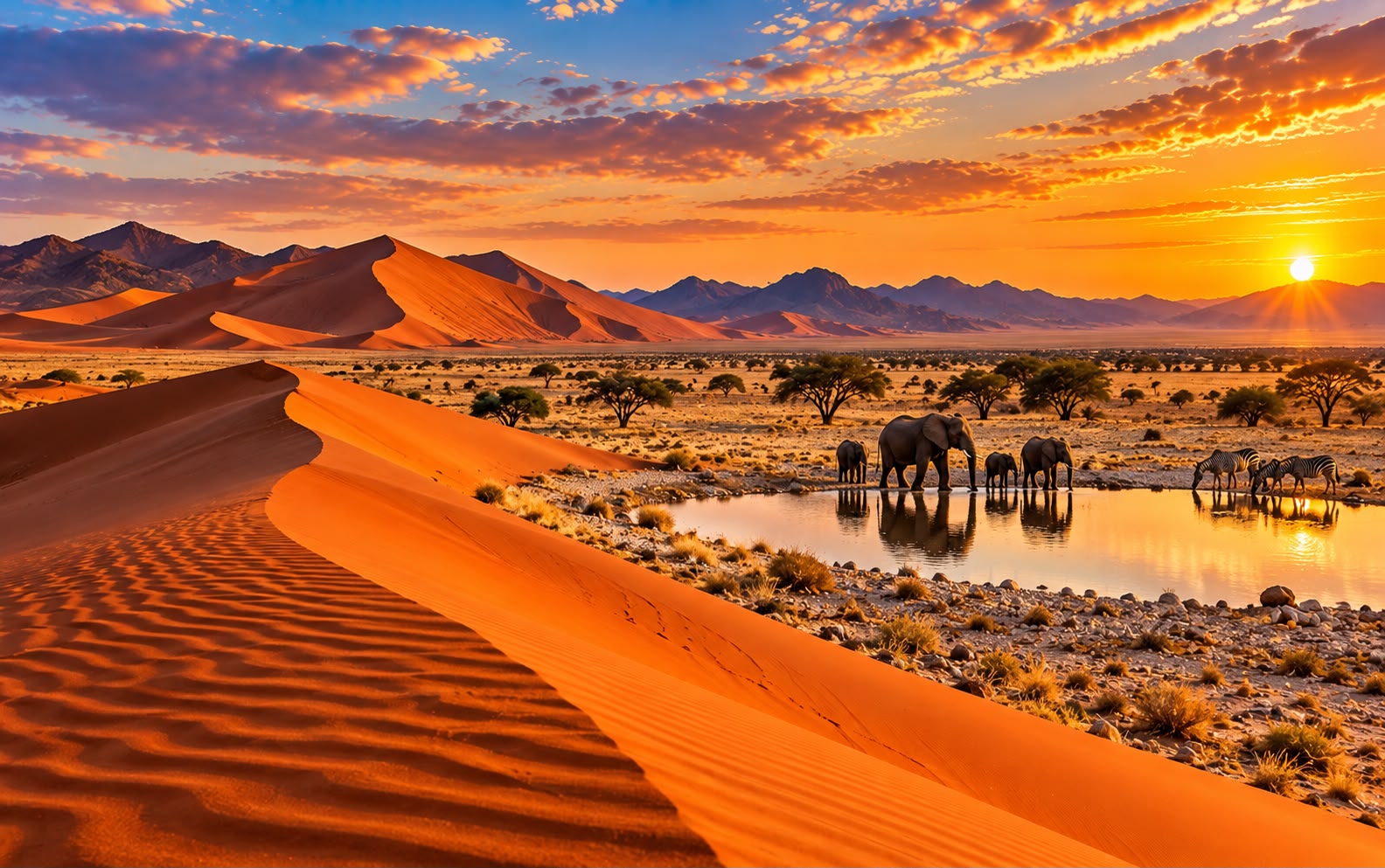
Namibia in 10 days: Sossusvlei, Swakopmund and Etosha
The great self-drive: red dunes you climb before sunrise, a skeleton coast where the desert meets cold Atlantic fog, and a salt pan where the animals come to you at waterholes — with the gravel-road rules, the two spare tyres, and the fuel-and-distance planning that this trip genuinely requires.
- Southern Africa
- 10 days
- ≈ AED 8,450 / person
- Self-drive + desert
Before you go
Namibia is the trip where the driving is the holiday. Two and a half million people in a country twice the size of Germany, roads that run straight to the horizon, and almost no traffic on any of them. You will spend hours seeing nothing, and then something extraordinary.
Three landscapes carry the route. Sossusvlei, where 300-metre red dunes stand over a white clay pan and the dead camelthorn trees of Deadvlei have not rotted in eight centuries. Swakopmund, a German colonial seaside town with cold Atlantic fog rolling over the dunes behind it. And Etosha, where you do not chase animals — you park at a waterhole and let them come.
Be clear about one thing before booking: this is a self-drive country, and the roads are mostly gravel. That is not a problem, but it is a skill and a set of rules.
Before you go: the roads, the fuel and the car
Entry, and when to go
- Most nationalities enter visa-free for up to 90 days — the EU, UK, US, Canada, Australia, South Africa, India and many others. Namibia has broadened this in recent years; check your own case and the current fee position, which has changed.
- Passport validity of six months and blank pages for stamps.
- May to October is the dry season and the right answer: cooler days, no rain, and animals concentrated at waterholes because there is nowhere else to drink. June to August are coldest — desert nights near freezing.
- November to April is hot, occasionally wet, and the game scatters. Green, but harder.
The gravel-road rules
This is the part that matters most, and the part most guides skip.
- Most of this route is gravel. It is well graded and perfectly drivable, at the right speed.
- Slow down. The single biggest cause of trouble is driving gravel at tarmac speed. Sixty to eighty km/h is sensible; the accidents happen above that.
- Two spare tyres, not one. Punctures are routine, help is far away, and every experienced operator here insists on it.
- Never drive at night. Wildlife on unfenced roads, no lighting, and no one coming past for hours.
- Fuel where you can, not where you must. Stations are far apart and some take cash only. Fill up at every town whether you need it or not.
- Tell someone your route. Mobile coverage disappears for long stretches.
- A 2WD high-clearance car covers this itinerary; a 4x4 is required only for sand driving and some far-north routes. Rent from an operator who explains the tyre rules without being asked.
Distances, honestly
- Windhoek → Sossusvlei: about 5 hours.
- Sossusvlei → Swakopmund: about 5 hours.
- Swakopmund → Etosha: about 6 hours.
- Etosha → Windhoek: about 5 hours.
These are driving hours at safe gravel speeds, before stops. They are why this is a ten-day trip and not a seven-day one.
Money and the practicalities
- The Namibian dollar (NAD) is pegged one-to-one with the South African rand, and rand is accepted everywhere. Namibian dollars are not accepted in South Africa, so spend them before you leave.
- Cards work in towns and lodges. Carry cash for fuel stations, park entry and small settlements.
- No malaria risk at Sossusvlei or Swakopmund. Etosha and the north carry risk in the wet season — take advice before you go.
- Tap water is safe in towns and at lodges on this route.
Day by day
Day 1 — Land in Windhoek
- 12:00 — Land at Hosea Kutako (WDH), 45 km east of the city — about 45 minutes in.
- 13:00 — Collect the car, and inspect it yourself. Check two spare wheels, the jack, the wheel brace and the tyre pressures before you leave the lot. On Namibian gravel a puncture is routine and a single spare is not enough. Photograph every panel.
- 15:00 — Windhoek. Christuskirche and the Independence Memorial Museum behind it fill an hour, and the top floor has the view.
- 17:00 — Shop tonight. Water — five litres per person per day — plus snacks, a cool box and fuel. Tomorrow’s road has very little on it, and that remains true for the next week.
- 19:00 — Dinner. Joe’s Beerhouse is the institution and it knows it; game meat, and it is better than the decor suggests.
- 20:30 — Download offline maps. Mobile signal disappears between towns and does not come back for hours.
Day 2 — South to the dunes
- 07:30 — Leave early. Sesriem is about five hours via the Khomas Hochland and the Spreetshoogte or Remhoogte pass — gravel, steep, and spectacular.
- 10:30 — The pass itself. Drop to 60 km/h on gravel and stay there: most accidents here are rollovers caused by speed on loose surface, and the rental insurance usually excludes them.
- 13:00 — Lunch from the cool box. There is nowhere to buy any.
- 15:00 — Arrive Sesriem. Stay inside the gate if you possibly can — it is the difference between being at Dune 45 for sunrise and arriving an hour after it.
- 16:30 — Sesriem Canyon, a kilometre-long slot cut 30 m into conglomerate, ten minutes from camp and a good leg-stretch.
- 18:30 — Elim Dune for sunset, or the camp bar.
- 20:30 — The stars. There is effectively no light within 200 km and the Milky Way casts a shadow. This is among the darkest accessible skies on earth.
Day 3 — Sossusvlei before sunrise
- 05:15 — Be at the inner gate when it opens. Guests inside Sesriem get in an hour before everyone else, and that hour is the whole point.
- 06:00 — Dune 45, 45 km in — a 170 m star dune climbed on the ridge line in the cool. Forty minutes up in soft sand, five minutes down if you run the face.
- 08:00 — Drive to the 2x4 car park at 60 km, then the last 5 km: shuttle (cheap, and the sensible option) or a deep-sand walk that will take an hour.
- 08:45 — Deadvlei: a white clay pan, 900-year-old blackened camel thorn trees that cannot rot in this dryness, the red wall of Big Daddy behind, and a blue sky. This is Namibia’s signature image and it earns it.
- 10:30 — Sossusvlei itself, then out.
- 12:00 — Leave before the heat peaks. It reaches the mid-forties and there is no shade anywhere.
- 14:00 — Lie still. This is a planned part of the day.
- 18:00 — Sunset, dinner, early night.
Day 4 — The desert road to the coast
- 08:00 — North-west toward the coast, about five hours. The Kuiseb and Gaub canyons break the drive, and the Tropic of Capricorn sign is a photograph everyone takes.
- 11:30 — The gravel plains. Nothing grows here, the horizon is flat in every direction, and it is the emptiest road on the trip.
- 14:00 — Walvis Bay, then 30 km north to Swakopmund.
- 15:00 — It will be cold and foggy, after a week of forty degrees. The Benguela current runs up this coast from Antarctica, chills the air, and that fog is the only reliable moisture the Namib gets — which is why the desert exists at all.
- 16:30 — Swakopmund’s German colonial streets: the Woermann House tower, the jetty, and two very good bakeries that are the reason people linger.
- 19:00 — Dinner. Fresh fish, after a week without it.
Day 5 — Sand, sea and fog
- 08:00 — Walvis Bay lagoon by boat: thousands of flamingos, pelicans that land on the bow, and Cape fur seals that climb aboard for the fish and are entirely unembarrassed about it. Three hours, with oysters and sparkling wine on the way back.
- 12:30 — Lunch at the Raft.
- 14:00 — Sandwich Harbour by 4x4 — the single best excursion on this coast. The dunes drop straight into the Atlantic with no beach between them, and getting there means driving the tideline and then the dune faces. Go with an operator; people get stuck and drowned here doing it themselves.
- 14:00 alt — Quad biking and sandboarding on the dunes behind town for something less scenic and more fun.
- 19:00 — Oysters. Walvis Bay’s are cold-water, cheap and far better than they have any right to be.
Day 6 — North toward Etosha
- 07:30 — Long drive north, roughly six hours.
- 09:00 — Cape Cross if you route up the coast: the largest Cape fur seal colony in the world, up to 200,000 animals. The smell arrives several minutes before the viewing platform does and is genuinely overwhelming.
- 11:30 — Spitzkoppe on the inland route instead — granite inselbergs rising 700 m off the plain, with a rock arch and bushman paintings. The better of the two stops.
- 14:00 — Lunch at Omaruru or Outjo.
- 17:00 — Sleep near Okaukuejo or the southern Andersson Gate. Inside the park if you booked early enough.
- 19:00 — Dinner, and fuel up — the camps sell it but intermittently.
Day 7 — Etosha: the waterhole day
- 06:30 — Into the park at gate opening. Etosha is not a chasing safari: the pan is a salt desert, the animals must come to water, and the method is to drive slowly between waterholes and then stop and wait at each.
- 08:00 — Okondeka and the western waterholes for lion.
- 11:00 — Back to camp as the heat builds.
- 12:30 — Rest. The animals do and so should you; between noon and three there is nothing moving.
- 15:30 — Out again, waterhole to waterhole.
- 19:30 — The floodlit waterhole at Okaukuejo after dark. Black rhino come in most nights, elephant push the rhino off, and the whole thing happens in silence twenty metres from a stone wall you sit on. It costs nothing and it is the best wildlife hour in Namibia. Stay late.
Day 8 — Etosha, east
- 06:30 — Work east across the pan toward Halali and Namutoni, waterhole to waterhole.
- 09:00 — Salvadora, Sueda and the pan edge, where springbok and zebra mass in open ground and the heat haze turns them to water.
- 12:00 — Halali camp, and its own waterhole — the best of the three for black rhino in daylight.
- 15:30 — East to Namutoni, the white German fort, and Klein Namutoni and Chudop nearby.
- 18:00 — Elephant, giraffe, zebra, springbok, oryx and wildebeest are near-certain over two days here. Rhino and lion are patience; leopard is luck.
- 19:30 — Last night in the park.
Day 9 — South to Windhoek
- 07:00 — Leave early. The drive back is about five hours on good tar once you clear the park.
- 12:30 — Lunch at Otjiwarongo or the Okahandja craft market, which is the place for woodwork.
- 15:00 — Windhoek. Wash the car — gravel dust is in every seam and rental companies notice.
- 17:00 — Spend the remaining Namibian dollars; they are pegged to the rand but not accepted outside the country.
- 19:30 — Last dinner.
Day 10 — Fly home
- Morning — Flights out of WDH are mostly morning or early afternoon; the airport is 45 minutes east.
- Allow time for the rental inspection. Gravel chips in the windscreen are normal and usually covered by the extra waiver — check what you actually signed, because the standard excess here is large and windscreens are the most common claim in the country.
Costs and practicalities
Best time to visit
May–October is the dry season and the best for wildlife; the green season has its own and quite different appeal.
- May–August — dry, cool, and the best game viewing at Etosha as animals concentrate on the waterholes. Nights are genuinely cold in the desert, below freezing in June and July.
- September–October — hot and very dry, and the peak of waterhole concentration at Etosha. The best month for game if you can take the heat.
- November–April — the rains, mostly as short afternoon storms. Sossusvlei with cloud and green grass is extraordinary and quite unlike the postcard, and the birding is at its best. Some roads wash out.
- The Skeleton Coast is cold and foggy year-round — the Benguela current sees to that.
Sossusvlei’s dunes are climbed at dawn in any season; by nine the sand is too hot.
Travel tips
- Self-driving is the way Namibia works and the gravel roads are the main hazard. Keep to 80km/h, slow right down for corrugations, and rollovers from oversteering on gravel are the single most common serious accident.
- Take the full tyre and windscreen insurance. Punctures are near-certain and the standard policy excludes both.
- Carry more water and fuel than you plan to need. Distances between stations run to hundreds of kilometres and mobile coverage is patchy.
- Book Sossusvlei accommodation inside the park gate if you want to be at Deadvlei at sunrise — the outside gate opens later.
- Do not drive at night. Kudu and warthog on the roads cause serious accidents.
- Cards work in towns and at lodges; carry Namibian dollars or rand (accepted at par) for fuel in remote places, where the pumps are cash-only.
- Etosha’s waterholes are the game drive. Park and wait rather than driving around; patience is what works here.
What this trip actually costs
Two people, 9 nights, mid-range lodges, excluding international flights:
| Item | Cost |
|---|---|
| Lodges and camps, 9 nights | NAD 32,000 (≈ AED 7,108) |
| Car hire, 9 days, two spares and full cover | NAD 18,000 (≈ AED 3,998) |
| Fuel, roughly 2,500 km | NAD 8,000 (≈ AED 1,777) |
| Park fees, Sossusvlei, Etosha, boat trip, activities | NAD 9,000 (≈ AED 1,999) |
| Food and drink, 10 days | NAD 8,000 (≈ AED 1,777) |
| eSIM, extras | NAD 1,000 (≈ AED 222) |
| Total for two | NAD 76,000 (≈ AED 16,881) |
- Roughly NAD 38,000 (≈ AED 8,440) per person. The car and the beds are the trip; almost everything else is cheap by safari standards.
- Etosha’s own rest camps cost less than the private lodges outside and get you inside the gates at opening, which is worth more than the nicer room.
- Camping instead of lodges roughly halves the accommodation line, and Namibia’s campsites are excellent.
What to pack
- Warm layers for the desert nights. June to August drops near freezing after dark, which surprises people who packed for Africa.
- Serious sun protection for the days, which are the opposite.
- A head torch for camps and the night waterhole.
- Binoculars, essential at Etosha’s waterholes.
- Type D and M plugs — Namibia uses the large South African round-pin. A standard universal adapter often does not fit; buy the right one before you go.
- A dust-proof bag for cameras. Gravel dust gets into everything.
FAQ
Is self-driving really safe? Yes, with the rules above: slow on gravel, two spares, never at night, fuel early. Thousands of visitors do it every year. Speed on gravel is what causes the incidents.
Do I need a 4x4? Not for this route. A high-clearance 2WD covers all of it. A 4x4 is for Sandwich Harbour, the far north-west and sand driving — and Sandwich Harbour is better done with a guide anyway.
Is ten days enough? For these three landscapes, yes, and cutting it to seven means spending most of it driving. Adding days is best spent on Damaraland or the Caprivi, not on stretching this loop.
When is the wildlife best? August to October, at the end of the dry season, when the waterholes are the only water left and the animals have no choice but to come to you.
Prices and entry rules change, and what you need depends on your passport; last checked 8 October 2026, so confirm with the embassy or your airline before booking.


