 The Itinerary
The Garden Route in 9 days: Cape Town to Addo, malaria-free
The coast road east from Cape Town, with whales at Hermanus, the Knysna lagoon, Tsitsikamma's forest and a malaria-free Big Five park at the end. Why this is the easiest self-drive in Africa, when the whales are actually there, and the load-shedding that still shapes an evening.
- Southern Africa
- 9 days
- ≈ AED 7,550 / person
- Big Five without the malaria tablets, on a road anyone can drive
Before you go
The site’s South Africa in 10 days runs Cape Town → the Winelands → Kruger, and skips the coast entirely. This is the other half of the country, and in several ways the easier one.
Two things make this route unusual for Africa. It is malaria-free end to end — no tablets, which matters enormously with children or if you would rather not. And it is a two-lane tarred national road the whole way, so no 4x4 and no guide required: you drive it yourself in an ordinary car.
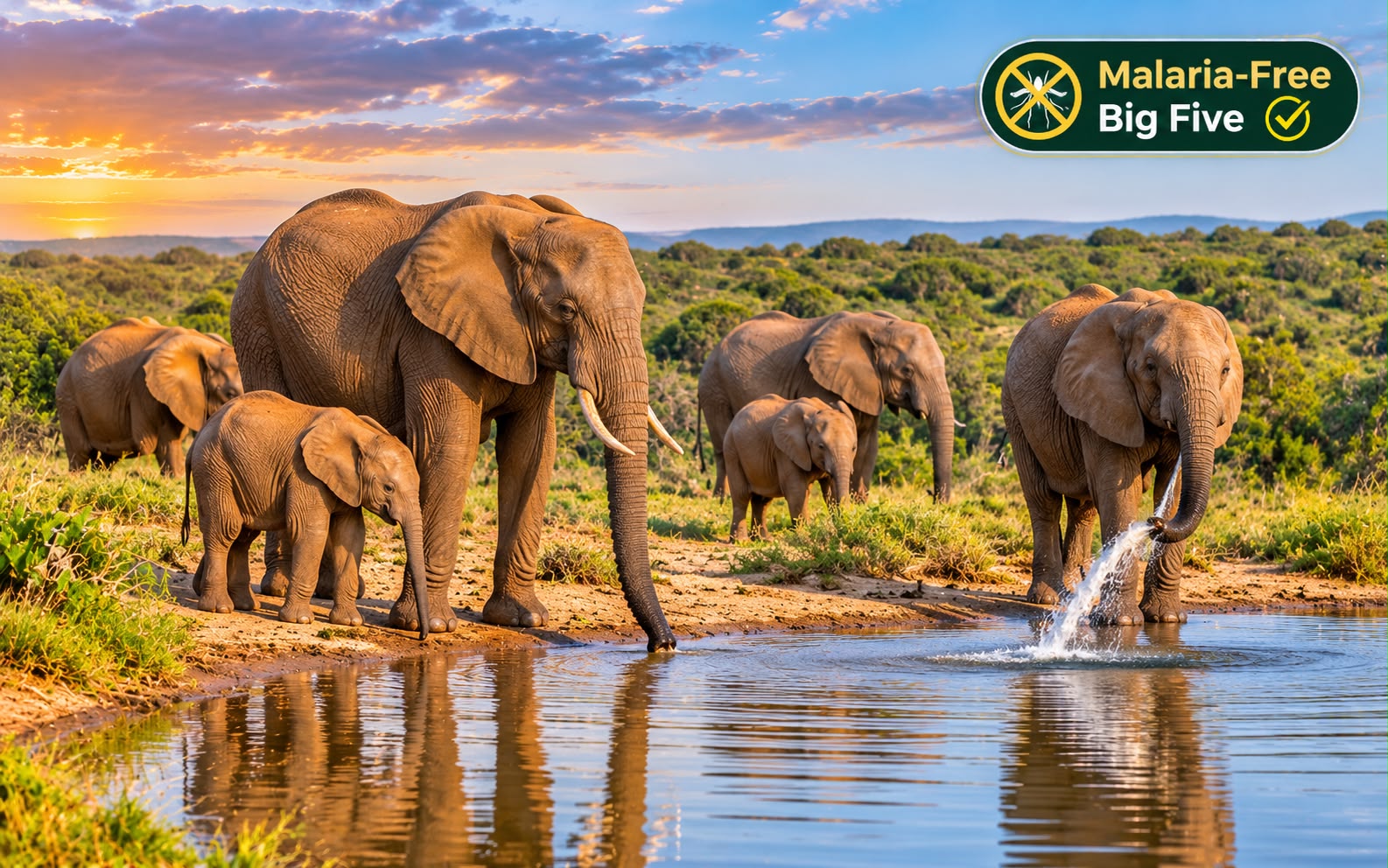
Big Five at the end, not the beginning. Addo Elephant Park is malaria-free, self-drivable, and holds all five — which is genuinely rare.
Fly into Cape Town and out of Gqeberha, formerly Port Elizabeth. Driving back costs two days.
Figure ZAR 34,000 (≈ AED 7,552) per person. September to April, with whales from roughly June to November.
Before you go: the admin
Entry, and children
- Many nationalities enter visa-free for 90 days; check yours on the official Department of Home Affairs site.
- South Africa has specific documentation requirements for travelling with children, which have changed more than once. An unabridged birth certificate has been required in the past, and consent letters where one parent travels alone. Check the current rules well before you fly — this is the single most common reason families are turned back at check-in.
- Last checked: 2 November 2026.
Malaria, and why it matters here
- The entire Garden Route and Addo are malaria-free. So is Cape Town.
- Kruger and the Lowveld are not, which is the reason many families choose this route instead.
- No tablets, no evening cover-up for that reason — though mosquito repellent is still sensible for comfort.
Driving
- Driving is on the left.
- The N2 is a good two-lane road and this is one of the easiest self-drives anywhere. No 4x4 needed, including in Addo.
- Do not drive at night. Unlit pedestrians, livestock and potholes are the reasons, and every local will tell you the same. Plan to be where you are sleeping by dusk.
- At traffic lights — “robots” locally — keep doors locked and bags out of sight. This is ordinary practice, not paranoia.
- Car guards in informal vests will watch your car in most car parks. A small coin tip on return is the custom.
- Fuel stations are attended — you do not pump your own — and a small tip is usual. Many are cash-preferred; carry some.
Load-shedding
- Scheduled power cuts still occur, varying by area and by stage, and they are published in advance through apps.
- Most hotels and lodges have generators or inverters; many restaurants do not.
- What it actually means: traffic lights out at junctions — treat them as a four-way stop — card machines down, and a dark hour in a smaller town. Carry some cash and a power bank and it is an inconvenience rather than a problem.
Booking
- Addo game drives and any lodge inside the park.
- Whale-watching boats at Hermanus in season.
- Tsitsikamma’s bungee, if that is happening.
- Cape Town over Christmas and New Year, which is peak domestic holiday season and prices reflect it.
Day by day
Day 1 — Cape Town
- Stay in the City Bowl, Green Point or Camps Bay.
- Morning — Table Mountain. The cableway closes in high wind and the decision is made that morning, so go the first clear day you get rather than saving it. Book online to skip the queue.
- Afternoon — The V&A Waterfront, or Bo-Kaap for the painted houses and Cape Malay history. Ask before photographing people’s homes.
- Evening — Signal Hill for sunset, and dinner in town.
Where to stay in Cape Town (two nights)
- Grand: a hotel on the Atlantic seaboard at Camps Bay or Bantry Bay.
- Mid-range: a guesthouse in Gardens or Green Point, walkable and central.
- Simple: Observatory or Woodstock — cheaper, lively, and better with a car.
Day 2 — The Cape Peninsula
- A full-day loop and one of the great coastal drives.
- 09:00 — Chapman’s Peak Drive towards Hout Bay. It is a toll road and closes in high wind or after rockfall — check before committing.
- 11:00 — Cape Point and the Cape of Good Hope in Table Mountain National Park. Baboons here are organised and will open an unlocked car. Keep windows up and never carry visible food.
- 14:00 — Boulders Beach at Simon’s Town, where an African penguin colony lives on a public beach with boardwalks. This is the children’s highlight of the whole trip.
- 16:30 — Kalk Bay for the harbour and a coffee, then back over the mountain.
- Evening — Pack; the road starts tomorrow.
Day 3 — East to Hermanus
- 09:00 — Collect the car if you have not already, and drive east, about two hours.
- The scenic option: Clarence Drive from Gordon’s Bay to Rooi-Els, which hugs the cliff above False Bay and is one of the finest stretches of road in the country.
- 11:00 — Hermanus. Between roughly June and November, southern right whales calve in Walker Bay, and Hermanus is one of the best land-based whale-watching sites in the world — the cliff path runs for several kilometres and you need no boat at all.
- There is a whale crier who walks the town blowing a kelp horn when whales are sighted.
- Out of season: the cliff path is still a fine walk, and Grootbos and the Hemel-en-Aarde wine valley are both nearby.
- Evening — Hermanus.
Day 4 — The long drive to Mossel Bay or George
- Morning — The N2 east, about four hours, inland across the Overberg wheat country and through the Tradouw or Outeniqua passes depending on your line.
- The worthwhile detour: Swellendam, the third-oldest town in the country, or a loop up to Oudtshoorn for the Cango Caves and the ostrich farms — that adds a night and is worth it if you have one spare.
- Afternoon — Mossel Bay or George. This is a transit day and the point is to arrive before dark.
- Evening — Early night.
Day 5 — Knysna and the lagoon
- Morning — Wilderness, with its lakes and its beach, then on to Knysna, about an hour.
- Midday — The Knysna Heads, the two sandstone cliffs guarding the lagoon mouth. The eastern head has the viewpoint; the western is a private estate.
- Afternoon — A lagoon cruise, or oysters, which Knysna is known for, or the Featherbed Nature Reserve by ferry.
- 16:00 — Plettenberg Bay, half an hour on, for the beach.
- Evening — Knysna or Plett.
Where to stay in Knysna or Plettenberg Bay (two nights)
- Grand: a lodge above the lagoon or on the Plett headland.
- Mid-range: a guesthouse in Knysna’s Leisure Isle or on Plett’s beachfront.
- Simple: self-catering apartments, of which the whole coast is full.
Day 6 — Tsitsikamma
- 09:00 — Drive east into the Tsitsikamma section of the Garden Route National Park, about an hour.
- 10:00 — Storms River Mouth. The suspension bridge over the gorge is a short walk from the car park and is the photograph. The Waterfall Trail beyond it is harder than it looks.
- 13:00 — Bloukrans Bridge, the world’s highest commercial bungee from a bridge at 216 metres. Watching is free.
- 15:00 — A canopy tour through the forest, or the Tsitsikamma Big Tree, an 800-year-old yellowwood on a boardwalk loop.
- Evening — Back to Plett, or push east to shorten tomorrow.
Day 7 — To Addo
- Morning — Drive east to Addo, about three hours, leaving the coast at the end.
- Afternoon — First game drive. Addo holds elephant in numbers — the park was created in 1931 to save the last eleven, and there are now hundreds — plus buffalo, lion, and both black rhino and leopard, which are rarely seen.
- You can self-drive the park in an ordinary car. Stay in the vehicle, windows up near elephant, and give them room — elephant have right of way, always.
- A guided drive is still worth one of your two sessions: the vehicle is higher, the guide knows the sightings, and only guides can run the night drives.
- Evening — A night drive, which is where you see what the day hides.
Where to stay at Addo (two nights)
- Grand: a private lodge on a reserve adjoining the park.
- Mid-range: SANParks rest-camp chalets inside the main gate — book early, they are the best value in the park.
- Simple: guesthouses in Addo village or Colchester, ten to twenty minutes out.
Day 8 — A full day at Addo
- 05:30 — Out at gate opening. The first and last two hours of daylight are when animals move, and the middle of the day is when they sleep in shade.
- Drive slowly. The commonest mistake is covering ground; the animals are usually found by people who stopped.
- The waterholes are the reliable bet in dry months.
- Midday — Back to camp for the heat.
- 16:00 — Second drive, until the gate closes. Gate times are enforced and there are fines for being late.
- Evening — Last night.
Day 9 — Out from Gqeberha
- Morning — Drive to Gqeberha, about an hour.
- If the flight is late: the beachfront at Summerstrand, or the Donkin Heritage Trail in town.
- Drop the car at the airport with the usual margin for the one-way fee paperwork.
Costs and practicalities
Best time to visit
September to April for weather; June to November for whales. The overlap in September, October and early November is the best of both.
- September to November — spring, wildflowers, and whales at Hermanus, with warm days and thin crowds. The best window.
- December and January — summer, hottest, and the South African school holidays, when the coast fills with domestic visitors and prices peak. Book far ahead.
- February and March — warm, quieter, excellent. Game viewing at Addo improves as it dries out.
- April and May — autumn, mild, very quiet, and good value.
- June to August — winter. Cool and wet in Cape Town, dry and bright on the Garden Route itself, whales arriving, and the best game viewing of the year at Addo because the bush is thin and the animals come to water.
Travel tips
- Check the child documentation rules before you book flights.
- Do not drive at night. Plan every day to finish by dusk.
- Table Mountain on the first clear morning, not the last day.
- Keep windows up around baboons at Cape Point and elephant at Addo.
- Doors locked at traffic lights; bags out of sight.
- Carry cash for fuel attendants, car guards and load-shedding hours.
- Download a load-shedding schedule app for the areas you will be in.
- Game drives at dawn and dusk. The middle of the day is for a pool.
- Give elephant the road. Reverse if asked.
What this trip actually costs
Two people, 8 nights, mid-range throughout, international flights excluded:
| Item | Cost |
|---|---|
| Guesthouses and lodges, 8 nights | ZAR 24,000 (≈ AED 5,331) |
| Food and drink, 9 days | ZAR 14,000 (≈ AED 3,110) |
| Car hire, 9 days, with fuel and the one-way fee | ZAR 13,000 (≈ AED 2,887) |
| Addo: park fees and two guided drives | ZAR 7,000 (≈ AED 1,555) |
| Whale boat, Tsitsikamma, Cango Caves | ZAR 6,500 (≈ AED 1,444) |
| Tolls, tips, parking and extras | ZAR 3,500 (≈ AED 777) |
| Total for two | ZAR 68,000 (≈ AED 15,104) |
- Roughly ZAR 34,000 (≈ AED 7,552) per person for nine days.
- South Africa is outstanding value for visitors with hard currency, and this route is the cheap way to see Big Five — a private-reserve safari elsewhere can cost more per night than this whole trip’s accommodation.
- Self-catering apartments are everywhere on this coast and take a large bite out of both the bed and food lines.
- Addo’s SANParks chalets are the best-value beds of the trip and book out furthest ahead.
- Hotel picks here are chosen on location, not on commission — always check prices and recent reviews before booking.
What to pack
- Binoculars. The single most useful thing at Addo and for the whales, and one pair between two is not enough.
- Neutral colours for game drives — not white, not black.
- A warm layer for dawn drives, which are cold even in summer.
- High-factor sunscreen and a hat. The African sun is stronger than the temperature suggests.
- A power bank, for load-shedding hours.
- Cash in small notes, for attendants and car guards.
- Walking shoes for Tsitsikamma and the Hermanus cliff path.
- A Type M or N adapter, 230V — South Africa’s plug is its own.
Part of a bigger trip?
- South Africa in 10 days is the Cape Town and Kruger version, with the Winelands.
- South Africa and Mauritius in 12 days adds an Indian Ocean week at the end.
- Add Oudtshoorn and the Cango Caves for a night inland, or the Wild Coast beyond Gqeberha for three more days of empty beaches.
FAQ
Is this route really malaria-free? Yes, end to end — Cape Town, the whole Garden Route and Addo are all outside the malaria zone, which is why it is the standard recommendation for families and for anyone who would rather not take prophylactics. Kruger and the Lowveld are a different matter.
Can I self-drive Addo, or do I need a guide? You can self-drive it in an ordinary car, and many people do the whole park that way. A guided drive is still worth one session: the vehicle is higher, the guide knows where things have been seen that morning, and night drives are guides-only. Stay in the car, keep windows up near elephant, and give them the road.
When are the whales actually there? Roughly June to November, peaking around September and October, when southern right whales calve in Walker Bay. Hermanus is one of the best land-based whale-watching spots anywhere — the cliff path puts you above them and you need no boat. Outside those months you will see none.
How much of a problem is load-shedding? Less than the headlines suggest, and not nothing. It is scheduled and published in advance, most hotels and lodges have backup power, and the practical effects are traffic lights out — treat the junction as a four-way stop — card machines down, and a dark hour in smaller towns. A power bank and some cash cover it.
Is it safe to drive? The driving itself is easy — a good two-lane road, no 4x4 needed. The rules that matter are local and universally given: do not drive at night, keep doors locked and valuables out of sight at traffic lights, and park where there is a car guard. Follow those and this is among the most straightforward self-drives anywhere.
Prices and entry rules change, and what you need depends on your passport; last checked 3 November 2026, so confirm with the embassy or your airline before booking.


