 The Itinerary
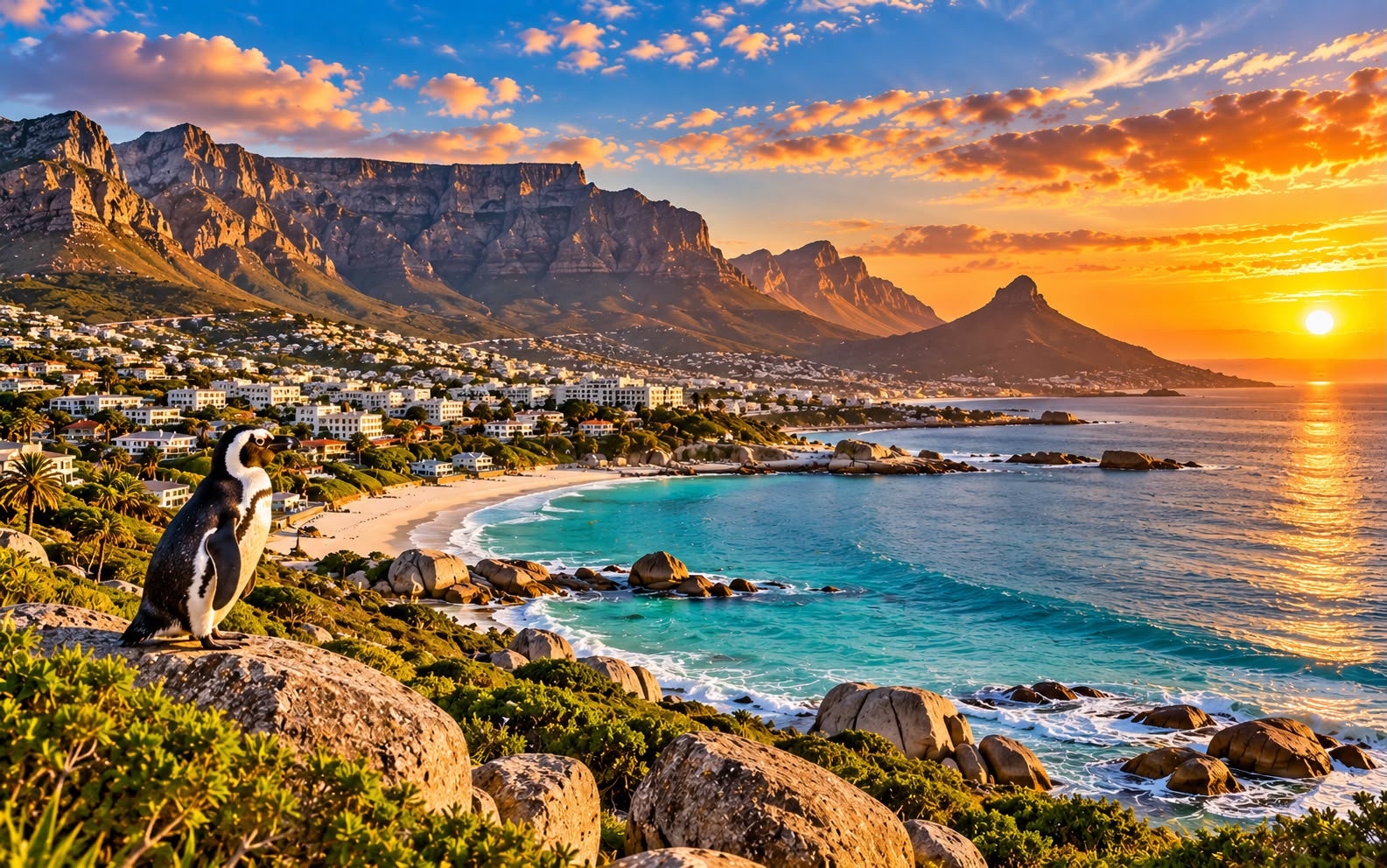
South Africa in 10 days: Cape Town and a Kruger safari
The two-in-one trip nothing else matches: a mountain-backed city with penguins on the beach, then a flight that lands inside a national park the size of a country — with the brand-new online ETA decoded, the safety rules locals actually follow, and the honest maths of a Big Five safari.
- Southern Africa
- 10 days
- ≈ AED 9,100 / person
- Safari + city
Before you go
No other single trip stacks this much: a city where a flat-topped mountain rises straight out of the ocean, a beach where penguins waddle between the boulders, wine valleys older than most countries — and then, one internal flight later, you land on an airstrip inside Kruger National Park and a giraffe crosses the road on the way to your lodge.
The timing has rarely been better. Many nationalities enter visa-free, and South Africa’s new online ETA has replaced the embassy queue for several others, India included — a phone application and a decision in about a day, for most adult travellers (details and one family-sized catch below). Check which applies to your passport before anything else. Getting there is easy from most hubs: Cape Town takes non-stops from the Gulf, Europe and across Africa.
This is a 10-day, two-base route: Cape Town (5 nights) then Kruger (4 nights), flying between them. Budget is in South African rand — figure ZAR 41,000 (≈ AED 9,107) per person excluding international flights. Go September–October if you can: Cape Town is in spring, whales are breaching off Hermanus, and Kruger is at its dry-season best, with thirsty animals crowding the waterholes.
Before you go: the admin
The new ETA (this changed everything)
- India is one of the first countries on South Africa’s Electronic Travel Authorisation — apply online at eta.dha.gov.za, with a smartphone selfie + passport scan. Decisions come instantly to ~24 hours, entry is for tourism, stays up to 90 days. The fee has hovered around ~R500 (it was free during the pilot; confirm the current amount in the application itself).
- Two conditions that matter: you must arrive by air at Cape Town, O.R. Tambo (Joburg) or Lanseria — fine, since Emirates lands you at Cape Town International — and you must apply before you fly; there is no ETA on arrival.
- The family catch: the ETA is for adults (18+) only, for now. If you are travelling on an ETA-eligible passport with children, they still need the traditional sticker visa via VFS Global wherever you apply (most families just do paper visas for everyone together): government fee ZAR 425 (~US$20) + VFS service charge ~US$60–80 5–15 working days, with proof of residence, certified bank statements, flights and hotel bookings in the file. Apply a month out and it’s routine.
- Passport: 30+ days validity beyond return and two blank pages (they’re strict on the pages).
Money, power and the practical stuff
- Card country. South Africa runs on tap-to-pay — even car-park attendants carry machines. Carry only small cash (R200–500) for tips and markets.
- Load-shedding, honestly: the scheduled national blackouts that made headlines are suspended — no load-shedding since May 2025, the longest clean run in a decade. Hotels all have backup anyway. This one’s off the worry list.
- Tipping is expected: 10–15% in restaurants, R5–10 to car guards, and on safari R150–300/day for your guide and about half that for a tracker — budget it.
- Malaria, said plainly: Kruger is a seasonal, low-to-moderate malaria area (risk higher November–April, lowest in the dry winter). See a travel clinic 2–3 weeks out about prophylaxis, use repellent at dawn/dusk, and if travelling with small children discuss timing — one more argument for September.
The safety section (read this one properly)
South Africa is run on rules locals follow without thinking, and tourists who adopt them have overwhelmingly easy trips. The rules: Uber everywhere after dark (it’s excellent and cheap — never walk city streets at night); phone stays in the pocket on downtown streets; nothing visible in a parked car, ever; draw cash at mall ATMs, not street ones; hike Table Mountain’s routes in company, not solo at dawn; townships only with a local guide. The places this itinerary lives — V&A Waterfront, Sea Point, Camps Bay, the winelands, safari lodges — are the easy, patrolled end of the country. Follow the rules and what you’ll actually remember is how warm everyone was.
Day by day
Day 1 — Land in Cape Town
- Morning — Emirates gets in mid-morning. Uber to the hotel (~R250 from the airport, 25 min), drop bags.
- 13:00 — Ease in at the V&A Waterfront: working harbour, seals lounging by the docks, the food hall at the Time Out Market or V&A Food Market (~R150–250).
- 16:00 — Signal Hill for sunset (Uber up, ~R120): the whole amphitheatre of city, ocean and mountain in gold. Jet lag’s best cure.
- 19:30 — Dinner at the Waterfront — try Cape Malay curry on night one; it tastes like a gentler cousin of home.
Where to stay in Cape Town (five nights)
- Luxury: One&Only Cape Town — 4.7/5 on TripAdvisor (~2,600 reviews), marina-island resort with Table Mountain filling the window. ~R18,000+. (The Silo, 4.6, is the city’s design icon if you’re celebrating.)
- Mid-range: Blackheath Lodge, Sea Point — 4.9/5 (~2,500 reviews), a Victorian boutique guesthouse with the kind of hosting that wins awards yearly. ~R2,800–4,000.
- Value: City Lodge Hotel V&A Waterfront — 4.0/5 (~800 reviews), plain rooms but breakfast included and a walkable, safe location that’s worth more than decor. ~R1,900–2,500.
Day 2 — Table Mountain and the Bo-Kaap
- 07:45 — Be at the Aerial Cableway for opening. Book online: R475 return (R530 at the ticket office; child R230; the R1,200 Fast Track is for December crowds, not September). The car’s floor rotates on the way up. Tickets are valid 7 days — which matters, because:
- The weather rule: Table Mountain opens and closes with the wind. Go the first clear morning of your stay, not the day your plan says — check the webcam at breakfast, and if the “tablecloth” cloud is pouring over the edge, swap today with another day. Up top: 90 minutes of easy marked trails, dassies (rock hyraxes — the elephant’s improbable tiny cousin), and both oceans at once.
- 12:30 — Down to the Bo-Kaap: the candy-coloured Cape Malay quarter, whose kitchens run halal by default. Lunch on koeksisters, samoosas and denningvleis (a Cape Malay cooking class here is the sleeper hit of the whole city, ~R900) .
- 15:30 — Company’s Garden stroll + the District Six Museum (~R60) for the apartheid history that explains everything else you’ll see.
- 19:00 — Dinner on Bree Street (~R300–450 pp).
Day 3 — The Peninsula: Cape Point and the penguins
- 08:00 — Full-day peninsula loop — small-group tour ~R1,400–1,700 pp, or private driver ~R2,800 for the car. The route is the point: Chapman’s Peak Drive bolted into the cliff-face, Hout Bay’s harbour, then:
- 11:00 — Cape of Good Hope / Cape Point (conservation fee R515, child ~R255): the old lighthouse funicular, ocean on three sides, and baboons who have PhDs in unattended sandwiches — keep car windows up, food hidden.
- 14:30 — Boulders Beach, Simon’s Town (~R215, child ~R105): the boardwalk through an African-penguin colony, brays and squabbles at arm’s length. 40 minutes is plenty — then coffee in Kalk Bay’s harbour-village lanes on the way home.
- 19:30 — Sea Point promenade walk (safe, loved, local) + dinner nearby.
Day 4 — Robben Island and Kirstenbosch
- 09:00 — Robben Island (book the moment your dates fix — 2–3 months ahead in season; R650 adult, R350 under-18, 3.5–4 h): the ferry from the Nelson Mandela Gateway, the limestone quarry, and cell no. 5 — with tours often guided by former political prisoners. It is the most affecting thing you will do in this city.
- 14:30 — Decompress at Kirstenbosch Botanical Garden (~R250): the Boomslang canopy walkway curling above the treetops against the mountain’s east face. Sunday summer concerts here are a Cape Town institution.
- 18:00 — Camps Bay sunset: white sand, palm strip, the Twelve Apostles going pink. Dinner on the strip (~R350–500 pp).
Day 5 — The Winelands
- 09:00 — Out to Franschhoek (45 min): the Wine Tram hop-on-hop-off, R350 (child R90), an open-sided tram trundling between estates — tastings run R60–260 per stop, so three stops is a civilised day. Non-drinkers aren’t an afterthought here: estates do chocolate, cheese and juice pairings, and the valley lunch is the real event (~R350–600).
- Alternative: Stellenbosch for oak-lined streets and Cape Dutch gables, or Babylonstoren’s farm-garden if you’d rather eat than taste.
- 18:30 — Back to town; pack for the bush. Early night — tomorrow you change worlds.
Day 6 — Fly into the park
- 09:30 — Airlink Cape Town → Skukuza (~2 h 35; from ~R3,500–4,500 one-way — book early, it’s a monopoly route and the whole trip’s clever move: the airstrip is inside Kruger, so your “airport transfer” is a game drive). Cheaper alternative: fly to Nelspruit/KMIA and drive 45 min.
- 13:00 — Check in, lunch overlooking the Sabie River — hippos grunt through the afternoon.
- 16:00 — First sunset game drive (open vehicle, ~R950–1,400): elephants turning gold, the drink-stop in the bush as the sky goes violent orange, spotlit eyes on the way home.
- 20:00 — Dinner at the lodge; fall asleep to the woop of hyenas. This is the good stuff.
Where to stay at Kruger (four nights, Skukuza side)
- Luxury: Kruger Shalati — The Train on the Bridge — 4.9/5 (~300 reviews, Travellers’ Choice 2026): a restored 1950s train parked permanently on the Sabie River bridge, pool hanging over the water. From ~R19,000/night all-in — the site’s most photographed splurge.
- Mid-range: Kruger Gate Hotel — 4.5/5 (~2,100 reviews, #1 in Skukuza): resort comfort literally at the Paul Kruger Gate, drives on tap. ~R3,200–4,800 B&B.
- Value: Skukuza Rest Camp (SANParks) — 3.8/5 (~1,700 reviews) and we’ll be straight: it’s functional, not fancy — but the rondavels sit inside the park on the riverbank for ~R2,100–2,700, and waking up already IN Kruger is the point.
Day 7 — Full safari day
- 05:15 — Yes, really. Dawn is when lions are still out and leopards are still moving; by 10:00 the bush clocks off. Full-day open-vehicle drive with a guide (~R1,900–2,400 pp incl. park fee day) or morning + night drive combo.
- The Big Five honesty box: in 3–4 days around Skukuza you will almost certainly see elephant, buffalo, giraffe, zebra, hippo and probably rhino and lion. Leopard is luck — maybe 50/50 on a short trip. Any guide promising all five daily is selling something. The fix for the obsessed: one night in the private Sabi Sands reserves next door, where off-road tracking makes leopard near-routine — at R15,000–30,000 pp/night.
- 13:00 — Camp lunch, pool, watch the river.
- 16:00 — Sundowner drive or the deck with binoculars — in Kruger, sitting still is also safari.
Day 8 — Dawn drive, bush walk
- 05:15 — Morning drive #2 — different direction, different cast. Conservation fee if entering daily from outside: R602/adult, R300/child per day (+1% community levy).
- 10:30 — Back for the big lodge breakfast.
- 15:00 — Guided bush walk (~R700–900, age limits apply): two armed rangers, single file, and suddenly you’re reading tracks and dung instead of scanning horizons. The bush at ground level is a different planet.
- 18:30 — Boma dinner under the marula tree.
Day 9 — Last drive, slow day
- 05:30 — One more dawn out — the drive where it all comes together, because the bush saves its best for people leaving.
- Midday — Pool, pack, buy the carved hippo you’ve been circling (haggle gently, pay fairly).
- 17:00 — Final sundowner on the Sabie. Gin goes down; elephants come down to drink. Nowhere else on this site does this.
Day 10 — Fly home
- Morning — Airlink Skukuza → Johannesburg (50 min, ~R3,000–3,600) connecting to the Gulf flights home from O.R. Tambo — Emirates and Etihad both run multiple daily. (Routing home via Cape Town works too if your return is CPT.)
Costs and practicalities
Best time to visit
September–October is the best all-round compromise in a country where the Cape and the Kruger run on opposite seasons.
- The Kruger and the lowveld — May–September is the dry winter and by far the best game viewing, with thin bush and animals at waterholes. Cold mornings.
- Cape Town and the Garden Route — November–March is the summer, dry, warm and the only reliable beach season. Winter there is wet and windy.
- September–October — the overlap: good game viewing before the rains, and the Cape warming with the Namaqualand wildflowers in August and September, which is one of the great floral displays on earth.
- Southern right whales at Hermanus: June to November, peaking September.
- Cape Town’s wind — the “Cape Doctor” — blows hardest from November to February and closes the Table Mountain cableway regularly.
Travel tips
- Take crime advice seriously but in proportion. Do not walk at night in city centres, keep valuables out of sight, and lock doors when driving in Johannesburg. The tourist corridors are well policed.
- Self-driving is easy and the roads are good. Driving is on the left, and the main hazards are pedestrians on rural roads and minibus taxis.
- Do not stop for anyone flagging you down on a highway, and be alert at junctions in Johannesburg.
- Load shedding — scheduled power cuts — still occurs. Hotels have generators; download the EskomSePush app to know when.
- Malaria prophylaxis for the Kruger lowveld, particularly October to May. The Eastern Cape reserves are malaria-free, which matters with children.
- Book Kruger accommodation months ahead for school holidays; self-drive in the park is excellent and far cheaper than a private reserve.
- Tipping is expected — 10–15% in restaurants, and car guards get small change.
What this trip actually costs
Two people, 9 nights, mid-range hotels + real safari, excluding international flights (Dubai–Cape Town returns run ~US$870–1,300 on Emirates; book 3+ months out):
| Item | Cost |
|---|---|
| Cape Town hotel, 5 nights | ZAR 14,000 (≈ AED 3,110) |
| Kruger-area lodge, 4 nights | ZAR 14,400 (≈ AED 3,198) |
| Internal flights: Cape Town→Skukuza + Skukuza→Joburg | ZAR 14,800 (≈ AED 3,287) |
| Game drives: 4 shared open-vehicle outings | ZAR 8,000 (≈ AED 1,777) |
| Kruger conservation fees, 3 park days | ZAR 3,650 (≈ AED 811) |
| Peninsula day tour + Winelands day | ZAR 5,400 (≈ AED 1,199) |
| City entries: Table Mountain, Robben Island, Cape Point, Boulders, Kirstenbosch | ZAR 4,200 (≈ AED 933) |
| Ubers around Cape Town | ZAR 2,000 (≈ AED 444) |
| Food, 10 days | ZAR 12,000 (≈ AED 2,665) |
| eSIM + misc | ZAR 600 (≈ AED 133) |
| Buffer: tips, sundowners, curio markets | ZAR 2,950 (≈ AED 655) |
| Total for two | ZAR 82,000 (≈ AED 18,213) |
- That’s ZAR 41,000 (≈ AED 9,107) per person (≈ US$2,340) — a genuine Big Five safari plus one of the world’s great cities for less than many Europe-only trips on this site.
- Book in this order: international flights → ETA online (adults) / VFS visas (kids) a month+ out → Airlink Cape Town–Skukuza (small planes, monopoly route — this sells out before hotels do) → Robben Island 2–3 months ahead → Kruger lodge → Cape Town hotel → Table Mountain online ticket (flexible 7-day validity) → peninsula/winelands tours last.
- Hotel and restaurant picks are unsponsored — no affiliate links in this article. Chosen on location and current TripAdvisor ratings; check recent reviews and prices before booking.
What to pack
- Layers: September Cape Town is 10–20°C and windy; Kruger dawn drives are genuinely cold in an open vehicle (fleece + windbreaker), then 28°C by noon.
- Neutral colours for safari (khaki/olive — no bright white, and skip dark blue/black, which tsetse-adjacent bugs adore), sunhat, and the best binoculars you can borrow — the single biggest safari upgrade.
- Repellent with DEET (dawn/dusk), plus whatever the travel clinic prescribed.
- A windproof jacket for Cape Point — “breezy” there means airborne.
- Power: South Africa’s plug is the chunky Type M (most plugs don’t fit) — one adapter each.
- Zoom lens if you have one; phones capture sunsets, not leopards.
FAQ
Is South Africa safe for a family trip, honestly? With the rules above: yes, and tens of thousands of Indian families do it yearly. The itinerary sticks to the easy corridor — Waterfront, Sea Point, winelands, national parks — and the two habits that do the real work are “Uber after dark” and “nothing visible in the car”. Crime headlines are real but overwhelmingly concentrated far from the tourist map. Kruger lodges are gated and staffed 24/7 — the safari leg is the most relaxed part.
Halal and vegetarian food? Among the easiest long-haul destinations for both. Cape Town’s Cape Malay community makes the Bo-Kaap a halal-by-default quarter, halal marks are common citywide, and South Africa’s 1.5-million-strong Indian community (Durban is the largest Indian city outside India) means every menu understands vegetarians — plus bunny chow, samoosas and a curry culture 160 years deep. Safari lodges cater halal/veg smoothly with advance notice — say it at booking, not at dinner.
ETA or paper visa — which do we do? Adults flying into Cape Town or Joburg: ETA online — minutes to apply, about a day to clear. Children under 18, or anyone entering by land/other airports: VFS sticker visa (ZAR 425 + ~US$70 service, 5–15 working days). Mixed families commonly file VFS for everyone at once so the whole family’s paperwork matches. Rules are evolving fast — recheck eta.dha.gov.za when you book.
When’s the best time to go? September–October is the sweet spot: Kruger is dry-season prime (animals pinned to waterholes, thin bush), Cape Town is spring-mild, and southern right whales are calving off Hermanus, an easy day trip. Nov–March is glorious Cape beach summer but wetter, greener, harder-spotting safari; June–August is the best game viewing of all but Cape Town does Atlantic winter.
Can we self-drive Kruger instead? Yes — it’s the great South African family tradition: rental car, R602/day conservation fee, your own pace on tar roads, and SANParks camps from ~R2,100. You give up the guide’s trained eyes, the open vehicle’s sightlines and the radio network that finds the lions — which is why this guide budgets shared drives. Do one self-drive day for the fun of it if you’re staying at a gate.
What’s South Africa guide #2? The Garden Route — the Cape Town → Hermanus → Knysna → Plettenberg Bay self-drive with whales, forests and bungee bridges — extends this exact trip by 4–5 days and is the natural sequel. On the list.
Prices and entry rules change, and what you need depends on your passport; last checked 8 October 2026, so confirm with the embassy or your airline before booking.


