 The Itinerary
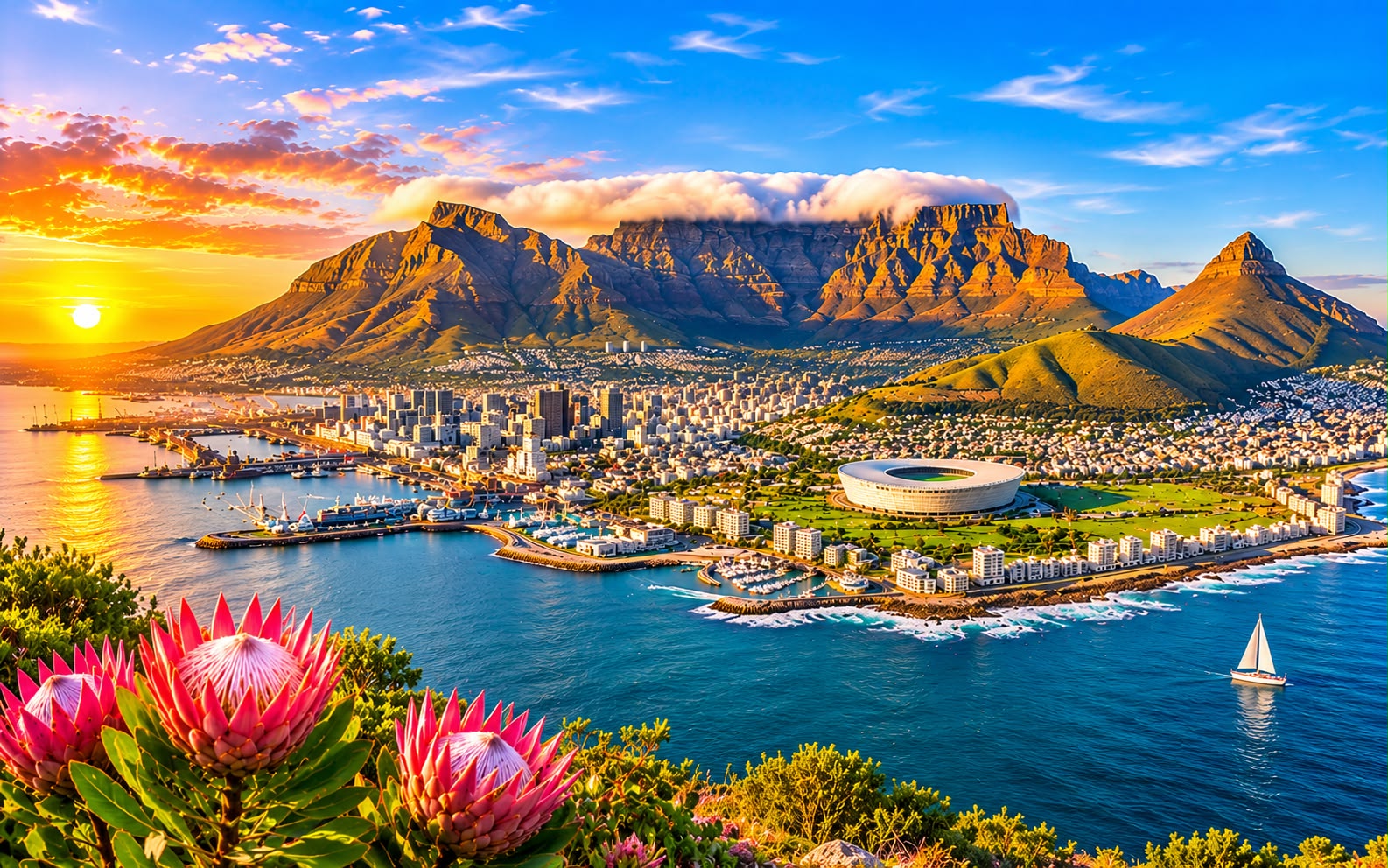
South Africa and Mauritius in 12 days: Cape Town, a safari and an island
Four days in Cape Town and the Winelands, three on safari in the Kruger, then four on a Mauritian beach. Why the malaria question decides which reserve you book, what a lodge rate includes that a hotel rate does not, and the two seasons that do not overlap.
- Southern Africa
- 12 days
- ≈ AED 12,100 / person
- The safari-and-beach honeymoon, with a real city at the front of it
Before you go
This is the classic safari-and-beach honeymoon, and the version with Cape Town at the front is the better one — a proper city, a mountain, and a wine region, before the game drives and the island.
Seven days in South Africa and five in Mauritius, joined by a direct flight of about four and a half hours from Johannesburg. Three nights on safari is the minimum that works — game viewing is a numbers game and two nights is four drives.
South Africa in 10 days and Mauritius in 8 days are each half at length.
Figure USD 3,300 (≈ AED 12,119) per person. May to September.
Before you go: the admin
Entry
- South Africa: visa-free for a long list of nationalities, usually 90 days; an online application for the rest.
- Mauritius: visa-free or visa on arrival for most nationalities, usually 60 days, plus an online arrival form submitted before you fly.
- Travelling with children through South Africa has extra documentation rules — an unabridged birth certificate, and consent from any parent not travelling. They are enforced at check-in, not just at the border.
- Last checked: 2 November 2026.
The malaria question, which decides your reserve
- The Kruger and its private reserves are a malaria area, low risk in the dry winter months and higher in summer. Prophylaxis is normally advised; ask a travel clinic six weeks out.
- If you would rather not, the Eastern Cape reserves near Port Elizabeth are malaria-free and have the Big Five. The game viewing is genuinely good and the reserves are smaller.
- This is the one decision to make before booking anything, because it changes the flights as well as the lodge.
- Mauritius has no malaria.
What a safari lodge rate includes
- Included: the room, all meals, two game drives a day, and usually local drinks.
- Not included: the park or conservation levy, premium wines and spirits, and the tips for the ranger and the tracker, which are separate, expected and add up over three nights.
- A lodge rate therefore is not comparable to a hotel rate. Two hundred dollars at a lodge covers your whole day; at a Cape Town hotel it covers the bed.
Money
- Rand in South Africa, rupees in Mauritius. Both are card-friendly; the rand goes further than almost any other currency on this site.
- Tipping is expected in South Africa — around 10 to 15 per cent in restaurants, and separately for safari guides.
- Mauritius is noticeably more expensive than South Africa, and resort prices inside a resort are the most expensive version of it.
Day by day
Day 1 — Land in Cape Town
- Arrive and stay in the City Bowl, the V&A Waterfront or Camps Bay. Each is a different trip; the City Bowl is the most central.
- Afternoon — the V&A Waterfront, and book Robben Island for later in the week — the ferry sells out and is weather-dependent.
- Evening — Bo-Kaap for the painted houses and Cape Malay food.
- Take a taxi app after dark rather than walking between neighbourhoods. This is ordinary big-city practice here, not alarmism.
Day 2 — Table Mountain, and the city
- Go up the mountain at the first opportunity the weather gives you. The cable car closes for wind frequently and people leave it to the last day and miss it.
- Book the cable car online and check the live status that morning before travelling out.
- Or walk up Platteklip Gorge, which is about two and a half hours, steep, and in full sun.
- Afternoon — the District Six Museum, which is small and is the honest account of what the city did to itself.
- Or Robben Island, if your ferry slot is today. The tours are led by former political prisoners.
Day 3 — The Cape Peninsula
- A full-day loop by hire car or driver — this is the one day a car genuinely helps.
- Chapman’s Peak Drive, cut into the cliff above the sea, then Boulders Beach at Simon’s Town for the African penguin colony, which is on a boardwalk and closer than you expect.
- Cape Point and the Cape of Good Hope, the lighthouse and the funicular. It is not the southern tip of Africa — that is Cape Agulhas, 150 km east — and the signs are honest about it.
- Back via Kirstenbosch, the botanical garden on the mountain’s eastern slope, with a canopy walkway.
- Baboons here will open a car door. Keep windows shut and food out of sight.
Day 4 — The Winelands
- An hour from Cape Town — Stellenbosch, Franschhoek and Paarl.
- Take the Franschhoek wine tram or a driver. Do not drive yourself between tastings; South Africa’s drink-driving limit is low and enforced.
- Tastings cost a fraction of what they do in Europe, and the food at the estates is some of the best in the country.
- Evening — back to Cape Town, and pack for an early flight.
Day 5 — To the bush
- Fly Cape Town to Johannesburg, then on to a bush airstrip — or drive from Johannesburg, about five hours to the Kruger’s southern gates.
- Afternoon — arrive, settle, and the first game drive at about four.
- Drives run at dawn and late afternoon, which is when the animals move. The middle of the day is for sleeping, and so will you be.
- Take the layers they tell you to. An open vehicle at 6 a.m. in July is near freezing and this surprises everyone.
Day 6 — Game drives
- 05:30 and 16:00. Two drives, three to four hours each.
- Tell your ranger what you have not seen. They plan around it, and radio traffic between vehicles is how leopards get found.
- Do not stand up in the vehicle or hang limbs over the side. Animals read the vehicle as one object and a person breaking that outline changes it.
- Midday — a bush walk, if the lodge offers one. Tracks, dung, birds and insects — a completely different scale and better than it sounds.
Day 7 — More drives, and the leopard problem
- The Big Five is lion, leopard, rhino, elephant and buffalo, and leopard is the one that holds out.
- Three nights is six drives, which is roughly what it takes to make leopard likely rather than lucky. Nobody can promise it.
- Ask about rhino photographs. Many lodges request that you do not geotag them, for reasons that are entirely real.
- Evening — the last drive ends with a sundowner somewhere with a view.
Day 8 — To Mauritius
- Fly back to Johannesburg, then on to Mauritius — about four and a half hours direct.
- You gain two hours. Mauritius is ahead of South Africa.
- Afternoon — arrive, and go nowhere. The island is 65 km across and the transfer to most resorts is under an hour, but this is a day for the pool.
- The north — Grand Baie and Trou aux Biches — is livelier; the east and south-west are quieter. Pick before you book; crossing the island repeatedly is how a short stay goes.
Day 9 — The lagoon
- Mauritius is ringed by a coral reef, which is why the water inside it is flat and the colour it is.
- Morning — snorkelling, or a catamaran to Île aux Cerfs, which is busy and is still worth one day.
- Or the north islands — Gabriel and Flat Island — which are quieter.
- Afternoon — nothing. This half of the trip is the rest after the 5:30 starts.
Day 10 — The interior
- Chamarel — the seven-coloured earths, the waterfall, and the rum distillery, all within a few kilometres.
- Black River Gorges National Park — the last of the island’s native forest, with walking trails and endemic birds.
- Or Le Morne, the basalt monolith on the south-west corner, a UNESCO site because escaped slaves sheltered on it.
- Afternoon — back to the coast.
Day 11 — The last island day
- Port Louis, the capital: the Central Market, the Blue Penny Museum, and Aapravasi Ghat, the immigration depot where half a million indentured labourers arrived.
- Or a dolphin trip at Tamarin at dawn, which is early and is the better choice if the weather is right.
- Or a last day doing nothing, which is a defensible plan on day eleven of twelve.
Day 12 — Out
- The airport is in the south-east, under an hour from most resorts, longer from the north.
- Allow three hours, and more if you are claiming VAT back.
- Morning — a last swim. Checkout is usually noon and the resort will hold bags.
Costs and practicalities
Best time to visit
May to September — the dry winter, which is the right season for both.
- May to September — the Kruger’s dry season: the grass is short, the bush is thin and the animals come to the water, which makes this by far the best game viewing. Mauritius is dry, cooler at 22–26°C, and outside the cyclone season. The window.
- It is cold on a winter morning drive — near freezing in June and July in an open vehicle. The lodges hand out blankets and hot water bottles for a reason.
- Cape Town is at its wettest from June to August, which is the trade-off: the bush is at its best exactly when the Cape is not. May and September are the best compromise.
- November to April — the Kruger is green, hot and thick, game is harder to see, and it is Mauritius’s cyclone season, roughly November to April. Cape Town, however, is glorious.
- If Cape Town matters more than the game viewing, come in October or November and accept a harder safari.
Travel tips
- Decide the malaria question first. It changes the reserve and the flights.
- Three nights on safari, not two. Six drives, not four.
- Go up Table Mountain the first clear day, not the last.
- Book Robben Island early. It sells out and it cancels for weather.
- Take a driver or the wine tram in the Winelands.
- Pack a serious warm layer for the morning drives, even in summer.
- Tip the ranger and the tracker separately, and in cash.
- Keep car windows shut around Cape Point baboons.
- Pick one coast in Mauritius and stay on it.
- Use taxi apps after dark in Cape Town and Johannesburg, and do not display phones or jewellery in the street.
What this trip actually costs
Two people, 11 nights, mid-range throughout, international flights excluded:
| Item | Cost |
|---|---|
| Safari lodge, 3 nights all-inclusive, two people | USD 2,200 (≈ AED 8,080) |
| Mauritius resort, 4 nights half board, two people | USD 1,700 (≈ AED 6,243) |
| Flights: Cape Town–Kruger and Johannesburg–Mauritius | USD 900 (≈ AED 3,305) |
| Cape Town hotel, 4 nights | USD 760 (≈ AED 2,791) |
| Food, wine and drink outside the inclusive nights | USD 620 (≈ AED 2,277) |
| Car hire, the Winelands, entries and transfers | USD 420 (≈ AED 1,542) |
| Total for two | USD 6,600 (≈ AED 24,239) |
- Roughly USD 3,300 (≈ AED 12,119) per person for twelve days.
- The safari line looks enormous and is not comparable to a hotel line. It covers every meal, two guided drives a day and most drinks — about half of it is what the Cape Town days spend separately on food.
- Conservation levies and guide tips are not in the lodge rate. Budget a few hundred dollars more across three nights.
- Cape Town is the best value on this trip by a distance. A Winelands tasting and lunch costs a fraction of its European equivalent.
- Mauritius is the expensive island half, and a half-board rate is usually better value than paying resort restaurant prices à la carte.
- Hotel picks here are chosen on location, not on commission — always check prices and recent reviews before booking.
What to pack
- A serious warm layer, hat and gloves for the morning game drives. Near freezing in an open vehicle in June and July.
- Neutral colours for the bush — khaki, olive, brown. No bright white and no dark blue, which attracts tsetse flies.
- Binoculars. One pair each, not one between two.
- A long camera lens if you have one. The vehicles get close, but not that close.
- Reef-safe sunscreen, a hat and sunglasses for both halves.
- Insect repellent with DEET, and antimalarials if your clinic advises them.
- A windproof for Cape Town, where the south-easter blows hard.
- Type M or N adapter for South Africa — South Africa’s large three-pin plug is unusual and most adapters do not cover it — and Type C/G for Mauritius.
Part of a bigger trip?
- South Africa in 10 days adds the Garden Route.
- Mauritius in 8 days gives the island proper time.
- Southern Africa in 18 days is the self-drive circuit through Namibia and Botswana.
- Kenya and Tanzania in 12 days is the East African safari instead.
- Mauritius for a honeymoon is the island half for two.
FAQ
Do I need malaria tablets for this trip? For the Kruger, probably — it is a malaria area, lower risk in the dry winter months and higher in summer, and a travel clinic should advise you six weeks out. If you would rather avoid the question entirely, the Eastern Cape reserves near Port Elizabeth are malaria-free and have the Big Five. Mauritius has no malaria.
Why three nights on safari rather than two? Because game viewing is arithmetic. Two nights is four drives, three is six, and leopard in particular tends to appear on the fifth or sixth rather than the second. Three nights also means one morning where you are not packing, which matters more than it sounds after a run of 5:30 starts.
Is the lodge price really comparable to a hotel price? No, and this is the most common misreading of a safari budget. A lodge rate includes every meal, two guided game drives a day and usually local drinks, so it covers the whole day. It does not include the conservation levy or the ranger and tracker tips, which are separate and expected.
Can I do Cape Town and the Kruger in the same good season? Not entirely. The bush is at its best from May to September, which is exactly when Cape Town is at its wettest and windiest. May and September are the honest compromise — decent weather at the Cape and genuinely good game viewing. If Cape Town is the priority, come in October or November and accept thicker bush.
Which coast of Mauritius should I stay on? Pick one and stay on it. The north around Grand Baie and Trou aux Biches is the liveliest with the most restaurants outside resorts; the east is calmer and has the best lagoons; the south-west around Le Morne is the most dramatic and the windiest. The island is only 65 km across, but crossing it repeatedly on a five-day stay is how the days disappear.
Prices and entry rules change, and what you need depends on your passport; last checked 2 November 2026, so confirm with the embassy or your airline before booking.


