 The Itinerary
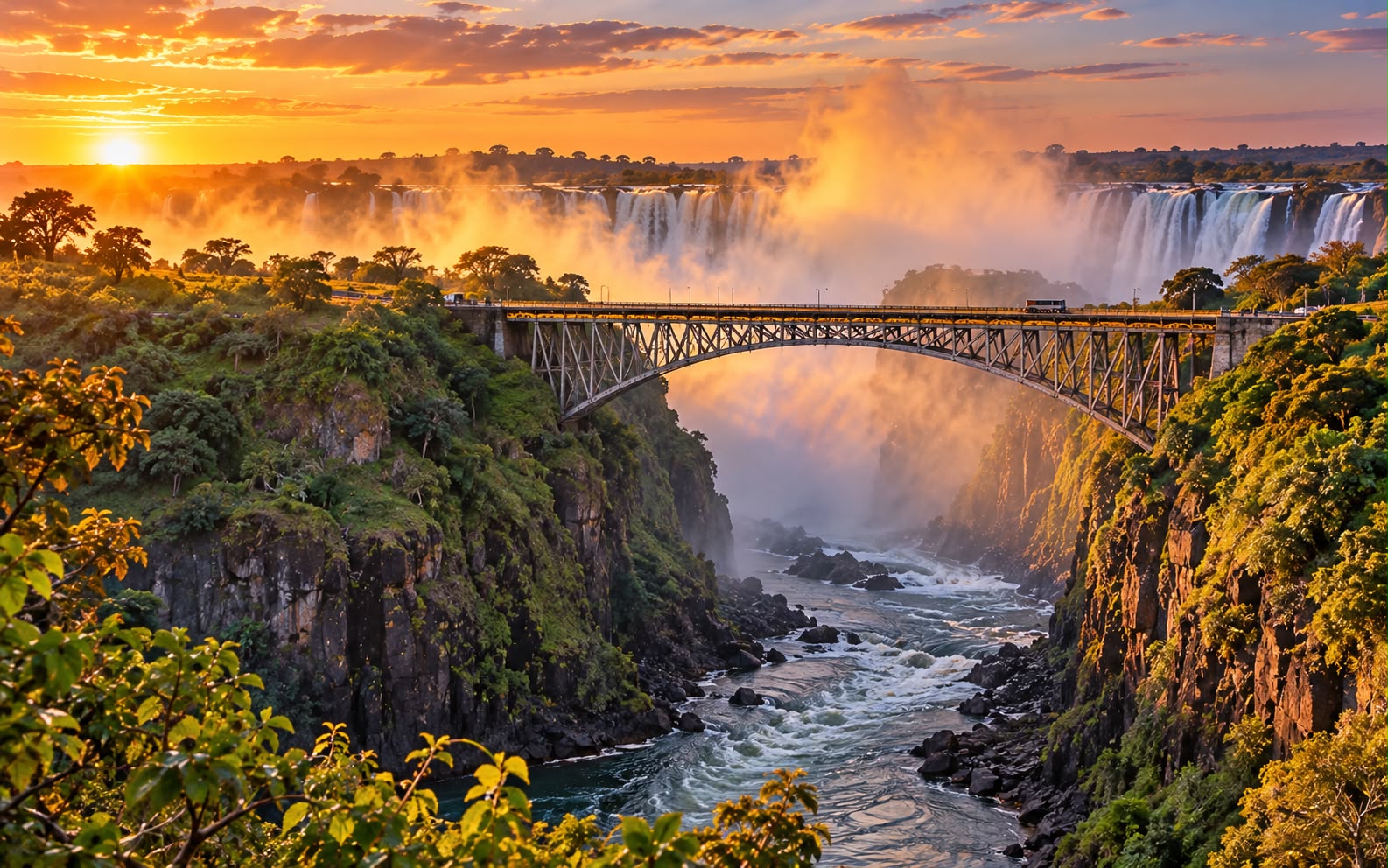
Zambia and Zimbabwe in 10 days: both sides of Victoria Falls, Hwange and South Luangwa
A mile-wide curtain of water you can see from two countries and swim to the lip of, the largest elephant concentration in Africa an hour across the border, and the valley where walking safaris were invented and are still done best.
- Southern Africa
- 10 days
- ≈ AED 14,700 / person
- The waterfall from both banks, and the country that invented the walking safari
Before you go
Before you go: the admin
The KAZA visa does the work
- The KAZA UniVisa covers Zambia and Zimbabwe on one document for 30 days, and allows a day trip into Botswana at Kazungula and back. It is bought on arrival at Livingstone, Victoria Falls or Lusaka airports, in cash.
- It is the single most useful thing on this page — the alternative is two separate visas and paying again each time you cross the bridge.
- Its availability has been suspended and restored more than once. Confirm it is being issued before you travel, and carry enough cash for two single-entry visas as a fallback.
- Passports need six months and several blank pages.
Flights and the crossings
- Fly into Livingstone or Victoria Falls — they are 11km apart with the Falls between them — and out of Lusaka.
- The Victoria Falls Bridge is the crossing, on foot or by taxi, and takes 20–45 minutes each way including formalities. You can walk it, which is the better option, and the bungee operators are halfway across.
- South Luangwa needs a flight — Livingstone or Victoria Falls to Mfuwe via Lusaka. There is no sensible road.
- Light aircraft legs have a 15–20kg soft-bag limit and it is enforced.
Money
- Both countries run on US dollars. Zimbabwe’s local currency has been reset repeatedly and is not worth engaging with; Zambian kwacha is used for small purchases.
- Bring clean, small-denomination US notes and more than you expect. ATMs are unreliable and often empty, and there is no way to draw more at a bush camp.
- Cards work at lodges and in Victoria Falls town and nowhere else useful.
One gentle brief
- The Falls look completely different by season, and the difference is larger than for any other sight on this site. High water is a wall of spray; low water is bare rock and swimmable pools. Decide which you came for.
- Zimbabwe’s guides are among the best trained in Africa — the professional guide qualification is notoriously hard — which is why the walking safaris here are worth the money.
- Fuel shortages recur in both. Fill up whenever you pass a station with supply.
Day by day
Day 1 — Land at Livingstone
- Arrive, buy the KAZA visa, which covers Zambia and Zimbabwe and a day trip into Botswana — buy it on arrival, not in advance.
- 14:00 — The Zambian side at Mosi-oa-Tunya gives you the Knife-Edge Bridge, which puts you directly in the spray — in high water you will be soaked through in ninety seconds, so hire the poncho and bag the camera.
- 16:00 — The Boiling Pot walk down to the gorge below the bridge — about 30 minutes down, longer back up.
- 18:00 — A sundowner on the Zambezi upstream, where the river is flat and wide and gives no hint of what happens next.
Day 2 — Devil’s Pool, or the helicopter
- 07:00 — Devil’s Pool is the Zambian side’s set piece — a rock lip at the very edge of the drop with a natural barrier in front of it. It opens roughly mid-August to mid-January, when the water is low enough, and is booked through the Livingstone Island operators. The early slot includes breakfast and has the fewest people.
- 11:00 — The microlight or helicopter is the other way to understand the geology — the Falls are a zigzag of former gorges, and you only see that from above. No cameras on the microlight, which is a disappointment and a safety rule.
- 15:00 — The Victoria Falls Bridge in the afternoon, walking across to Zimbabwe for the first view from the other bank. You can walk to the midpoint without formalities.
- 18:00 — The bungee and the gorge swing go from the bridge, if that is your register.
Day 3 — The Zimbabwean side, properly
- 07:00 — About two-thirds of the Falls face is on the Zimbabwean side, and the rainforest walk gives you sixteen viewpoints along it — Devil’s Cataract, Main Falls, Danger Point.
- In high water, February to June, this is the side to be on and you will see very little except water and spray. In low water, September to December, the Zambian side can be almost dry and Zimbabwe keeps its flow.
- 11:00 — The craft market at the entrance, where the haggling is hard and good-natured.
- 15:00 — The Victoria Falls Hotel for afternoon tea on the terrace, with the bridge framed by the gorge — colonial in the exact sense, and the view is the reason.
- 17:30 — A Zambezi sunset cruise, or dinner at the Boma if you want the drumming-and-mopane-worm version.
Day 4 — Chobe, as a day trip into Botswana
- 06:30 — An hour and a half to Kazungula and across into Botswana — this is what the KAZA visa is for.
- 09:00 — Do the boat, not the game drive. The river cruise puts you at eye level with elephant, buffalo and hippo on the floodplain and is the better half of the day by a long way.
- Chobe has the highest elephant density in Africa, and in the dry season they come to the river in their hundreds.
- 13:00 — Lunch at a lodge on the river.
- 15:00 — A second boat, or the game drive if you want both — but the afternoon boat is better.
- 19:00 — Back across the border by evening — the posts close and the queue at Kazungula is unpredictable.
Day 5 — To Hwange
- 08:00 — Two and a half hours south-east from Victoria Falls.
- 11:30 — The Painted Dog Conservation centre at the main gate is worth an hour — painted dogs are the specialty and Hwange holds one of the largest remaining populations.
- 13:00 — Into camp. Hwange is Zimbabwe’s largest park at 14,600km², with no natural permanent water — the game concentrates on pumped waterholes, which is both the reason the elephants are here in such numbers and a conservation argument that is still running.
- 16:00 — An afternoon drive and a hide. Sitting at a waterhole from four until dark is better than driving around looking.
- 19:30 — Dinner at camp, and the waterhole floodlit.
Day 6 — Hwange: a full day
- 05:30 — Out at first light for the predators, and the Nyamandhlovu platform for the morning elephant traffic.
- 09:00 — A walking safari with a Zimbabwean professional guide if your camp offers it — this is what they are trained for and it is a completely different way of being in the bush. Zimbabwe’s guiding qualification is the hardest in Africa and it shows.
- 13:00 — The middle of the day at camp, which is when the game rests too.
- 16:00 — Out again, further this time.
- 19:30 — The night drive, which Hwange permits and most national parks do not — genet, civet, honey badger.
Day 7 — Fly to South Luangwa
- 07:00 — Back to Victoria Falls or Livingstone, then fly to Mfuwe via Lusaka. It is most of a day.
- Light-aircraft and regional baggage limits are strict — soft bags, and the camps will store the rest.
- 16:00 — Arrive at the camp in the late afternoon and go straight out — the Luangwa’s riverbanks at dusk are the introduction.
- South Luangwa has the highest leopard density in Africa and the sightings are usually on the night drive.
- 20:00 — Dinner, and the hippos start up outside.
Day 8 — Walking the Luangwa
- 06:00 — The walking safari was invented here, by Norman Carr, and the park still does it better than anywhere. You walk in single file behind an armed scout and a guide, and you learn to read the ground rather than scan the horizon.
- Neutral clothing, closed shoes, no perfume, and do what the scout says without discussion.
- 10:00 — Breakfast in the bush, carried out ahead of you.
- 13:00 — The middle of the day off, which in the hot season is not optional.
- 16:00 — The Luangwa is one of the great wildlife rivers — hippo in concentrations of hundreds, crocodile, and the oxbow lagoons that the game comes down to.
- 19:00 — The night drives are where the leopard, genet and porcupine are. Zambia permits spotlighting; most countries do not.
Day 9 — South Luangwa, and the endemics
- 06:00 — Thornicroft’s giraffe and Crawshay’s zebra are endemic subspecies found only in this valley — the giraffe is the one with the dark, sharply-edged patches.
- 10:00 — A village or school visit if your camp runs a genuine community programme, and ask whether it is one.
- 14:00 — A bush camp night if the dates allow — walking between camps with your luggage carried ahead, which is the purest version of the thing. The bush camps open roughly June to October.
- 16:30 — A last afternoon drive.
- 19:30 — Confirm tomorrow’s flight tonight, which in Zambia is not a formality.
Day 10 — Fly out via Lusaka
- 08:00 — Mfuwe to Lusaka and the international connection.
- Leave real margin. Internal flights in Zambia change for reasons nobody will explain, and missing the international leg is expensive — an overnight in Lusaka is cheaper than a rebooked long-haul.
Costs and practicalities
Best time to visit
The Falls and the game pull in opposite directions, and this is the single most important planning fact on the page.
- February–June — the Falls at peak flow, fed by the Zambian and Angolan rains. April and May are the maximum, when the spray rises 400m and can obscure the view entirely from the Zambian side. The bush is thick and the game is dispersed.
- July–October — the best game viewing, with the bush thinning and animals crowding the remaining water. Hwange’s waterholes and the Luangwa’s lagoons are at their most concentrated in September and October, which is also extremely hot.
- August–January — low water at the Falls, which reveals the rock face and opens Devil’s Pool, roughly mid-August to mid-January.
- November–April — the emerald season. Green, dramatic skies, excellent birding, cheap, and many South Luangwa camps close entirely because the roads go.
June to August is the compromise: the Falls still have real flow and the game is already concentrating.
Travel tips
- Confirm the KAZA UniVisa is being issued before you travel, and carry cash for two separate visas as a fallback. It has been suspended more than once.
- Walk the bridge rather than taking a taxi across. It is the best fifteen minutes in Victoria Falls and you can watch the bungee from above it.
- Hire a poncho and bag the camera on the Knife-Edge Bridge in high water. “Waterproof” jackets are not waterproof against that.
- Devil’s Pool is seasonal and booked through licensed operators only. Do not go near the lip independently; people have died doing it.
- Soft bags, 15–20kg, for the light aircraft legs.
- Malaria prophylaxis is essential in both countries and the Zambezi and Luangwa valleys are high-risk year-round.
- Tipping is expected at camps — guide, scout and general staff separately, with guidance given at check-in.
What this trip actually costs
Two people, 9 nights, mid-range camps and lodges, international flights excluded:
| Item | Cost |
|---|---|
| Camps and lodges, 9 nights, mostly full board | USD 3,600 (≈ AED 13,221) |
| Activities: Devil’s Pool, helicopter, Chobe cruise, walking | USD 1,200 (≈ AED 4,407) |
| Internal flights to Mfuwe via Lusaka, two people | USD 1,100 (≈ AED 4,040) |
| Park fees, both Falls sides, Hwange, Luangwa and Chobe | USD 900 (≈ AED 3,305) |
| Transfers, guides and the bridge crossings | USD 700 (≈ AED 2,571) |
| Food, drink and tips outside full board | USD 500 (≈ AED 1,836) |
| Total for two | USD 8,000 (≈ AED 29,380) |
- Roughly USD 4,000 (≈ AED 14,690) per person. Zambia is the dearer half — South Luangwa’s camps and the flight to reach them are most of the difference.
- Dropping South Luangwa saves about a third and turns this into a six-day Falls and Hwange trip, which is a perfectly good shorter version.
- The KAZA visa saves around $100 per person against buying separately.
- Hotel picks here are chosen on location, not on commission — always check prices and recent reviews before booking.
What to pack
- A soft duffel, 15kg, for the light aircraft.
- Neutral colours for walking safaris — khaki and olive, and the guides will insist.
- Proper closed walking shoes. Walking safaris are not done in sandals.
- A genuine waterproof and a dry bag for the Falls in high water.
- A fleece. Dawn drives in June and July are cold and the open vehicle makes it colder.
- Clean small-denomination US dollars, more than you plan to spend.
- Binoculars each, and a torch for the camps, which run generators for part of the night only.
FAQ
Which side of the Falls is better? Both, which is why this route does both. Zimbabwe has about two-thirds of the face and keeps its flow in low water; Zambia has the Knife-Edge Bridge, the Boiling Pot and Devil’s Pool.
When does Devil’s Pool open? Roughly mid-August to mid-January, depending on water level. It is booked through the Livingstone Island operators and is not somewhere to go independently.
Is the KAZA visa reliable? It has been suspended and reinstated more than once. Check before you travel and carry cash for two single-entry visas as a fallback.
Why Zambia for walking safaris? Because South Luangwa invented them and still does them best — armed scout, small group, single file, and a guiding tradition going back to Norman Carr in the 1950s.
Can I add Botswana properly? Chobe as a day trip is included. Doing the Okavango properly is a separate trip with its own fly-in camps and a much larger budget.
Prices and entry rules change, and what you need depends on your passport; last checked 29 October 2026, so confirm with the embassy or your airline before booking.


