 The Itinerary
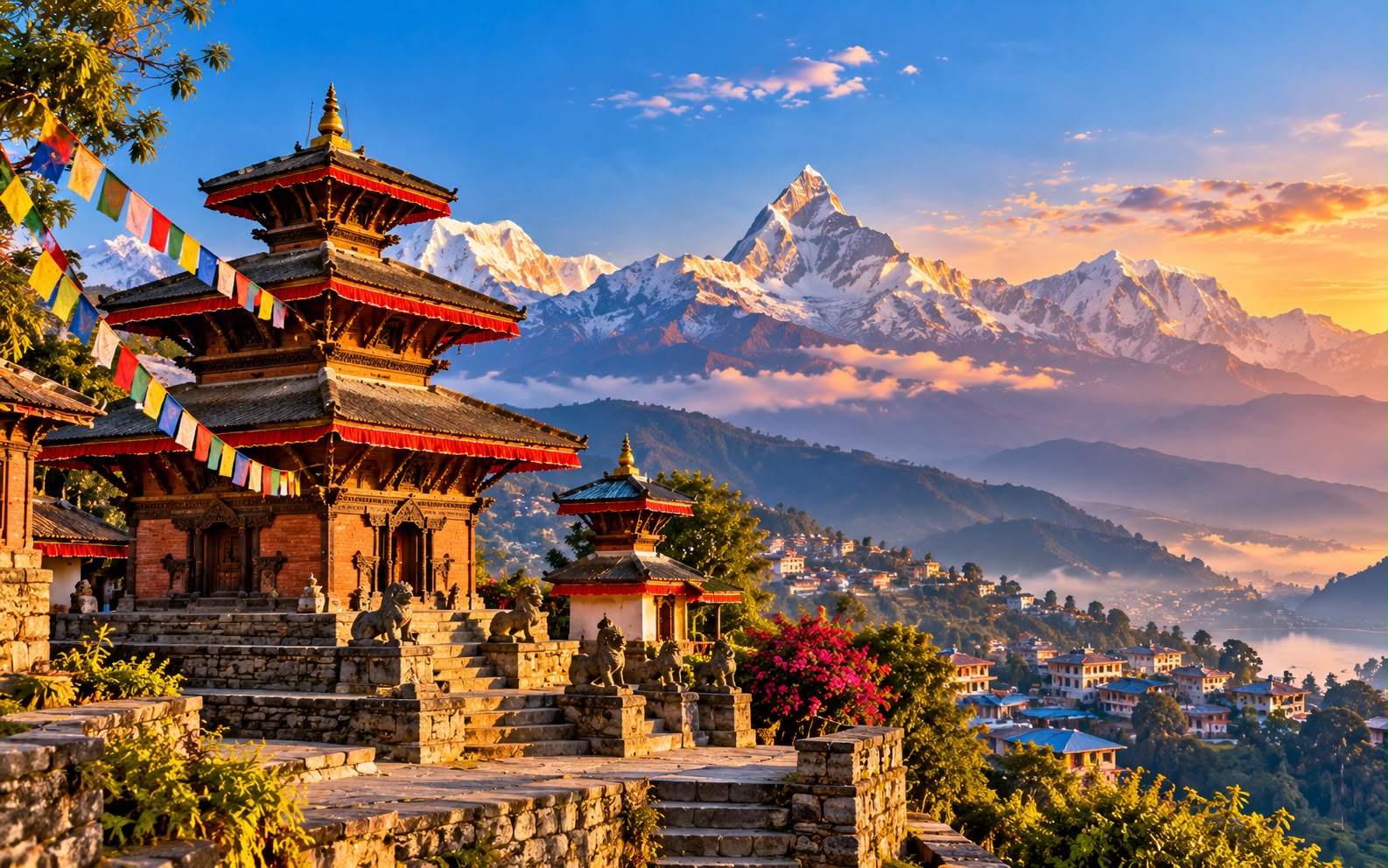
Nepal in 10 days: Kathmandu, Pokhara and Chitwan
The Himalaya without the trekking boots: Kathmandu's living medieval squares and the Pashupatinath aarti, Annapurna filling the sky at Sarangkot sunrise, rhinos from an open jeep in Chitwan — and a one-hour flight past Everest's face to finish. Visa on arrival in fifteen minutes — or none at all on an Indian passport; SAARC rates halve the tickets; one rupee-note rule catches everyone.
- South Asia
- 10 days
- ≈ AED 3,400 / person
- First-time visitors
Before you go
Nepal compresses more wonder per kilometre than anywhere on this site. In one small country: seven UNESCO monuments in a single valley, a lake town where the Annapurna range hangs over breakfast like a painted backdrop, jungle lowlands where one-horned rhinos outnumber tourists — and, on a clear morning, a scheduled airliner that flies you past Mount Everest and home in time for a second breakfast.
It is the best-value Himalaya there is, and for Indian passports the friendliest border on earth — no visa, no fee, no form. Everyone else gets a visa on arrival that takes about fifteen minutes. This first Nepal guide is the no-trekking classic: temples, mountains and rhinos with a hotel bed every night. (The trekking specials — Poon Hill, and the Everest Base Camp epic — are coming; see the FAQ.)
Go October–November — post-monsoon crystal air, the mountains at their sharpest, and festival season (Dashain/ Tihar) as a bonus — or March–April (rhododendrons, warm). December–February is cold but clear; June–September is monsoon: green, cheap, and the peaks mostly hide. All costs are in Nepali rupees (NPR).
Before you go: the open border, money and altitude
Visas, and the open border
- Most passports: visa on arrival at Kathmandu airport — ~US$30/15 days, US$50/30 days, kiosk + cash counter; nearly every passport qualifies.
- Indian passports: no visa exists at all. Fly in on the passport (recommended; an original Election Commission Voter ID also works, especially at land borders — Aadhaar/PAN/licences do not). Children under 15: birth certificate + parent’s ID. No fee, no stay-limit stamp for tourism. It is genuinely that simple.
The rupee-note rule, and SAARC pricing
- The rule that catches Indian travellers: ₹500 and ₹2,000 Indian notes are not legal in Nepal. Carry ₹100s (widely accepted at ~1.6 NPR) or just use ATMs/cards. Getting caught changing big INR notes is a genuine hassle.
- SAARC pricing applies again: Indian/SAARC rates run a fraction of foreigner tickets at the heritage sites — and Pashupatinath is free for Indians (foreigners NPR 1,000, and non-Hindus can’t enter the main sanctum at all).
The aviation honesty
- The aviation honesty, plainly: Nepal’s domestic flying has a patchier safety record than its neighbours. The sensible protocol this guide follows: Buddha Air or Yeti ATRs, morning flights, never connect a Pokhara flight to your international departure same-day (weather delays are routine — build the buffer night in, as this itinerary does). Roads are the alternative: slow, bumpy, scenic, fine.
Money and tipping
- Cards work at hotels and nicer restaurants; Thamel stalls, taxis and temples run on cash — NPR 500s and 100s. ATMs everywhere (fee ~NPR 500).
- Tipping: not formalised — NPR 100–200 for drivers/porters, ~10% at tourist restaurants, guide tips by day.
- Bargain in Thamel with a smile (start ~half), never at fixed-price shops; pashmina, singing bowls and khukuri knives are the classic hauls (knife goes in checked luggage!).
Altitude and dust
- No altitude worries on this route (Kathmandu 1,400 m, Sarangkot 1,600 m) — this is the Himalaya at walking-around height.
- Kathmandu’s dust is real: a light mask for traffic hours helps sensitive lungs. Bottled/filtered water only.
Day by day
Day 1 — Land in Kathmandu, Thamel evening
- Afternoon — Land KTM (4 h from the Gulf; 1.5–2 h from Delhi). Prepaid taxi into town (~NPR 800–1,000).
- 17:00 — First wander in Thamel — the joyful trekking-shop bazaar-maze — with a decompression stop in the Garden of Dreams (NPR 400, neo-classical calm).
- 19:30 — First momos (Nepal’s dumpling religion, NPR 200–400 a plate) and thukpa; a Nepali band covering classic rock somewhere nearby is contractually guaranteed.
Where to stay in Kathmandu (three nights + one at the end)
- The legend: The Dwarika’s — 4.8/5 on TripAdvisor (~1,500 reviews), a museum-grade heritage hotel of carved-wood salvage; its Krishnarpan restaurant serves 6–22 course Nepali feasts. ~NPR 40,000+.
- Thamel calm: Oasis Kathmandu Hotel — 4.9/5 (~2,200 reviews), a quiet courtyard two lanes from the noise. ~NPR 8,000–12,000.
- Value: Aryatara Kathmandu — 4.9/5 (~1,700 reviews), breakfast included, walk-everywhere. ~NPR 5,000–7,500.
Day 2 — The holy circuit: monkeys, kings and the great aarti
- 07:00 — Swayambhunath (the “Monkey Temple”; NPR 200 foreigners/SAARC less): 365 steps to the all-seeing eyes, the whole valley waking below, monkeys running the place with confidence. Hold your snacks.
- 10:00 — Kathmandu Durbar Square (foreigners NPR 1,000 / SAARC ~150): the medieval royal plaza — Kasthamandap, the towering Taleju temple, and the Kumari Ghar, home of the living goddess (she appears at her window some mid-days; no photos of her).
- 13:00 — Newari lunch: bara, choila, the works (~NPR 400–700 pp).
- 16:00 — Pashupatinath — Nepal’s holiest Shiva temple on the Bagmati (free for Indians, who may enter the sanctum; foreigners NPR 1,000, outer complex only). Walk the ghats respectfully — cremations burn here around the clock; no photographs of the pyres — and the sadhu-lined terraces above.
- 18:00 — Stay for the evening Bagmati aarti (~18:00, nightly): fire, bells and bhajans on the river steps — Varanasi’s intimacy at a tenth of the crowd. The single most moving hour in Kathmandu.
- 20:00 — Dinner back in Thamel; sleep well — you’ve earned all three religions’ blessings.
Day 3 — Boudhanath breakfast, Bhaktapur afternoon
- 08:00 — Boudhanath (NPR 400): the white whale-eye stupa, one of the largest on earth — join the clockwise kora with the morning pilgrims, prayer wheels spinning, then breakfast on a rooftop café staring at the eyes.
- 11:00 — Drive 40 minutes east to Bhaktapur (foreigners NPR 1,800 / SAARC ~500): the best- preserved medieval city in the valley — the 55-Window Palace, five-tiered Nyatapola temple, pottery square where the wheels still spin. Eat juju dhau — the “king of curds” — from a clay bowl (NPR 100; a top-five Nepal memory for most visitors).
- 16:30 — Back to Kathmandu; Patan’s golden Durbar Square (SAARC ~250) if energy allows — its museum is Nepal’s best.
- 19:30 — Farewell-for-now dinner; pack a small bag — mountains tomorrow.
Day 4 — Fly to Pokhara, float on Phewa Lake
- 09:00 — KTM → Pokhara, 25 minutes (Buddha/Yeti, from ~US$80–110; sit LEFT side — the entire Himalaya files past the window). The tourist bus (~NPR 1,500–2,500, 7–8 winding hours) is the budget alternative.
- 11:00 — Check in Lakeside: Pokhara runs at half Kathmandu’s pulse and twice its oxygen.
- 14:00 — Row (or be rowed) across Phewa Lake (~NPR 700–1,000/boat/hour) to the Tal Barahi island temple; Machhapuchhare — the “Fishtail” — floats on the water when clouds allow.
- 17:30 — Lakeside strip sunset: juice bars, bookshops, the mountains going pink.
- 19:30 — Lakeside dinner (~NPR 500–900 pp) — the town’s Israeli-Italian-Indian-everything menus are a trekking-town inheritance.
Where to stay in Pokhara (three nights)
- The icon: Fish Tail Lodge — 4.7/5 (~1,800 reviews), on its own peninsula, reached by rope-drawn pontoon; Annapurna views from the lawn. ~NPR 18,000– 25,000.
- Boutique: Temple Tree Resort & Spa — 4.7/5 (~2,100 reviews), pool and spa off the strip. ~NPR 14,000– 20,000.
- Value: Hotel Middle Path & Spa — 4.9/5 (~1,700 reviews), lakeside location at guesthouse money. ~NPR 6,000–9,000.
Day 5 — Sarangkot sunrise, then (optionally) jump off it
- 04:45 — Drive up Sarangkot (1,600 m; ~NPR 200 entry) for the sunrise that sells Nepal: first light igniting Annapurna South, Machhapuchhare and Dhaulagiri across a 140-km white wall. Cold, crowded at the rail, unforgettable. Tea at the top.
- 08:30 — The paragliding option (~NPR 10,000– 12,000 for a 20–30 min tandem, video extra): Sarangkot is one of the world’s great commercial flying sites — launch over the lake with hawks thermalling beside you. Operators are well-drilled; weather cancels honestly.
- 11:30 — Cross the lake and climb (or drive) to the World Peace Pagoda — the white stupa with the full lake-mountains-city panorama.
- 14:30 — The quick hits: Davis Falls (NPR 100), the Gupteshwor Mahadev cave opposite (a Shiva shrine deep under the waterfall — pilgrimage bonus for the devout), optional Seti gorge peek.
- 18:00 — Massage (~NPR 2,000–3,000/hour) or an early rooftop dinner as the fishtail catches the last light.
Day 6 — The slow Pokhara day
- Menu, pick freely: the excellent International Mountain Museum (NPR 600 — Everest history, Sherpa culture, mountaineering kit through the ages); cycle the lake’s quiet north shore; boat-and-swim at cleaner Begnas Lake (40 min away, blissfully local); a momo-making class; or absolutely nothing on a lakeside lawn — Pokhara’s true specialty.
- 19:00 — Dal bhat done properly (the “dal bhat power, 24 hour” plate — unlimited refills are the custom, ~NPR 400–800): tomorrow needs jungle energy.
Day 7 — Down to the jungle: Chitwan
- 08:30 — Drive south (4–5 h, tourist bus ~NPR 1,500 or private car ~NPR 12,000/vehicle) off the hills onto the steamy Terai plain — Nepal changes country entirely in an afternoon.
- 13:30 — Check into your Chitwan lodge (Sauraha side; 2-night full-board packages with all activities, naturalist, and the NPR 2,000/day + VAT park fee bundled run ~US$130–200 pp mid-range; Barahi Jungle Lodge is the riverfront luxury benchmark, Sauraha’s family lodges the value tier).
- 16:00 — Sunset canoe on the Rapti in a dugout: gharial and mugger crocodiles on the banks, kingfishers strafing, the jungle turning gold.
- 19:30 — Tharu cultural evening — the indigenous stick dance around the fire — then lodge dinner and the loudest cicadas of your life.
Day 8 — Rhino day
- 06:30 — Bird walk with the naturalist (Chitwan logs 500+ species before most guests wake).
- 09:00 — Full jeep safari into the park: the star is the greater one-horned rhinoceros — Chitwan holds ~700 and sightings are near-routine — plus spotted deer, wild boar, gaur, langurs, sloth-bear luck and the Bengal tiger lottery (rare, real, and the reason everyone whispers).
- The ethics line, consistent with this site: ride the jeep, skip the elephant — elephant-back safaris and bathing shows persist in Sauraha, and we don’t fund them. The jeep sees more anyway.
- 16:00 — Village cycle or riverside sundowner; elephants (wild ones) sometimes cross at dusk — that’s the version worth seeing.
- 20:00 — Last jungle night: Tharu dinner, firefly audit.
Day 9 — Back to Kathmandu, farewell feast
- 08:30 — Drive back to Kathmandu (5–6 h; or the 20-min Bharatpur flight, ~US$90, for the road-weary).
- 15:30 — Last Thamel sweep: the pashmina you negotiated on Day 1 is still there; so is the singing bowl.
- 19:00 — The farewell feast: Krishnarpan at Dwarika’s (the ceremonial 6+ course Nepali dinner, ~NPR 5,000–8,000 pp — the splurge that doubles as a cultural finale) or a beloved Thamel thakali kitchen at a tenth of that.
- Pack. Set the alarm. Tomorrow you meet Everest.
Day 10 — The Everest flight, then home
- 05:30 — Airport for the Everest mountain flight (~1 hour; Indians ~₹12,150 / ~NPR 19,500 — the SAARC fare; other passports US$250–275; Buddha Air/Yeti, every seat a window, cockpit visits in turn): the Langtang and Rolwaling ranges parade past until the black pyramid of Sagarmatha — Everest — fills the glass at eye level. Weather cancellations rebook or refund in full — the buffer this itinerary gives you.
- 10:00 — Back for breakfast, checkout, and the afternoon international flight home — mountains in the camera, no blisters on the feet.
Costs and practicalities
Best time to visit
October–November is the clearest and most reliable window of the year, and March–April is the second.
- October–November — the best. Post-monsoon air is washed clean, the Annapurna and Everest views are at their sharpest, and the trails are dry. Dashain and Tihar fall in October and November and are the biggest festivals of the year.
- March–April — warm, with the rhododendron forests in flower, which is the Himalayan spring and spectacular. Slightly hazier views than autumn.
- December–February — cold and very clear. The high passes close, but Kathmandu, Pokhara and the lower treks are fine and empty. Chitwan is at its best for wildlife.
- June–September — the monsoon. Trails are leeches and mud, flights to Lukla are cancelled for days, and the mountains are behind cloud. Upper Mustang and Dolpo are in the rain shadow and are the exception.
Travel tips
- TIMS cards and area permits are required for trekking — ACAP for Annapurna, Sagarmatha for Everest — and are checked at the trailheads.
- Lukla flights are cancelled for weather constantly, and in peak season they run from Ramechhap rather than Kathmandu, which is a four-hour drive. Build buffer days at both ends.
- Altitude sickness kills people here every year. Ascend slowly above 3,000m, take a rest day every 1,000m, and descend if symptoms appear. Diamox helps but does not replace acclimatisation.
- Carry travel insurance that covers helicopter evacuation above 4,000m — standard policies do not, and the bill runs to five figures.
- Kathmandu’s air quality is poor in winter, and a mask is genuinely useful.
- Cash in rupees for the trails. ATMs in Kathmandu, Pokhara and Namche only; teahouses are cash.
- Walk clockwise around stupas and mani walls, and pass them on the left.
What this trip actually costs
Two people, 9 nights (4 KTM + 3 Pokhara + 2 Chitwan), mid-range comfort, at foreigner rates, international flights excluded:
| Item | Cost |
|---|---|
| Hotels, 7 nights (KTM + Pokhara; Chitwan below) | NPR 58,000 (≈ AED 1,415) |
| Chitwan 2-night full-board package for two (safari, canoe, park fees) | NPR 40,000 (≈ AED 976) |
| Transport: KTM→Pokhara flight, tourist buses, taxis | NPR 42,000 (≈ AED 1,025) |
| Visa on arrival, 15 days × 2 (US$30 each) | NPR 9,000 (≈ AED 220) |
| Monument and gate entries | NPR 9,500 (≈ AED 232) |
| Everest mountain flight for two | NPR 64,000 (≈ AED 1,562) |
| Food, 10 days (momo-powered) | NPR 44,000 (≈ AED 1,074) |
| eSIM, extras | NPR 2,500 (≈ AED 61.01) |
| Buffer: a paraglide, the Krishnarpan splurge, singing bowls | NPR 11,000 (≈ AED 268) |
| Total for two | NPR 280,000 (≈ AED 6,833) |
- Roughly NPR 140,000 (≈ AED 3,417) per person (≈US$910) — still with Vietnam and Malaysia in the site’s best-value tier. The Everest flight is nearly a quarter of it: skip it and the trip dips near NPR 108,000 (≈ AED 2,636) pp (but don’t skip it).
- SAARC passports pay noticeably less. Indian, Bangladeshi, Sri Lankan and other SAARC travellers get the domestic gate rates (NPR 3,500 (≈ AED 85.41) rather than NPR 9,500 (≈ AED 232)) and the SAARC fare on the Everest flight (NPR 39,000 (≈ AED 952) for two rather than NPR 64,000 (≈ AED 1,562)) — and on an Indian passport there is no visa line at all. The same nine nights come to about NPR 120,000 (≈ AED 2,928) per person.
- Book in this order: flights (KTM round trip; Indians can even come overland from India) → the Everest flight and KTM–Pokhara legs (morning slots, reputable carriers) → hotels free-cancel (Dashain/Tihar season fills) → Chitwan package → paragliding on the ground by weather → temples, lakes and momos require no reservation.
- Hotel and restaurant picks here are unsponsored — no affiliate links in this article. Chosen on location and current ratings; always check prices and recent reviews before booking.
What to pack
- Layers: Kathmandu mornings 8–12°C in season, Chitwan afternoons 28°C+ — the trip spans both daily.
- A warm layer + gloves for the 4:45am Sarangkot rail and the Everest-flight dawn.
- Slip-off shoes (temples, stupas, lodges), socks you like (cold marble).
- ₹100 notes if coming from India (see the rupee rule), NPR cash wallet otherwise.
- Repellent + light long sleeves for Chitwan dusk; neutral safari colours.
- A light mask for Kathmandu traffic, eye drops, bottled-water discipline.
- Space for pashmina and a singing bowl; the khukuri goes in checked baggage.
FAQ
Really no visa at all on an Indian passport — what’s the catch? No catch — the 1950 treaty keeps the border open both ways. The two real rules: carry the right document (passport or original Voter ID; kids under 15 need birth certificate + parent’s ID) and leave ₹500/₹2,000 notes at home. Every other nationality: US$30–50 visa-on-arrival, ten quiet minutes at the kiosk.
Is the Everest flight worth it — and is it safe? It’s the best US$140 (SAARC) an Indian traveller spends in Nepal: a guaranteed-window hour with the highest mountains on earth at eye level. On safety: book the established carriers (Buddha/Yeti), fly the early-morning calm, and accept weather cancellations gracefully — the system errs cautious, which is exactly what you want.
When exactly for the mountain views? October–November is the answer — post-monsoon clarity, Sarangkot delivering daily. December–February: cold mornings, still clear. March–April: warm, rhododendron-red hills, slight haze creeping in by May. June–September: assume no mountains and enjoy the green (and the discounts).
Chitwan — ethical wildlife or not? The park itself is a conservation triumph (rhinos back from ~100 to ~700). Our line: jeep and canoe safaris yes; elephant-back rides and bathing shows no — same stance as our Thailand guide. Book lodges that don’t push elephant activities; the naturalist-led jeep sees more animals anyway.
Halal and vegetarian food? Vegetarians are home: dal bhat, veg momos, paneer everything — half the country eats meat-free half the time. Halal takes light planning: Kathmandu’s Muslim quarter around Jame Masjid (Durbar Marg) and several Thamel restaurants serve halal, Pokhara has a handful; lodges happily cook fish/veg on request. When in doubt, the vegetarian lane in Nepal is genuinely excellent.
What about the treks — Poon Hill, Everest Base Camp? Coming as their own guides: Poon Hill (4–5 teahouse days, first-trek friendly) slots straight into this route at Pokhara, and the EBC epic joins our special-expedition shelf beside Siberia and Oymyakon. If you needed a sign to start walking uphill after dinner — this is it.
Prices and entry rules change, and what you need depends on your passport; last checked 8 October 2026, so confirm with the embassy or your airline before booking.


