 The Itinerary
Nepal and Bhutan in 12 days: Kathmandu, Pokhara, Punakha and Tiger's Nest
One opened its doors in 1951 and has been absorbing the world since; the other charges you a daily fee to come in and spends it on forests and free healthcare. Stupas and trekking lodges on one side, dzongs and a monastery on a cliff on the other.
- South Asia
- 12 days
- ≈ AED 11,750 / person
- Two Himalayan kingdoms that answered modernity in opposite ways
Before you go
Before you go: the admin
Two systems, and one of them is unlike anywhere else
- Nepal issues a visa on arrival at Kathmandu for most nationalities — 15, 30 or 90 days, paid in cash at a kiosk. Bring US dollars in small notes and a passport photo.
- Bhutan cannot be visited independently. You book through a licensed Bhutanese operator who arranges the visa, and a guide accompanies you throughout. This is the rule, not an upsell.
- The Sustainable Development Fee is the structure of the Bhutanese half — charged per adult per night on top of all costs, with reductions for children. Everything else follows from it, including why the country has so few visitors.
- Indian, Bangladeshi and Maldivian nationals have a different and much cheaper arrangement.
Flights, and the one that matters
- Fly into Kathmandu and out of Kathmandu — Paro connects almost exclusively through Kathmandu, Delhi, Bangkok or Singapore, and Kathmandu is the natural hub for this pairing.
- Only two airlines fly into Paro, Drukair and Bhutan Airlines, and only a handful of pilots are certified to land there — the approach threads between 5,000m ridges and is visual only.
- Sit on the left flying Kathmandu to Paro. Everest, Kanchenjunga and Makalu line up out of that window on a clear morning, and it is the best commercial flight in the world.
- Paro flights are cancelled for cloud and wind and they only operate in daylight. Build a buffer day at the end.
- Kathmandu to Pokhara is 25 minutes by air or six to eight hours by road.
Money
- Nepalese rupees and Bhutanese ngultrum. The ngultrum is pegged to the Indian rupee, which also circulates in Bhutan.
- Bhutan is largely prepaid — your operator covers hotels, meals, guide and transport, so you need cash only for tips, drinks and shopping.
- Cards barely work in Bhutan. Nepal takes them in Kathmandu and Pokhara.
One gentle brief
- The two countries are a deliberate contrast. Nepal is busy, cheap, chaotic and open; Bhutan is quiet, expensive, ordered and deliberately limited. Doing them together is how you notice both.
- Neither is a high-altitude trip on this routing. Kathmandu is 1,400m, Pokhara 820m, Thimphu 2,320m and Paro 2,200m. Tiger’s Nest tops out at 3,120m and is the only real exertion.
- Dress respectfully in Bhutan — long sleeves and long trousers at dzongs, no hats indoors, shoes off in temples. Your guide will be in formal gho or kira and you are expected to make an effort.
Day by day
Day 1 — Kathmandu
- Arrive and go gently. The valley is 1,400m, which is not high, but the air and the traffic are both a lot at once.
- 15:00 — Swayambhunath — 365 steps, monkeys, and the valley below. Nothing loose or shiny; the macaques here are practised.
- 17:30 — Boudhanath, one of the largest stupas in the world, and the kora around it with the Tibetan community at dusk. Walk clockwise, as everyone does.
- 19:30 — Dinner in Boudha rather than Thamel, which is quieter and better.
- Several valley monuments were damaged in the 2015 earthquake and restoration continues; some are scaffolded and some are rebuilt.
Day 2 — Pashupatinath, Patan
- 06:00 — Pashupatinath at dawn — the most important Hindu temple in Nepal, with the cremation ghats on the Bagmati. Non-Hindus cannot enter the main temple; the view is from the far bank, and do not photograph the cremations.
- 09:00 — The sadhus on the terraces will pose for a fee agreed first. Several are performers; some are not.
- 12:00 — Patan for the Krishna Mandir and the museum, which is the best in Nepal.
- 16:00 — Patan’s backstreets and courtyards, where the metalworkers still beat statues by hand.
- 18:30 — Back across the river before the evening traffic sets.
Day 3 — Bhaktapur
- 08:00 — Bhaktapur Durbar Square, the best preserved of the three royal squares, and go early — the ticket is for the day and the morning is empty.
- 10:00 — The Nyatapola temple, five tiers on five plinths, each guarded by a pair of figures ten times stronger than the pair below.
- 12:00 — The pottery square where they still throw by hand, and the clay is left to dry in the open square.
- 15:00 — Changu Narayan, the oldest temple in the valley, twenty minutes away and almost always empty.
- 18:00 — Stay in Bhaktapur overnight if you can — the square after the day visitors leave is the best hour in the valley.
Day 4 — Pokhara
- 09:00 — Twenty-five minutes by air, with the Annapurnas out of the right-hand window. Sit on the right.
- 12:00 — Phewa Lake and a rowing boat to the Tal Barahi temple on its island.
- 15:00 — The lakeside, which is where the town is, and hire the boat yourself rather than taking the oarsman.
- 17:30 — The World Peace Pagoda above the lake at sunset, reached by boat and a 45-minute climb.
- Early night — tomorrow starts at half past four.
Day 5 — Sarangkot, and the foothills
- 04:30 — Sarangkot before dawn — 1,600m, half an hour by road, and the sunrise hitting Machhapuchhre and Annapurna South in sequence. It is the view this valley exists for.
- 07:00 — Paragliding from Sarangkot is among the best in the world and runs most mornings September to May — you launch from where you watched the sunrise and land by the lake.
- Or walk the first day of the Annapurna foothills — Dhampus and Australian Camp, out and back, no permit needed for a day walk.
- 14:00 — Back for the afternoon.
- 17:00 — Devi’s Falls and the Gupteshwor cave, which are twenty minutes apart and fill an hour.
Day 6 — Fly to Paro
- 08:00 — Back to Kathmandu, then the Paro flight. Sit on the left.
- The landing is the thing — a visual approach between ridges, two turns on finals, and applause when the wheels touch. Only a handful of pilots are certified for it.
- 14:00 — Paro’s Rinpung Dzong in the afternoon, and the National Museum in the watchtower above it.
- 17:00 — The pace changes immediately. Bhutan is quiet in a way that takes a day to adjust to after Kathmandu.
- Bhutan requires a daily Sustainable Development Fee and a licensed guide — everything is arranged before you arrive.
Day 7 — Thimphu
- 08:30 — An hour and a half east.
- 10:30 — Thimphu is the only capital in the world with no traffic lights — a policeman directs the main junction by hand, and the lights were installed once and removed after complaints.
- 11:30 — The Buddha Dordenma, 51m of gilded bronze above the valley, with 125,000 smaller Buddhas inside it.
- 14:00 — The Folk Heritage Museum and the Institute for Zorig Chusum, where the thirteen traditional arts are taught as a formal curriculum — students will let you watch.
- 16:00 — The takin preserve — the national animal, which looks assembled from spare parts and is found nowhere else.
- 17:30 — Tashichho Dzong in the late afternoon, when the administration empties and the monastic half remains.
Day 8 — Over Dochula to Punakha
- 08:00 — Over the Dochula Pass at 3,100m, with 108 chortens on the ridge and the eastern Himalaya across the whole horizon on a clear winter morning. The clear mornings are October to February.
- 11:00 — Chimi Lhakhang, the fertility temple of the Divine Madman, reached by a walk through rice fields — and the phallus paintings on the village houses are serious folk religion rather than a joke.
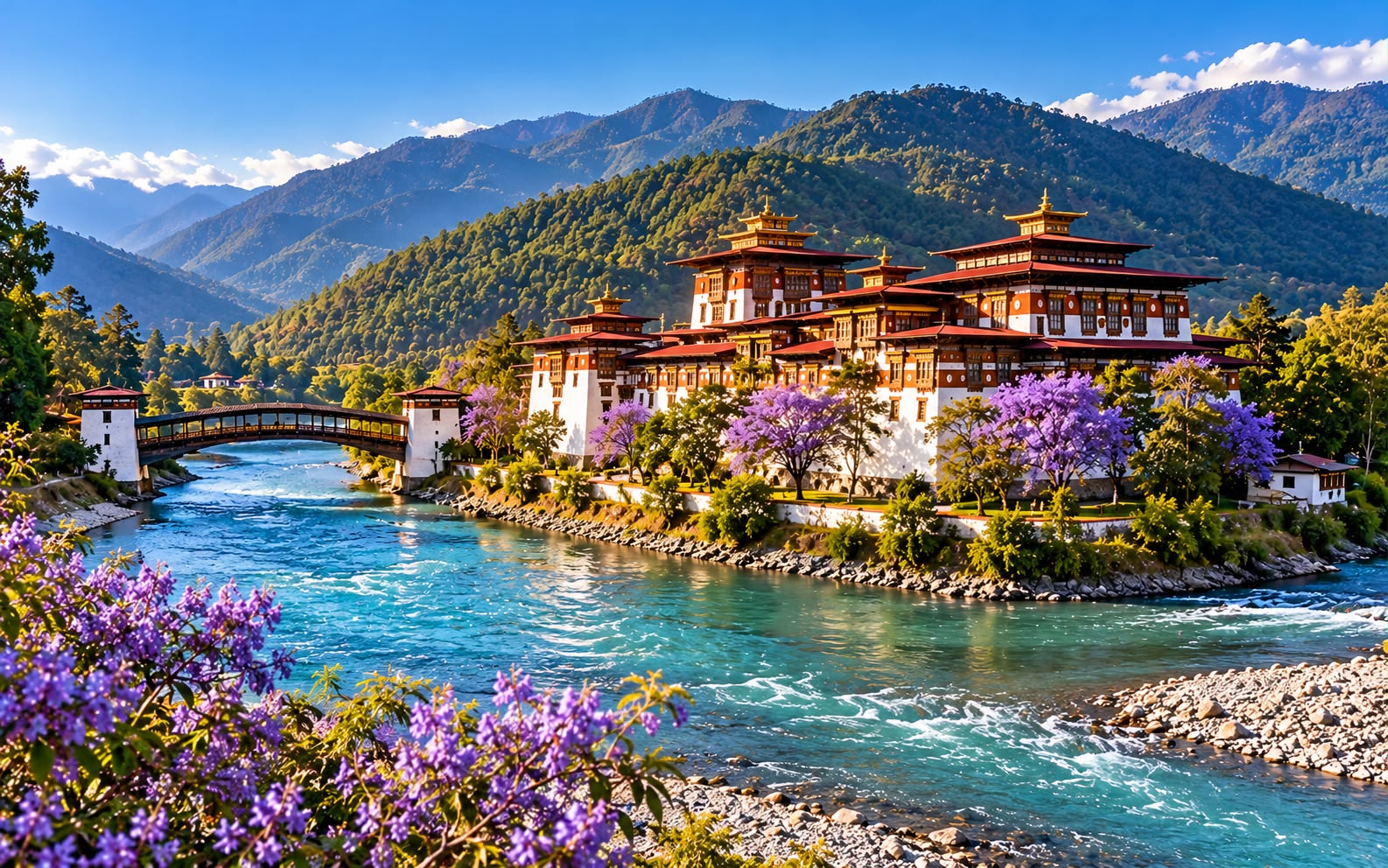
- 14:00 — Punakha Dzong at the confluence of the Pho Chhu and Mo Chhu — the most beautiful building in Bhutan, and the place where the kings are crowned. The jacarandas round it flower in late spring.
- Punakha is 1,200m and warm when Thimphu is cold, which is why the monk body winters here.
- 17:00 — The suspension bridge downstream, one of the longest in the country, strung with prayer flags.
Day 9 — Punakha
- 08:00 — The Khamsum Yulley Namgyal Chorten, an hour’s walk up through terraced fields on the far bank.
- 12:00 — Lunch by the river, and rafting the Mo Chhu in the afternoon if the water is up — it is gentle and the dzong comes into view from the water.
- 16:00 — A village walk, which your guide will arrange and which is the best hour of the Bhutan leg for most people.
- 19:00 — Back over the pass tomorrow, so pack tonight.
Day 10 — Back to Paro
- 09:00 — Over Dochula again — and if it was cloudy going out, this is the second chance.
- 13:00 — Into Paro.
- 15:00 — Kyichu Lhakhang in the afternoon — seventh century, one of the oldest temples in Bhutan, and far quieter than anything else on this route.
- 17:00 — An archery match if one is on; it is the national sport and the targets are 145m apart.
- 19:00 — Early night. Tomorrow is the climb.
Day 11 — Tiger’s Nest
- 07:00 — Start at seven. It gets hot, and the afternoon cloud comes in.
- Taktsang Palphug — Tiger’s Nest — clings to a cliff 900m above the Paro valley at 3,120m. Guru Rinpoche is said to have flown here on a tigress in the eighth century.
- It is a three-hour climb with about 900m of ascent, a cafeteria at the halfway point, and then a descent and re-ascent of several hundred steps across the gorge.
- 10:00 — The cafeteria, which is the first view and where many people stop.
- 11:30 — No cameras or phones inside the temple complex; there are lockers.
- 15:00 — Down, and a hot stone bath in the evening, which is the Bhutanese answer to a hard day and involves river stones heated in a fire and dropped into a wooden tub.
Day 12 — Fly out via Kathmandu
- 07:00 — Paro’s flights go in the morning for the light and the wind.
- Leave a buffer day before any onward international connection. Paro cancellations are routine and the next flight may be a day later — this is the single most important line in the itinerary.
Costs and practicalities
Best time to visit
October–November is the best window for both, which is unusually convenient.
- October–November — the clearest air of the year in both countries. Nepal’s post-monsoon skies are washed clean and the Annapurnas are properly visible; Bhutan is dry and mild. Dashain and Tihar in Nepal and the Thimphu and Paro tshechus fall in the autumn and spring respectively.
- March–April — the second window: rhododendrons in flower in both, the Paro Tshechu in late March or April, and Bhutan’s jacarandas at Punakha. Slightly hazier mountain views than autumn.
- December–February — cold, very clear, and the quietest. The Dochula Pass view of the eastern Himalaya is at its best on a clear winter morning, and black-necked cranes are in the Phobjikha valley from late October to February. Nepal’s high passes close; Kathmandu and Pokhara are fine.
- June–September — the monsoon. Nepal’s mountains are behind cloud for weeks, Pokhara flights are unreliable, and Bhutan is wet and green with leeches on the trails.
Bhutanese festival dates move with the lunar calendar. Confirm before booking anything around one.
Travel tips
- Sit on the left flying Kathmandu to Paro. Everest, Kanchenjunga and Makalu line up out of that window and it is the best commercial flight anywhere.
- Build a buffer day before your international departure. Paro flies in daylight only and is cancelled for cloud; a missed connection out of Kathmandu is expensive.
- Book Bhutan through a licensed operator well ahead, especially around the tshechus, when hotel stock is small and fills.
- Tiger’s Nest is a three-hour climb to 3,120m. Start at seven, take water, and a stick from the stall at the bottom helps more than it looks.
- No photography inside Bhutanese temples, and shoes off, hats off, long sleeves and trousers at every dzong.
- Smoking is heavily restricted in Bhutan — tobacco sales were banned for years, and bringing a personal quantity means declaring it and paying duty.
- Do not photograph cremations at Pashupatinath, which is the same rule as Varanasi and matters as much.
What this trip actually costs
Two people, 11 nights, mid-range comfort, international flights excluded:
| Item | Cost |
|---|---|
| Bhutan package: hotels, guide, driver and meals, 6 nights | USD 2,400 (≈ AED 8,814) |
| Flights: Kathmandu–Paro return and Kathmandu–Pokhara | USD 1,600 (≈ AED 5,876) |
| Bhutan Sustainable Development Fee, two people, 6 nights | USD 1,200 (≈ AED 4,407) |
| Nepal hotels, 5 nights | USD 500 (≈ AED 1,836) |
| Food and drink in Nepal | USD 400 (≈ AED 1,469) |
| Nepal guides, entries and Sarangkot | USD 300 (≈ AED 1,102) |
| Total for two | USD 6,400 (≈ AED 23,504) |
- Roughly USD 3,200 (≈ AED 11,752) per person, and the split is stark: Bhutan is around 80% of the cost for half the nights.
- The SDF is a government fee, not a markup, and it funds free healthcare and education and the constitutional requirement to keep 60% forest cover. Whether that is worth it is a real question and the answer for most people who go is yes.
- Nepal alone is one of the cheapest countries on this site. The contrast is part of what the trip is about.
- Hotel picks here are chosen on location, not on commission — always check prices and recent reviews before booking.
What to pack
- Long sleeves and long trousers for Bhutan’s dzongs, and a collared shirt rather than a t-shirt.
- Shoes that come off easily, repeatedly.
- Walking shoes with grip for Tiger’s Nest, which is steep and dusty.
- A warm layer. Thimphu and Paro at 2,200–2,320m are cold at night in any season, and the Dochula Pass is colder.
- US dollars in small notes for the Nepal visa on arrival.
- A power bank and a universal adapter — Bhutan uses several plug types.
- Sun protection. Himalayan sun at altitude burns through cloud.
FAQ
Why is Bhutan so expensive? Because it charges a Sustainable Development Fee per person per night and requires you to book through a licensed operator with a guide. It is deliberate policy to keep visitor numbers low, and the money funds free healthcare, free education and the forest cover requirement.
Can I visit Bhutan independently? No. A licensed Bhutanese operator arranges the visa and a guide accompanies you throughout. Indian, Bangladeshi and Maldivian nationals have a different arrangement.
How hard is Tiger’s Nest? Three hours up, 900m of ascent to 3,120m, with a cafeteria halfway and a flight of steps down and up across the gorge at the end. It is the hardest easy walk most visitors do, and almost everyone manages it.
Will I see Everest? From the Kathmandu–Paro flight on a clear morning, if you sit on the left. The dedicated Everest mountain flight from Kathmandu is the other option.
Is the altitude a problem? Not on this routing. Nothing is slept above 2,320m and Tiger’s Nest tops out at 3,120m for an hour.
Prices and entry rules change, and what you need depends on your passport; last checked 29 October 2026, so confirm with the embassy or your airline before booking.


