 The Itinerary
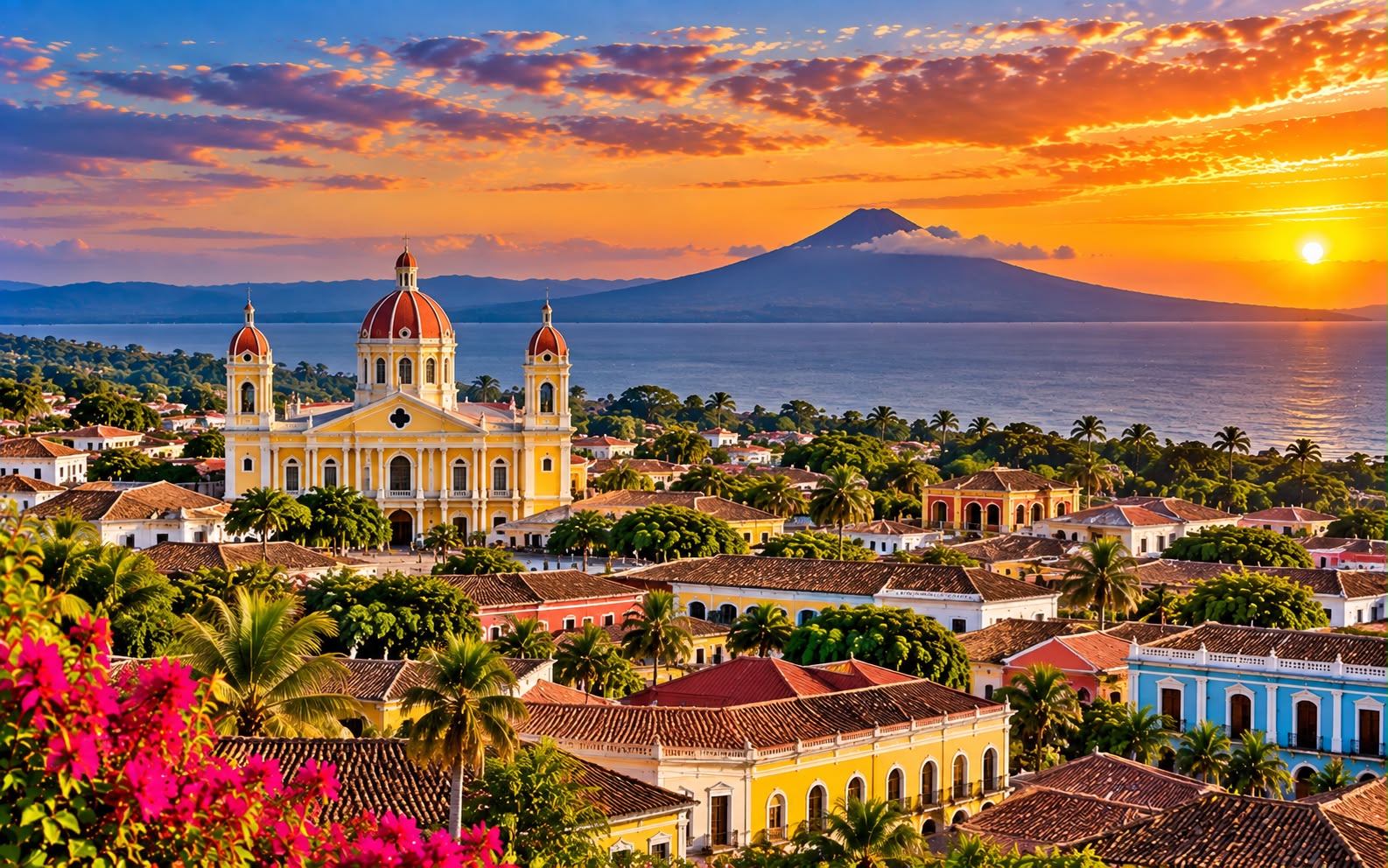
Nicaragua in 7 days: Granada, León and Ometepe
A crater with a lava lake you can stand above after dark, an island made of two volcanoes rising out of a freshwater lake, a cathedral roof you walk barefoot across, and a cinder cone people ride down on a plank.
- Mexico and Central America
- 7 days
- ≈ AED 3,700 / person
- Volcanoes you can look into, and two colonial cities
Before you go
Nicaragua is the largest country in Central America and the one with the most volcanoes — a chain of them running down the Pacific side, several active enough to look into.
At Masaya, you drive to the rim after dark and look down at an open lava lake, churning orange a few hundred metres below. There are very few places on earth where that is possible, and fewer still where you can park beside it.
Ometepe is an island formed by two volcanoes rising straight out of Lake Nicaragua — the tenth-largest freshwater lake in the world, big enough to have its own sharks historically. You arrive by ferry, with both cones in front of you.
And the two colonial cities are a rivalry the country has never quite resolved: Granada, painted and ordered on the lakeshore, and León, hotter and rougher and more interesting, with the largest cathedral in Central America — whose brilliant white roof you walk across barefoot.
The shape: Granada (2 nights) → Ometepe (2) → León (2). Figure NIO 37,000 (≈ AED 3,692) per person excluding flights. Go December–April, the dry season.
Before you go: the 15-minute admin
Current conditions — read this first
- Check your own government’s current travel advice before booking. Nicaragua has been under sustained political repression since 2018: independent media and NGOs have been closed, and advisories from several countries warn about arbitrary detention, including of foreign nationals, and about scrutiny of phones and social media at the border.
- Ordinary tourism continues and the areas on this route are not conflict zones. The risk advisories describe is political rather than criminal.
- Do not photograph police, military or government buildings, and think about what is on your phone before you arrive. That is unusual advice for this region and it is the specific thing visitors get caught by.
Visas
- Many nationalities enter visa-free and pay a small tourist card fee on arrival.
- The CA-4 agreement shares 90 days across Nicaragua, Honduras, El Salvador and Guatemala combined.
Money
- Nicaraguan córdoba. US dollars are widely accepted and often quoted for tours and hotels; change is given in córdobas.
- Cards work in Granada and León; carry cash for Ometepe, where ATMs are few and sometimes empty.
SIM and data
- Claro and Tigo SIMs are cheap and need a passport. Coverage is good except on Ometepe’s eastern side.
Getting around
- Managua airport is the only international gateway; Granada is about an hour away, León about 90 minutes.
- Shuttles between the tourist towns are the normal way to move and are inexpensive. Private drivers are not much more for two people.
- Ometepe is reached by ferry from San Jorge, about an hour. The crossing can be rough; the larger ferry is worth waiting for.
- On the island, hire a scooter or a 4x4 — the road around the southern volcano is rough in places.
Travelling with kids?
- Masaya’s lava lake is a drive-up viewpoint with a railing — remarkable and requiring no effort.
- Ometepe’s Ojo de Agua is a spring-fed swimming pool under trees and reliably popular.
- Volcano boarding at Cerro Negro has minimum ages and involves a 45-minute climb carrying a board.
- Volcanic gas at Masaya means short visits; the rangers enforce a time limit at the rim.
Day by day
Day 1 — Granada
- Afternoon — Land at Managua, transfer to Granada, about an hour.
- 16:00 — The Parque Central and the yellow cathedral, then Calle La Calzada running down toward the lake.
- 17:30 — Climb La Merced church tower for the best view in the city: painted roofs, the cathedral, and Mombacho volcano behind.
- 19:30 — Dinner on La Calzada.
Where to stay in Granada (two nights)
- Mid-range: colonial houses converted to small hotels around the centre, most with courtyards and a pool.
- Value: guesthouses a few blocks from the plaza, very cheap.
Day 2 — Las Isletas, Mombacho and the lava lake
- 08:30 — Las Isletas: 365 small islands in Lake Nicaragua, thrown there when Mombacho’s cone collapsed. Boat among them — herons, cormorants, and a small island of rescued monkeys.
- 11:30 — Mombacho volcano: a truck up the steep access road to cloud forest at the top, with crater trails and, on a clear day, a view over the whole lake.
- 16:00 — Back for a rest; the evening is the main event.
- 17:30 — Masaya Volcano at dusk. Vehicles drive to the rim of the Santiago crater and you look straight down into an open lava lake. Visits are timed and short because of the gas, and you book a slot in advance. It is the single most extraordinary hour in the country.
Day 3 — To Ometepe
- 08:30 — Drive south to San Jorge, about 90 minutes, and take the ferry to Ometepe, an hour across with both volcanoes growing in front of you.
- 12:00 — Arrive Moyogalpa, collect a scooter or a driver, and cross to Santa Cruz or Balgüe between the two cones.
- 15:00 — Ojo de Agua: a natural spring pool walled in stone under trees, which is exactly what you want after the ferry.
- 18:00 — Sunset over the lake with Concepción behind you.
Where to stay on Ometepe (two nights)
- Mid-range: lodges around Santa Cruz and Balgüe, between the volcanoes, many farm-based.
- Value: hostels and family guesthouses in Moyogalpa or Altagracia.
Day 4 — The island
- 06:00 — If you are climbing, Maderas is the achievable one: eight hours return, muddy, with a crater lagoon at the top and a guide required. Concepción is harder, hotter and more exposed.
- Not climbing? San Ramón waterfall, the petroglyph fields at Finca El Porvenir, and the beach at Santo Domingo fill the day comfortably.
- 16:00 — Kayak on the Río Istián between the two volcanoes, through channels full of birds and turtles.
- Evening — The island goes dark early and the sky is very good.
Day 5 — North to León
- 08:00 — Ferry back, then drive north past Managua to León, about four hours in total.
- 14:00 — León Cathedral, the largest in Central America and UNESCO-listed — and the thing to do is go up onto the roof, barefoot on blinding white render, with the volcano chain lined up on the horizon.
- 16:30 — The murals and the Museum of the Revolution, run by veterans of the insurrection, who will show you around themselves and tell you their own version. It is partial, and that is the value of it.
- 19:00 — Dinner. León is a university city and eats late.
Where to stay in León (two nights)
- Mid-range: colonial hotels within a few blocks of the cathedral.
- Value: hostels around the centre, where the volcano boarding is booked.
Day 6 — Cerro Negro, and the coast
- 07:00 — Volcano boarding at Cerro Negro: a 45-minute climb up a black cinder cone carrying a reinforced plank, then down the 41-degree slope on it in about a minute. It is Nicaragua’s signature activity and it only exists here.
- 13:00 — Lunch, then Las Peñitas on the coast, 30 minutes away, for the Pacific and a quiet beach.
- 17:00 — Sunset there, or back in León.
Day 7 — Managua, fly home
- Morning — Drive to Managua, about 90 minutes.
- Midday — If there is time, the Huellas de Acahualinca — human footprints preserved in volcanic mud for around 2,100 years, left by people walking toward the lake.
- Afternoon — Fly out.
Costs and practicalities
Best time to visit
December–April is the dry season and the practical window for the volcanoes and the colonial cities.
- December–February — the best months. Dry, with the papagayo trade winds cooling Granada and León, and clear views from the volcano summits.
- March–April — the hottest and driest, with León regularly over 35°C. The landscape is brown.
- May–November — the rains, usually a heavy afternoon hour. Green, cheap, and the mornings are generally clear. Hurricane risk on the Caribbean side peaks September to November.
- Surfing on the Pacific is best April to October, when the offshore winds and the southern swell combine at Popoyo and San Juan del Sur.
Ometepe and the Río San Juan are wetter than the Pacific strip in any month.
Travel tips
- Check current advice. Nicaragua has been politically repressive since 2018 and the situation for journalists, NGO workers and anyone discussing politics is serious. Avoid demonstrations entirely.
- Volcano boarding down Cerro Negro is the signature activity at León — a guided, fast descent on a board. Goggles and a suit are provided; shorts are a mistake.
- The córdoba is the currency and US dollars circulate widely. Carry small dollar notes and expect change in córdobas.
- Cards work in Granada, León and Managua; the islands and small towns are cash.
- Managua is not a city for wandering. Most visitors transit it; Granada and León are the bases.
- The chicken buses are the cheap network; shuttles between tourist towns are quicker and safer.
- Drink bottled water and be careful with ice outside established places.
What this trip actually costs
Two people, 6 nights, mid-range comfort, flights excluded:
| Item | Cost |
|---|---|
| Hotels, 6 nights | NIO 26,000 (≈ AED 2,594) |
| Shuttles, ferry, scooter and transfers | NIO 14,000 (≈ AED 1,397) |
| Food and drink, 7 days | NIO 16,000 (≈ AED 1,596) |
| Masaya, Mombacho, boats, volcano boarding | NIO 12,000 (≈ AED 1,197) |
| Guides and entries | NIO 6,000 (≈ AED 599) |
| Total for two | NIO 74,000 (≈ AED 7,383) |
- Roughly NIO 37,000 (≈ AED 3,692) per person — among the cheapest weeks on this site. Nicaragua costs noticeably less than Costa Rica next door for similar landscape.
- Book the Masaya night slot in advance. Numbers are capped, the visit is timed, and it is the best hour of the week.
- Ometepe’s ferry schedule sets your days at both ends. Check it before fixing the rest.
- Hotel picks here are chosen on location, not on commission — always check prices and recent reviews before booking.
What to pack
- Closed shoes you do not mind ruining. Maderas is mud and Cerro Negro is black grit that gets into everything.
- A buff or bandana for the volcano boarding descent.
- Insect repellent; dengue is present.
- Cash in small notes for Ometepe, where ATMs are unreliable.
FAQ
Is it safe? Ordinary crime is lower than in several neighbours and the route here is not a conflict zone. The risk advisories describe is political — arbitrary detention, scrutiny of phones and social media. Read your own government’s current advice, and do not photograph police or government buildings.
Is Granada or León better? Granada is prettier and easier; León is hotter, scruffier and more alive, with the cathedral roof and the volcano boarding. Most people who do both prefer León and are surprised by it.
Do I have to climb a volcano? No. Masaya is a drive-up, Mombacho is a truck ride, and Ometepe can be done entirely at lake level. Only Maderas and Concepción are real climbs.
How does it compare with Costa Rica? Similar landscape, a fraction of the price, far fewer visitors, and much less tourism infrastructure. That is the trade in both directions.
Prices and entry rules change, and what you need depends on your passport; last checked 8 October 2026, so confirm with the embassy or your airline before booking.


