 The Itinerary
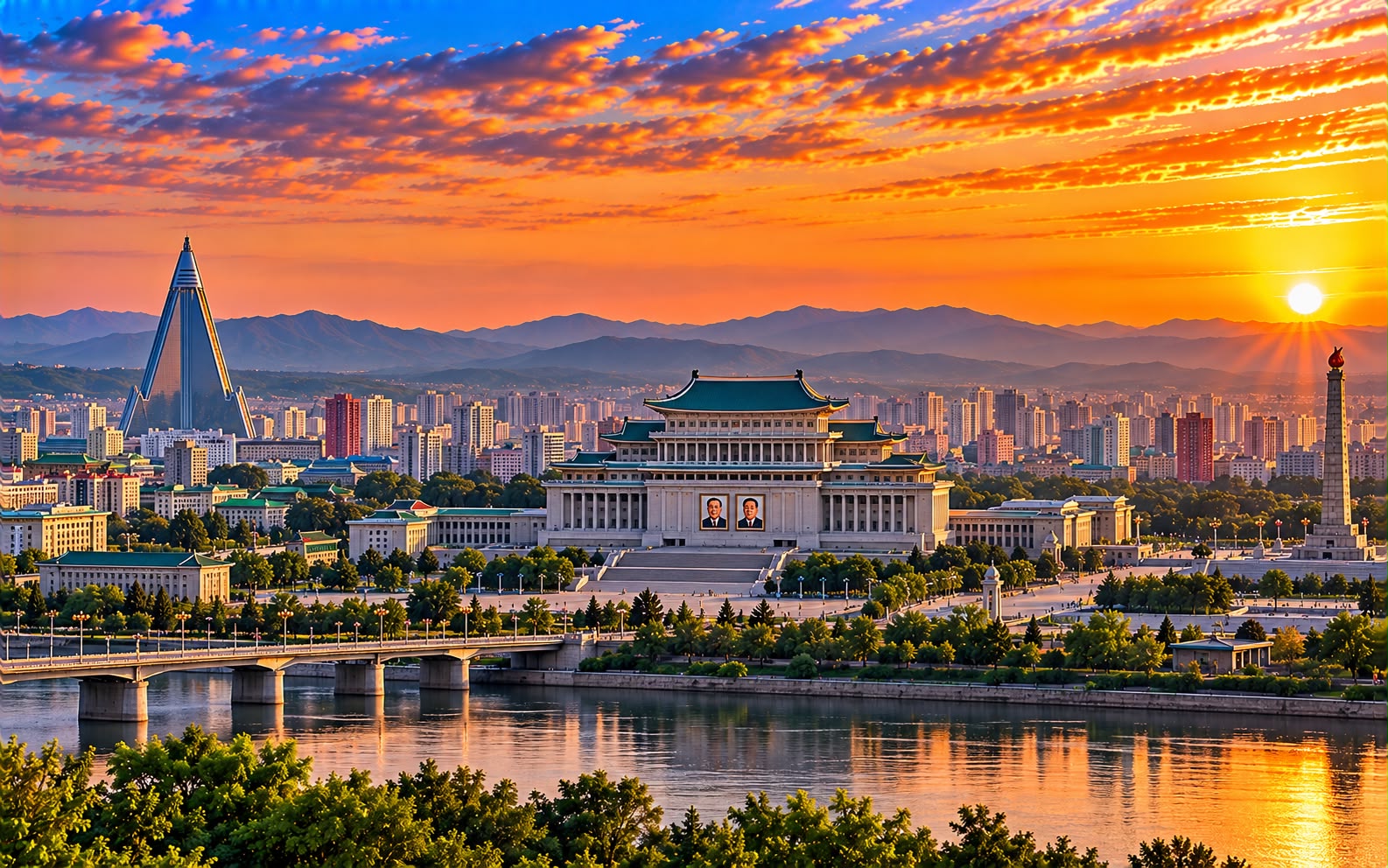
North Korea in 7 days: Pyongyang, the DMZ and what a guided tour actually shows you
A country you can only see on a state-run tour, accompanied at all times, where every dollar reaches the government and what you are shown is chosen for you — described with the practical and ethical questions stated rather than skirted.
- East Asia
- 7 days
- ≈ AED 8,100 / person
- Understanding the questions before deciding — this is not an ordinary trip
Before you go
Read this first
North Korea is unlike every other country on this site, and the reasons are not about scenery.
Access, which has been closed more than open:
- The borders shut in January 2020 and stayed shut for years. Limited reopenings since have been partial, brief and reversed — Russian groups, then a short window at Rason in early 2025 which was suspended again.
- Assume it is closed until an operator confirms otherwise. Any itinerary here is contingent.
- United States citizens are barred by their own government from using a US passport to travel to, in or through the DPRK without a special validation. This has been in force since 2017, after Otto Warmbier, a US student, was detained, sentenced to fifteen years’ hard labour for removing a poster, and returned home in a coma in which he died.
Safety, which is not about crime:
- Arbitrary detention is the risk. Visitors have been held for photographs, for religious material, for discarded newspapers bearing a leader’s image, and for conduct judged disrespectful.
- Several governments advise against all travel. Most have no embassy; consular protection is effectively nil for many nationalities.
- You cannot leave your guides. Minders accompany every visitor at all times and you do not move independently.
The ethical question, which is the real one:
- Essentially all of the money goes to the state. Hotels, guides, transport, entry fees and the mandatory tour are state-run. There is no local private economy for a tourist to support.
- You will not see the country. You will see a prepared itinerary of monuments, model facilities and arranged encounters. Journalists and researchers have documented for decades how carefully managed this is.
- North Koreans who interact with you may be at risk if an interaction is judged improper.
- The counter-argument that visitors sometimes make is that contact is better than none, and that guides are ordinary people. It is worth reading both sides properly before deciding.
This guide takes no position on whether you should go. It states what the decision involves, which most coverage does not.
If you do go, this is the shape of a standard tour.
Pyongyang is a planned capital rebuilt from almost nothing after 1953, and the monumental architecture is genuinely striking — Kim Il Sung Square, the Juche Tower, the Mansudae bronzes, and a metro a hundred metres down with chandeliers and socialist-realist mosaics.
Kaesong was the Koryo capital and holds the Historic Monuments and Sites in Kaesong — a UNESCO World Heritage site covering the Manwoldae palace ruins, the Koryo Museum and royal tombs.
The DMZ at Panmunjom is the Korean War armistice line, and seeing it from the northern side is the single most disorienting thing available in Korea.
Myohyangsan holds the International Friendship Exhibition — tunnels in a mountain storing tens of thousands of gifts presented to the Kims by foreign governments and figures, which is both absurd and revealing.
Seven days, if a tour runs. Figure USD 2,200 (≈ AED 8,080) per person excluding flights to Beijing. Historically April–June or September–October.
Before you go: the 15-minute admin
How a visit works
- You cannot travel independently. You book with a specialist tour operator, almost all of which route through Beijing, and the DPRK state tourism body assigns your guides.
- The visa is issued as a separate document, not usually stamped in the passport.
- You travel in a group with a fixed itinerary. Changes are not made at your request.
- Two guides plus a driver accompany every group. You do not walk out of the hotel alone.
- Journalists are not admitted on tourist visas, and attempting it has consequences for everyone on the trip.
The rules you must actually follow
- Bow where you are asked to bow, at the Mansudae statues and at the leaders’ portraits. Refusing is treated as a serious insult.
- Photograph the statues whole. Cropping a leader’s image — cutting off part of the figure — is an offence.
- Do not photograph soldiers, checkpoints, construction, queues, anything from a moving bus without permission, or anything your guide asks you not to.
- Do not fold, discard or sit on a newspaper carrying a leader’s image.
- Bring no religious material and do not proselytise. This has led to long detentions.
- Do not give anything to North Koreans without your guide’s agreement.
- Your phone and laptop may be inspected on entry and exit.
Money
- You bring cash — euros, Chinese yuan or US dollars — and use it directly at tourist shops. The won is not available to visitors in practice.
- No cards. No ATMs. No international phone service without a special SIM, which is expensive and monitored.
- The tour price is paid in advance and covers almost everything.
Day by day
Day 1 — Pyongyang
- Every hour of this itinerary is set by your guides, of whom there are always two, and the schedule is not yours to change. Times below are the shape these days take, not choices you make.
- Phones are permitted; GPS devices and some publications are not. Expect your luggage to be inspected on entry and exit.
- 14:00 — Mansudae Grand Monument — the bronze statues of Kim Il Sung and Kim Jong Il, where groups lay flowers and bow. This is normally the first stop and is not optional. You will be asked to buy flowers and to bow.
- Photograph the statues whole. Cropping either figure is a genuine offence and your guides will ask you to delete it.
- 16:30 — The Arch of Triumph, deliberately larger than the one in Paris.
- 19:00 — Dinner at the hotel, which is on an island and which you do not leave unaccompanied.
Day 2 — The city
- 09:00 — Kim Il Sung Square, where the parades happen, with the position markers painted on the paving.
- 10:30 — The Grand People’s Study House, and the English class you are shown is a set piece — enjoy it as that.
- 13:00 — The Juche Tower with its view over the Taedong.
- 15:00 — The Pyongyang Metro, at least two stations deep underground, with mosaics and chandeliers. Foreign visitors now ride several stops rather than the two of the old itineraries.
- 17:00 — The Victorious Fatherland Liberation War Museum, which tells the Korean War entirely from the DPRK’s position and includes the captured USS Pueblo.
- The guide will ask what you think. Courtesy costs nothing and argument costs your guides, not you.
Day 3 — Mangyongdae and the performances
- 09:00 — The Mangyongdae birthplace site, the thatched house presented as Kim Il Sung’s family home.
- 12:00 — A co-operative farm or a factory, which is the standard mid-week inclusion.
- 15:00 — The Children’s Palace performance — hours of rehearsed accordion, calligraphy and dance, extraordinary and uncomfortable in roughly equal measure.
- 19:00 — A mass gymnastics display if one is running — the Arirang-style shows involve tens of thousands of performers and a card-flipping backdrop of similar scale. They run only in some years; ask before you book around one.
Day 4 — Kaesong and the DMZ
- 07:30 — Two and a half hours south on the empty motorway, which has almost no other traffic on it.
- 10:30 — Kaesong, the Koryo capital, with the UNESCO-listed palace ruins, museum and tombs, and a traditional quarter of tiled roofs.
- 12:30 — Lunch in a traditional courtyard house, served in a dozen brass bowls.
- 14:30 — Panmunjom and the Joint Security Area, from the north. The blue huts straddle the line; soldiers face each other at a few metres.
- The briefing you receive is the mirror image of the one given on the southern side, which is the instructive part.
- Photography here is restricted to what you are told, and that instruction is absolute.
- 18:30 — Back to Pyongyang.
Day 5 — Myohyangsan
- 08:00 — Two hours north into the mountains.
- 10:30 — The International Friendship Exhibition — climate-controlled halls inside a mountain holding gifts to the Kims from governments, parties and individuals worldwide. You wear cloth overshoes, and bags and cameras are left at the door.
- 14:00 — Pohyon Temple, an eleventh-century Buddhist monastery in the valley below, which holds a set of the Tripitaka Koreana blocks.
- 15:30 — The mountain walks around it, which is the one hour of this trip that feels unscripted.
- 18:00 — Back, or overnight at the Hyangsan hotel.
Day 6 — Pyongyang, the rest of it
- 09:00 — The Victorious War Museum if it did not fit earlier, or the Korean Art Gallery.
- 12:00 — A local restaurant — cold noodles at Okryugwan is the one North Koreans themselves queue for.
- 15:00 — The Monument to Party Founding, and the bookshop on Kim Il Sung Square, which is where the souvenirs genuinely are.
- 17:00 — The Taedong riverbank, and this is as close to watching ordinary life as the itinerary gets.
- 19:30 — A farewell dinner with the guides, which is the convention and is usually the best evening.
Day 7 — Out
- 08:00 — The train or flight back to Beijing. The train is 24 hours via Dandong and the flight is 90 minutes.
- Expect a thorough exit inspection of phones and cameras. Anything you were asked to delete should already be deleted.
- Your guides come to the station or the airport. They will have spent a week with you and the goodbye is usually genuine.
Costs and practicalities
Best time to visit
April–June and September–October are the months the state tours have historically run in, and the calendar here is set by political dates as much as by weather.
- April–June — spring, mild, and 15 April is the Day of the Sun, the founder’s birthday and the largest set piece of the year.
- July–August — hot, humid and the monsoon, with flooding that has closed roads and cancelled tours.
- September–October — the best weather of the year: clear, dry and comfortable. 9 September is the national foundation day and major anniversaries bring mass games and parades.
- November–March — very cold, down to minus 15°C in Pyongyang, and many tours do not operate.
The Mass Games are not an annual fixture. They have run in some years and not others, and dates are announced late. Nothing here should be treated as scheduled until a tour operator confirms it.
Travel tips
- The borders shut in January 2020 and reopening has been partial and unpredictable. Confirm current status with a specialist operator before planning anything.
- You cannot travel independently. Two guides accompany every group at all times, the itinerary is fixed, and departing from it is not possible.
- US passport holders have been barred by their own government’s restrictions for years; check your own country’s position.
- Every dollar you spend reaches the state. That is the central ethical fact of this trip and it should be decided on before anything else.
- Phones are allowed but there is no usable internet. Expect to be entirely offline.
- Photography is tightly controlled. No military, no construction sites, no poverty, and statues of the leaders must be photographed whole — never cropped. Guides review images.
- Bow at the Mansudae statues when your group does. Refusing creates a problem for your guides, not for you.
What this trip would cost
Two people, 6 nights, on a standard group tour, excluding flights to Beijing:
| Item | Cost |
|---|---|
| Tour package, two, all-inclusive | USD 3,400 (≈ AED 12,487) |
| Beijing–Pyongyang flights or train, two | USD 800 (≈ AED 2,938) |
| Visa, permits and administration | USD 200 (≈ AED 735) |
| Total for two | USD 4,400 (≈ AED 16,159) |
- Roughly USD 2,200 (≈ AED 8,080) per person. The package covers hotels, meals, guides, transport and entries because there is nothing else to buy.
- Essentially all of it reaches the state. That is the fact to weigh, and it is not reducible by choosing a different hotel.
- Prices rise sharply for small groups and private tours.
- Hotel picks do not apply here — accommodation is assigned.
What to pack
- Cash in euros or yuan, since there is nowhere to draw money.
- Smart-casual clothes for the monument visits; shorts and vests are not acceptable at them.
- Nothing religious, and no material about the DPRK.
- A camera you are willing to have inspected, and the discipline to ask before using it.
FAQ
Can I visit North Korea at the moment? Assume not unless an operator confirms a tour is running. The borders closed in January 2020 and reopenings since have been partial and reversed. Any plan is contingent.
Can Americans go? Not on a US passport without a special validation from the State Department, in force since 2017 following Otto Warmbier’s detention and death.
Is it safe? Ordinary crime is not the risk. Arbitrary detention is, and the triggers can seem trivial — a photograph, a poster, a discarded newspaper. Most governments can offer little or no consular help.
Does my money fund the government? Yes, essentially all of it. There is no private tourism economy. People do go and argue that contact has value; others argue the funding and the propaganda value outweigh it. Both arguments deserve reading before you decide.
Will I see what the country is really like? No. You will see a prepared itinerary with guides present throughout. That is worth knowing before you spend the money.
What language do they speak? Korean. Guides generally speak good English, and that is the only conversation you will have.
Prices and entry rules change, and what you need depends on your passport; last checked 29 October 2026, so confirm with the embassy or your airline before booking.


