 The Itinerary
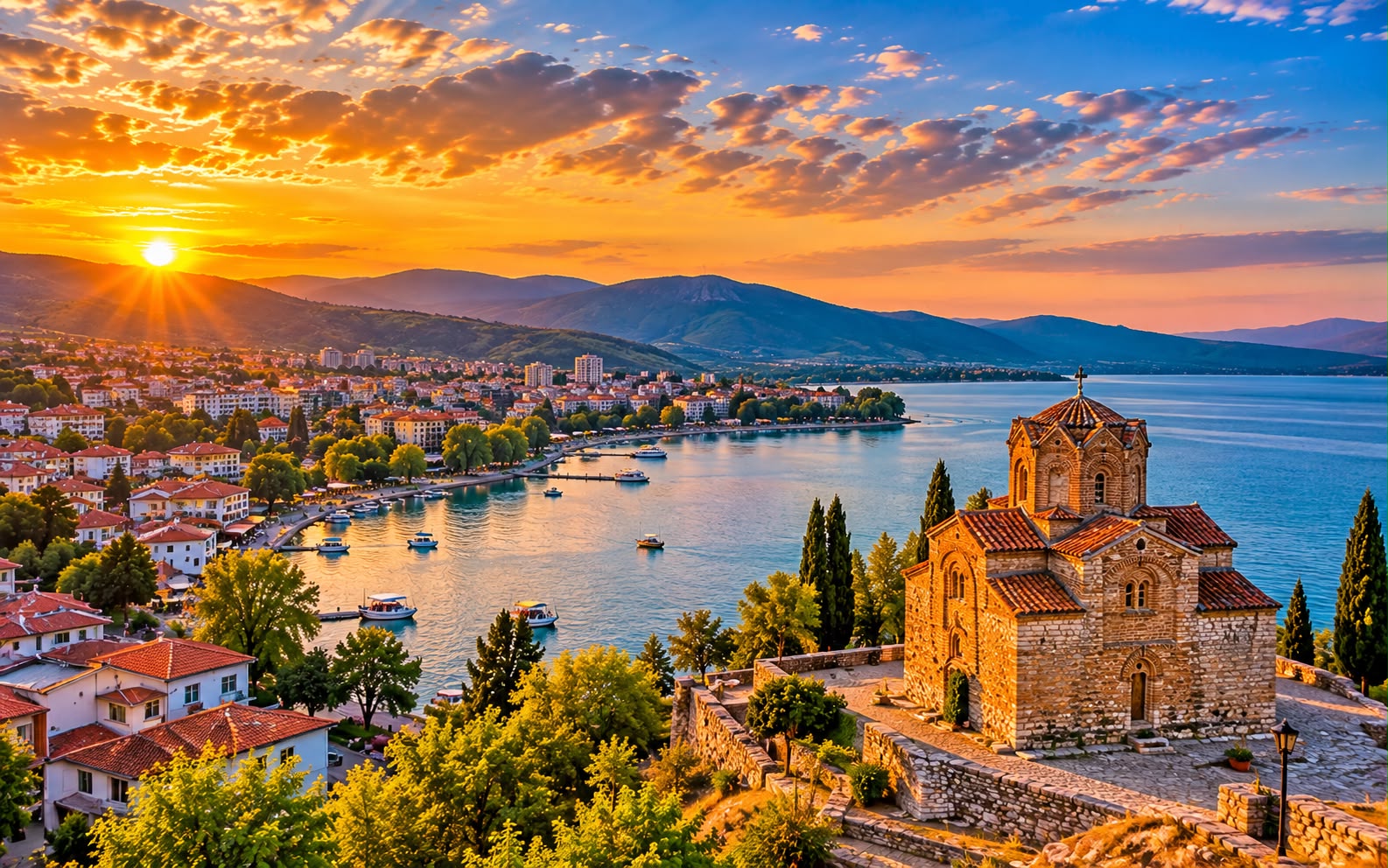
North Macedonia in 7 days: Skopje, Matka and Lake Ohrid
A capital rebuilt twice and then dressed in statues, a canyon with one of the world's deepest underwater caves half an hour from it, and a lake three million years old with a cliff-top church that is the most photographed building in the Balkans.
- Southern Europe
- 7 days
- ≈ AED 2,600 / person
- One of Europe's oldest lakes, at Balkan prices
Before you go
Lake Ohrid is the reason to come. It is somewhere between two and three million years old — one of the oldest lakes on earth — nearly 300 metres deep, and home to species that exist nowhere else. The town on its shore is UNESCO-listed twice over, for culture and for nature, which almost nothing is. The Church of St John at Kaneo stands on a cliff above the water and is the photograph every Balkan travel article uses.
Skopje is the other half, and a stranger place. Flattened by an earthquake in 1963 and rebuilt in concrete, it was then given a government makeover in the 2010s that added neoclassical facades and a very large number of statues to a brutalist city. The results are divisive and worth seeing precisely for that. Behind all of it sits the Čaršija, one of the largest Ottoman bazaars left in the Balkans, which survived both the earthquake and the makeover.
In between: Matka Canyon half an hour from the capital, with kayaks and a cave that is among the deepest underwater caves known; Mavrovo’s mountains and a monastery with a carved iconostasis that took craftsmen years; and Bitola, which has a Roman city on its edge.
The shape: Skopje (2 nights) → Ohrid (3) → Bitola (1). Figure MKD 39,000 (≈ AED 2,608) per person excluding flights. Go May–June or September; Ohrid in August is full.
Before you go: the 15-minute admin
Visas
- North Macedonia is not in the EU or Schengen. Many nationalities enter visa-free for 90 days — check yours against the current list.
- The country changed its name from “Macedonia” to “North Macedonia” in 2019. Older guidebooks, maps and booking sites still use the old one.
Money
- Macedonian denar, roughly 61 to the euro and pegged. Euros are sometimes accepted in Ohrid and you lose on the rate every time.
- Cards work in cities; carry cash for monasteries, boats and village restaurants.
- Very cheap: mains 300–600 denar, a full dinner with wine under 1,500.
SIM and data
- Tourist SIMs from A1 or Telekom at Skopje airport. Coverage is good around the lake and patchy in Mavrovo.
Getting around
- Skopje airport is 25 minutes from the centre. Ohrid has its own airport, which is worth checking — flying into one and out of the other saves a long backtrack.
- A car is the sensible option for days 3 to 7. Hire from €30–40/day. Buses connect Skopje and Ohrid in about three hours but nothing else usefully.
- The Skopje–Ohrid road is mountainous and slow. Allow three hours and do not plan to arrive after dark.
Travelling with kids?
- Matka is kayaking and a boat into a cave, which usually wins.
- Ohrid is a swimming lake with a fortress above it. The water is clear and cold.
- The Bay of Bones is a reconstructed stilt village on the water — a museum you walk out onto.
- Monasteries want covered shoulders and quiet.
Day by day
Day 1 — Skopje: bazaar, fortress, statues
- Afternoon — Land, taxi in, check in.
- 16:00 — The Stone Bridge over the Vardar, then straight into the Old Bazaar (Čaršija): Ottoman lanes, mosques, hamams and craft workshops, and the oldest continuously trading quarter in the city.
- 17:30 — Kale Fortress above it for the view over both halves of the city, which makes the contrast between them obvious.
- 19:00 — Dinner in the Čaršija — tavče gravče (baked beans), ajvar with everything, and Macedonian wine, which is much better than its price.
Where to stay in Skopje (two nights)
- Mid-range: the centre around Macedonia Square, or Debar Maalo, the restaurant district, which is where the city actually eats.
- Value: guesthouses on the Čaršija side of the river, cheap and atmospheric.
Day 2 — Matka Canyon and the mountain cross
- 09:30 — Drive or taxi to Matka Canyon, about 30 minutes. Kayaks hire by the hour on the reservoir, or take the boat along the gorge.
- 11:00 — Vrelo Cave, reached by boat: among the deepest underwater caves known anywhere, with the explored portion still not reaching the bottom. The dry chamber you can enter is enough.
- 14:00 — Back to the city for lunch, then Mount Vodno by cable car to the Millennium Cross, 66 metres of steel on the summit, with Skopje spread out below.
- 18:00 — Back down for the Mother Teresa Memorial House — she was born in Skopje in 1910 — and a walk through the statues of Macedonia Square at dusk, when they are at their most theatrical.
Day 3 — Through Mavrovo to the lake
- 09:00 — Collect the car and drive south-west through Mavrovo National Park, about two hours of mountain road.
- 11:00 — Saint Jovan Bigorski Monastery, built into a wooded hillside, with a carved walnut iconostasis that took three woodcarvers years to finish and is the finest thing of its kind in the country.
- 13:00 — Lunch, then the sunken church at Mavrovo lake — a half-submerged village church standing in the water, depending on the level.
- 16:00 — On to Ohrid, about two hours, and check in.
- 19:00 — Walk the lakefront at dusk.
Where to stay in Ohrid (three nights)
- Mid-range: the old town on the hill, with lake views and a walk down to the water.
- Value: rooms in private houses along the shore, which is how most of the town is let, and very cheap outside August.
Day 4 — Ohrid old town
- 09:00 — Climb to the Church of St John at Kaneo first, before the boats. A small 13th-century church on a cliff over the water, and the reason the town is on posters.
- 10:30 — Plaošnik and the ancient theatre, cut into the hillside in the Hellenistic period and still used for performances.
- 12:30 — Samuel’s Fortress, the walls above the town, named for the tsar who made Ohrid his capital around the year 1000.
- 14:30 — Lunch, then the old town lanes: the Church of St Sophia with its 11th-century frescoes, and the workshops making Ohrid pearls from fish scales by a recipe two families keep to themselves.
- 18:00 — Swim, then dinner on the water. Ohrid trout is protected and often farmed rather than wild — ask.
Day 5 — The south of the lake
- 09:30 — Drive or take the boat south to Sveti Naum, near the Albanian border: a monastery of 905 standing above the springs that feed the lake, with peacocks wandering the grounds and small boats that row you over the spring pools.
- 13:00 — Lunch there, then the Bay of Bones on the way back — a reconstruction of a Bronze Age pile-dwelling village built out over the water on the site of the real one, which was found by divers.
- 16:00 — Swim somewhere on the eastern shore. The lake is clear, deep and cold, and this is the thing most visitors remember.
- Evening — Ohrid.
Day 6 — Bitola and the Roman city
- 09:30 — Drive to Bitola, about an hour and a half. It was the Ottoman Empire’s consular city and still has the grandest street in the country, Širok Sokak, lined with nineteenth-century facades and cafés.
- 11:30 — Heraclea Lyncestis on the edge of town, founded by Philip II of Macedon, with Roman baths, a theatre and floor mosaics of birds and trees that are the best-preserved in the region.
- 14:00 — Lunch on Širok Sokak, then the Old Bazaar and the clock tower.
- 16:00 — Pelister National Park above the town if you have time — pine forest, and two glacial lakes called the Eyes.
- Evening — Stay in Bitola or drive back toward Skopje.
Day 7 — Back to Skopje, fly home
- Morning — Drive north, about two and a half hours, or fly out of Ohrid directly if the schedule allows.
- Afternoon — Last of the Čaršija for ajvar, rakija and copperware, then the airport.
Costs and practicalities
Best time to visit
May–June and September. The country is continental and landlocked, and Lake Ohrid — the reason most people come — is at its best at the shoulders.
- May–June — green, warm, and Ohrid before the crowds. The best for walking in Mavrovo and Galičica.
- July–August — hot, up to 35°C in Skopje, and Ohrid fills with regional holidaymakers. The Ohrid Summer Festival in July and August is the cultural high point.
- September — the best month of the year. The lake is still warm, the crowds have gone, and the light is clear.
- October–April — cold and often snowy, with skiing at Mavrovo from December to March and Ohrid very quiet.
Lake Ohrid is one of the oldest lakes in the world at over a million years, and it is cold — swimmable from about July to September.
Travel tips
- The denar is the currency, not the euro. Cards work in Skopje and Ohrid and less reliably elsewhere.
- Skopje’s 2014 rebuilding programme covered the centre in neo-classical statues and facades; it is divisive locally and worth asking about rather than just photographing.
- The Old Bazaar in Skopje is the best part of the city and is Ottoman rather than reconstructed.
- Buses cover the country and the Skopje–Ohrid run takes about three hours. The railways are limited.
- The name dispute with Greece was settled in 2019 but remains sensitive. “North Macedonia” is the state; “Macedonian” is the language and the people.
- Cover shoulders and knees at monasteries — Sveti Naum and Sveti Jovan Kaneo in particular.
- Tap water in Skopje and Ohrid is safe and comes off the mountains.
What this trip actually costs
Two people, 6 nights, mid-range comfort, flights excluded:
| Item | Cost |
|---|---|
| Hotels, 6 nights | MKD 24,000 (≈ AED 1,605) |
| Car hire, 5 days + fuel | MKD 22,000 (≈ AED 1,471) |
| Food and drink, 7 days | MKD 20,000 (≈ AED 1,337) |
| Boats, caves, monasteries and sites | MKD 8,000 (≈ AED 535) |
| Transfers and incidentals | MKD 4,000 (≈ AED 267) |
| Total for two | MKD 78,000 (≈ AED 5,215) |
- Roughly MKD 39,000 (≈ AED 2,608) per person. This is one of the cheapest countries in Europe and the food in particular costs very little.
- Ohrid in August doubles accommodation and fills the lakefront. June and September are the same weather without the crowd.
- Flying out of Ohrid instead of returning to Skopje saves half a day and a tank of fuel — check it before booking the inbound.
- Hotel picks here are chosen on location, not on commission — always check prices and recent reviews before booking.
What to pack
- Swimwear, May to September. The lake is the point.
- Layers for the mountains — Mavrovo and Pelister are much colder than the lake.
- Covered shoulders and knees for monasteries.
- Shoes for a fortress climb and a Roman site, neither paved.
FAQ
Is three nights in Ohrid too many? No. One day is the old town, one is the south of the lake, and the third is for swimming and doing very little, which is what the place is for.
Can I visit Albania from Ohrid? Yes — the border near Sveti Naum is a short drive, and Albania’s own lakeside town of Pogradec is close. Check whether your hire car is permitted to cross; many are not.
Skopje or Ohrid, if I only have three days? Ohrid, without hesitation. Skopje is interesting; Ohrid is the reason the country is on anyone’s list.
Is the name change confusing in practice? Occasionally. Flights, maps and older bookings still say “Macedonia”. It is the same country and the same airports.
Prices and entry rules change, and what you need depends on your passport; last checked 8 October 2026, so confirm with the embassy or your airline before booking.


