 The Itinerary
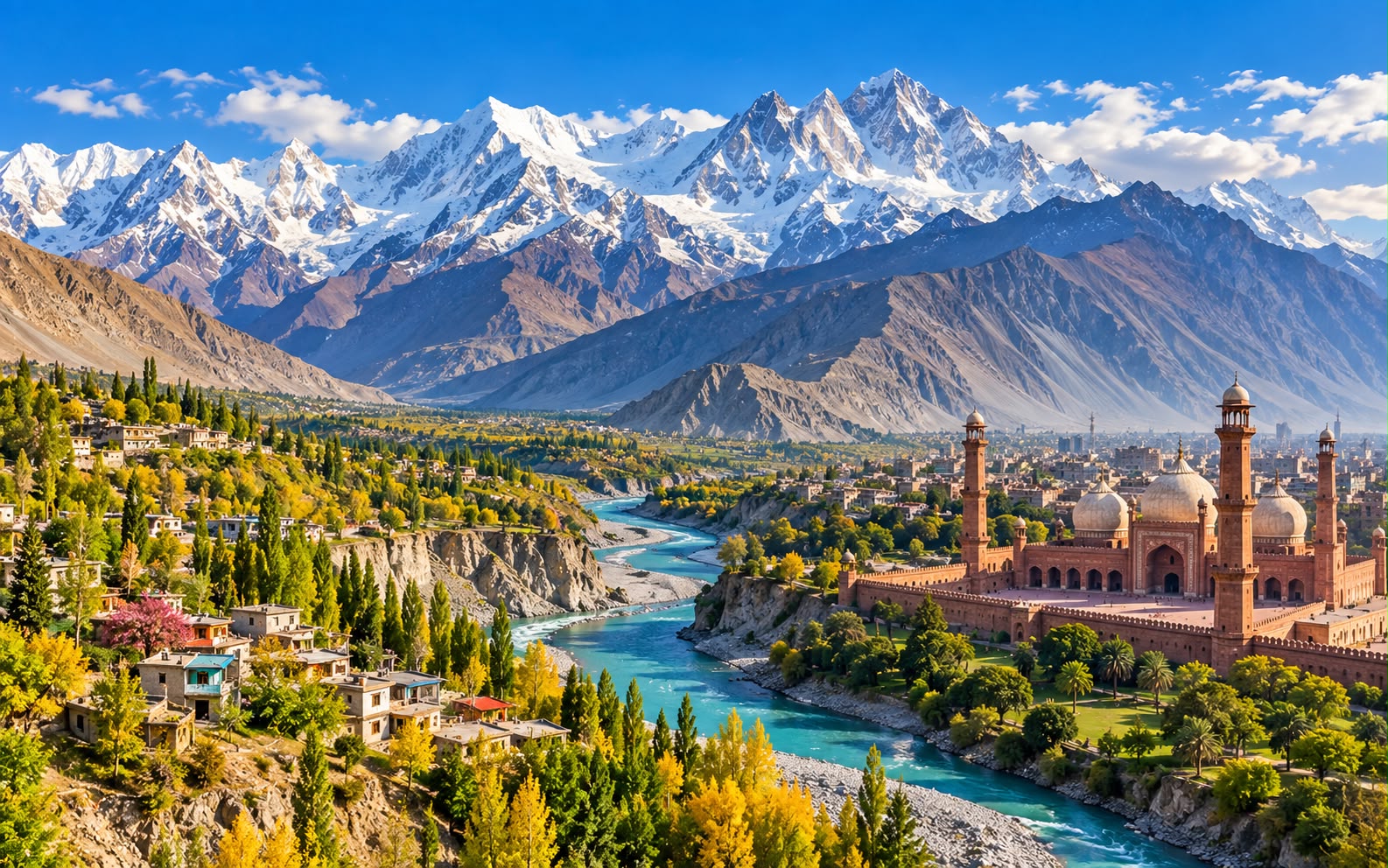
Pakistan in 8 days: Hunza, the Karakoram and Lahore
A valley ringed by 7,000-metre peaks, a lake made by a landslide that drowned a village, the highest paved border crossing on earth at 4,693 metres, and a Mughal capital with a fort, a marble mosque and a border ceremony performed like theatre.
- South Asia
- 8 days
- ≈ AED 3,850 / person
- The world's highest mountains, and a Mughal city
Before you go
Northern Pakistan holds more high mountains than anywhere else on earth. Five of the world’s fourteen peaks above 8,000 metres are here, the Karakoram and the Himalaya and the Hindu Kush meet within a hundred kilometres of each other, and the road that runs through the middle of it — the Karakoram Highway — is routinely called the finest drive in the world.
Hunza is where you stay. A valley of apricot terraces and stone villages under Rakaposhi at 7,788m, with two forts above it that have stood for six and seven hundred years. North of it, Attabad Lake is a startling blue sheet of water created in 2010 when a landslide dammed the river and drowned a village. Further on, the Khunjerab Pass crosses into China at 4,693 metres — the highest paved border crossing anywhere.
Then Lahore, which is a different country entirely: Mughal capital, a fort and a marble mosque facing each other across a square, a walled old city, and food that Pakistanis from everywhere else concede is the best.
The shape: Islamabad (1 night) → Hunza (4) → Lahore (2). Figure PKR 290,000 (≈ AED 3,848) per person excluding international flights. Go May–October for the north; the Khunjerab Pass closes in winter.
Before you go: the 15-minute admin
Current conditions — read this first
- Check your own government’s current travel advice before booking. Advice on Pakistan is not uniform: it distinguishes sharply between regions, and the areas on this itinerary — Gilgit-Baltistan and Punjab — are treated differently from Balochistan and the areas along the Afghan border, which most advisories tell visitors to avoid entirely.
- This route deliberately stays in the north and in Punjab. It does not go near the regions that carry the strongest warnings.
- Conditions change. This site cannot keep current with them, and no guide here should be read as saying the advice no longer applies.
Visas
- Most nationalities now use the e-visa, applied for online with a hotel booking or an invitation. Processing is usually days rather than weeks.
- Apply through the official government portal, not an agent reselling the same form.
Money
- Pakistani rupee, and cash is still king outside the big hotels. ATMs work in Islamabad, Gilgit and Lahore; do not count on them in the valleys.
- Very cheap by international standards once you are there. The flights and the 4x4 are the real costs.
SIM and data
- Tourist SIMs need passport registration and can take an hour; Jazz and Zong have the best northern coverage.
- Expect no data above Passu and intermittent service in Hunza. Download maps.
Getting around
- Islamabad to Gilgit is a one-hour flight on a clear day and a 14–16 hour drive on the Karakoram Highway otherwise. The flight is spectacular and cancels often — build a spare day in, or accept the drive.
- Hire a car with a driver for the north. It is inexpensive, the roads demand local knowledge, and it is how everyone does it.
- Islamabad–Lahore is a four-hour drive on the M2 motorway, or a 50-minute flight.
Travelling with kids?
- The altitude is real: Hunza sits around 2,500m and the Khunjerab Pass is 4,693m. Children feel it faster than adults, and the pass is a long day out.
- Attabad Lake and the forts are the easy wins.
- Pakistani hospitality toward children is immediate and overwhelming, which is lovely and occasionally tiring.
- Food is rich and chilli-heavy; ask for mild.
Day by day
Day 1 — Islamabad
- Afternoon — Land, check in. Islamabad is green, planned and quiet — nothing like the rest of the country.
- 16:00 — Faisal Mosque, among the largest in the world, a vast white tent of a building below the Margalla Hills, with no dome at all.
- 18:00 — Daman-e-Koh viewpoint in the hills above for sunset over the city.
- 20:00 — Dinner. Early night; the flight north goes at dawn.
Day 2 — North to Gilgit and into Hunza
- 06:00 — Fly to Gilgit if the weather allows — an hour threading between peaks, with Nanga Parbat at 8,126m out of the window. If it cancels, this becomes a long road day and the itinerary absorbs it.
- 11:00 — Meet the driver and head up the Karakoram Highway to Hunza, about three hours.
- 13:00 — Stop at the Rakaposhi viewpoint at Ghulmet for lunch with 7,788 metres directly in front of you.
- 16:00 — Karimabad, the main village in Hunza. Check in and do nothing; you have gained a lot of altitude today.
Where to stay in Hunza (four nights — Karimabad has the view, Aliabad has the services)
- Mid-range: hotels on the Karimabad ridge, most with terraces facing Rakaposhi.
- Value: guesthouses in Aliabad or Altit, cheaper and ten minutes from the fort.
Day 3 — The two forts
- 09:30 — Baltit Fort, 700 years old above Karimabad, restored in the 1990s by the Aga Khan Trust. Tibetan in influence, timber and stone, and the view from the roof down the valley is the one on every poster.
- 12:30 — Lunch, then Altit Fort, a century older and smaller, with the restored royal garden beneath it and a village of stone lanes that funds its own restoration.
- 16:00 — Walk the terraces between the villages. Apricots in June, the whole valley turning gold in October.
- 18:00 — Sunset over Rakaposhi from the ridge.
Day 4 — Attabad, Passu and the Hussaini bridge
- 09:00 — North on the Karakoram Highway. Attabad Lake first: a 21km lake of improbable turquoise created in January 2010 when a landslide dammed the Hunza river and submerged a village, cutting the highway for years. The road now runs through Chinese-built tunnels above it.
- 11:00 — Passu, under the Passu Cones — a row of shark-tooth rock spires that look invented.
- 12:00 — The Hussaini suspension bridge, a rope and plank crossing over the river with gaps between the slats. Walk as far as nerve allows; nobody is judging.
- 14:00 — Borith Lake and the Passu glacier viewpoint, then back down the valley.
Day 5 — Khunjerab Pass
- 07:00 — The long day. Three hours up to the Khunjerab Pass at 4,693m, the highest paved international border crossing on earth, where Pakistan meets China across a gate in the middle of nowhere.
- 11:00 — At the top. Khunjerab National Park holds snow leopard, Marco Polo sheep and ibex; you will more likely see yaks and marmots. Keep the stop short — altitude sickness starts here, not in Hunza.
- 13:00 — Back down, with a stop at Sost or Gulmit for lunch.
- 17:00 — Karimabad. Rest.
Day 6 — Eagle’s Nest, and south
- 05:00 — Duikar (Eagle’s Nest) for sunrise. The light hits Rakaposhi, Diran and Ultar Sar in sequence and this is the single best half hour of the trip. It is cold.
- 08:00 — Breakfast, pack, and drive back to Gilgit.
- 11:00 — Fly or drive to Islamabad.
- 15:00 — If time allows, Taxila: a UNESCO site of Gandharan Buddhist monasteries and stupas, where Greek and Indian influence met after Alexander, with a museum of sculpture that is among the best in Asia.
- Evening — Islamabad or drive on to Lahore.
Day 7 — Lahore
- 09:00 — Lahore Fort, UNESCO-listed: the Sheesh Mahal of mirrored glass, the Naulakha Pavilion, and the Picture Wall along the outside.
- 11:30 — Badshahi Mosque across the square, built by Aurangzeb in 1673 in red sandstone and white marble, and for three centuries the largest mosque in the world. The courtyard holds a hundred thousand.
- 14:00 — The Walled City: Delhi Gate, the restored Shahi Hammam, and the Food Street under the mosque walls.
- 17:00 — Wagah border ceremony, 45 minutes out. Indian and Pakistani guards perform a daily lowering of the flags in a routine of high kicks and theatrical aggression, in front of grandstands on both sides. It is genuinely unlike anything else.
- 20:30 — Lahore eats late and very well.
Day 8 — Shalimar, and home
- 10:00 — Shalimar Gardens, Shah Jahan’s terraced Mughal garden of 1641, also UNESCO-listed.
- 12:00 — The Lahore Museum for Gandharan sculpture, including the Fasting Buddha, or last shopping in Anarkali bazaar.
- Afternoon — Fly home from Lahore, or back to Islamabad on the motorway.
Costs and practicalities
Best time to visit
May–October for the north, which is the opposite of most of South Asia, because the mountains are the reason to come and they are snowbound the rest of the year.
- May–June — the Karakoram Highway opens through to Khunjerab, the valleys are in blossom, and the Hunza apricot blossom is in late March and early April lower down.
- July–August — the warmest and the only window for the high passes and the Fairy Meadows and Deosai plains. Deosai is accessible roughly July to September only.
- September–October — the best of the year. Clear skies, the Hunza autumn colour in late October, and the trekking at its finest.
- November–April — the Khunjerab Pass closes, the northern valleys are cut off by snow, and the mountains are for expeditions only.
- The plains — Lahore, Karachi — are the reverse: best November to March, and 45°C in summer.
Travel tips
- Check advice region by region. Khyber Pakhtunkhwa, Balochistan and the Afghan border carry severe warnings; Gilgit-Baltistan, Hunza and Punjab are a very different proposition.
- Some areas require a No Objection Certificate and foreigners may be assigned a police escort on certain roads. Your operator arranges this.
- The Karakoram Highway is spectacular and slow. Landslides close it regularly; build spare days into any northern itinerary.
- Bring US dollars to change. Cards work in Islamabad, Lahore and Karachi hotels; the north is cash.
- Dress conservatively — shalwar kameez is comfortable and appropriate, and women should carry a dupatta for head covering at mosques and shrines.
- Pakistani hospitality is genuinely overwhelming and refusing tea repeatedly causes offence. Accept.
- Altitude at Khunjerab is 4,693m and you reach it by road in a few hours. Take it slowly and do not overexert at the top.
What this trip actually costs
Two people, 7 nights, mid-range comfort, international flights excluded:
| Item | Cost |
|---|---|
| Hotels, 7 nights | PKR 180,000 (≈ AED 2,388) |
| Car with driver, 5 days in the north | PKR 150,000 (≈ AED 1,990) |
| Domestic flights, two legs each | PKR 120,000 (≈ AED 1,592) |
| Food and drink, 8 days | PKR 70,000 (≈ AED 929) |
| Forts, parks, Taxila and entries | PKR 60,000 (≈ AED 796) |
| Total for two | PKR 580,000 (≈ AED 7,696) |
- Roughly PKR 290,000 (≈ AED 3,848) per person. The driver and the domestic flights are most of it; everything on the ground is inexpensive.
- Build in a spare day. The Gilgit flight cancels for weather often enough that planning without slack is how people end up driving sixteen hours.
- The Khunjerab Pass closes roughly November to April and the date moves with the snow.
- Hotel picks here are chosen on location, not on commission — always check prices and recent reviews before booking.
What to pack
- Serious warm layers. Hunza is cold at night in any season and the Khunjerab Pass is near freezing in summer.
- Modest dress, particularly in Lahore — covered shoulders and knees, and a scarf for mosques.
- Altitude awareness. Drink more than you want to, and do not sleep higher than Hunza.
- Cash. ATMs thin out fast north of Gilgit.
FAQ
Is it safe? The answer depends entirely on where. Advisories treat Gilgit-Baltistan and Punjab very differently from Balochistan and the Afghan border areas, and this route stays in the former. Check your own government’s current advice before booking — that is the first item in the admin section for a reason.
Can I do the Karakoram Highway by road instead of flying? Yes, and many prefer it — Islamabad to Gilgit is 14–16 hours over two days with an overnight at Chilas or Besham. It is a spectacular drive and it costs a day in each direction.
How bad is the altitude? Hunza at 2,500m affects few people. The Khunjerab Pass at 4,693m affects many, briefly. Go up for an hour, come back down, and do not plan anything demanding that evening.
When do the apricots blossom? Late March into April, which is the other reason to come — the whole valley turns pink and white under snow peaks. The pass is closed then, so it is a different trip.
Prices and entry rules change, and what you need depends on your passport; last checked 8 October 2026, so confirm with the embassy or your airline before booking.


