 The Itinerary
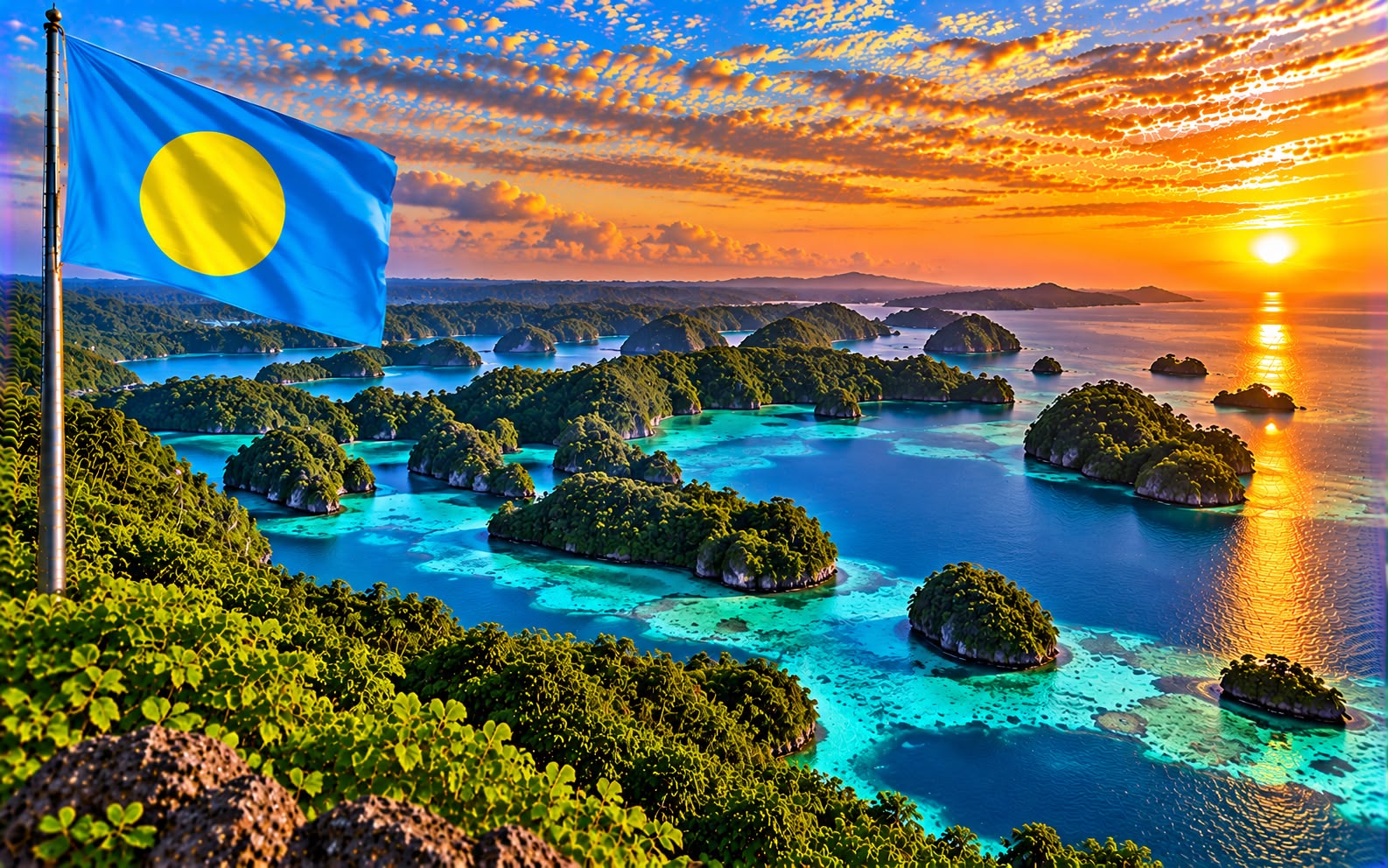
Palau in 8 days: Blue Corner, the Rock Islands and Jellyfish Lake
Four hundred mushroom-shaped limestone islands on the UNESCO list, a wall dive where you hook onto the reef and watch sharks hold station in the current, and a marine sanctuary covering eighty per cent of the country's waters.
- Pacific Islands
- 8 days
- ≈ AED 8,450 / person
- Arguably the best diving on earth, and a lake full of stingless jellyfish
Before you go
Palau is a few hundred islands in the western Pacific with about twenty thousand people on them, and it is on most serious divers’ lists at or near the top.
Blue Corner is why. A reef plateau that juts into open ocean, where the current runs hard across it and the pelagics line up in it — grey reef sharks, jacks, barracuda, napoleon wrasse — and you hook onto dead reef with a reef hook and hang there watching, like sitting in a river. There is nothing else quite like it.
The Rock Islands Southern Lagoon is the other half: a UNESCO site of around 445 uninhabited limestone islands, undercut at the waterline by erosion and snails into mushroom shapes, scattered across turquoise water. Among them are marine lakes, cut off from the sea for thousands of years, and in one of them — Jellyfish Lake — golden jellyfish that have lost their sting migrate across the surface each day following the sun, in millions.
Palau also takes its conservation seriously enough to be inconvenient. Eighty per cent of its waters are a no-take marine sanctuary. Every visitor signs the Palau Pledge, stamped into their passport. And reef-toxic sunscreen is banned — the first country to do it.
Eight days. Figure USD 2,300 (≈ AED 8,447) per person excluding flights. Go November–April, the drier half.
Before you go: the 15-minute admin
What Palau asks of you on arrival
- The Palau Pledge is stamped into your passport and you sign it at immigration. It is written as a promise to the children of Palau to tread lightly, and it is a legally recognised commitment rather than a souvenir.
- Reef-toxic sunscreen is banned. Sunscreens containing oxybenzone, octinoxate and several related chemicals are prohibited — they can be confiscated at the airport and shops will not sell them. Buy mineral sunscreen before you fly, or in Koror.
- An environmental and departure fee is collected on your ticket or on departure. Budget for it.
- The Rock Islands need a permit, bought in Koror and valid for several days; Jellyfish Lake is a separate, dearer permit on top. Your dive shop handles both.
- Do not touch anything — corals, clams, the jellyfish. Rangers patrol and fines are real.
Jellyfish Lake, honestly
- The jellyfish population crashed in 2016 during an El Niño drought and the lake was closed to visitors. It reopened in 2019 as numbers recovered, and they have fluctuated since.
- Check the current state before you build a trip around it. Dive shops in Koror know, and will tell you straight.
- Snorkelling only — diving in the lake is prohibited, because bubbles disturb the layers and the anoxic water below about 15 metres is genuinely dangerous.
Visas and getting there
- Most nationalities enter visa-free for 30 days. Check your own case officially.
- Flights come from Asia, not the Pacific — Taipei, Manila, Seoul and Guam are the usual routings. This is why Palau pairs naturally with a trip to Asia and awkwardly with one to Fiji.
- Schedules are thin. Book early and leave buffer.
Money and costs
- The US dollar is the currency, which removes one problem.
- It is an expensive country. Almost everything is imported, and diving is the main cost.
- Cards work at hotels and dive shops; carry cash for markets and smaller places.
Diving practicalities
- Blue Corner and the other channel dives are current-driven and are not beginner dives. Most operators want an Advanced certification and a reasonable logbook, and will ask.
- A reef hook is essential and your shop will provide or sell one. Learn to use it before you need it.
- Nitrox is worth it here given the repeat profiles.
- Leave 24 hours between your last dive and flying. Build it into the itinerary — this one catches people.
Travelling with kids?
- Jellyfish Lake and the Rock Islands snorkelling are superb for competent swimmers.
- The channel dives are not for children.
- Palau is safe, easy and English-speaking, and the logistics are simple once you are there.
Day by day
Day 1 — Koror
- Afternoon — Arrive, sign the Pledge, and get to Koror, the main town, 20 minutes away.
- 16:00 — The Belau National Museum, the oldest in Micronesia, and the bai — a traditional meeting house with painted storyboards on its gables — rebuilt beside it.
- 18:00 — Etpison Museum for the Pacific art and the shell money, and dinner.
Where to stay in Koror (seven nights — this is a single-base trip)
- Mid-range: the hotels along the Koror waterfront, close to the dive shops.
- Splurge: the resorts on Malakal and the smaller islands.
Day 2 — Rock Islands and Jellyfish Lake
- 08:00 — Out into the Rock Islands Southern Lagoon. The permit is bought, the boat threads between the islands, and the shapes are the point — limestone knobs undercut into mushrooms, with no beaches on most of them.
- 10:00 — Jellyfish Lake on Eil Malk: a short, steep climb over the ridge and down to the lake, then snorkelling out into the middle where the golden jellyfish gather. They have no meaningful sting; you swim among millions of them. No fins near the jellyfish — kicking damages them.
- 13:00 — The Milky Way, a lagoon of white limestone mud that people coat themselves in, and Clam City for the giant clams.
- 16:00 — Kayak among the islands, which is the best way to see them.
Day 3 — Blue Corner and Blue Holes
- 07:30 — The first proper diving day.
- Blue Holes — four openings in the reef top dropping into a cathedral-sized chamber, exiting onto the wall.
- Blue Corner — hook in on the plateau edge and watch the traffic go past in the current: grey reefs, whitetips, big schools of jacks and barracuda, turtles, and the resident napoleon wrasse.
- Afternoon — German Channel, a cut blasted through the reef by German phosphate miners a century ago, now a manta cleaning station.
Day 4 — Peleliu
- Full day south to Peleliu, where one of the hardest battles of the Pacific war was fought in 1944 — over two months for an island six kilometres long.
- Above water: the Thousand Man Cave, the airfield, the wrecked tanks and guns still in the jungle, and the memorials. A local guide is essential and the history is grim and well told.
- Below water: Peleliu Corner and the wall, among the strongest currents in Palau and only for experienced divers, plus WWII wrecks in the shallows.
Day 5 — Ulong and the wrecks
- Ulong Channel, which many divers rate above Blue Corner — you drift into a channel past a huge lettuce coral and a shark-filled mouth.
- Chandelier Cave, a flooded cavern system near Koror with air chambers you surface into, stalactites hanging above the water.
- Afternoon — The Iro or Helmet Wreck, Japanese ships sunk in 1944 in Malakal harbour.
Day 6 — Babeldaob
- A day out of the water, and useful before flying.
- 08:00 — North onto Babeldaob, the big island, which almost no visitor sees. The compact road loops it.
- 10:00 — The Badrulchau stone monoliths in the north — basalt columns in rows on a hillside, their purpose unknown and locally attributed to gods.
- 13:00 — Ngardmau Falls, the highest in Palau, reached by a forest walk or a monorail.
- 15:00 — The Capitol at Ngerulmud — a vast domed parliament building on an empty hillside, serving the smallest capital population in the world.
Day 7 — Last dives, or the lagoon
- Morning — Two final dives, or a snorkelling day in the Rock Islands if you are flying tomorrow.
- Count back 24 hours from your flight and stop diving before it. This is the day people get wrong.
- Afternoon — Koror, the handicraft shop at the museum, and the storyboards — carved wooden panels telling Palauan legends, the one thing worth carrying home.
Day 8 — Fly out
- Most flights leave late at night or very early. Budget a long last day and a late checkout.
Costs and practicalities
Best time to visit
November–April is the drier season and the best for diving, which is why most people come.
- November–April — the dry season, with the best visibility and the calmest crossings to the Blue Corner and Peleliu.
- December–March — peak diving conditions, and the spawning aggregations at Ulong and the Blue Corner follow the moon phases rather than the calendar.
- May–October — wetter, with the heaviest rain from June to August. Visibility drops somewhat and there is a modest typhoon risk, though Palau sits mostly below the main track.
- Manta rays at German Channel are year-round, with December to March the most reliable.
The Rock Islands and Jellyfish Lake are accessible year-round; the lake’s jellyfish population has crashed and recovered more than once with El Niño, so check its current status.
Travel tips
- You sign the Palau Pledge in your passport on arrival — a commitment to act responsibly, written by the children of Palau. It is a legal stamp, not a gimmick.
- Reef-toxic sunscreen is banned. Oxybenzone and several other ingredients are illegal to bring in; buy reef-safe before you travel.
- The Rock Islands require a permit and the Jellyfish Lake permit is separate and more expensive. Buy them through your dive shop.
- Do not touch the jellyfish and no scuba in the lake — the bubbles harm them and there is a toxic layer below 15m.
- The US dollar is the currency. Cards work at hotels and dive shops; carry cash elsewhere.
- Blue Corner is a strong-current dive requiring a reef hook and decent experience. Be honest about your logged dives.
- Peleliu’s WWII sites still hold unexploded ordnance. Stay with the guide and do not pick anything up.
What this trip actually costs
Two people, 7 nights, mid-range comfort, international flights excluded:
| Item | Cost |
|---|---|
| Hotels, 7 nights | USD 1,400 (≈ AED 5,142) |
| Diving, five days, two divers | USD 1,800 (≈ AED 6,611) |
| Rock Islands and Jellyfish Lake permits | USD 400 (≈ AED 1,469) |
| Food and drink, 8 days | USD 700 (≈ AED 2,571) |
| Transfers, car hire, Peleliu guide | USD 300 (≈ AED 1,102) |
| Total for two | USD 4,600 (≈ AED 16,894) |
- Roughly USD 2,300 (≈ AED 8,447) per person, which makes Palau one of the more expensive weeks on this site. Diving is nearly half of it and is the reason to come.
- Non-divers pay far less — snorkelling the Rock Islands and Jellyfish Lake costs a fraction of a dive package, and the lagoon alone is worth a week.
- Permits are a real line and are not optional. They fund the sanctuary.
- Multi-day dive packages are cheaper per tank than booking day by day.
- Hotel picks here are chosen on location, not on commission — always check prices and recent reviews before booking.
What to pack
- Mineral sunscreen, bought before you fly. Anything with oxybenzone or octinoxate is illegal here.
- A reef hook if you own one, and a 3mm wetsuit — the water is warm but the dives are long.
- A dive computer, and your certification and logbook, which will be checked.
- Water shoes for the Jellyfish Lake climb, which is sharp limestone.
- A dry bag — every day is a boat day.
- No fins at the lake, so a mask and snorkel you are happy swimming in.
FAQ
Do I need to be an experienced diver? For Blue Corner, German Channel and Peleliu, effectively yes — these are current dives and operators will ask for an Advanced certification and recent logged dives. There is plenty of easier diving and outstanding snorkelling for everyone else.
Are the jellyfish still there? Yes, with the caveat that numbers collapsed in 2016, the lake closed, and it reopened in 2019 as they recovered. Populations fluctuate with drought cycles — check with a Koror operator before planning around it.
Can I dive in Jellyfish Lake? No. Snorkelling only — bubbles disturb the lake’s layers and the deep water is anoxic and dangerous.
How do I get there? Flights from Taipei, Manila, Seoul and Guam. Palau is far easier to combine with an Asia trip than with the rest of the Pacific.
What language do they speak? Palauan and English, both official. English is spoken everywhere.
Prices and entry rules change, and what you need depends on your passport; last checked 8 October 2026, so confirm with the embassy or your airline before booking.


