 The Itinerary
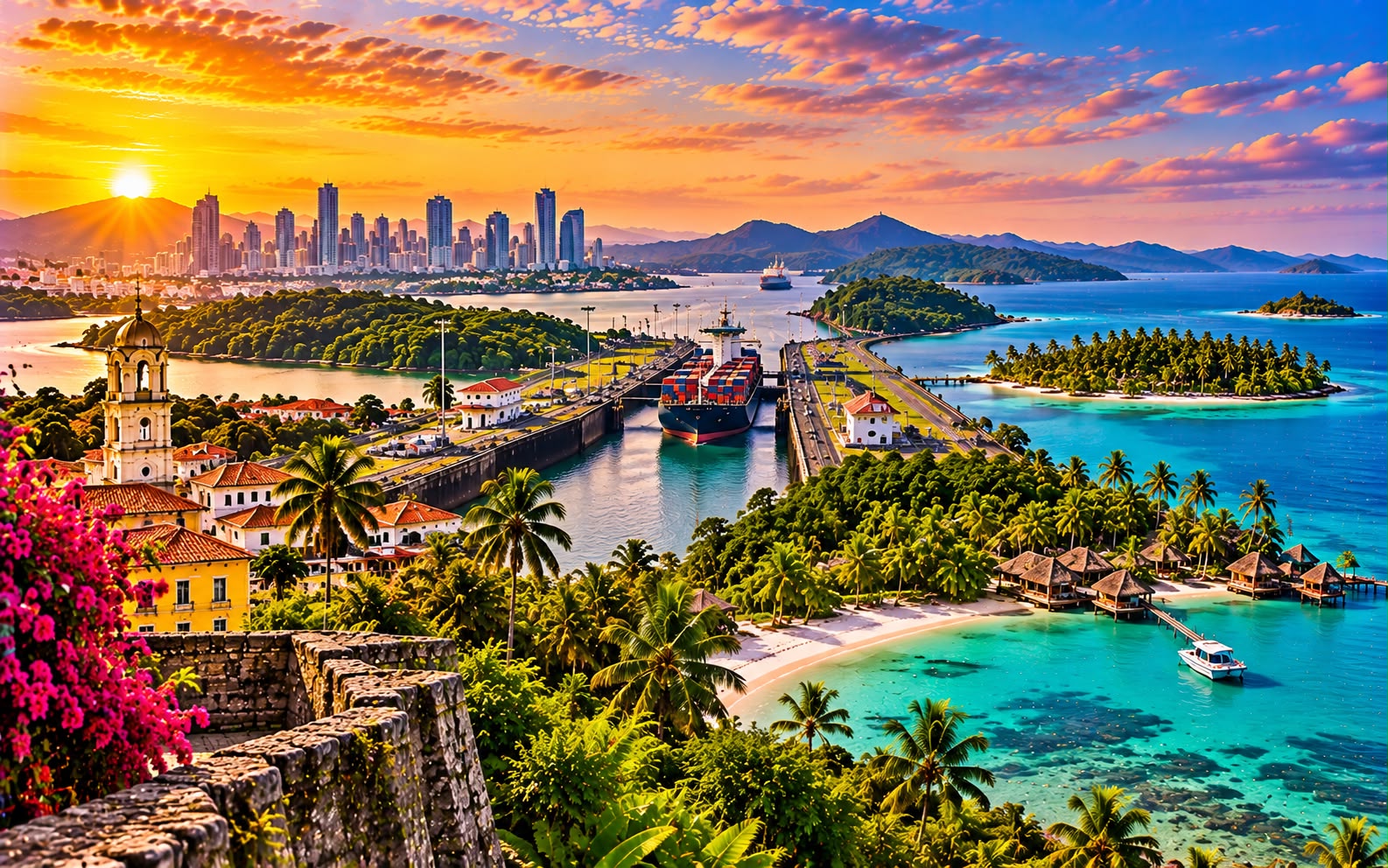
Panama in 9 days: the Canal, Bocas del Toro and San Blas
A country narrow enough to see both oceans in a day, and two island groups that could not be less alike: ships climbing through locks between the Atlantic and Pacific, an archipelago of 365 islands run by the Guna themselves, and a Caribbean backpacker chain with reefs — with the boat realities and the US dollar that is already in your wallet.
- Mexico and Central America
- 9 days
- ≈ AED 7,150 / person
- Two oceans + islands
Before you go
Panama is 50 km wide at its narrowest, which is why the canal is here and why you can stand on the Pacific in the morning and reach the Caribbean by lunchtime. It is also the easiest country in Central America to travel: the currency is the US dollar, the capital has a real skyline and a metro, and English is common.
Three parts make the trip. Panama City has the canal locks, a restored colonial quarter and the causeway built from the spoil. Guna Yala, usually called San Blas, is an archipelago of 365 islands governed autonomously by the Guna people — palm, sand, reef, and almost nothing else. Bocas del Toro is the Caribbean island chain near Costa Rica, busier and more developed, with good snorkelling and a strong social scene.
The two island groups are very different trips, and it is worth being clear which one you actually want.
Before you go: boats, the Guna, and the two coasts
Entry
- Most nationalities enter visa-free for 90 to 180 days — the EU, UK, US, Canada, Australia and most of Latin America.
- Proof of onward travel and funds can be requested at immigration, and occasionally is.
- Panama uses the US dollar as legal tender, alongside its own balboa coins which are pegged one to one. Cards work widely in the city; the islands are cash.
San Blas is not a resort, and that is the point
- Guna Yala is autonomous territory. You enter with permission, pay a community fee, and the rules are theirs.
- Getting there is a 4x4 transfer from Panama City — roughly two and a half hours over a mountain road that is steep and winding — followed by a small boat. Departures are before dawn.
- Accommodation is basic by design: sand-floor cabins, bucket or limited showers, generator power for a few hours, and no wifi worth the name. That is the deal, and the islands are extraordinary.
- Drones are banned and photographing people requires permission, which is often declined. Respect it.
- Boats between islands are small and open. In swell it is wet; in wind it can be cancelled.
Bocas del Toro is the other thing
- Bocas is reachable by a short domestic flight from Panama City (about an hour) or by a long bus and ferry.
- It is developed, sociable and easy — hostels, restaurants, water taxis between islands, and reliable wifi.
- The snorkelling and surf are good; the beaches are not San Blas.
- Do not try to do both in a week. This itinerary does, in nine days, and it is tight.
Seasons and the canal
- December to April is the dry season and the better time, especially for the islands.
- May to November is wet — usually afternoon rain rather than all-day, and the Caribbean side is wetter and less seasonal.
- The canal visitor centres at Miraflores and Agua Clara have viewing platforms. Ships transit on a schedule; check the day’s timetable so you are there when something is actually in the lock.
Day by day
Day 1 — Land in Panama City
- 14:00 — Land at Tocumen (PTY). It is 25 km from the centre and the taxi runs 30–50 minutes depending on the hour.
- 15:30 — Drop bags in Casco Viejo, the restored colonial quarter on its own small peninsula. Stay here, not in the high-rise banking district — everything you want to walk to is in these fifteen blocks.
- 17:00 — Walk Plaza de la Independencia and the streets around it while the light is good: half the quarter is restored, half is still ruins with trees growing out of it, and the mixture is the appeal.
- 18:30 — Paseo Las Bóvedas, the sea wall at the tip, for the skyline across the bay — 60 glass towers facing a 17th-century wall.
- 20:00 — Dinner in the old town. Ceviche at the Mercado de Mariscos is the cheap version and excellent; the rooftops behind the cathedral are the other kind of evening.
Day 2 — The canal, and the old city
- 08:30 — Miraflores Locks, 20 minutes out. Go early: southbound transits run roughly 08:00–11:00, and a Panamax ship rising 16 metres in a chamber with 60 cm of clearance either side is the single best thing in the city. Check the day’s schedule before you leave — with no ship in the lock it is just a museum.
- 11:30 — The observation deck and the film, then out before the tour buses land.
- 13:00 — Lunch back in Casco Viejo.
- 14:30 — The quarter properly: the ruined Jesuit convent, the Iglesia San José golden altar that was hidden from Morgan’s pirates with a coat of paint, and the Canal Museum on Plaza Catedral, which is better than the one at the locks.
- 17:00 — Biomuseo on the Amador causeway if you want the Gehry building — it is small, and the building is the exhibit.
- 19:30 — Early dinner. Pack a small bag for San Blas and leave the rest at the hotel; you are up before four.
Day 3 — To San Blas
- 04:30 — 4x4 pickup. The drive crosses the continental divide and drops into Guna Yala — two and a half hours, the last forty minutes steep, winding and not for weak stomachs.
- 07:30 — Cartí port. Guna Yala is an autonomous territory: there is a community fee, your passport is checked, and photography of people needs asking first.
- 08:30 — Boat out to your island, 30–60 minutes across open water. Expect to get wet.
- 10:00 — Arrive. The islands are the size of a football pitch, the accommodation is a hut on sand, and the electricity is a generator that runs for a few hours after dark.
- 12:00 — Fish, coconut rice, and a hammock.
- 15:00 — Snorkel off the reef edge. That is the whole programme, and it is the correct one.
- 19:30 — No light pollution for 50 km in any direction. Look up.
Day 4 — The islands
- 09:00 — The boat day, and your host picks the route by the weather: a sandbar that is nothing but sand and a metre of water in every direction, a natural pool where starfish sit on the bottom, and a shipwreck reef for the best snorkelling.
- 13:00 — Lunch on whichever island you have landed on.
- 15:00 — A Guna village visit if it is offered — dense, ordered, and a working community rather than a display. Molas, the reverse-appliqué panels, are made and sold here and are the one souvenir worth carrying.
- 17:30 — Back to your island for sunset.
- Note — Two nights is the minimum that justifies the journey. One night means you spend more hours travelling than lying down.
Day 5 — Back to the city, and on to Bocas
- 06:00 — Boat back to Cartí, then the 4x4 over the mountains.
- 10:30 — Panama City. Straight to Albrook, the domestic airport, not Tocumen — they are different airports on opposite sides of town and this catches people out.
- 12:30 — Fly to Bocas del Toro, one hour over the isthmus.
- 14:00 — Land on Isla Colón, 200 m from the water taxis.
- 15:30 — Bocas Town: Caribbean clapboard on stilts over the sea, bicycles, and a pace that has nothing to do with the capital.
- 19:00 — Dinner over the water. The Caribbean side is Afro-Antillean and the food changes accordingly — coconut rice, patacones, fish in escabeche.
Day 6 — Reefs and islands
- 08:30 — The classic boat day. Dolphin Bay first, where bottlenose feed in the shallows — go early, before a dozen boats are circling them.
- 10:30 — Cayo Coral: the best snorkelling in the archipelago, shallow gardens over white sand, with lunch on the stilted restaurant above it.
- 13:30 — Red Frog Beach on Bastimentos, named for the strawberry poison-dart frogs a guide will find for you in ten minutes.
- 16:00 — Zapatilla Cays if the sea is flat and the boat is going — an uninhabited pair inside the marine park, and the picture everyone takes home.
- 18:30 — Back to town.
Day 7 — Bastimentos, or surf
- Option A — Bastimentos on foot. Water taxi to Old Bank, then the jungle path across the island to Wizard Beach: 30 minutes, muddy, and worth it for an empty stretch of sand. The Ngäbe communities inland run guided walks.
- Option B — surf. December to March and June to August bring the swell. Lessons at Playa Bluff or beginner breaks on Isla Carenero, ten minutes by taxi boat.
- Option C — do nothing, which on the Caribbean side is a legitimate plan.
- 18:00 — Last island evening. Confirm tomorrow’s flight; Bocas departures move with the weather.
Day 8 — Back to Panama City
- 09:00 — Fly back to Albrook, one hour.
- 11:00 — Panamá Viejo, the ruins of the original 1519 city that Henry Morgan sacked in 1671 — the cathedral tower still stands and the site museum explains why the survivors rebuilt eight kilometres west at Casco Viejo.
- 14:00 — Lunch, then the Amador Causeway by rented bike: six flat kilometres on the spoil dug out of the canal, with the ships queueing at the Pacific entrance beside you.
- 17:30 — Cerro Ancón for the last view — the canal on one side, the skyline on the other.
- 20:00 — A rooftop in Casco Viejo. The city likes its own skyline and it is right to.
Day 9 — Fly home
- Morning — Free. The Mercado de Mariscos for a last ceviche, or the fish market’s upstairs counters for breakfast.
- Afternoon — Tocumen is Latin America’s main connecting hub and the queues reflect it. Three hours before a long-haul, and allow for the traffic getting there.
Costs and practicalities
Best time to visit
December–April is the dry season and the practical window, though Panama’s two coasts and its highlands differ.
- December–April — dry on the Pacific side and in the city, and the best for the canal, the Pearl Islands and the Azuero peninsula. Peak season.
- May–November — the rains, usually an afternoon downpour. Green, cheap, and the mornings generally clear.
- The Caribbean side — Bocas del Toro and San Blas — is wetter year-round and has its own short drier spells in September and October, which is the inverse of the Pacific.
- Boquete and the highlands are cool and misty in any month, with the bajareque drizzle most days.
- Whale watching in the Gulf of Chiriquí and around Coiba runs July to October.
Carnival, in the four days before Ash Wednesday, shuts the country, and Las Tablas is where it is at its most serious.
Travel tips
- The US dollar is the currency — the balboa exists only as coins, pegged one-to-one. No exchange needed.
- Panama City is the best-connected hub in Central America and Tocumen is the regional interchange, which makes it an easy place to start or end a longer trip.
- San Blas (Guna Yala) is autonomous. It has its own entry fee, its own rules, and photography of people requires permission and often a small payment. Tours are run by Guna operators.
- Book the canal visitor centre for a transit day. Miraflores is busiest when ships are passing, roughly morning and mid-afternoon; check the schedule.
- Bocas del Toro is reached by a short flight or a long bus and boat. The flight is worth it.
- Cards work in the city and in Boquete; San Blas and the islands are cash only.
- Tap water is safe in Panama City and most of the country, but not in Bocas del Toro.
What this trip actually costs
Two people, 8 nights, mid-range, excluding international flights:
| Item | Cost |
|---|---|
| Panama City hotels, 3 nights | USD 420 (≈ AED 1,542) |
| San Blas, 2 nights, all-inclusive with transfers and boats | USD 700 (≈ AED 2,571) |
| Bocas hotels, 3 nights | USD 480 (≈ AED 1,763) |
| Bocas flights ×2 return, boat days, canal, museums | USD 1,100 (≈ AED 4,040) |
| Food and drink, 9 days | USD 900 (≈ AED 3,305) |
| Taxis, water taxis, eSIM, extras | USD 300 (≈ AED 1,102) |
| Total for two | USD 3,900 (≈ AED 14,323) |
- Roughly USD 1,950 (≈ AED 7,161) per person — mid-range for Central America, with San Blas the most expensive nights per unit of comfort and the most memorable.
- The Bocas flight is worth it. The overland alternative is a ten-hour bus plus a ferry.
- Panama City is where the food budget goes; the islands are half-board by necessity.
What to pack
- Cash in US dollars, in small notes, for San Blas — there is no card machine on an island of forty people.
- A dry bag, which is not optional for either archipelago.
- Reef-safe sunscreen and a rash vest. You will be in the water for days and the sun is equatorial.
- A head torch for generator-free hours on San Blas.
- Insect repellent, particularly for Bocas.
- Type A/B plugs, 120V, as in the US.
FAQ
San Blas or Bocas — which if I only do one? San Blas for the islands themselves: emptier, more beautiful, culturally distinct, and basic. Bocas for comfort, snorkelling variety and company. They are not substitutes.
Is San Blas really that basic? Yes. Sand floors, limited showers, generator power for a few hours and no useful internet. Two nights is the sweet spot for most people.
How long does the canal take to see? Two hours at Miraflores if you time it to a transit, and the timetable is published daily. A full transit cruise takes most of a day and is a different, much more expensive thing.
When should I go? December to April, the dry season, especially if the islands matter. The Caribbean side is less seasonal and rains a bit year-round.
Prices and entry rules change, and what you need depends on your passport; last checked 8 October 2026, so confirm with the embassy or your airline before booking.


