 The Itinerary
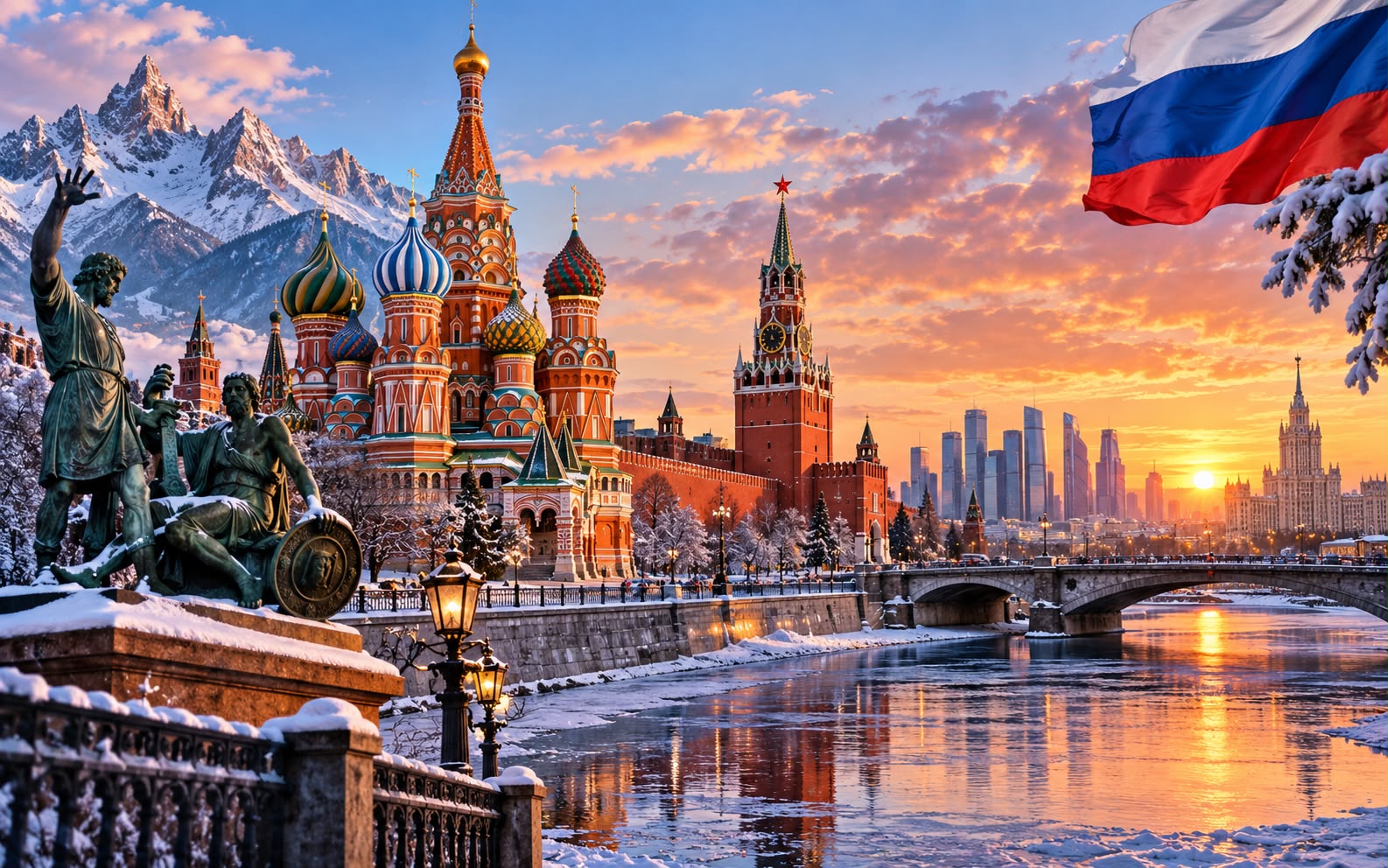
Russia in 10 days: Moscow, St Petersburg and the Arctic
Two imperial capitals and the Arctic Circle in one trip — Red Square, the Hermitage, and hunting the northern lights in Murmansk, with the payment, SIM and e-visa rules that make or break a Russia trip in 2026.
- Eastern Europe
- 10 days
- ≈ AED 3,700 / person
- First-time visitors
Before you go
Russia in one trip means three different countries: Moscow’s scale and golden domes, St Petersburg’s canals and palaces, and — the leg almost no first-timer guide covers — Murmansk, 200 km above the Arctic Circle, where you stand under the northern lights two hours’ flight from the capital. This route does all three in 10 days, with the two big cities linked by Russia’s best train.
One thing upfront: Russia is the most admin-heavy trip on this site. None of it is hard, but all of it must be done before you fly — the payment, SIM and visa systems do not forgive improvisation. The first section below is longer than usual for exactly that reason.
All costs are in Russian rubles (RUB), with conversions calculated at today’s exchange rate. Opening hours are approximate — treat anything marked ~ as a guide, not a contract.
Before you go: the admin that actually matters
Know before you book — honestly
- Several Western governments currently advise their citizens against travel to Russia. Check your own government’s advice before booking, and check whether your travel insurance stays valid under it — some policies are void in advise-against destinations.
- Your Visa and Mastercard will not work — not at ATMs, not in shops, not online. This is solvable (below), but only before you fly.
- WhatsApp, Instagram and Facebook are blocked. Telegram works. Set up alternatives with family before you leave.
- None of this makes the trip unpleasant on the ground — cities feel orderly and tourists are welcomed — but go with accurate expectations, not 2019 assumptions.
Visas
- E-visa (most travellers): citizens of 64 countries — including India, China, and most of the EU — apply at evisa.kdmid.ru, ~USD 52, processed in ~4 days, 30-day stay, valid 120 days from issue. You need a passport (6+ months), a digital photo, and medical insurance — no invitation letter, no hotel confirmations.
- Visa-free: UAE, Qatar and several other Gulf and Asian passports have bilateral visa-free agreements — check the official list for yours.
- Not eligible for the e-visa: US, UK, Canadian, Australian and NZ passports — these need a full consular visa with an invitation, a longer and pricier process.
- Medical insurance is mandatory with the e-visa and must be arranged before arrival — a standard travel policy naming Russia and your dates does it. Carry the PDF offline.
- Unlike Georgia, a residence permit does not substitute for a visa here — eligibility follows your passport.
Money — read this twice
- Foreign Visa, Mastercard and Amex are dead in Russia: no ATMs, no card machines, no Russian websites.
- Bring cash: USD, EUR or AED in crisp, unmarked notes — Russian banks reject creased or stamped bills. Exchange at bank branches in the city, never at the airport counters.
- Set up a prepaid virtual MIR card before you fly — several services issue one remotely in minutes; it lets you pay by QR and buy train/museum tickets online. This single step removes most of the pain.
- UnionPay from a foreign bank is unreliable — don’t build your plan on it.
- Budget in cash terms: Russia is cheap for what you get — a good restaurant meal runs 800–1,500 RUB per person, a metro ride ~60 RUB.
SIM and data
- Buying a physical Russian SIM is no longer practical for tourists — since 2025 it requires biometric registration and a Russian government services account.
- The workaround: an international travel eSIM (Yesim, Ubigi, Nomad and similar, ~USD 15–40) that roams onto Russian networks.
- Expect a ~24-hour block on data the first time your foreign SIM/eSIM touches a Russian network — a 2025 security rule. Activate the eSIM the day before you land if the provider allows it, and download offline maps regardless.
- Yandex Maps is the map that works properly here (Google Maps works but with degraded data). Install Yandex Go (taxis) and Yandex Translate before you fly, plus a reputable VPN if you need your blocked apps.
Buy and install it before you fly — see the 24-hour note above.
Getting around
- Moscow: the metro is the fastest way everywhere — and a genuine attraction; stations look like ballrooms. Buy a Troika card at any station (~60 RUB per ride). Signage has English.
- Taxis: Yandex Go, with payment set to cash — the app works fine on a foreign number, and cash settles the foreign-card problem.
- Moscow → St Petersburg: the Sapsan high-speed train, ~4 hours city centre to city centre, roughly 2,000–8,000 RUB depending on class and demand. Book ahead — via the RZD site with your MIR card, or an international reseller before you leave. Departs Leningradsky Station, arrives Moskovsky.
- St Petersburg → Murmansk / Murmansk → Moscow: ~2–2.5 hour domestic flights (Aeroflot, Smartavia and others), typically 4,000–8,000 RUB one way, booked with the MIR card or through an agent.
Travelling with kids?
- This route was first run with a toddler — it works, with adjustments: the metro has long stair runs and few lifts, so a carrier beats a stroller everywhere except the big parks.
- Moscow’s VDNKh is the kids’ day: the Moskvarium aquarium (~2,300 RUB family ticket on weekdays) and the Cosmonautics Museum’s rockets.
- Aurora hunts are car-based — children can nap in the van between stops — but they run late; plan the next morning slow.
- Pack a thermos for warm drinks, hand warmers for Arctic nights, and a stroller rain/snow cover in autumn and winter.
Day by day
Day 1 — Land in Moscow, first look at Red Square
Assumes a daytime arrival. Stay inside or near the Garden Ring — anywhere within a few metro stops of Red Square.
- 14:00 — Check in, drop bags. Buy a Troika card at the nearest metro station and top it up.
- 15:30 — Zaryadye Park (open all day, free) — the modern park beside the Kremlin; walk the Floating Bridge for the postcard river-and-Kremlin panorama.
- 17:00 — First walk across Red Square (open access, free unless an event closes it) — St Basil’s domes, GUM’s lights, Kremlin walls. Arriving at dusk is the right introduction.
- 19:00 — Dinner: Stolovaya 57 inside GUM — a Soviet-canteen revival that is cheap, fast and genuinely good (~400–700 RUB/person); the queue moves quickly. Walk GUM’s arcades after.
Where to stay in Moscow
- Splurge: Hotel Metropol — the 1905 Art Nouveau landmark two minutes from Red Square; still operating under its own name, history in every corridor.
- Mid-range: Cosmos Selection Tverskaya — the former Marriott on Tverskaya under local management: central, modern, reasonable.
- Budget: Godzillas Hostel — the long-running backpacker favourite near Tverskaya, walking distance to the centre.
Day 2 — The Kremlin day
Book Kremlin tickets online ahead (tickets.kreml.ru, MIR card needed) — and note the whole complex is closed Thursdays.
- 9:00 — Red Square in morning light — the photos without the crowds.
- 10:00 — Kremlin Cathedral Square (winter ~10:00–17:00, summer 9:30–18:00, closed Thu; ~1,100 RUB) — the cathedrals where tsars were crowned, plus the giant broken Tsar Bell.
- 12:00 — Armoury Chamber (timed sessions 10:00 / 12:00 / 14:30 / 16:30; ~1,400 RUB) — Fabergé eggs, coronation gowns, carriages. No photos inside; worth it anyway.
- 14:00 — Late lunch in GUM or nearby — Teremok (blini chain, ~400 RUB) is the fast local option.
- 15:30 — St Basil’s Cathedral (daily, winter ~11:00–17:00; ~1,000 RUB) — smaller and stranger inside than you expect.
- 17:30 — Walk Nikolskaya Street’s lights → Bolshoi Theatre facade → up Tverskaya.
- 20:00 — Dinner around Tverskaya or Kamergersky Lane — Georgian restaurants are Moscow’s favourite night out, a nice full-circle if you’ve read our Georgia guide.
Day 3 — Space, parks and the Arbat
- 9:30 — Metro to VDNKh — the vast Soviet exhibition grounds: golden fountains, grand pavilions, pure Stalin-Empire-style theatre. Free to wander.
- 10:30 — Cosmonautics Museum (closed Mon; ~10:00–19:00, ~300–500 RUB) — Gagarin, real capsules, the space-race story told from the other side. With kids, swap in the Moskvarium aquarium next door.
- 13:00 — Lunch at VDNKh’s food courts.
- 14:30 — Metro south to Gorky Park + Muzeon Park — the riverside park pair: playgrounds, cafés, and Muzeon’s open-air graveyard of decommissioned Soviet statues.
- 17:30 — Old Arbat Street — buskers, souvenir shops, caricaturists; touristy and fun to walk once.
- 19:30 — Dinner on or near the Arbat, then pack — early train tomorrow.
Day 4 — Sapsan to St Petersburg
- 8:00 — Metro to Leningradsky Station (allow buffer; passport checked at boarding).
- 9:00–13:00 — Sapsan to St Petersburg — flat green Russia at 200 km/h; the bistro car does decent coffee.
- 13:30 — Arrive Moskovsky Station — you step out directly onto Nevsky Prospekt. Check in nearby.
- 15:00 — First walk down Nevsky: Kazan Cathedral’s colonnade, the Singer Building bookshop, canal bridges.
- 17:00 — Church of the Savior on Spilled Blood from the Griboyedov Canal embankment — the most photographed onion domes in Russia; go inside tomorrow or now (~9:00–18:00ish, closed Wed; ~500 RUB).
- 19:00 — Dinner near Nevsky. For the classic cheap St Petersburg experience: Pyshechnaya 1958 on Bolshaya Konyushennaya — sugar-dusted pyshki doughnuts and sweet coffee, unchanged since 1958, a few hundred rubles.
Where to stay in St Petersburg
- Splurge: Grand Hotel Europe or Hotel Astoria — the two imperial-era grand dames, both still running: ballrooms, history, St Isaac’s views.
- Mid-range: Helvetia Hotel — a quiet courtyard hotel just off Nevsky with a strong service reputation.
- Budget: Soul Kitchen Hostel — repeatedly rated among the best hostels in Europe, on the Moika embankment.
Day 5 — Hermitage and the imperial centre
The Hermitage is closed Mondays — plan around it. Pre-book at hermitagemuseum.org (foreign cards fail; use the MIR card or buy with cash at the machines).
- 10:45 — Be at the Hermitage / Winter Palace for the 11:00 opening (Tue/Fri/Sat until 20:00, other days to 18:00; ~1,200 RUB, under-14s free). Head first to the Jordan Staircase, the state rooms and the Rembrandts; 4 hours covers the highlights of a 350-room palace.
- 14:30 — Late lunch off Palace Square — the Marketplace chain does fresh canteen-style Russian food (~500 RUB).
- 15:30 — St Isaac’s Cathedral colonnade (~10:30–18:00, colonnade ~400 RUB) — 262 steps to the best panorama in the city.
- 17:30 — Cross to Peter & Paul Fortress (grounds open late, free; cathedral with the Romanov tombs ~800 RUB) — the city’s birthplace on its own island.
- 19:30 — Evening option A: Neva river cruise (May–Oct, heated cabins in autumn, ~1,000–1,500 RUB). Option B: ballet or opera at the Mariinsky — book online weeks ahead; even the cheap seats are an event.
Day 6 — A palace out of town
Pick one palace — doing both in a day is a forced march. Book either online in advance.
- Option A — Peterhof (grounds ~9:00–20:00; Grand Palace closed Mon): the “Russian Versailles” on the Gulf of Finland. The 140-fountain cascade runs May to mid-October — outside those months go for the palace and sea-edge park. Hydrofoil from the Hermitage embankment (~45 min, seasonal) or minibus.
- Option B — Catherine Palace, Pushkin (closed Tue; ~12:00 entry slots sell out — book early): the blue-and-gold baroque palace with the reconstructed Amber Room. Better in late autumn/winter when Peterhof’s fountains are off.
- 14:30 — Back in the city; late lunch.
- 16:00 — General Staff Building (Hermitage’s modern wing: Matisse, Picasso, ~700 RUB) if you have art left in you — or browse Nevsky’s bookshops and food halls.
- 20:00 — Dinner reservation somewhere memorable — St Petersburg’s new-Russian restaurants around Rubinstein Street are the city’s food heart; book ahead on weekends.
Day 7 — Fly north: Murmansk and the first aurora hunt
Aurora season runs late August to mid-April — solar maximum makes 2025–2027 statistically the best years this decade. Book tours 1–2 weeks ahead in season.
- 11:00 — Fly St Petersburg → Murmansk (~2h15). Landing, you’re above the Arctic Circle — the world’s largest city north of it.
- 14:30 — Check in, rest, early dinner (the Azimut’s restaurant does Arctic fish well).
- 20:00–00:00 — Northern lights hunt (~3,000–7,500 RUB/person small-group, ~15,000–25,000 RUB private) — guides chase gaps in the cloud by forecast, minivan-based with short walks. Dress in every layer you brought; the van stays warm. No lights tonight? You have two more nights — that’s the whole reason this leg is three nights long.
Where to stay in Murmansk
- Best in town: Azimut City Hotel Murmansk — the 18-storey landmark, well-rated, central, and the easiest tour pickup point in the city.
- Budget: Rooms & Breakfast Mini Hotel — small, central and warmly reviewed.
Day 8 — Teriberka: the edge of the world
- 8:30 — Full-day trip to Teriberka (~4,000–5,000 RUB/person incl. transport) — 2.5 hours across open tundra to the Barents Sea.
- 11:00 — The famous ship graveyard — rusting wooden hulls in the shallows — then the whale-skeleton arch and the beach of round “dragon egg” boulders.
- 13:00 — Lunch in a local café: Barents cod, and king crab if it’s on — this is the cheapest place on earth to eat it.
- 14:30 — Walk to the Arctic Ocean waterfall that drops straight into the sea; tundra views the whole way.
- 16:00 — Drive back; sunset over the tundra.
- 21:00 — Optional second aurora hunt, or watch the forecast from the hotel — some nights the lights come to you.
Day 9 — Reindeer, huskies and Soviet Arctic history
- 9:00 — Sami village + husky park (~40 min out; ~3,500–4,500 RUB/person with transport) — feed reindeer, short sled rides, husky enclosures, Sami tents and fish soup. The most child-delighting morning of the trip.
- 14:00 — Back in Murmansk: Lenin nuclear icebreaker (the world’s first nuclear-powered ship, now a museum at the port; tour days vary — check locally, ~few hundred RUB).
- 16:00 — Alyosha Monument — the colossal WWII memorial above the bay; go for the panorama at dusk.
- 19:00 — Farewell Arctic dinner — try the local trio: venison, cod, cloudberries.
Day 10 — Fly home via Moscow
- Morning — Fly Murmansk → Moscow (~2.5 h), connecting onward from there.
- Long layover? The Izmailovsky Market (weekends are fullest) is 40 minutes from the airports by taxi+metro — the best souvenir hunting in Russia: matryoshkas, Soviet watches, fur hats, amber.
- Evening departures get Gulf and Asian travellers home overnight.
Costs and practicalities
Getting there
Fares swing hard by season and by day of the week — moving a trip by a few days is often the biggest single saving on the whole budget.
Best time to visit
May to mid-October, and within that the White Nights of June in St Petersburg are the single most distinctive thing the country offers.
- May–June — the best of the year. The White Nights peak around 21 June, when it never properly gets dark in St Petersburg, and the Scarlet Sails celebration in late June fills the Neva.
- July–August — warmest, and the busiest. Moscow and St Petersburg are both pleasant and the parks are in full use.
- September–mid-October — golden autumn, clear light, and far fewer people. The best month for photography.
- Late October–April — cold, dark and snowy. Moscow and St Petersburg under snow are extraordinary and the museums are empty, but daylight in December is about six hours.
Victory Day, 9 May, closes central Moscow for the parade and fills every hotel.
Travel tips
- Check current advice and the practicalities carefully before planning anything. Sanctions and the political situation have changed what is possible for many travellers.
- Western-issued cards do not work. No Visa, no Mastercard, no ATM access. Bring the entire budget in cash and expect to carry it.
- Flights are indirect for most travellers, typically via Istanbul, Dubai or Yerevan.
- Registration is required if you stay more than a few working days; hotels do it automatically, private accommodation does not and the obligation is yours.
- Carry your passport and migration card at all times. Police checks happen and not carrying them is an offence.
- Do not photograph military, government buildings or transport infrastructure, and be careful in and around metro stations.
- Political conversation puts the other person at risk. Do not raise it, including online while you are there.
What this trip actually costs
Two people, 9 nights, mid-range comfort, international flights excluded:
| Item | Cost |
|---|---|
| Hotels, 9 nights (3 Moscow + 3 St Petersburg + 3 Murmansk) | RUB 57,000 (≈ AED 2,555) |
| Sapsan Moscow–St Petersburg, 2 tickets | RUB 7,000 (≈ AED 314) |
| Domestic flights (StP→Murmansk, Murmansk→Moscow), 2 pax | RUB 26,000 (≈ AED 1,165) |
| Murmansk tours (aurora hunt, Teriberka, Sami village), 2 pax | RUB 27,000 (≈ AED 1,210) |
| Museums and palaces, 2 pax | RUB 10,000 (≈ AED 448) |
| Food and drink, 10 days | RUB 25,000 (≈ AED 1,121) |
| Metro, Yandex Go, eSIM, extras | RUB 12,000 (≈ AED 538) |
| Total for two | RUB 164,000 (≈ AED 7,351) |
- Roughly RUB 82,000 (≈ AED 3,676) per person — hostels and shared tours pull it toward RUB 55,000 (≈ AED 2,465); the Metropol, the Mariinsky and king crab every night push it well past RUB 120,000 (≈ AED 5,379).
- Book in this order: e-visa (2+ weeks out) → virtual MIR card → Murmansk hotel and aurora tours in season → Sapsan → Hermitage and palace tickets.
- Hotel and restaurant picks here are unsponsored — no affiliate links in this article. Chosen on location and current ratings; always check prices and recent reviews before booking.
What to pack
- Serious layers for Murmansk in aurora season: thermal base, fleece, windproof shell, insulated boots, warm hat and gloves — you’ll stand still outdoors at −5 to −15°C for hours.
- Hand warmers and a thermos — aurora-hunt essentials, and phone batteries die fast in the cold; bring a power bank too.
- Normal city clothes for Moscow and St Petersburg — locals dress up a little for restaurants and theatres.
- Crisp USD/EUR/AED banknotes — worn bills get refused at exchange.
- VPN installed and tested before arrival; offline Yandex Maps downloaded.
- Printed copies of your e-visa and insurance, plus offline PDFs.
- Universal adapter (Russia uses European two-pin, type C/F).
FAQ
Should I go to Russia right now? That’s a personal call. Several Western governments advise against travel; many Gulf, Asian and Latin American travellers visit routinely. Day to day, Moscow and St Petersburg feel safe and orderly, and tourists are treated well. Read your own government’s guidance, confirm your insurance is valid under it, and decide with current information — this guide tells you how, not whether.
When is the best time for this exact route? September–March, because Murmansk’s aurora needs dark skies (the season runs late August to mid-April; deep winter adds polar-night atmosphere but −20°C cold). For the cities alone, June’s White Nights in St Petersburg are magical — but you’ll see no aurora, so that’s a different trip.
Will my cards really not work? Really. No foreign Visa/Mastercard/Amex, in machines or online. Cash plus a prepaid virtual MIR card set up before you fly covers everything; UnionPay is a lottery not a plan.
Is language a problem? Less than you’d think: both metros have English signage, museums sell English audio guides, and Yandex Translate’s camera mode handles menus. Learn Cyrillic’s 33 letters on the flight — an hour of effort that makes street signs readable all trip.
What about vegetarians? Harder than most destinations but workable: blini, borscht without meat (ask), mushroom everything, Georgian restaurants (vegetarian gold) in every city. Strict vegans should self-cater partly.
How far ahead should I book? E-visa: 2–3 weeks. Aurora tours and the Murmansk hotel: 1–2 weeks (more around New Year and February). Hermitage, Catherine Palace and Mariinsky tickets: as soon as dates are fixed. Sapsan: 2+ weeks for the cheap fares.
Prices and entry rules change, and what you need depends on your passport; last checked 23 October 2026, so confirm with the embassy or your airline before booking.


