 The Itinerary
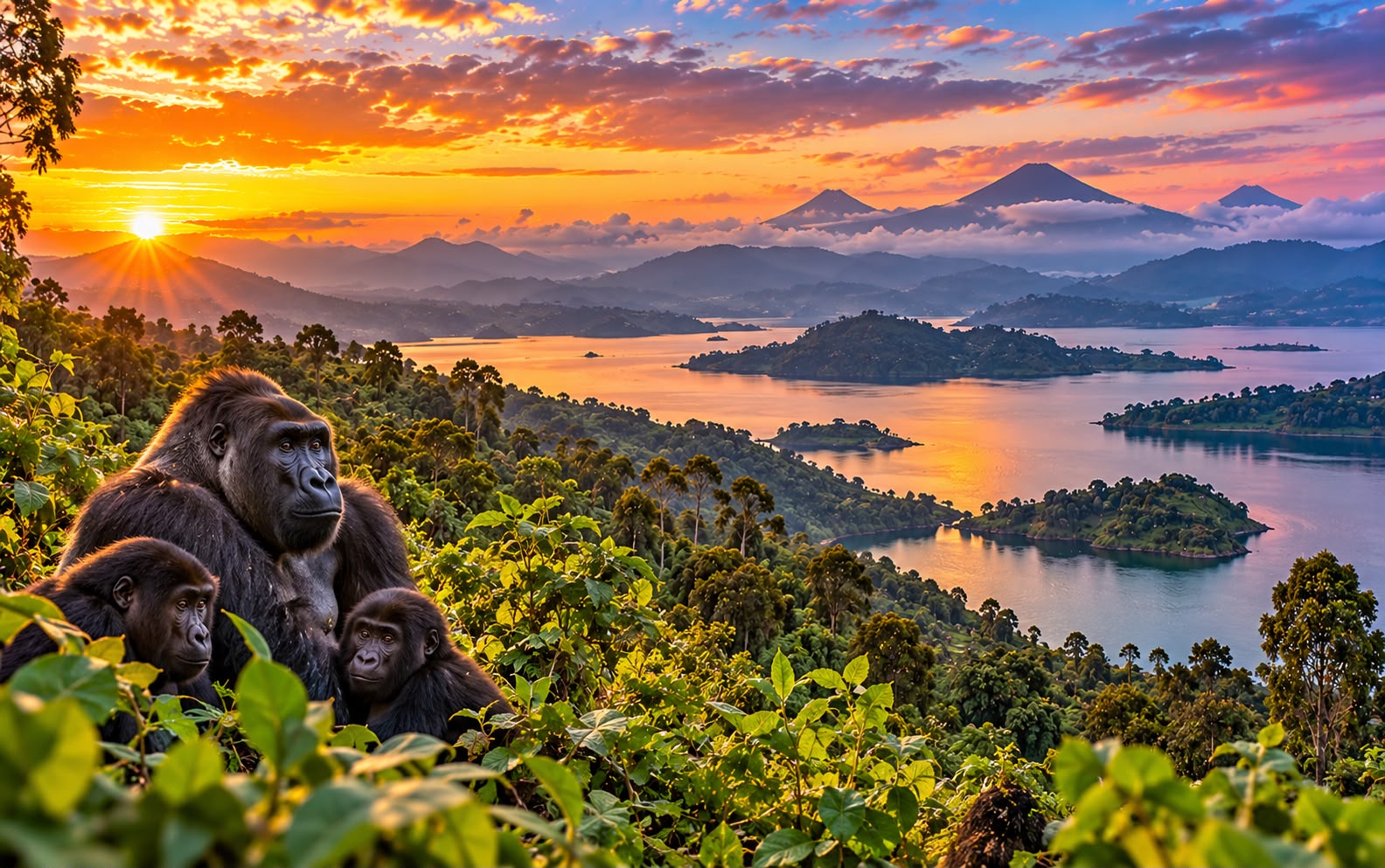
Rwanda in 8 days: gorillas, Nyungwe and Lake Kivu
An hour with a gorilla family on a forested volcano, and a country that has made itself one of Africa's easiest to travel: chimpanzees in a montane rainforest, a canopy walkway over the treetops, a lake with no crocodiles, and a memorial that should be visited first — with the permit reality stated plainly.
- East Africa
- 8 days
- ≈ AED 9,950 / person
- Mountain gorillas
Before you go
Rwanda is small, green, startlingly clean, and organised in a way that surprises people who have travelled elsewhere in the region. The roads are good, the country is safe, plastic bags have been banned since 2008, and you can drive its whole length in a day.
The reason most people come is one hour long. Mountain gorillas live in the Virunga volcanoes on the northern border, and a permit buys you sixty minutes with a habituated family, at a distance of a few metres. There are only about a thousand of these animals left in the world, all in this small range of mountains.
The rest of the country justifies the trip on its own: Nyungwe, one of Africa’s oldest montane rainforests, with chimpanzees and a canopy walkway strung 50 m above a ravine; Lake Kivu, with no crocodiles or hippos and therefore swimmable; and Kigali, whose genocide memorial is among the most important places in Africa.
Before you go: the permit, the cost and what to expect
Entry
- Rwanda offers visa on arrival to all nationalities, which is unusual and welcome. Many nationalities — including most African, Commonwealth and some others — enter visa-free. An eVisa is available for everyone else.
- The East Africa Tourist Visa covers Rwanda, Uganda and Kenya together if you are combining them.
- Plastic bags are illegal and confiscated at the airport, including the ones inside your suitcase. Repack before you fly.
The gorilla permit, honestly
This is the single most important planning fact in this guide.
- A gorilla permit in Rwanda costs USD 1,500 per person, for one hour with one family. That is not a typo, and it is the highest price of the three gorilla countries.
- Permits are capped at eight visitors per family per day, which is why they are scarce and expensive. The money funds conservation and community programmes, and the gorilla population has been rising.
- Book months ahead, through the Rwanda Development Board or a licensed operator. Peak months sell out.
- Uganda’s permits cost substantially less for the same animals in the same mountain range, and the DRC’s less again. Rwanda’s advantage is the short, good road from Kigali — under three hours — and the general ease of the country.
- Minimum age is 15.
- If you are ill — even a cold — you will not be allowed to go, because gorillas catch human respiratory infections and it kills them. There are no refunds for this, and the rule is right.
What the trek is actually like
- You are assigned a family on the morning, based on fitness and preference. Some are an hour’s walk, some are four hours on steep, muddy, stinging-nettle-covered slopes at 2,500–3,000 m.
- Porters are available and cheap, and hiring one is both a real help and direct local income. Take one.
- The hour starts when you reach the family and it goes very fast. Masks are required, a distance is enforced, and flash is banned.
- Gaiters and gardening gloves sound excessive and are not — the nettles here are serious.
Money and getting around
- The franc (RWF), and prices run into the thousands. Cards work in Kigali and at lodges; carry cash elsewhere.
- US dollars are used for permits and some lodges — bring clean notes.
- Roads are good and drivers are the norm. A car with a driver for the week is the standard way to do this itinerary and is not expensive relative to the permit.
- Kinyarwanda, French and English are all official; English is widely used in tourism.
Day by day
Day 1 — Land in Kigali
- 14:00 — Land at Kigali (KGL), 10 km from the centre. Visa on arrival is straightforward for most nationalities.
- 15:00 — Drop bags. Kigali is built over a series of ridges, it is strikingly clean, and the traffic is orderly in a way that surprises people who have travelled elsewhere in the region.
- 16:30 — Plastic bags are banned and have been since 2008 — they are confiscated at the airport. The last Saturday of each month is umuganda, a compulsory community clean-up morning when shops shut and traffic stops until midday; if you arrive on one, plan around it.
- 18:00 — A drink at Hôtel des Mille Collines — the “Hotel Rwanda” — which is now simply a hotel with a pool, and is more ordinary than its reputation.
- 20:00 — Dinner. Kigali has a real restaurant scene; Rwandan coffee is excellent and mostly exported.
Day 2 — The memorial, and north
- 09:00 — The Kigali Genocide Memorial. This is not an optional cultural stop — it is the context for the whole country, and in 1994 around one million people were killed in a hundred days. 250,000 are buried in the gardens here. The exhibition is careful, chronological and unsparing, including the international failure to intervene. The children’s room at the end is the hardest part.
- 11:30 — Allow two hours inside and expect to want the rest of the morning. The gardens are designed for exactly that.
- 13:00 — Lunch.
- 14:30 — Drive north to Musanze (Ruhengeri), under three hours on good tarmac, with the Virunga volcanoes rising ahead — five cones, often cloud-topped, straddling three borders.
- 17:30 — Arrive. Check the lodge’s briefing time.
- 19:00 — Dinner, kit laid out, early night. Lay out: boots, gaiters, gardening gloves for the nettles, rain shell, 2 litres of water.
Day 3 — Gorillas
- 05:30 — Volcanoes National Park headquarters at Kinigi: registration, coffee, dancers, and the allocation. Groups are matched to fitness, so say honestly how fit you are — the easy families are a genuinely different day from the hard ones.
- 07:00 — Drive to the trailhead, then walk. One to five hours each way, through farmland, then bamboo, then stinging nettles and vines on steep volcanic mud. Hire a porter — about USD 10–20, it directly employs people from the villages that gave up this land, and they will haul you up the worst of it.
- 10:30 — The trackers radio in. Bags down, masks on, and the hour starts.
- The hour — Seven metres back, no flash. A silverback at arm’s length ignoring you completely, juveniles tumbling, an infant on its mother’s back. It costs USD 1,500 and almost nobody comes out of that hour thinking about the money.
- 14:00 — Back down. Certificates at headquarters.
- 16:00 — Rest. Do not plan anything.
Day 4 — Golden monkeys, or Dian Fossey
- Option A — golden monkeys, 06:00. A permit at a fraction of the gorilla price, for an endangered monkey found only in the Virungas. They move constantly through the bamboo and the hour is noisier and more chaotic than the gorillas. Far easier walking.
- Option B — Dian Fossey’s grave, 06:00. A steep two-hour climb to the Karisoke research site at 3,000 m, where Fossey lived from 1967 and was murdered in 1985. She is buried beside Digit and the other gorillas she studied, in the gorilla graveyard she dug herself. Historically the richer of the two.
- 13:00 — Back, and lunch.
- 15:00 — Drive to Lake Kivu at Gisenyi (Rubavu), about an hour.
- 17:30 — The lakeshore, with the Democratic Republic of Congo on the far side and Nyiragongo’s glow visible after dark on a clear night.
Day 5 — Lake Kivu
- 08:00 — Swim. Kivu has no crocodiles, no hippos and no bilharzia, which makes it one of very few African lakes you can simply get into.
- 10:00 — A boat to the islands — Napoleon Island for the fruit bats, which leave in a cloud at dusk.
- 13:00 — Lunch on the shore.
- 15:00 — The Congo Nile Trail by bike — the full route is 227 km over ten days, but a half-day along the shore south of Gisenyi gives you terraced hills, coffee washing stations and children shouting muzungu at you from every village.
- 18:00 — The fishermen go out at dusk: wooden trimarans with long poles, three to a set, and the crews sing in unison to keep time with the paddles. It happens every evening, it is not for you, and it is the best hour on the lake.
- 20:00 — Dinner — tilapia and isombe.
Day 6 — South to Nyungwe
- 08:00 — The drive south along Kivu, and it is one of the great African road journeys: four to six hours of switchbacks high above the lake, through tea estates and hills terraced to the summit. Rwanda is called le pays des mille collines and this is the road that proves it.
- 12:00 — Lunch at Kibuye (Karongi), halfway, on the water.
- 15:30 — The landscape changes as you climb into Nyungwe — one of the oldest montane rainforests in Africa, old enough to have survived the last ice age, which is why its biodiversity is what it is.
- 17:00 — Arrive. Settle, and book tomorrow at reception.
- 19:00 — Dinner. It is cool and wet up here; bring a layer.
Day 7 — Chimps and the canopy
- 05:00 — Chimpanzee tracking. An early, muddy start — the chimps nest high and move at first light, and you are following trackers who went out before you. Sightings run at about 70%.
- 08:00 — When you find them it is loud, fast and chaotic: screaming, drumming on buttress roots, and a troop moving through the canopy above you at speed. Entirely unlike the gorillas.
- 11:00 — Back, and breakfast.
- 14:00 — The canopy walkway — 160 m long and 50 m above a ravine, the only one of its kind in East Africa, on the Igishigishigi trail. It moves underfoot, which is the point.
- 16:00 — The Isumo waterfall trail or a colobus troop walk — Nyungwe’s Angolan colobus move in super-troops of up to 400, which is unique.
- 19:00 — Last forest night.
Day 8 — Back to Kigali, and home
- 08:00 — The drive back, around five hours via Huye, or a short domestic flight if your schedule is tight.
- 13:00 — Kigali. Lunch.
- 15:00 — The craft cooperatives — Nyamirambo Women’s Centre for textiles and a neighbourhood walking tour, or the Caplaki market for agaseke peace baskets, which are woven by cooperatives of survivors and perpetrators working together.
- 18:00 — The airport is 20 minutes out and most long-haul departures are evening.
- Note — Keep the gorilla certificate flat. It is the best thing you will take home.
Costs and practicalities
Best time to visit
June–September is the long dry season and the best for gorilla trekking, with a second window in December and January.
- June–September — dry, and the easiest trekking conditions in the Volcanoes park. The busiest and the most expensive.
- December–February — the short dry season, also good, and slightly quieter.
- March–May — the long rains. The forest is at its wettest and the trails are deep mud, but the gorillas are there and the park is far less busy.
- October–November — the short rains, with afternoon storms.
Gorillas are tracked year-round and the permit price does not change by season. Nyungwe’s chimpanzees are easier in the wet season, when they stay lower; Akagera’s game viewing is best in the dry, from June to September.
Travel tips
- Gorilla permits are expensive and limited — a fixed price per person per trek, with only a few dozen permits a day. Book months ahead through the Rwanda Development Board or an operator.
- The minimum age is 15 and you will be turned away with a cold or flu — the rule protects the gorillas, who share our respiratory infections.
- Hire a porter. It costs little, the trek is steep and muddy, and it is the main way trekking money reaches the surrounding villages.
- Plastic bags are illegal in Rwanda and confiscated at the airport. Bring none, including bin liners and ziplocks in some interpretations.
- Kigali is strikingly clean, orderly and safe — the last Saturday of each month is Umuganda, a national community work morning when most things close until midday.
- Cards work in Kigali and at lodges; carry francs elsewhere. Mobile money is widespread.
- The Genocide Memorial is essential and harrowing. Allow time, and treat it as the place of mourning it is.
What this trip actually costs
Two people, 7 nights, mid-range, excluding international flights:
| Item | Cost |
|---|---|
| Gorilla permits ×2 | RWF 4,400,000 (≈ AED 10,941) |
| Lodges, 7 nights | RWF 1,700,000 (≈ AED 4,227) |
| Car with driver, 7 days, and fuel | RWF 900,000 (≈ AED 2,238) |
| Chimp permit, golden monkeys, canopy walk, memorial, boats | RWF 500,000 (≈ AED 1,243) |
| Food, drink, porters and tips | RWF 500,000 (≈ AED 1,243) |
| Total for two | RWF 8,000,000 (≈ AED 19,893) |
- Roughly RWF 4,000,000 (≈ AED 9,947) per person, and the permits are more than half of it. Everything else about Rwanda is reasonably priced.
- If the permit price is the obstacle, Uganda is the answer — the same animals, the same mountains, a considerably cheaper permit and a longer drive.
- Lodges range from simple guesthouses to some of Africa’s most expensive; the figure above assumes comfortable mid-range.
What to pack
- Gaiters and thick gardening gloves for the gorilla trek. The nettles and the thorns are the reason.
- Waterproofs. It is called a rainforest for a reason, in every month.
- Boots with grip for steep mud.
- A mask for the gorilla hour — usually provided, bring your own anyway.
- No plastic bags, which are illegal and will be taken.
- Warm layer for altitude evenings.
- Type C/J plugs, 230V.
FAQ
Is the permit worth USD 1,500? People who have done it almost universally say yes, and the money demonstrably funds the conservation that has grown the population. If it is out of reach, Uganda offers the same experience for less.
How fit do I need to be? Moderately. Treks range from one to five hours on steep, muddy ground at altitude. Tell the briefing honestly and you will be matched to an appropriate family; a porter makes a large difference.
Is Rwanda safe? Yes, and notably so — it is among the safest countries in Africa for visitors, with low crime and excellent roads.
When should I go? June to September and December to February are the drier seasons and the easier treks. The rainy months are green, quieter and considerably muddier.
Prices and entry rules change, and what you need depends on your passport; last checked 8 October 2026, so confirm with the embassy or your airline before booking.


