 The Itinerary
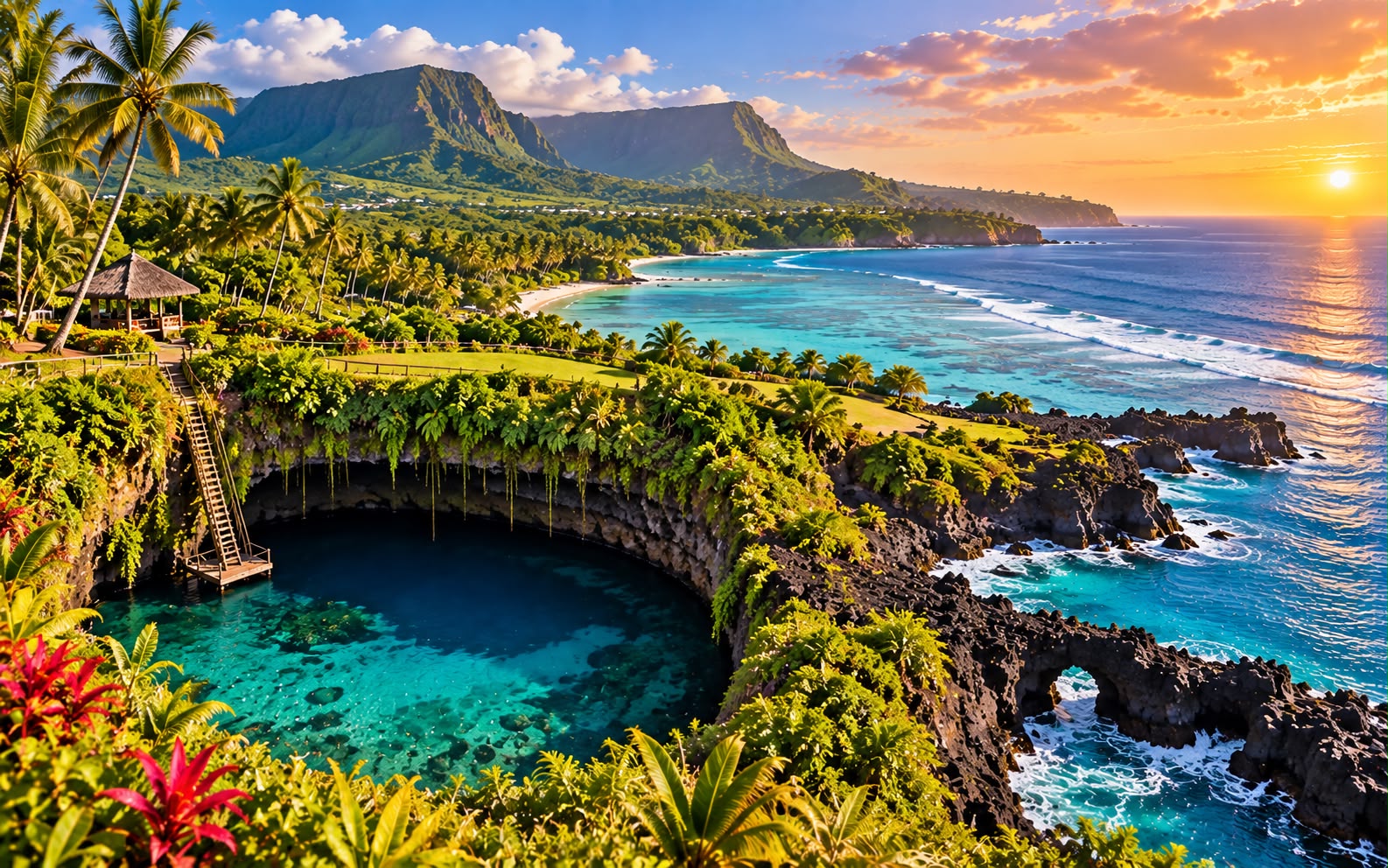
Samoa in 8 days: To Sua, the lava coast and Savai'i
The Pacific island where the old social system never broke: you sleep in an open-sided fale on the sand for a few tala, swim down a ladder into a garden sinkhole filled with sea water, walk across a lava field that swallowed a village, and watch blowholes fire coconuts a hundred feet into the air.
- Pacific Islands
- 8 days
- ≈ AED 6,300 / person
- Fa'a Samoa, and beach fales
Before you go
Most Pacific destinations sell you a resort. Samoa sells you a fale — an open-sided thatched hut on the sand, with a mat, a mosquito net and roll-down blinds, usually including breakfast and dinner, for a fraction of what a hotel costs. You sleep with the sea three metres away and no wall between you and it.
That is possible because of fa’a Samoa — the Samoan way — which is not a tourist phrase. Around 80% of land is still customary, held by extended families under a matai chief system that has governed here for three thousand years and was never dismantled. Almost everything you will visit is owned by a village, charges a small fee to that village, and is the better for it.
The island itself delivers: To Sua Ocean Trench, a collapsed lava tube in a garden that you climb down a ladder into; the Saleaula lava fields on Savai’i, where an eruption buried a village and left a church standing in the flow; and blowholes that throw spray higher than the palms.
Before you go: Sundays, fales and the two islands
Entry and money
- Most nationalities enter visa-free for 60 or 90 days.
- Samoan tālā (WST). Cash is essential outside Apia — fales, village fees and buses take nothing else. Draw everything in Apia or at the airport.
- Cards work at Apia hotels and supermarkets and very few other places.
Sunday is genuinely different
- Samoa is deeply Christian, and Sunday is observed. Most shops, many restaurants and some attractions close; villages hold services morning and evening and expect quiet.
- Sa — evening prayer curfew — happens in villages around dusk, for perhaps ten or fifteen minutes. If you are walking or driving through a village when the bell or conch sounds, stop and wait it out. People will not be rude about it, and stopping is the courteous thing.
- Go to a village service if invited. The singing is extraordinary and the invitation is genuine.
- Sunday to’ona’i, the family feast after church, is the meal of the week.
Fales, and village fees
- Beach fales are the accommodation that defines Samoa: open-sided, on the sand, usually half-board included, often with shared bathrooms. They cost a fraction of a hotel.
- Almost every beach, waterfall and swimming hole is village land and charges a small fee collected at a hut on the way in. This is correct, it goes to the village, and it is usually a few tālā.
- Dress: shoulders and knees covered away from the beach, and do not wear swimwear through a village. A lavalava — wrapped cloth — solves it and everybody wears one.
Getting around, and the ferry
- Hire a car for Upolu. Driving is on the left, which Samoa switched to in 2009 — one of the only countries ever to change sides.
- Buses are brightly painted wooden-bodied trucks, cheap, infrequent, and run to no timetable. Worth doing once.
- Savai’i is reached by ferry from Mulifanua to Salelologa — about 90 minutes, several times daily, and it takes cars. Schedules change and the last sailing is earlier than you expect; check locally rather than online.
When to go
- May to October is the dry season, cooler and less humid, and the time to come.
- November to April is the wet season and the cyclone window, with heavier rain and higher humidity. It is also cheaper and greener.
- It is warm year-round — high twenties to low thirties, always.
Day by day
Day 1 — Land in Apia
- Most flights land in the small hours. Faleolo (APW) is 35 km west of Apia, about 45 minutes.
- 10:00 — Having slept, walk Apia: the seafront, the clock tower, and the Flea Market for lavalava, shell jewellery and siapo bark cloth.
- 12:00 — The Fish Market, which is at its best very early but is good at any hour.
- 13:30 — Lunch, then draw all the cash you need for the week.
- 15:00 — Robert Louis Stevenson Museum at Vailima, the house he built and died in at 44 — Samoans called him Tusitala, the teller of tales, and carried his coffin up Mount Vaea.
- 16:30 — The climb to his tomb on Mount Vaea: 45 minutes up a forest track, steep and humid, with the epitaph he wrote for himself on the stone at the top and the whole harbour below.
- 19:00 — Dinner in Apia. Oka — raw fish in coconut cream and lime — and palusami, taro leaves baked in coconut.
Day 2 — The north coast, and east
- 08:30 — Collect the car and head east along the north coast.
- 09:30 — Piula Cave Pool, in the grounds of a Methodist theological college: a freshwater spring in a cave beneath the church, running straight out into the sea. You can swim through a short underwater passage between two chambers if you want to.
- 11:00 — Falefa Falls and Fuipisia Falls, the latter a 55 m drop you look over the lip of.
- 13:00 — Lunch, then on to Lalomanu on the south-east corner.
- 15:00 — Lalomanu beach, consistently called one of the best in the Pacific — white sand, a reef a hundred metres out, and a line of beach fales along it.
- 16:00 — Check into a fale. Snorkel straight off the beach.
- 18:30 — Dinner at the fale, cooked by the family who run it, eaten at a long table with whoever else is staying.
- 20:30 — The blinds roll down and that is the whole building. You will hear the reef all night.
Day 3 — To Sua Ocean Trench
- 08:30 — To Sua, half an hour west along the south coast, and get there early — it fills by eleven and the ladder takes one person at a time.
- 09:00 — It is a 30 m collapsed lava tube in the middle of a manicured garden, connected to the sea by an underwater tunnel so it rises and falls with the tide. You go down a steep wooden ladder to a platform and then into water that is startlingly clear and deep.
- 10:30 — Swim toward the tunnel mouth and feel the surge. Time it with the tide — mid-tide is best, and the staff will tell you.
- 12:00 — The gardens, the blowholes on the shore below, and the cliff-edge swings.
- 13:30 — Lunch, then Lotofaga and the south coast road.
- 15:30 — Sopo’aga Falls viewpoint, and the Togitogiga Falls in O Le Pupu-Pue national park, where you can swim under a low cascade.
- 18:00 — Back to Lalomanu.
Day 4 — The south coast, and the lava
- 08:30 — West along the south coast, which is the quieter and prettier side.
- 09:30 — Giant Clam Sanctuary at Savaia: a village-run reserve where you snorkel over dozens of Tridacna clams up to a metre across, blue and green mantles, in shallow water.
- 11:30 — Return to Apia, or stay south.
- 13:00 — Lunch at Manono-tai if you take the boat — Manono island has no cars, no dogs and a footpath right round it in 90 minutes, and it is the easiest way to see a village that functions entirely traditionally.
- 16:00 — Back to the mainland.
- 18:00 — Sleep near Mulifanua for the morning ferry, or in Apia.
- 19:30 — Dinner, and confirm the ferry time.
Day 5 — Ferry to Savai’i
- 08:00 — The ferry from Mulifanua to Salelologa, about 90 minutes across the Apolima Strait with the car.
- 10:00 — Savai’i is larger than Upolu, far less developed, and feels like Samoa fifty years ago. It is also the sixth largest island in Polynesia and almost entirely volcanic.
- 11:00 — Saleaula lava fields on the north coast. The Mt Matavanu eruption of 1905–11 poured across this coast for six years and buried five villages. What is left is a black expanse you walk across, with the shell of the LMS church standing in the middle of it — the lava flowed in the door and around the walls and set, and there is a nun’s grave the flow parted around and left untouched.
- 13:30 — Lunch.
- 15:00 — Lava tube caves at Letui or the Dwarf’s Cave at Paia, which is village-guided, pitch black and genuinely large.
- 17:00 — Check into a beach fale at Manase on the north coast.
- 19:00 — Dinner, and the north coast is very quiet indeed.
Day 6 — Blowholes and waterfalls
- 08:30 — Alofaaga Blowholes at Taga on the south-west coast, and this is Savai’i’s set piece: the sea forces through lava tubes and fires spray thirty metres and more into the air. The local men will throw a coconut into the hole and it is launched out of sight. Pay them for it.
- 11:00 — The Afu Aau (Olemoe) Falls, inland: a wide fall into a deep cold pool in forest, with a village fee at the gate, and almost nobody there.
- 13:30 — Lunch at Satupa’itea.
- 15:00 — The Canopy Walkway at Falealupo, a rope bridge into a 40 m banyan on the island’s western tip, if it is open — check, because it has been closed for repairs at times.
- 17:00 — Cape Mulinu’u, the westernmost point, and a sunset that for a century was billed as the last of the day anywhere on earth — until Samoa jumped the dateline in 2011 and became one of the first places to see tomorrow instead.
- 19:00 — Back to Manase.
Day 7 — Savai’i, slow, and back
- 08:00 — Snorkel off Manase, or walk the coast.
- 10:00 — Mt Matavanu crater if the track is passable — a guided walk to the rim of the cone that caused the lava field, with a village guide and a jeep most of the way.
- 13:00 — Lunch, then the ferry back to Upolu — allow plenty of time and check the sailing.
- 16:30 — Land at Mulifanua, and drive to Apia.
- 18:00 — A fiafia night if your hotel runs one — Samoan dance including the siva and the fire knife, which originated here, performed by staff and often by their children. It is unapologetically for visitors and it is also very good.
- 20:30 — Last dinner.
Day 8 — Fly home
- Morning — Faleolo is 45 minutes from Apia. Many departures are in the small hours, so check whether your “morning” flight is actually tonight.
- Last stop — the Flea Market for siapo bark cloth and coconut oil.
- Note — Spend the tālā; it is not changeable elsewhere.
Costs and practicalities
Best time to visit
May–October is the dry season and the better half of the year, with the cyclone season in the other.
- May–October — dry, 24–29°C, lower humidity, and the best for the waterfalls, To Sua and the coastal walks. Humpback whales pass from July to October.
- November–April — hot, humid and wettest, with the cyclone season at its most active from January to March. Rates fall and the island is intensely green.
- Turtle nesting runs roughly October to February.
- Diving and snorkelling visibility is best in the dry months, though the lagoons are swimmable year-round.
Samoa moved west of the date line in 2011, so it is now a day ahead of American Samoa two hours away — worth knowing if you are island-hopping.
Travel tips
- Sunday is strictly observed. Almost everything closes, villages hold sa — evening prayer curfew — and walking or driving through a village during it is a real discourtesy. Stop and wait.
- Many beaches and waterfalls are village-owned and charge a small custom fee. It is legitimate and goes to the village.
- Cover shoulders and thighs away from the beach. A lavalava is the practical and respectful garment and is sold everywhere.
- Accept the ava at a kava ceremony — spill a few drops, say manuia, and drink.
- Beach fales are the classic accommodation — open-sided huts on the sand, usually with breakfast and dinner included. Basic, cheap, and the best of Samoa.
- Cards work in Apia and at resorts; carry tala elsewhere.
- Rip currents and reef passages are dangerous. Swim where locals do, and take reef shoes for the coral.
What this trip actually costs
Two people, 7 nights, beach fales and one Apia hotel, excluding international flights:
| Item | Cost |
|---|---|
| Beach fales, 5 nights, half board, two people | WST 2,500 (≈ AED 3,342) |
| Apia hotel, 2 nights | WST 1,100 (≈ AED 1,471) |
| Car hire, 7 days, and fuel | WST 2,400 (≈ AED 3,208) |
| Savai’i ferry with vehicle, return | WST 500 (≈ AED 668) |
| Village fees, To Sua, blowholes, falls, caves | WST 700 (≈ AED 936) |
| Food and drink beyond half board, 8 days | WST 1,800 (≈ AED 2,406) |
| SIM, extras | WST 400 (≈ AED 535) |
| Total for two | WST 9,400 (≈ AED 12,567) |
- Roughly WST 4,700 (≈ AED 6,283) per person — about USD 1,700, and most of that is the flight to get here, not the ground cost.
- Beach fales with half board are the great value of the Pacific — a fraction of a Fijian or Tahitian resort for a better location.
- Village fees are small and constant. Carry coins and small notes; nobody at a gate hut has change for a hundred.
- Resorts at Coconuts or Sinalei would roughly double this.
What to pack
- A lavalava — buy one on day one at the market. It solves every modesty question and is what everyone wears.
- Reef shoes. Much of the swimming is over coral and lava rock, and the lava is sharp.
- A torch. Fales have no electric light after the generator goes off, and the caves need one.
- A mosquito net is usually provided — check when booking, and bring repellent regardless; dengue occurs.
- A dry bag for the ferry and the boat to Manono.
- Australian-style Type I plugs, 230V.
- Cash in small notes, drawn in Apia.
FAQ
Are beach fales really that basic? Open sides with roll-down blinds, a mattress on the floor or a simple bed, a mosquito net, and a shared bathroom block. That is the whole building. Half board is normally included and the food is cooked by the family. People who want a door and air conditioning will not enjoy it; people who want to hear the reef all night will not stay anywhere else again.
How strictly is Sunday observed? Strictly. Shops shut, villages hold services, and the whole country slows down. Plan a beach day or a travel day around it, and if you are in a village at dusk when sa is called, stop walking for ten minutes. It is a small courtesy and it is noticed.
Upolu or Savai’i? Both, and this itinerary splits them. Upolu has Apia, To Sua and Lalomanu; Savai’i has the lava fields, the blowholes and far fewer people. Savai’i is where most visitors say the trip actually happened.
Samoa or Fiji? Fiji has more resorts, more flights and the Yasawa island- hopping. Samoa has the stronger living culture — fa’a Samoa is intact in a way that is rare — and the beach fale system, which has no Fijian equivalent at that price.
When should I go? May to October, the dry season. November to April is cyclone season, wetter and cheaper.
Prices and entry rules change, and what you need depends on your passport; last checked 8 October 2026, so confirm with the embassy or your airline before booking.


