 The Itinerary
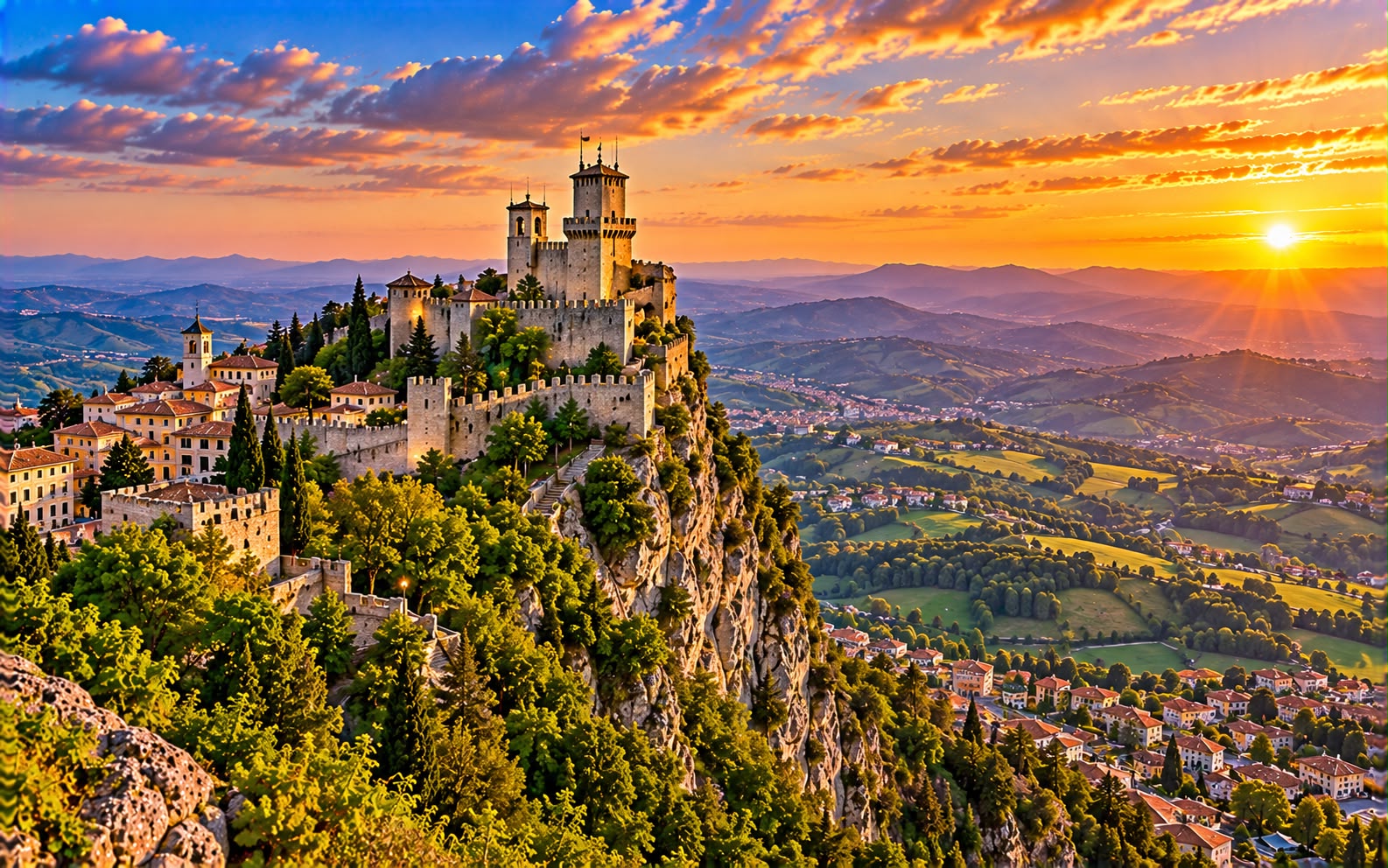
San Marino in 2 days: the three towers, Monte Titano and the oldest republic
A country that has run itself continuously since, by its own account, 301 AD — perched on a single mountain above the Adriatic plain, with three towers along its ridge and two heads of state who serve six months each.
- Southern Europe
- 2 days
- ≈ AED 550 / person
- Three fortresses on a limestone ridge, in the world's oldest surviving republic
Before you go
San Marino claims to be the oldest surviving sovereign state and the oldest constitutional republic in the world, founded by a stonemason called Marinus who fled Diocletian’s persecution and settled on Monte Titano in 301 AD. The date is traditional rather than documented, but the republic’s continuity since the Middle Ages is real, and its 1600 statutes are among the oldest written constitutions still in force.
It is 61 square kilometres on and around a single limestone ridge rising abruptly out of the Romagna plain, with about 34,000 people.
The three towers along the ridge are the image, on the flag and the coins: Guaita, the oldest, from the eleventh century; Cesta, on the highest point at 755 metres, with a museum of medieval arms; and Montale, the smallest, closed to visitors. The historic centre and Monte Titano are on the UNESCO list.
Its constitutional arrangement is genuinely unusual. Two Captains Regent serve as joint heads of state for six months, invested on 1 April and 1 October, a system descended directly from Roman consuls — and for three days after leaving office any citizen may formally complain about their conduct.
You sleep in Rimini or in San Marino itself, and either works. This guide is two days, which is honest: the country is small and the mountain is the whole of it.
Two days. Figure EUR 140 (≈ AED 573) per person excluding getting to the Adriatic coast. Go April–June or September–October; the summer crowds are considerable and the winter fog swallows the view.
Before you go: the 15-minute admin
Getting there
- There is no airport and no railway. You arrive by road.
- Rimini is the gateway: about 45 minutes by bus from Rimini station, several a day, cheap. Rimini has an airport and is on the main Bologna–Ancona line.
- Bologna is about two hours by car, Florence about three.
- There is no border control and no passport stamp. San Marino is not in the EU but is in a customs union with it and uses the euro.
- The cable car from Borgo Maggiore to the Città takes two minutes, runs every fifteen, and saves a steep climb. It is also the best view of the arrival.
Where to park, if you drive
- Do not drive into the historic centre — it is pedestrianised and the approach roads are hairpins.
- Park at Borgo Maggiore and take the cable car, or use the numbered car parks on the mountain and walk up.
Money and shopping
- The euro, by agreement, and San Marino mints its own coins — which, like the Vatican’s, are collectable and rarely circulate.
- It is a duty-free shopping destination for Italians, which is why the approach road is lined with electronics and perfume shops. This is most of the country’s visitor traffic and it is easy to ignore.
- Stamps and coins are a genuine specialism — the philatelic office has funded a meaningful share of the state budget historically.
- A passport stamp is available from the tourist office for a few euros. It is a souvenir, not a requirement.
Travelling with kids?
- The towers are castles with battlements and a ridge walk between them, which does most of the work.
- The Museum of Torture and the various waxwork and curiosity museums in the centre are tourist-trap fare; the State Museum is the real one.
- The cable car is short and popular.
Day by day
Day 1 — Up the mountain
- Late morning — Arrive at Borgo Maggiore and take the cable car up to the Città di San Marino.
- 12:00 — Piazza della Libertà and the Palazzo Pubblico, the town hall and seat of government, rebuilt in the 1890s in a deliberately medieval style. The changing of the guard happens outside it on summer afternoons.
- 13:00 — Lunch. San Marino eats Romagnolo — piadina, strozzapreti, and the local torta tre monti, a layered wafer cake named after the towers.
- 15:00 — The Basilica del Santo and, beside it, the small Church of San Pietro cut into the rock.
- 16:00 — The State Museum for the archaeology and the paintings, which is the serious collection here.
- Sunset — From the ramparts, looking east, you can see the Adriatic and on a clear evening the coastline from Rimini down towards Ancona.
Where to stay (one night)
- In San Marino: the small hotels inside the walls, which empty completely when the day-trippers leave and are the reason to stay.
- Cheaper: Borgo Maggiore below, or Rimini on the coast.
Day 2 — The three towers and the ridge
- 09:00 — Guaita, the First Tower, eleventh century, the oldest and the most photographed. It was used as a prison into the twentieth century and the cells are still there.
- 10:00 — The Passo delle Streghe — the “Witches’ Pass” — the ridge path linking Guaita to Cesta, a few hundred metres along the spine of the mountain with a drop on both sides. This is the walk people come for.
- 10:45 — Cesta, the Second Tower, on the summit at 755 metres, holding the Museum of Ancient Weapons — around 550 pieces from the medieval period onwards.
- 11:45 — The path on towards Montale, the Third Tower, which is closed to visitors but is the quietest part of the ridge and the best view back at the other two.
- 13:00 — Lunch, then the Cava dei Balestrieri — the crossbow range, where the national crossbow corps still competes; matches are held on 3 September, the national day.
- 15:00 — Down by cable car, and the bus to Rimini.
Costs and practicalities
Best time to visit
April–June and September–October. San Marino sits on Monte Titano at 750m, which makes it cooler than the Adriatic coast below and often cloud-wrapped in winter.
- April–June — clear air, long views to the Adriatic, and the towers walkable without the summer coach traffic.
- July–August — warm and busiest, with day-trippers from Rimini arriving mid-morning. The Medieval Days festival in late July fills the old town with reenactors and is genuinely good.
- September–October — the best of the year: warm, clear, and quiet once the coast season ends.
- November–March — cold, often in cloud, and some attractions reduce hours. 3 September is the Feast of Saint Marinus, the national day.
The view is the point and the view needs clear air — Monte Titano is frequently fogged in from November to February.
Travel tips
- There is no border control and no airport. Arrive by bus from Rimini — about 50 minutes — or drive up the hairpins.
- It uses the euro without being in the EU, and mints its own collectable coins.
- The passport stamp is a paid souvenir at the tourist office. There is no immigration check.
- Park at the bottom and take the cable car. The historic centre is largely pedestrian and the parking at the top is limited and expensive.
- The three towers are a single ticket and the walk between them along the ridge is the best part of a visit.
- It is a duty-free shopping destination for Italians, which explains the electronics and perfume shops; the souvenir weaponry shops are a long-standing oddity.
- Wear proper shoes. The old town is steep, cobbled and polished by eight centuries of feet.
What this trip actually costs
Two people, 1 night, mid-range comfort, excluding travel to Rimini:
| Item | Cost |
|---|---|
| Hotel, 1 night | EUR 110 (≈ AED 450) |
| Bus from Rimini and cable car, two | EUR 34 (≈ AED 139) |
| Three towers combined ticket, two | EUR 20 (≈ AED 81.89) |
| State Museum and entries, two | EUR 16 (≈ AED 65.51) |
| Food and drink, 2 days | EUR 100 (≈ AED 409) |
| Total for two | EUR 280 (≈ AED 1,146) |
- Roughly EUR 140 (≈ AED 573) per person, which makes San Marino one of the cheapest countries in western Europe to visit.
- A combined ticket covers the two open towers and the state museums and is much better value than paying separately.
- Staying the night inside the walls costs little more than Rimini and gives you the town empty after about six in the evening, which is a different place entirely.
- Skip the waxworks and the torture museum unless that is your thing; they are private attractions trading on the footfall.
- Hotel picks here are chosen on location, not on commission — always check prices and recent reviews before booking.
What to pack
- Shoes with grip for the ridge path, which is stone and uneven.
- A layer — the mountain is windy and noticeably cooler than the coast.
- Cash for the bus, though cards work almost everywhere else.
FAQ
Is it really the oldest republic? It is the oldest surviving one, on the strength of continuous self-government since the Middle Ages and a constitution dating to 1600. The 301 AD founding is tradition rather than documented history.
How long do I actually need? A day covers the towers and the centre. The second day exists so you can walk the ridge slowly and see the town after the coaches leave, which is when it is worth being there.
Can I get a passport stamp? Yes, from the tourist office for a few euros. There is no border control, so it is a souvenir.
Is the shopping worth it? It is duty-free relative to Italy and is why most Italian visitors come. For a foreign traveller it is mostly electronics shops on the approach road and easy to skip.
What language do they speak? Italian, with a Romagnol dialect. No difficulty for anyone who manages in Italy.
Prices and entry rules change, and what you need depends on your passport; last checked 8 October 2026, so confirm with the embassy or your airline before booking.


