 The Itinerary
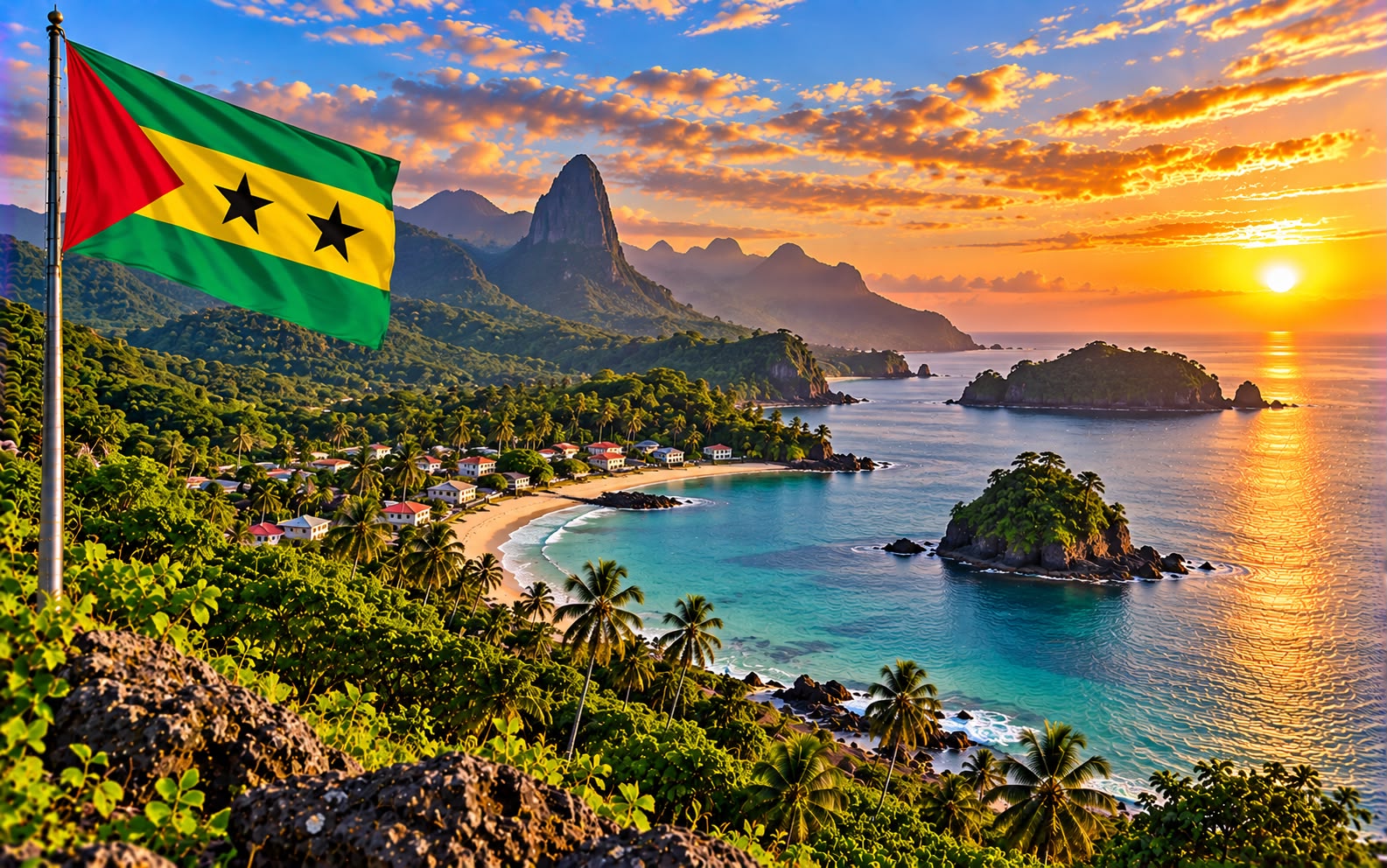
São Tomé and Príncipe in 7 days: Pico Cão Grande, the roças and Príncipe
Two equatorial islands of cocoa estates going back to the jungle, a 370-metre volcanic plug standing out of the forest, beaches where turtles nest, and the plantation where a 1919 eclipse photograph confirmed Einstein was right.
- West Africa
- 7 days
- ≈ AED 3,850 / person
- A volcanic needle in rainforest, and the plantation where relativity was proved
Before you go
São Tomé and Príncipe is two islands and a scatter of islets in the Gulf of Guinea, sitting on the equator about 300 kilometres off Gabon. It is the second-smallest country in Africa, was uninhabited until the Portuguese arrived in the 1470s, and was once the largest cocoa producer in the world.
What that left is roças — vast plantation estates with hospitals, chapels, railways and rows of workers’ housing, built on a scale that assumed permanence, and now variously abandoned, half-lived-in, or restored as hotels. Walking into one is the strangest thing on the islands and the most memorable.
Pico Cão Grande is the image: a volcanic plug rising about 370 metres as a near-vertical needle out of the rainforest, usually with cloud snagged on it. You see it from the south road and it does not look real.
Príncipe, the smaller island, is a UNESCO Biosphere Reserve — forested peaks, empty beaches, perhaps eight thousand people. And at Roça Sundy in May 1919, Arthur Eddington photographed a total solar eclipse and measured the bending of starlight around the sun. It confirmed general relativity and made Einstein world-famous. There is a plaque, and a view, and almost nobody there.
Seven days. Figure USD 1,050 (≈ AED 3,856) per person excluding flights. Go June–September — the gravana, the cool dry season — or December–February.
Before you go: the 15-minute admin
Getting there, and the Príncipe hop
- Flights are limited. The usual routings are via Lisbon, Accra or Libreville, and there are only a few a week on some of them.
- São Tomé to Príncipe is a 35-minute flight on a small aircraft, usually once or twice a day, with a strict and genuinely enforced baggage limit — commonly around 10kg hold plus hand luggage. Leave a bag at your São Tomé hotel; everyone does.
- Book the Príncipe legs before you arrive. Seats are few and they fill.
- Leave a buffer day before your international flight. The inter-island hop is weather-dependent and the international connections are infrequent enough that missing one is expensive.
Visas
- Visa-free entry applies to a long list of nationalities for short stays, including the EU, UK, US and others. Others apply online.
- Check your own case officially before booking.
- Yellow fever certificate is required if arriving from an endemic country — which includes Gabon and Ghana, the two most likely connections.
Health
- Malaria is present, though transmission has been cut dramatically and is now much lower than on the mainland. Take advice; prophylaxis is commonly recommended.
- The sun on the equator is vertical and severe.
- Medical facilities are limited on São Tomé and minimal on Príncipe. Evacuation cover matters.
Money
- The dobra (STN), pegged to the euro, which makes the arithmetic simple.
- Bring euros in cash. Cards work at a handful of hotels; ATMs exist in São Tomé town and should not be relied on. Príncipe is cash only in practice.
- Costs are moderate — the islands are not cheap, because almost everything is imported.
Getting around
- Hire a car with a driver for São Tomé, around $90–110 a day. Roads on the main loop are reasonable; the tracks to the roças and the south are not.
- A 4WD is wanted for Bombaim and the interior.
- On Príncipe, your lodge arranges everything; the island has one road worth the name.
- Distances are tiny and journeys still take a while — the north-south run on São Tomé is two hours.
Language
- Portuguese, plus the creoles — Forro, Angolar and Lung’Ie on Príncipe. English is rare outside the better hotels; French is sometimes useful.
Travelling with kids?
- Warm, calm, shallow water on much of the coast and no crowds anywhere.
- Turtle watching at Praia Jalé in season is excellent and involves a late night.
- The forest walks are steep, hot and wet.
- Medical cover is the real constraint.
Day by day
Day 1 — São Tomé town
- Afternoon — Arrive. The airport is ten minutes from town.
- 16:00 — The old town: the pink Presidential Palace, the cathedral, and the Forte de São Sebastião on its point, which holds the national museum.
- 17:30 — The market and the waterfront, where the fishing boats come in.
- 19:30 — Dinner. The food is Portuguese-African — calulu, fish, breadfruit — and the islands grow their own coffee and chocolate.
Where to stay on São Tomé (four nights across the trip)
- Mid-range: in town, or the beach hotels just north at Lagarto and Pantufo.
- Character: a restored roça — several take guests and the experience is the point.
Day 2 — The north and the roças
- 08:00 — North-west around the coast to Neves and Lagoa Azul, where the dry north has baobabs on the shoreline and clear water for snorkelling.
- 11:00 — Roça Agostinho Neto, the largest estate on the island: a hospital, a chapel, a railway, and rows of worker housing, much of it still lived in by the descendants of the people who worked it. It is simultaneously magnificent and very uncomfortable, and it explains the country.
- 14:00 — Roça Água Izé on the east coast, and the Boca do Inferno blowhole.
- 17:00 — Back to town.
Day 3 — The south and Pico Cão Grande
- 08:00 — South down the east coast, past the plantations and into the forest.
- 10:30 — Pico Cão Grande comes into view from the road near Angolares — a 370-metre basalt needle standing out of the canopy. There is a viewpoint; the climb itself is a serious technical ascent and not a day’s walk.
- 12:00 — Praia Jalé or Praia Inhame at the southern tip: palm-backed beaches with almost nobody on them. Four species of sea turtle nest on these beaches, and a community conservation project runs night walks in season, roughly October to February.
- 15:00 — Roça São João dos Angolares, now a small hotel and the best lunch on the island, cooked by a famous local chef.
- Evening — Stay in the south, or return north.
Day 4 — Obô, and the interior
- 08:00 — Into Obô Natural Park, which covers much of the islands’ forest. Walks run from a couple of hours to a full day; the Lagoa Amélia crater on São Tomé’s shoulder is the classic.
- The forest is one of the most important for endemic birds in Africa — the São Tomé giant sunbird, the ibis, the fiscal, the grosbeak, several of them found on this island and nowhere else.
- 13:00 — Roça Bombaim in the interior, reached by a rough track: an estate at the end of the road, still growing cocoa, with a few rooms and a very long veranda.
- 16:00 — A chocolate tasting — the islands’ cacao is among the best in the world and small producers here work it from tree to bar.
Day 5 — To Príncipe
- Morning — Fly to Príncipe, 35 minutes. Bag limit enforced.
- Midday — Santo António, the smallest capital in Africa — a few streets of colonial buildings on a river mouth.
- Afternoon — Praia Banana, the crescent of sand on the west coast used in a rum advertisement decades ago and essentially unchanged since. There is rarely anyone on it.
Where to stay on Príncipe (two nights)
- Splurge: the restored roça and island lodges, which are expensive and are most of what exists.
- Simple: guesthouses in Santo António, far cheaper and perfectly adequate.
Day 6 — Roça Sundy and the forest
- 09:00 — Roça Sundy, on the north of the island. In May 1919, Arthur Eddington set up here to photograph a total solar eclipse and measure whether the sun’s gravity bent the light of stars behind it. It did, by the amount Einstein had predicted, and the announcement that November made him the most famous scientist alive. The estate is now a hotel; there is a plaque where the telescope stood.
- 12:00 — Lunch, then a forest walk in the biosphere reserve, or the hike up towards Pico Papagaio, the island’s own volcanic spire.
- 16:00 — Praia Boi or Praia Grande — the latter a turtle nesting beach — and the long views back at the peaks.
Day 7 — Back, and out
- Morning — Fly to São Tomé.
- Afternoon — Last chocolate, last coffee, and the airport. Keep the connection generous.
Costs and practicalities
Best time to visit
June–September is the gravana, the cool dry season, and the best window for walking and for the roads.
- June–September — dry, cooler, and the most reliable for the Obô forest trails and the Pico Cão Grande viewpoints. The best time for turtle hatchlings.
- December–February — a shorter dry spell, gravanito, also usable.
- March–May and October–November — the two rainy peaks, heavy and humid. The southern roads become difficult.
- Turtle nesting runs roughly October to February on the southern beaches, with hatchlings into April.
- Humpback whales pass from July to October.
Príncipe is wetter than São Tomé in every month, and its forest is the better of the two.
Travel tips
- Portuguese is essential. Very little English or French is spoken.
- Bring euros in cash. The dobra is pegged to the euro; cards work at a couple of São Tomé hotels and nowhere else.
- The flight to Príncipe is small and often full. Book early and keep baggage light.
- Roça visits are the island’s history — the colonial plantation estates, several still inhabited. Go with a guide who can explain what you are looking at rather than treating them as ruins.
- A yellow fever certificate is required and malaria prophylaxis is essential.
- Power cuts are frequent. Carry a head torch and a power bank.
- The roads south of São Tomé town are poor and a 4x4 is needed for the far south. Allow far longer than the distances suggest.
What this trip actually costs
Two people, 6 nights, mid-range comfort, international flights excluded:
| Item | Cost |
|---|---|
| Hotels and roças, 6 nights | USD 700 (≈ AED 2,571) |
| Car with driver on São Tomé, 4 days | USD 400 (≈ AED 1,469) |
| Príncipe flights, two return | USD 400 (≈ AED 1,469) |
| Park fees, guides, boats, turtle walk | USD 300 (≈ AED 1,102) |
| Food and drink, 7 days | USD 300 (≈ AED 1,102) |
| Total for two | USD 2,100 (≈ AED 7,712) |
- Roughly USD 1,050 (≈ AED 3,856) per person. Príncipe is what lifts it — the flights and the island’s lodges are both expensive relative to São Tomé.
- Skipping Príncipe brings this to around USD 700 (≈ AED 2,571) per person and costs you Roça Sundy, Banana beach and the biosphere reserve. It is a real trade-off rather than an obvious saving.
- Staying in a roça on São Tomé costs little more than a town hotel and is the better memory.
- Bring it all in euros, in cash, especially for Príncipe.
- Hotel picks here are chosen on location, not on commission — always check prices and recent reviews before booking.
What to pack
- Euros in cash, in small notes.
- Malaria prophylaxis — take current advice — and repellent.
- Rain gear. It is equatorial rainforest and it rains in every month.
- Shoes that drain, for the forest tracks and the roça approaches.
- Reef-safe sun cream and a hat; the sun is directly overhead.
- A soft bag for the Príncipe flight, which has a strict weight limit.
FAQ
Is Príncipe worth the extra cost? It is the better island — emptier, greener and more dramatic — and it roughly doubles the budget. If the money is tight, São Tomé alone is a good week.
Can I climb Pico Cão Grande? It is a technical rock climb on poor rock, attempted by very few. The viewpoints from the road are what visitors do.
When can I see turtles? Nesting runs roughly October to February on the southern beaches, with community-run night walks. Hatchlings follow a couple of months behind.
Is it really where relativity was confirmed? Yes — Eddington’s expedition observed the 29 May 1919 eclipse from Roça Sundy on Príncipe, with a second team at Sobral in Brazil. The two sets of plates together confirmed the prediction.
What language do I need? Portuguese. English is rare. A phrasebook goes a long way and is appreciated.
Prices and entry rules change, and what you need depends on your passport; last checked 8 October 2026, so confirm with the embassy or your airline before booking.


