 The Itinerary
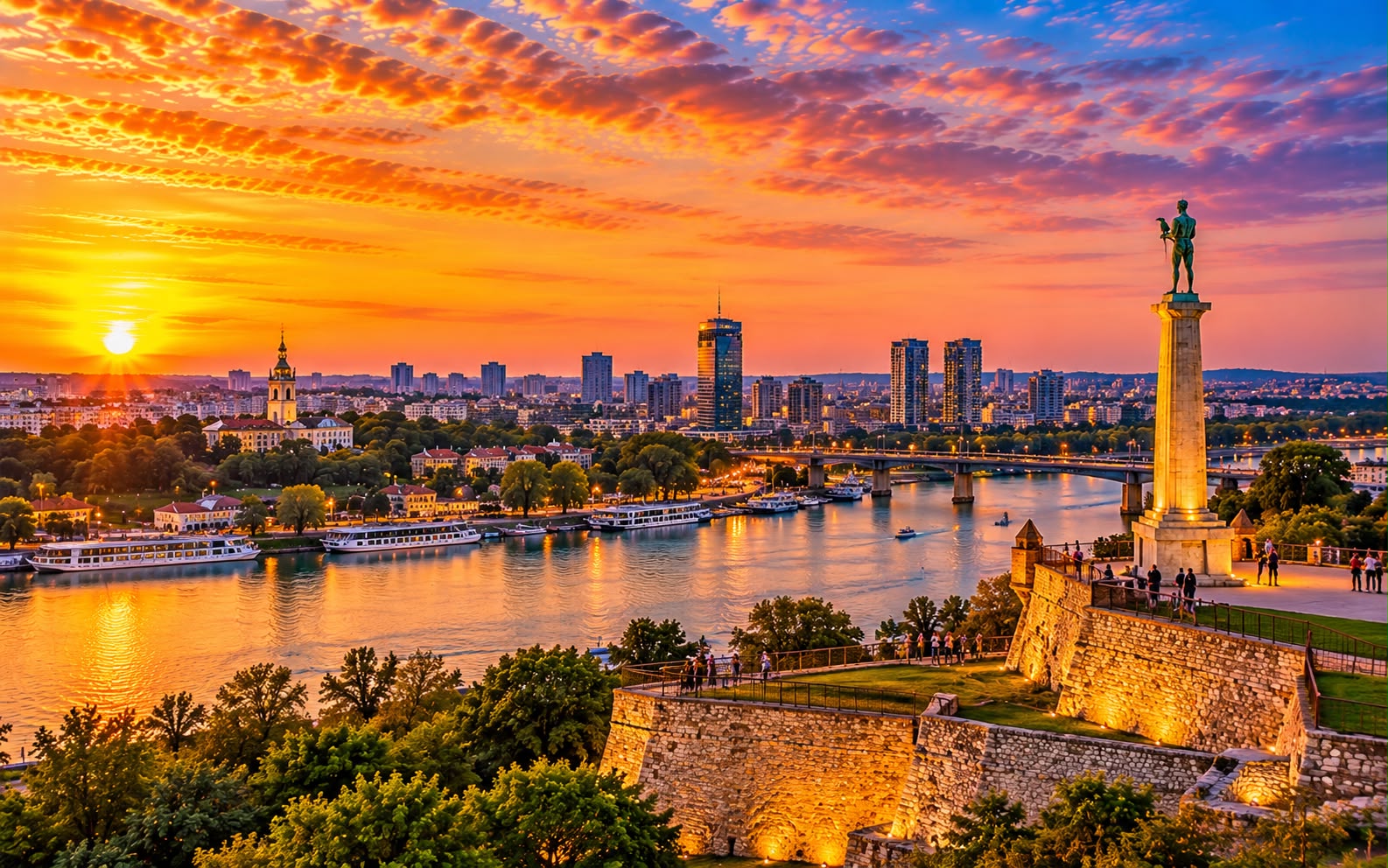
Serbia in 7 days: Belgrade, Novi Sad and the western hills
A fortress where the Sava meets the Danube, floating nightclubs moored to the riverbank, a narrow-gauge railway that climbs a mountain in a figure of eight, a canyon of hairpin meanders patrolled by griffon vultures, and a 12th-century monastery in white marble.
- Southern Europe
- 7 days
- ≈ AED 2,550 / person
- A capital that stays up, and canyons nobody photographs
Before you go
Belgrade has been destroyed and rebuilt more times than almost any city in Europe — somewhere around forty — which is what happens when you sit on the confluence of the Sava and the Danube and everyone wants it. The result is a capital with no single architectural period and no pretension about it: Austro-Hungarian, Ottoman, interwar, brutalist and new, all on the same street.
It is also the best value night out in Europe, and not subtle about it. Splavovi — nightclubs built on rafts moored to the riverbank — run until dawn, and the city’s reputation for going late is entirely earned.
Beyond it, the country empties out fast. Novi Sad is an hour north with a fortress above the Danube. West, the Šargan Eight railway climbs a mountain in a figure of eight through 22 tunnels, and Drvengrad is a wooden village a film director built for a shoot and then kept. South, the Uvac canyon doubles back on itself in hairpins with the largest griffon vulture colony in the region overhead, and Studenica has been a working monastery since the 1190s.
The shape: Belgrade (2 nights) → Novi Sad (1) → Mokra Gora (2) → Kraljevo area (1). Figure RSD 73,000 (≈ AED 2,546) per person excluding flights. Go May–June or September–October; July and August are hot and the festivals are expensive.
Before you go: the 15-minute admin
Visas
- Serbia is not in the EU or Schengen, and many nationalities enter visa-free for 30 or 90 days. Check your own against the current list.
- A Schengen visa does not cover Serbia and a Serbian entry does not touch your Schengen allowance — useful if you are stitching a longer European trip together.
- If Kosovo is also on your itinerary, read that guide’s border section first. The order you travel in matters.
Money
- Serbian dinar. Not the euro, despite neighbours using it. Cards work in cities; carry cash for monasteries, rural restaurants and the Uvac boat.
- Among the cheapest countries in Europe. Mains 800–1,600 dinar, a good dinner with wine under 3,000.
- Tipping: round up, or 10% for good service.
SIM and data
- Tourist SIMs from A1, Telekom or Yettel at the airport, a few hundred dinar for the week. Roaming from the EU is not free here.
- Coverage is good except deep in the Uvac canyon.
Getting around
- Belgrade airport is 25 minutes from the centre by taxi; use the official taxi desk in arrivals and take the printed slip.
- Belgrade–Novi Sad is 35 minutes on the fast train, which is genuinely good and very cheap.
- A car is needed from day 4. Western and southern Serbia are not served usefully by public transport. Hire from €30–45/day.
- Roads are decent on the main corridors and slow in the hills. Allow more time than the map suggests.
Travelling with kids?
- The Šargan Eight is a train that goes through 22 tunnels and crosses itself — it does the work on its own.
- Uvac is a boat trip with a cave at the end, which tends to land well.
- Belgrade’s Kalemegdan has a dinosaur park and a military museum full of outdoor tanks.
- The monasteries expect quiet and covered shoulders.
Day by day
Day 1 — Belgrade, the fortress and the old streets
- Afternoon — Land, taxi in, check in. Most of what you want is walkable from Knez Mihailova.
- 16:00 — Kalemegdan: the fortress park above the point where the Sava runs into the Danube. Walk out to the Pobednik statue for the view the city is built around, and the Military Museum’s open-air hardware if that appeals.
- 18:00 — Knez Mihailova, the pedestrian spine, down to the Republic Square and the National Museum.
- 20:00 — Skadarlija, the cobbled bohemian quarter, for dinner: ćevapi, pljeskavica, kajmak, and rakija whether you asked for it or not.
Where to stay in Belgrade (three nights across the trip)
- Luxury: the riverfront towers at Belgrade Waterfront or the restored grand hotels near Terazije.
- Mid-range: Dorćol and Vračar, both walkable to the centre and full of places to eat.
- Value: apartments in Savamala or near Slavija, cheap and central.
Day 2 — Tesla, St Sava, and the river
- 10:00 — Nikola Tesla Museum. Small, and the only museum in the world holding his personal effects — his ashes are here, in a gilded sphere. The induction-motor demonstrations are done by hand and worth the entry alone.
- 12:00 — The Temple of Saint Sava, one of the largest Orthodox churches anywhere. Begun in 1935, interrupted by occupation and then by communism, and the interior only finished recently — a dome mosaic in gold that you will not be ready for.
- 14:30 — Lunch, then Zemun: a separate Austro-Hungarian town until 1934, with low streets and the Gardoš Tower above them. Walk the Danube quay back toward the centre.
- 19:00 — Dinner in Dorćol, then the splavovi if you have the stamina. They are moored along both rivers and they do not get going until midnight.
Day 3 — Novi Sad and the fortress clock
- 09:30 — Fast train to Novi Sad, 35 minutes.
- 10:30 — Petrovaradin Fortress across the river — “the Gibraltar on the Danube”, with 16km of tunnels beneath it and a clock tower whose hands are reversed, the big hand counting hours so boatmen on the river could read it from a distance.
- 13:00 — Lunch on Zmaj Jovina, the pedestrian street, under the Name of Mary church.
- 15:00 — Sremski Karlovci, 20 minutes away: a small baroque town that is the centre of Serbian wine, and bermet, a fortified dessert wine that was reportedly served on the Titanic.
- Evening — Back to Novi Sad or Belgrade. If you are here in July, EXIT festival takes over the fortress and the whole trip needs planning around it.
Day 4 — West to Mokra Gora
- 09:00 — Collect a car and drive south-west, about three and a half hours into the hills.
- 13:00 — The Šargan Eight (Šarganska osmica): a restored narrow-gauge railway that climbs 300 metres in 13.5km by looping through a figure of eight, 22 tunnels and ten bridges. The round trip takes about two and a half hours. Book ahead in summer.
- 16:00 — Drvengrad, the wooden village the director Emir Kusturica built on a hill for a film and then kept — timber houses moved here from around the country, a cinema, and streets named after people he admires.
- Evening — Stay in Mokra Gora or nearby Zlatibor.
Day 5 — The Uvac meanders
- 08:30 — Drive south to Uvac, about two hours. Book the boat in advance; there are set departures and they fill.
- 10:30 — The boat trip. The river doubles back on itself in extreme hairpin meanders between 100-metre cliffs, and the gorge holds one of Europe’s largest colonies of griffon vultures — three-metre wingspans, often directly overhead.
- 12:30 — The Ice Cave stop on most boat trips, and the climb to the viewpoint above the meanders, which is the photograph you have probably already seen without knowing where it was.
- 16:00 — Drive on toward Kraljevo or Vrnjačka Banja, about two hours, for the night.
Day 6 — Studenica, and back north
- 09:30 — Studenica Monastery, founded in the 1190s by Stefan Nemanja, the dynasty’s founder. White marble churches inside a circular wall, with 13th-century frescoes in the Church of the Virgin that are among the best surviving Byzantine painting anywhere. UNESCO-listed and still a working community — cover shoulders and knees.
- 12:30 — Lunch, then Žiča monastery on the way out if you want a second, painted deep red.
- 15:00 — Drive north to Belgrade, about three hours, and return the car.
- 19:30 — Last dinner.
Day 7 — Belgrade, fly home
- Morning — The Museum of Yugoslavia and the House of Flowers, where Tito is buried, which explains a great deal about the region, or Ada Ciganlija, the river island the city swims at.
- Afternoon — Airport, 25 minutes.
Costs and practicalities
Best time to visit
May–June and September–October. Belgrade summers are hot and the shoulder months are when the city and the countryside are both at their best.
- May–June — green, warm, and the Danube and Sava riverfronts in use. The best for the Tara and Đerdap national parks.
- July–August — hot, up to 35°C, and EXIT festival in Novi Sad in July and the Guča trumpet festival in August, which is one of the most extraordinary and least restrained events in Europe.
- September–October — the best of the year. The rakija and wine harvest, warm days, and clear light on the Drina.
- November–March — cold and grey, with Kopaonik and Zlatibor skiing from December and Belgrade’s cafe culture moving indoors.
Orthodox Christmas on 7 January and the slava family feasts are the winter calendar.
Travel tips
- The dinar, not the euro. Cards work in Belgrade and the cities; carry cash for villages and monasteries.
- Entering Serbia after a Kosovo stamp can be refused. If you plan both, enter Serbia first and return through it, or fly in and out of Kosovo separately.
- Register with the police within 24 hours if you are not in a hotel. Hotels do it automatically; private rentals often do not and the obligation is yours.
- Rakija is offered constantly and refusing outright is awkward. Accept, sip, and leave it.
- Belgrade’s splavovi — the river raft clubs — are the nightlife, and they move and change each season. Ask locally rather than booking online.
- Buses cover the country far better than the trains, which are slow.
- Cover shoulders and knees at monasteries; Studenica and Sopoćani are working houses and wraps are usually lent.
What this trip actually costs
Two people, 6 nights, mid-range comfort, flights excluded:
| Item | Cost |
|---|---|
| Hotels, 6 nights | RSD 54,000 (≈ AED 1,884) |
| Car hire, 4 days + fuel | RSD 32,000 (≈ AED 1,116) |
| Trains and transfers | RSD 6,000 (≈ AED 209) |
| Food and drink, 7 days | RSD 38,000 (≈ AED 1,326) |
| Šargan Eight, Uvac boat, museums, monasteries | RSD 16,000 (≈ AED 558) |
| Total for two | RSD 146,000 (≈ AED 5,093) |
- Roughly RSD 73,000 (≈ AED 2,546) per person once you strip the shared car. Serbia is among the cheapest countries in Europe and it shows most in food and drink.
- The car is a third of the budget and only needed from day 4. Belgrade and Novi Sad are better without one.
- EXIT festival in July multiplies Novi Sad prices and fills Belgrade too. Either plan for it or avoid it.
- Hotel picks here are chosen on location, not on commission — always check prices and recent reviews before booking.
What to pack
- Layers. The hills are much cooler than Belgrade, and the Uvac boat is cold on the water even in summer.
- Covered shoulders and knees for monasteries. Skirts are usually lent at the gate; it is easier to arrive dressed.
- Shoes for a fortress and a gorge viewpoint, neither of which is paved.
- Cash in dinar, especially for rural stops.
FAQ
Is Belgrade safe at night? Yes, and it is busy very late. Ordinary city care applies. Use registered taxis or an app rather than cars touting outside clubs.
Do I need the car for the whole week? No. Hire it on day 4 in Belgrade and return it on day 6. Belgrade and Novi Sad are connected by a fast train and parking in both is a nuisance.
Can I combine Serbia with Kosovo? Yes, but the order matters and getting it wrong can mean being refused entry. Read the border section of the Kosovo guide before you book anything.
Is Uvac worth the drive? It is the single most striking landscape in the country and almost unphotographed outside Serbia. If you only make one detour, make it this one.
Prices and entry rules change, and what you need depends on your passport; last checked 8 October 2026, so confirm with the embassy or your airline before booking.


