 The Itinerary
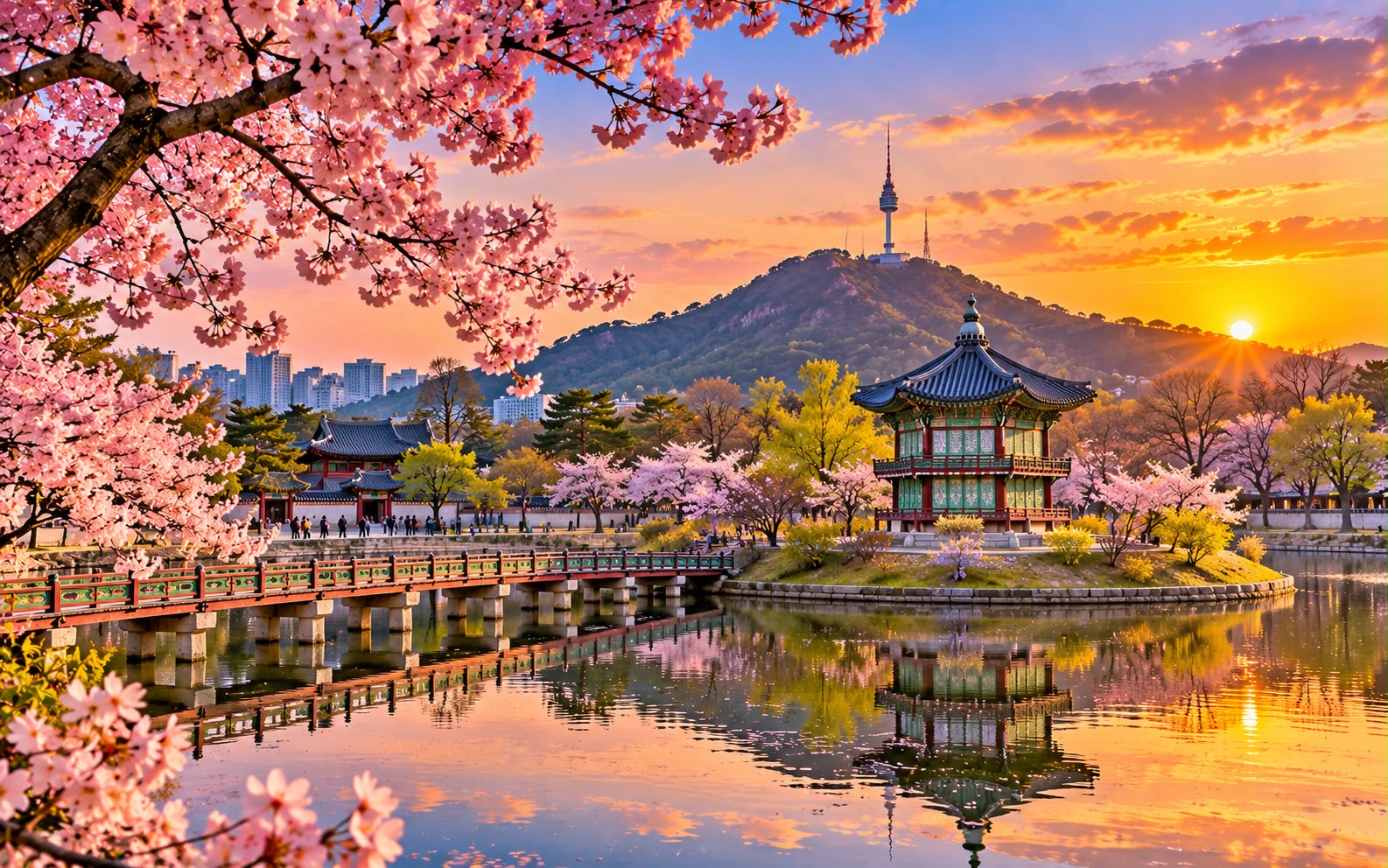
South Korea in 10 days: Seoul and Busan
The K-everything trip done properly: palaces entered free in a rented hanbok, a stare into North Korea from the DMZ, midnight food alleys, then the KTX south to Busan's rainbow village and a sky capsule over the sea — plus the one app truth (Google Maps doesn't work here), the visa file that passes, and where halal Seoul actually lives.
- East Asia
- 10 days
- ≈ AED 5,150 / person
- First-time visitors
Before you go
South Korea compressed a century of change into fifty years and kept the receipts: Joseon palaces stand across the street from robot baristas, monks chant uphill from e-sports stadiums, and the food — barbecue smoke, market alleys, convenience-store midnight feasts — may be the best value eating in the developed world. Your teenagers already know the soundtrack.
This first Korea guide runs the classic pair: Seoul, six days deep (palace-and-hanbok day, DMZ day, three neighbourhoods of food), then the KTX bullet train south to Busan — Korea’s salty, candy-coloured second city — before looping home.
Go late March–April (cherry blossom) or late October– November (foliage) — Korea’s two jackpot seasons; May–June and September are the reliable lovely middle. July brings jangma monsoon humidity; winter is -5 to -10°C, neon-bright and cheap. All costs are in Korean won (KRW; ₩10,000 ≈ US$7.2).
Before you go: the visa file and the app truth
The visa, or the K-ETA
- Check which one applies to you, because they are very different. A long list of nationalities enters visa-free and needs only the K-ETA — ~US$7, online, approved in days. Everyone else, India included, needs the C-3-9 tourist visa: there is no visa-on-arrival, and K-ETA is not available to passports that need a visa.
- If it’s the visa: apply through a Korean embassy or a KVAC centre in the country you live in — typically 7–10 working days, and the fee lands around US$65–90 with service charges (single entry, up to 90 days).
- The file Korea likes: 6 months of statements showing steady salary and settled balances (“averages, not last-week top-ups”), employment and leave evidence, proof of residence if you are applying outside your own country, itinerary and refundable bookings. Apply 3–4 weeks out.
The app truth (read before landing)
- Google Maps cannot route you in Korea — mapping-data export laws neuter it. Download Naver Map and Kakao Map (both have English) before flying; they are the national navigation, bus-arrival and everything apps.
- Papago beats Google Translate for Korean — menus, signs, conversations.
- T-money (card ₩3,000–4,000 at any convenience store, or phone versions) taps every metro, bus and taxi in the country; fares from ~₩1,400. Kakao T hails taxis (honest meters, no negotiation culture).
- Cards work almost everywhere; keep ₩50,000 in cash for street stalls and markets. No tipping, anywhere, ever — it can genuinely confuse people.
Day by day
Day 1 — Land in Seoul, Myeongdong by night
Stay in Myeongdong (shopping + food + airport express convenience) or Insadong/Jongno (palace quarter charm).
- Afternoon — Land ICN (~9 h direct from the Gulf). AREX express to Seoul Station (₩11,000, 43 min), T-money loaded, check in.
- 18:30 — Myeongdong street-food alley as the griddles light: tornado potatoes, cheese-scallion skewers, hotteok (brown-sugar pancakes) for dessert — dinner by instalments (~₩15,000–25,000 pp).
- 20:30 — First skincare-shop reconnaissance (the haul comes later; resistance now builds character). Early night — hanbok waits.
Where to stay in Seoul (five nights + one at the end)
- Luxury: JW Marriott Seoul — 4.9/5 on TripAdvisor (~2,300 reviews), Express-Bus-Terminal connected, pool with a skyline. ~₩450,000+.
- Boutique: Hotel28 Myeongdong — 4.8/5, cinema-themed calm in the middle of everything. ~₩220,000–300,000.
- Value: Hotel Skypark Myeongdong 3 — steps from the night market; TripAdvisor’s value shortlist regular. ~₩130,000–180,000.
Day 2 — Hanbok day: palaces for free
- 09:00 — Rent a hanbok near Gyeongbokgung (₩10,000–15,000 for 4 hours, hair-braiding extra) — and here’s the trick: hanbok wearers enter the royal palaces free.
- 09:40 — Gyeongbokgung (₩3,000 without hanbok; ₩0 with; CLOSED TUESDAYS): position for the 10:00 royal guard-changing ceremony at Gwanghwamun Gate, then Geunjeongjeon throne hall and the lake pavilion — the photos take themselves.
- 12:30 — Return the hanbok; lunch in Insadong (bibimbap, ~₩10,000–15,000).
- 14:00 — Bukchon Hanok Village: 600-year-old tiled-roof lanes between the palaces — the famous view down alley 31. Etiquette matters: people live here — quiet hours are enforced, whisper and wander.
- 16:30 — Insadong’s Ssamziegil spiral market and a traditional tea house (omija tea, ₩8,000, worth every antioxidant).
- 18:30 — Cheonggyecheon stream walk at lamp-light into Gwangjang Market: mung-bean pancakes (bindaetteok, ₩5,000), “drug” kimbap, tteokbokki — eat standing at the grandmothers’ counters (~₩15,000 pp buys a feast).
Day 3 — The DMZ: staring into North Korea
- 07:30 — DMZ day tour (~₩100,000–120,000 pp, passport mandatory, most tours closed Mondays): the world’s tensest border as a day trip — the 3rd Infiltration Tunnel (walk into the dug-under-the- border tunnel itself), Dora Observatory (telescopes across the wire into a North Korean village and its giant flagpole), Imjingak’s rusted locomotive and ribbon-covered fence.
- The honesty: the famous JSA blue huts (Panmunjom) have been suspended/limited for tourists since 2023 — standard tours don’t include them, whatever old blogs say; and tours can cancel on short notice when tensions rise. It remains the most sobering, fascinating day in Korea. Dress plainly; jokes travel badly here.
- 16:30 — Back in Seoul; decompress the modern way:
- 18:00 — Hongdae — buskers and K-pop dance crews on the walking street, vintage shops, then norebang (private karaoke, ₩20,000–30,000/hour of glory) and Korean fried chicken (~₩22,000 a bird, halal versions exist — see FAQ).
Day 4 — The secret garden and the two Gangnams
- 10:00 — Changdeokgung Palace + the Secret Garden (₩3,000 + ₩5,000 timed garden tour — book online; closed Mondays — note the alternation: Gyeongbokgung rests Tuesdays, Changdeokgung Mondays): the Huwon’s pavilion-and-lotus-pond valley is the palaces’ quiet masterpiece.
- 12:30 — Ikseondong hanok lanes — the old houses turned café-bakery wonderland (brunch ~₩15,000).
- 15:00 — Metro south of the river: the Starfield Library at COEX (free — the two-storey book cathedral), the tongue-in-cheek Gangnam Style hands statue, or Bongeunsa temple doing serene resistance across from the mall.
- 18:30 — K-BBQ initiation, done right: samgyeopsal or galbi on the table grill — staff wield the scissors, you wrap (lettuce + meat + ssamjang + garlic, one bite), and the side dishes refill free (~₩25,000–40,000 pp). Beef-only grills abound for the pork-averse.
Day 5 — The choice day (and the tower)
Pick your Seoul:
- The K-drama pilgrimage: Nami Island + Petite France day (~₩70,000–90,000 tours, or DIY by ITX) — the tree avenues and lakeside lanes half your favourite dramas filmed on.
- The theme-park day: Lotte World (indoor+outdoor, ~₩62,000) or Everland (bigger, further) — kids vote, parents comply.
- The Seoul-classics day: morning Namsan walk to N Seoul Tower (observatory ~₩21,000; the love-locks terrace is free and arguably better), War Memorial (free, superb), then Itaewon — the Seoul Central Mosque and the city’s halal restaurant row (see FAQ) for dinner.
- 20:30 — Whichever day you chose: Han River hour — convenience-store ramyeon at a Hangang park bench, cooked at the store’s hot-water station, city lights across the water. Seoul’s cheapest perfect moment (~₩5,000).
Day 6 — KTX south, into the rainbow village
- 09:00 — Seoul Station → Busan by KTX: 2h40, ₩59,800 standard class (book seats on Korail’s app days ahead; right side for late-route sea glimpses).
- 12:30 — Check in Haeundae or Gwangalli; market lunch.
- 14:00 — Gamcheon Culture Village: the hillside refugee settlement repainted into a Lego-bright maze — buy the stamp map (₩2,000), hunt the murals, queue briefly for the Little Prince ledge photo, get lost on purpose (2–3 hours).
- 18:00 — Down to Nampo-dong: BIFF Square’s film- festival handprints and street snacks (ssiat hotteok — the seed-stuffed Busan upgrade), then Jagalchi fish market — pick your fish downstairs, they grill it upstairs (~₩30,000–50,000 for two; the grilled-mackerel route needs no adventurousness).
Where to stay in Busan (three nights)
- Beachfront luxury: Grand Josun Busan — 4.9/5 (~900 reviews), the pool deck floating over Haeundae sand. ~₩350,000+.
- Central classic: Lotte Hotel Busan — 4.8/5 (~2,600 reviews), Seomyeon’s metro-hub polish. ~₩200,000–280,000.
- View value: Hotel Aqua Palace — 4.7/5, Gwangalli-front rooms staring at the lit bridge. ~₩130,000–180,000.
Day 7 — Sea temple, sky capsule
- 09:00 — Bus/taxi 40 min east to Haedong Yonggungsa (free): the rare Korean temple built ON the sea rocks — dragons, lanterns, waves exploding below the Buddha. Go early; coaches arrive by 11.
- 12:00 — Back to Haeundae: raw-fish alley or dwaeji gukbap (Busan’s pork-rice soup — the city’s soul dish, ~₩10,000) for the initiated.
- 14:00 — Blueline Park: ride the sky capsule along the clifftop rail to Cheongsapo (couple capsule ~₩60,000–70,000 one-way — book a slot; the pastel capsules over the sea are Busan’s postcard) and the beach train back (~₩7,000 pp). Daljmaji hill cafés if time floats.
- 17:00 — Haeundae beach hour; sandcastle-grade sand, proper swimming in season.
- 19:30 — Gwangalli Beach evening: the diamond-lit bridge, café-row neon — and on Saturday nights, the free drone show writes whales and hearts over the water (10 minutes, check that week’s schedule). Dinner on the strip (~₩20,000–35,000 pp).
Day 8 — Cliffs, soup and the bathhouse question
- 09:30 — Choose your coast: Taejongdae cliffs (Danubi train loop, lighthouse over jade water) or the Songdo cable car (crystal-floor cabins over the bay, ~₩20,000 return).
- 12:30 — Seomyeon for lunch and Korea’s best underground shopping maze.
- 15:00 — The cultural deep-end (optional but memorable): Spa Land Centum — the famous jimjilbang (Korean bathhouse; ~₩25,000): note honestly, the bath floors are nude and gender-split (universally observed, briefly startling, quickly liberating), while the shared sauna zones are pyjama-clothed and family-friendly. Alternatives: Huinnyeoul culture village’s cliff lane — Busan’s quieter, whiter Gamcheon.
- 19:00 — Farewell-Busan dinner: hoe (Korean sashimi) on Millak’s raw-fish floors, or one more KBBQ with the bridge lights.
Day 9 — Back up the line, last Seoul evening
- 11:00 — Final Haeundae stroll; 13:00 KTX north (₩59,800).
- 16:00 — Seoul re-entry for the finale: the Myeongdong/Olive Young haul (the skincare suitcase event this trip was partly always about) and any K-pop merch pilgrimage still outstanding.
- 19:30 — Last supper by temperament: a splurge on temple cuisine (Balwoo Gongyang-style tasting, ~₩50,000–80,000 — vegan Buddhist fine dining, book ahead), or Gwangjang round two because you’ve thought about that bindaetteok for a week.
- Overnight near Myeongdong/Seoul Station for the morning train to the plane.
Day 10 — Home from Incheon
- Morning — AREX to ICN (leave 3.5 h — the airport is its own city; the Korean Cultural Street and transit spa are genuinely good). Long-haul flight home, hand luggage 40% sheet masks by volume.
Costs and practicalities
Best time to visit
Late March–April for blossom and October–November for autumn colour, and both are short, precise and heavily travelled.
- Late March–April — the cherry blossom moves north over about three weeks, reaching Jeju and Busan first and Seoul around the first week of April. Jinhae’s festival is the biggest.
- May–June — warm, green and underrated; the best value of the year.
- July–August — hot, very humid, and the jangma monsoon in late June and July, followed by typhoon risk into September.
- October–November — the autumn foliage, which is as good as the blossom and lasts longer. Seoraksan turns first in mid-October, Seoul in early November.
- December–February — cold and dry, with skiing in Gangwon and the Hwacheon ice festival in January.
Chuseok in September or October and Seollal in January or February are the two national holidays when the whole country travels.
Travel tips
- Get a T-money card at any convenience store. It works on subways, buses and taxis nationwide and is the single most useful purchase on arrival.
- Korea is nearly cashless and foreign cards work widely, but some small restaurants and markets are cash-only.
- Download Naver Map or KakaoMap. Google Maps is crippled in Korea by mapping export restrictions and will not give you walking or driving directions.
- A K-ETA may be required depending on nationality — check, as the requirement has been waived and reinstated for different countries.
- Remove shoes when entering homes, temples, guesthouses and many restaurants with floor seating.
- Pour for others, not yourself, and receive a drink with two hands from someone older. This matters more than any other etiquette rule here.
- Tipping is not customary and can cause confusion.
What this trip actually costs
Two people, 9 nights (5+3+1), mid-range comfort, international flights excluded:
| Item | Cost |
|---|---|
| Visas for two (C-3-9 via the embassy route) | KRW 210,000 (≈ AED 566) |
| Hotels, 9 nights | KRW 1,600,000 (≈ AED 4,316) |
| KTX Seoul⇄Busan, two seats each way | KRW 240,000 (≈ AED 647) |
| Local transport: T-money taps, AREX, buses, Kakao taxis | KRW 210,000 (≈ AED 566) |
| Tours & sights: DMZ day, hanbok rentals (palace entry free), Secret Garden, N Tower, sky capsule + beach train | KRW 390,000 (≈ AED 1,052) |
| Food, 10 days (markets to KBBQ) | KRW 900,000 (≈ AED 2,428) |
| eSIM | KRW 30,000 (≈ AED 80.93) |
| Buffer: Nami day, Lotte World, the Olive Young event | KRW 220,000 (≈ AED 593) |
| Total for two | KRW 3,800,000 (≈ AED 10,251) |
- Roughly KRW 1,900,000 (≈ AED 5,125) per person (~US$1,375) — Japan-adjacent wonder at two-thirds the bill: transit is ₩1,400 a ride, market feasts run ₩15,000, and the palaces cost less than the hanbok that gets you in free. Guesthouse beds and convenience-store breakfasts pull it near KRW 1,500,000 (≈ AED 4,046); beachfront suites and daily splurges pass KRW 2,600,000 (≈ AED 7,014).
- Book in this order: visa (3–4 weeks out, the file polished) → flights (ICN round trip) → hotels free-cancel (cherry-blossom and foliage weeks sell out) → DMZ tour (passport details required; not Mondays) → Secret Garden timed slot and KTX seats on the Korail app → sky-capsule slot 2–3 days out → Naver Map, Kakao Map and Papago installed before wheels-up — that’s the real checklist item.
- Hotel and restaurant picks here are unsponsored — no affiliate links in this article. Chosen on location and current ratings; always check prices and recent reviews before booking.
What to pack
- Walking shoes rated for 20,000-step days and palace gravel; slip-on-ability helps (floors, fitting rooms, temple halls).
- Layers: spring/autumn swing 8–20°C daily; winter needs the real coat; summer needs the smallest clothes you own plus a rain shell (jangma).
- Modest-enough cover for temples; socks without holes (you’ll be shoeless more than you think).
- An empty duffel inside the suitcase — the skincare/merch haul is not a hypothesis.
- Power bank (the apps run the day), T-money card kept from arrival, ₩50,000 street-food float.
- Kids: the DMZ has minimum-age quirks by tour (check); Lotte World compensates.
FAQ
How strict is the Korean visa? Document-strict, decision-fair: the embassy wants a clean 6-month statement story, employer letters and a credible itinerary. Applicants commonly report 7–10-working-day turnarounds. No VoA exists, and K-ETA is not available to passports that need a visa — don’t buy one from a copycat site.
Is the DMZ safe — and worth it? Statistically as safe as any escorted tour in Korea (the machinery around it is the point), and yes — standing in a tunnel North Korea dug under the border recalibrates the evening news forever. Know the 2026 reality: JSA/Panmunjom visits remain suspended for general tourists; the 3rd Tunnel + Dora Observatory format is the real product. Tours cancel when politics twitch — book early-trip, keep a swap day.
When exactly for cherry blossoms or foliage? Blossoms: late March (Busan first) to mid-April (Seoul) — Jinhae’s festival near Busan is the national epicentre. Foliage: late October–early November, palaces and Namsan glowing. Both windows sell hotels out a season ahead; this itinerary works identically in either.
Halal and vegetarian food? Better than reputation, with a map: Itaewon is halal HQ (Seoul Central Mosque, certified Korean fried chicken and BBQ, kebab row), Myeongdong keeps several halal-certified Korean kitchens, Busan is thinner (Haeundae’s Indian/Pakistani spots carry it). Vegetarians need the phrases — broth and fish sauce hide everywhere — but bibimbap (“gogi ppae juseyo” — no meat), japchae, kimbap variants and temple cuisine (Korea’s 1,700-year vegan tradition) make it genuinely rewarding. Note: traditional kimchi often contains fermented seafood — ask, or enjoy the mul-kimchi.
Language barrier? Lower than feared: metro and signs are bilingual, menus have photos, Papago handles the rest, and politeness (“annyeonghaseyo” + a small bow) opens every door. The apps matter more than the alphabet — though hangul takes literally one afternoon to learn and turns every sign into a puzzle you can solve.
What’s Korea guide #2? Jeju Island (Hallasan, lava tubes, haenyeo divers, the beaches) or the seasonal special (a blossom/foliage-chasing route timed to the week). And for the K-pop households: a dedicated fandom-Seoul day-by-day is quietly under consideration.
Prices and entry rules change, and what you need depends on your passport; last checked 8 October 2026, so confirm with the embassy or your airline before booking.


