 The Itinerary
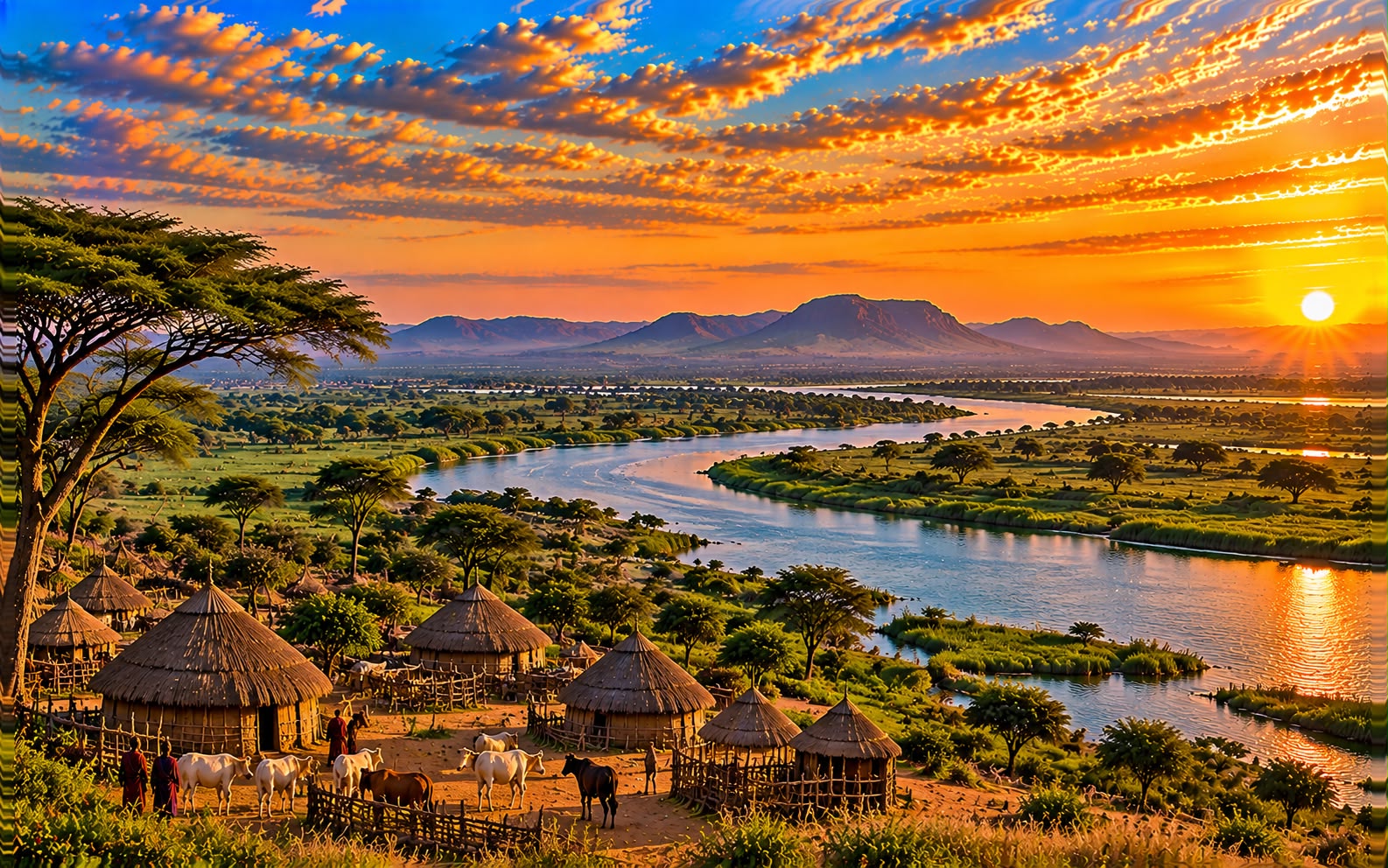
South Sudan in 8 days: the Mundari cattle camps and the largest land migration on earth
A migration of six million antelope that nobody had counted until an aerial survey in 2023 found it was the largest on earth, and cattle camps where herders sleep among three-metre horns in smoke from dung fires — in the world's youngest country, which almost no one visits.
- East Africa
- 8 days
- ≈ AED 12,100 / person
- Six million antelope moving at once — more than the Serengeti, confirmed only in 2023
Before you go
Read this first
Most governments advise against all travel to South Sudan, or against all travel outside Juba with all-but-essential advice for the capital. Several state that their ability to assist you is severely limited.
- The civil war of 2013–2018 killed an estimated 400,000 people. The 2018 peace agreement holds in part, and its implementation has repeatedly stalled.
- Political tension escalated sharply in 2025, including the detention of First Vice-President Riek Machar in March, and clashes in Upper Nile. The risk of renewed national conflict is real.
- Intercommunal and cattle-raiding violence is frequent in Jonglei, Warrap, Unity, Lakes and Upper Nile and can be severe.
- Armed groups and criminality affect roads throughout. Most overland movement outside Juba is not advised.
- Kidnapping and armed robbery are specific risks.
- The humanitarian situation is among the worst in the world, with the Sudan war next door pushing hundreds of thousands across the border.
- Medical facilities are minimal. You need evacuation cover and a realistic plan to use it.
This guide does not tell you to go. A handful of specialist operators run photographic trips to the Mundari camps and, very occasionally, charters to the migration. That is a considered risk taken with current information and serious logistics. Check your own government’s advice, which reflects this week rather than this year.
In 2023 an aerial survey by African Parks and the government counted roughly six million antelope moving across the Boma–Badingilo landscape. White-eared kob, tiang, Mongalla gazelle and bohor reedbuck. It is the largest land mammal migration on earth — larger than the Serengeti wildebeest migration, which is around 1.3 million animals — and almost nobody knew the full scale of it until that survey flew.
It survived a civil war in which almost every other wildlife population in the country collapsed. There is essentially no tourism infrastructure for it. Seeing it means a charter aircraft, a bush camp and an operator who has done it before.
The Mundari are what most visitors actually come for. Cattle herders on the White Nile north of Juba, whose Ankole-Watusi cattle carry horns that span well over two metres. The camps burn dung through the day — the smoke keeps flies off the cattle and coats everything, people included, in pale ash. Herders sleep beside their animals. Cattle are wealth, bride price, status and identity, and are not eaten.
It is among the most photographed subjects in Africa and among the least visited, which is a tension worth holding: the images are spectacular, and the people in them live in a country in crisis. Go with an operator who pays the community properly and ask what that arrangement is.
Juba itself is a small, hot, hard-working capital on the White Nile, with the Nile tilapia, the John Garang Mausoleum and a market that is the best place to understand what the economy actually is.
Eight days. Figure USD 3,300 (≈ AED 12,119) per person. December to March, the dry season — and the migration is in the Badingilo–Boma corridor roughly from January.
Before you go: the 15-minute admin
Entry
- A visa is required and needs a letter of invitation; your operator provides it. E-visa systems have come and gone — use the operator’s route.
- Yellow fever vaccination is mandatory and is checked at Juba.
- Juba International is the entry point, via Addis Ababa, Nairobi, Entebbe, Cairo or Dubai.
- Photography permits are required and are issued in Juba by the Ministry of Information. Do not photograph anything, anywhere, before you have one in your hand.
Money
- The South Sudanese pound has lost most of its value and the official rate is not the rate anyone transacts at. Price everything in dollars.
- Cash only, in clean, post-2013 US dollars. Older or marked notes are refused.
- No card works and no ATM is usable. Bring the full budget.
- Juba is expensive — a legacy of a decade of aid and oil economies with very little domestic production.
On the ground
- A specialist operator is mandatory in practice. They hold the permits, the community relationships and the aircraft.
- The photography permit is checked and the absence of one leads to detention and confiscated equipment. This is the single most common way visitors get into trouble here.
- Do not photograph the airport, bridges, military, police or government buildings even with a permit.
- No overland movement outside the Juba–Terekeka corridor without specific operator advice.
- Curfews are imposed in Juba at short notice after political events.
- Carry your own medical kit. Evacuation is to Nairobi.
Day by day
Day 1 — Juba
- Permits are required for photography and for movement, and your operator holds them — you do not travel without one.
- Bring US dollars in cash. There is no working card infrastructure.
- 10:00 — Arrive, collect permits, and let the operator handle the airport, which is chaotic and where a fixer halves the time.
- 14:00 — The John Garang Mausoleum, and the independence story that attaches to it — 2011, and the civil war that followed two years later.
- 16:30 — Konyo Konyo market in the late afternoon.
- 18:00 — The White Nile from the riverbank, with the bridge in the distance that you must not photograph.
- Photography rules here are strict and enforced — no bridges, no government buildings, no uniforms, no airport.
Day 2 — North to the Mundari
- 09:00 — Two to three hours north along the Nile, then into the camps.
- 14:00 — Arrive in the afternoon for the smoke and the light, which is the whole reason photographers come. The dung fires are lit against mosquitoes and the whole camp disappears into smoke.
- Ask before photographing individuals, every time, and understand what your operator is paying and to whom.
- 17:00 — The cattle come in, which is the event of the Mundari day.
- The cattle are not for sale, not for eating and not for touching without permission. They are family — an Ankole bull is worth more than most things its owner possesses.
- 19:00 — Camp with them, if your operator arranges it — the camps move, and locating them is done on the day.
Day 3 — A full Mundari day
- 04:00 — Staying is how you see the milking at four in the morning — by torchlight, into gourds, with the calves let to the udder first.
- 06:00 — The cattle being driven out at first light, which with the dawn behind them is the other photograph.
- 09:00 — The ash, which is dung ash, goes on people and cattle alike as insect repellent and sunscreen. It gets into everything you own — bring clothes you will throw away.
- 13:00 — The middle of the day in whatever shade there is.
- 17:00 — Dusk and dawn are entirely different scenes, so the second evening is not a repeat of the first.
Day 4 — The river, and back
- 06:00 — A last dawn, which is the one most people say they would have come for alone.
- 10:00 — The Nile at Terekeka, and the fishing communities along it.
- 14:00 — Back toward Juba, or stay out a third night if the charter is tomorrow.
- 18:00 — Into Juba, and confirm the flight tonight.
Day 5 — Fly to Badingilo or Boma
- Charter from Juba to a bush strip; there is no road option worth considering.
- 08:00 — The flight, which is 90 minutes and is itself the best view of the landscape you will get.
- If the charter does not happen — weather, aircraft, permissions — have the Mundari extension ready as the alternative. It frequently is.
- 12:00 — Fly-camping with the operator’s crew — there are no lodges. Everything comes in with you.
- 16:00 — The first drive. African Parks took on management of Badingilo and Boma in 2022, and the survey work since has transformed what is known about the landscape.
Day 6 — The migration
- 05:30 — Out at first light.
- The migration is a moving target and nobody can guarantee you will intersect it. January to March is the window, and even then it is a search — white-eared kob and tiang in numbers the 2023 surveys put in the millions, which would make it the largest land mammal migration on earth.
- 11:00 — Back through the heat.
- 16:00 — A long afternoon drive, often an hour’s flying-time’s worth of ground by vehicle.
- 19:00 — Camp, and the sky out here is unpolluted in every sense.
Day 7 — A second search day
- 05:30 — Again, because one day is not a sample.
- This is not a conventional safari. The roads are tracks, the animals are not habituated, and the reward is scale rather than close sightings.
- 13:00 — Lunch in camp.
- 16:00 — The last drive, and the Boma escarpment if that is the sector you are in.
- 19:00 — Pack. The strip has no lights and the flight is early.
Day 8 — Juba and out
- 08:00 — Back by charter, then the international connection.
- 13:00 — A few hours in Juba if the timing allows, for the market.
- Build a buffer day. Internal flights here move for reasons nobody will explain to you — and the international departures out of Juba are few enough that missing one costs a day or more.
Costs and practicalities
Best time to visit
December–March is the dry season and the only practical window — the rains make most of the country impassable.
- December–March — dry, hot, and the only time the Mundari camps and the bush strips are reliably reachable. The migration is in the Badingilo–Boma corridor roughly January to March.
- April–May — the rains begin and travel becomes difficult quickly.
- June–October — the wet season. The Sudd swells, roads disappear, and the country is largely unreachable by vehicle.
- November — the water recedes and the ground begins to firm.
The Mundari camps move with the water and the grazing, so their location changes within the season — your operator finds them rather than booking them.
Travel tips
- A photography permit is required and enforced. Get it in Juba from the Ministry of Information before photographing anything; the absence of one means detention and confiscated equipment.
- Even with a permit, do not photograph the airport, bridges, military, police or government buildings.
- Bring clean, post-2013 US dollars. Older or marked notes are refused; no card works and no ATM is usable.
- A specialist operator is mandatory in practice — they hold the permits, the community relationships and the aircraft.
- A yellow fever certificate is mandatory and checked at Juba. Malaria prophylaxis is essential.
- Ask before photographing individuals in the cattle camps, every time, and understand what your operator pays and to whom.
- Bring clothes you will throw away. The dung smoke in the camps does not come out, and the ash gets into everything.
What this trip would cost
Two people, 7 nights, expedition standard, international flights excluded:
| Item | Cost |
|---|---|
| Charter to Badingilo or Boma, return, two people | USD 3,200 (≈ AED 11,752) |
| Operator, vehicles, crew and fly-camping | USD 2,000 (≈ AED 7,345) |
| Juba hotels, 3 nights | USD 600 (≈ AED 2,204) |
| Permits, community fees and park entry | USD 600 (≈ AED 2,204) |
| Food, drink and supplies throughout | USD 200 (≈ AED 735) |
| Total for two | USD 6,600 (≈ AED 24,239) |
- Roughly USD 3,300 (≈ AED 12,119) per person. The charter is half of it, and without it the migration is not reachable at all.
- A Mundari-only trip is far cheaper — drop the charter and the park fees and it comes down to roughly a third.
- All of it in clean US dollars, much of it prepaid by transfer.
- Evacuation cover is essential and is a separate specialist product. Standard travel insurance excludes countries under advisory.
- Figures are indicative and aviation costs here move constantly.
- Hotel picks here are chosen on location, not on commission — always check prices and recent reviews before booking.
What to pack
- Clean, post-2013 US dollars.
- A yellow fever certificate.
- Malaria prophylaxis.
- Clothes you will throw away. The dung smoke does not come out.
- Dust protection for cameras, several blowers, and more cleaning cloths than seems sane.
- A head torch, a power bank and a solar charger — there is no grid in the camps.
- Your own comprehensive medical kit.
FAQ
Is the South Sudan migration really bigger than the Serengeti’s? Yes. The 2023 aerial survey counted around six million animals against roughly 1.3 million wildebeest in the Serengeti ecosystem. It had never been systematically surveyed before.
Can I be sure of seeing it? No. It is a moving population across a vast landscape with no roads and no lodges, and finding it is a search conducted from a light aircraft and a bush camp.
Why do the Mundari cover themselves in ash? It is burnt dung, used as insect repellent and sun protection for both people and cattle. The smoke also keeps flies off the herd.
Do I need a photography permit? Yes, and it is enforced. Get it in Juba before you photograph anything, and still avoid the airport, bridges, military and government buildings.
Will my cards work? No. Bring the whole budget in clean US dollars.
What language do they speak? English is the official language. Juba Arabic is the lingua franca; Dinka, Nuer, Bari and Mundari are among more than sixty indigenous languages.
Prices and entry rules change, and what you need depends on your passport; last checked 29 October 2026, so confirm with the embassy or your airline before booking.


