 The Itinerary
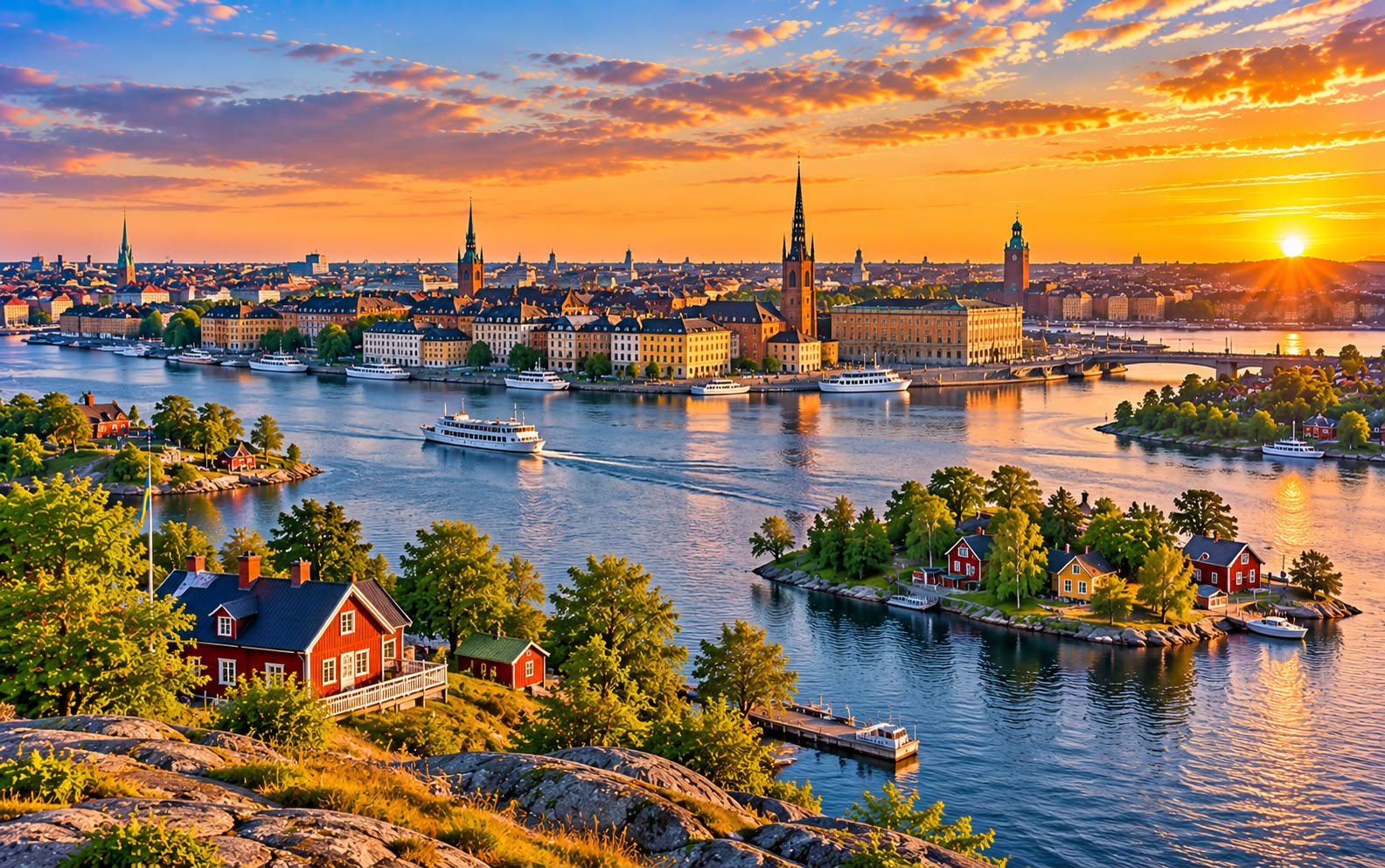
Sweden in 7 days: Stockholm and the archipelago
A capital built across fourteen islands with thirty thousand more on its doorstep: a warship raised whole from the harbour, an old town of ochre lanes, a ferry out to red cottages and swimming rocks — plus the cashless reality, the fika habit and why the long summer evenings are the whole argument for going.
- Northern Europe
- 7 days
- ≈ AED 8,150 / person
- Design + islands
Before you go
Stockholm is built on fourteen islands and looks out at roughly thirty thousand more. That geography is the trip: a compact, walkable capital where you are never far from water, and a ferry network that turns an afternoon into an island day.
The city itself holds two things worth crossing a continent for. The Vasa — a warship that sank on her maiden voyage in 1628, sat in the mud for 333 years, and was raised almost intact — and Gamla Stan, the old town, which is a medieval street plan painted in ochre and rust.
Seven days is enough for the city properly, two island days, and a short run to Uppsala. Go in June or July if you can: the evenings stretch past ten and the whole country moves outdoors.
Before you go: cashless, and the seasons
Entry, and the season that changes everything
- Sweden is in Schengen, so one visa covers it along with the rest of the area. The process, the lead times and the documents that cause refusals are in our Schengen visa guide.
- Visa-free nationalities need nothing beyond a passport, with the EES biometric border now fully operational — allow extra time on first arrival.
- Sweden is not in the euro. It uses the krona (SEK).
- The season is the trip. June to August gives long light, warm water and an archipelago in full use. December gives Christmas markets and dark by three. November and February give neither, and are best avoided unless the flights are free.
Genuinely cashless
- Sweden is the most cashless country you will visit. Many cafés, museums and buses do not accept cash at all — this is not a preference, it is a sign on the door.
- Bring a card that works contactlessly and a backup on a different network. Cash is close to useless; do not change money.
- Decline the terminal’s offer to bill you in your home currency — the markup is 5–10%.
- Sweden is expensive, but less so than its reputation if you eat where locals eat: the dagens lunch set menu at midday costs a fraction of the same food at dinner.
Getting around
- Stockholm’s transport is one system — metro, bus, tram and commuter ferry on a single travel card, bought in the app.
- The metro is an attraction. Many stations are carved into bedrock and painted; the blue line is the famous one, and riding it counts as sightseeing.
- Archipelago ferries run from the city centre. Summer service is frequent; off-season it thins sharply, so check the timetable before planning an island day.
- Uppsala is 40 minutes by train, frequent, and an easy half-day.
The habits
- Fika is not a coffee break, it is an institution — coffee and something sweet, sitting down, usually twice a day. Take part.
- Shoes off indoors, always, including in many small guesthouses.
- Allemansrätten, the right to roam, means you may walk and swim almost anywhere in nature, provided you disturb nothing and leave nothing.
- English is close to universal and spoken very well.
Day by day
Day 1 — Land, and the old town at dusk
- 14:00 — Land at Arlanda (ARN). The Arlanda Express runs to Central Station in 18 minutes; the Flygbussarna coach takes 45 and costs a third as much. Both are fine.
- 15:30 — Drop bags. Gamla Stan puts you in the middle of it; Södermalm is where you will eat better.
- 16:30 — Walk into Gamla Stan: Stortorget and its painted facades, Mårten Trotzigs Gränd at 90 cm the narrowest lane in the city, and the Royal Palace — 600 rooms, and still the working one.
- 18:00 — Monteliusvägen, the cliff path on Södermalm, for the view back over the water to the old town. Ten minutes’ walk and the best free thing in Stockholm.
- 19:30 — Dinner in Gamla Stan’s back streets rather than on Västerlånggatan, where the prices are for people who do not know there is a back street.
- Note on light — In June it barely gets dark at all; in December it is dark by three. Both are worth experiencing and they are entirely different cities.
Day 2 — The Vasa, and Djurgården
- 08:30 — The Vasa Museum at opening, before the tour groups. A 64-gun warship that sank 1,300 m into her maiden voyage in 1628, sat in the mud for 333 years, and came up 98% intact. Allow two hours; you will want them, and the ship is genuinely difficult to take in.
- 11:00 — Walk Djurgården, the royal park island. The Nordiska Museet if it rains.
- 12:30 — Lunch at Rosendals Trädgård, a biodynamic garden café in the middle of the island — soup, bread, and cake in a greenhouse.
- 14:00 — Skansen, the world’s first open-air museum (1891): 150 buildings moved here from across Sweden, plus Nordic animals — bear, wolf, lynx, moose. Two to three hours.
- 17:00 — The ABBA Museum if that is your thing; it is unembarrassed and well made.
- 19:30 — Södermalm for dinner — the hillier, scruffier, better-eating half of the city. SoFo, the blocks south of Folkungagatan, is the concentration.
Day 3 — Out to the archipelago
- 09:00 — Ferry from Strömkajen. The archipelago is 30,000 islands and you cannot see it in a day, so pick one: Vaxholm (one hour, a fortress town, easiest) or Grinda (two hours, mostly nature, better).
- 11:00 — Arrive. Red wooden cottages with white trim, bare granite worn smooth by ice, and pine down to the waterline.
- 12:30 — Lunch at the island inn — herring, new potatoes, dill.
- 14:00 — Walk the shore path, and swim if it is June to August. The Baltic is brackish, cold and clean, and the rocks are warm.
- 17:00 — The late ferry back, which in midsummer runs in full daylight and feels like the middle of the afternoon.
- 20:00 — Dinner back in town.
- Alternative — The Cinderella boats are faster and the Waxholmsbolaget commuter ferries are cheaper and slower. Check the last return before you go out; they thin considerably outside summer.
Day 4 — Museums, and the metro
- 09:30 — Fotografiska on the Södermalm waterfront — four changing photography exhibitions, open late, and the top-floor café has the view.
- 12:00 — Lunch, then across to Kungsholmen.
- 13:30 — Stadshuset, the City Hall, by guided tour only — the Blue Hall where the Nobel banquet is held (it is not blue) and the Golden Hall lined with 18 million mosaic tiles. The tower climb is separate and worth it.
- 15:30 — Ride the blue line. Stockholm’s metro is the longest art gallery in the world — T-Centralen’s blue vine-work, Solna Centrum’s red forest, Kungsträdgården’s excavated ruins. A single ticket covers 90 minutes of hopping between them.
- 17:30 — Nationalmuseum for the older collection, free and open late on Thursdays.
- 19:00 — Fika, properly: coffee and a kanelbulle at a place with a queue. It is a fixed part of the day here, not a snack.
Day 5 — Uppsala
- 08:30 — Train north from Central Station, 40 minutes, and trains leave several times an hour.
- 09:30 — Uppsala Cathedral, the tallest in Scandinavia at 118 m, with Gustav Vasa’s tomb and Carl Linnaeus buried in the floor.
- 11:00 — Gustavianum, the old university building, for the anatomical theatre in the cupola — 1660s, and used in public. The university is the oldest in the Nordics, founded 1477.
- 13:00 — Lunch by the Fyris river.
- 14:30 — Gamla Uppsala, ten minutes out: three royal burial mounds from the 6th century, a museum, and a church on the site of the pagan temple that stood here before it. This predates everything else on the trip by a thousand years.
- 17:30 — Train back.
- 19:30 — Dinner in Stockholm.
Day 6 — Stockholm your way
- Option A — Drottningholm. The royal residence, a UNESCO site, reached by steamboat in an hour across Lake Mälaren — the palace, the Chinese Pavilion and an 18th-century theatre with its original stage machinery still working.
- Option B — art. Moderna Museet on Skeppsholmen (Picasso, Dalí, and a Rauschenberg goat), then the island’s walk round.
- Option C — a second island. Sandhamn or Fjäderholmarna, the latter only 25 minutes out and enough for an afternoon.
- Option D — markets and nothing. Östermalms Saluhall for the food hall, Hötorgshallen for the cheaper one, and a long slow day.
- 19:30 — Last dinner. Try the herring properly prepared — pickled three ways, with potatoes, sour cream and västerbotten cheese — rather than the version that put you off.
Day 7 — Fly home
- Morning — Arlanda Express from Central, 18 minutes, every 15 minutes. The commuter train takes 40 and costs considerably less if you have the time.
- Note — Sweden is close to cashless. Many places take no cash at all, including some museums and most cafés, so a card is not optional here — it is the only thing that works.
Costs and practicalities
Best time to visit
June–August for the long light and December–March for the far north, and Sweden’s two halves are genuinely different trips.
- May–June — the best of the year in the south. Long evenings, Stockholm’s archipelago opening, and Midsummer in late June, which empties the cities entirely and is the most important day in the Swedish calendar.
- July–August — warmest, and most Swedes are on holiday for July. The archipelago and the west coast are in full use.
- September–October — autumn colour, the quietest good month, and the berry and mushroom season.
- December–March — the north: northern lights, dog sledding, the Icehotel at Jukkasjärvi, and the Sámi culture at Jokkmokk’s winter market in early February. Daylight is minimal above the Arctic Circle.
- The midnight sun above the Arctic Circle runs late May to mid-July.
Travel tips
- Sweden is almost entirely cashless. Many shops, buses and museums do not accept cash at all. Cards and Swish run everything.
- It uses the krona, not the euro, despite being in the EU.
- Allemansrätten — the right of public access — lets you walk, forage and camp on most uncultivated land, away from homes, for a night or two. It comes with responsibilities, not just rights.
- Alcohol above 3.5% is sold only at Systembolaget, the state monopoly, with limited hours and none on Sundays.
- Fika is a real institution — coffee and a cinnamon bun, taken seriously and often twice a day.
- Tipping is not expected. Service is included; rounding up is plenty.
- Mosquitoes in the north from June to August are serious. Repellent and a head net for Lapland.
What this trip actually costs
Two people, 6 nights, mid-range, excluding international flights:
| Item | Cost |
|---|---|
| Hotels, 6 nights | SEK 21,000 (≈ AED 7,797) |
| Transport cards, archipelago ferries, Uppsala trains | SEK 3,000 (≈ AED 1,114) |
| Vasa, Skansen, Fotografiska, City Hall, Drottningholm | SEK 3,200 (≈ AED 1,188) |
| Food and drink, 7 days | SEK 15,000 (≈ AED 5,569) |
| eSIM, extras | SEK 1,800 (≈ AED 668) |
| Total for two | SEK 44,000 (≈ AED 16,337) |
- Roughly SEK 22,000 (≈ AED 8,168) per person. Beds and food are the whole budget; museums and transport are reasonable by European standards.
- The dagens lunch is the single biggest saving available — the same kitchens serve a set lunch at a fraction of dinner prices.
- Alcohol is state-monopoly retail and heavily taxed. Drinking out is where budgets go.
What to pack
- Layers, even in July. The archipelago is cooler than the city and the wind comes off the Baltic.
- A swimsuit in summer. Swimming from rocks is the point of an island day.
- European Type C/F plugs.
- Comfortable shoes — Stockholm is hillier than it looks, especially Södermalm.
- An eye mask in June if you are a light sleeper; it does not get properly dark.
FAQ
Is Sweden as expensive as people say? Beds and restaurant dinners, yes. Transport, museums and supermarket food, no. Eating the set lunch and cooking one or two nights changes the number substantially.
Do I need any cash at all? Almost certainly not. Many places refuse it outright. Bring two cards instead.
Is seven days enough? For Stockholm and the archipelago, comfortably. Adding Lapland or Gothenburg means adding four days — they are a long way north and west respectively.
When should I go? June and July for the light and the islands. December for the Christmas markets and the dark cosiness. Avoid November and February, which offer neither.
Prices and entry rules change, and what you need depends on your passport; last checked 8 October 2026, so confirm with the embassy or your airline before booking.


