 The Itinerary
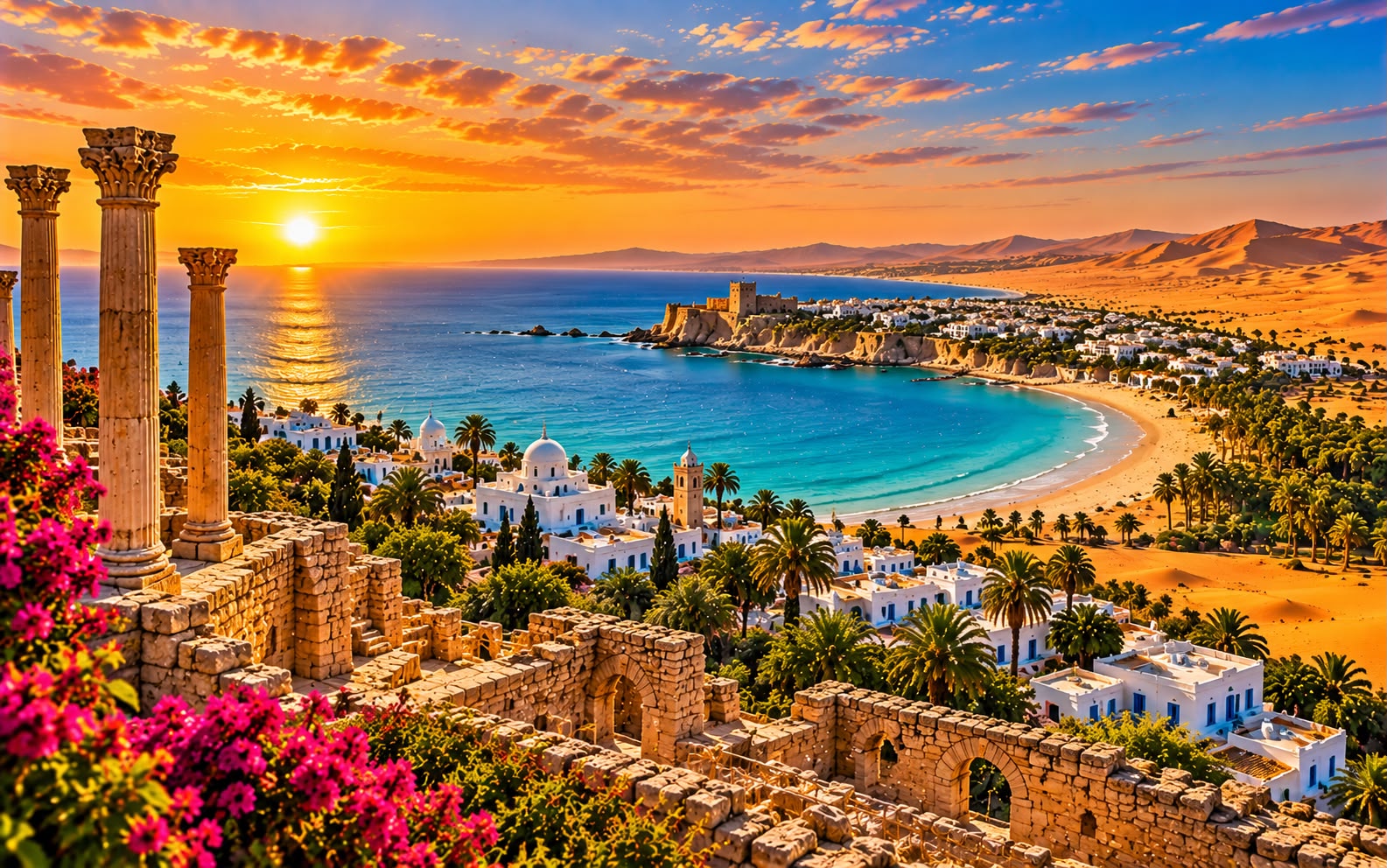
Tunisia in 9 days: Carthage, the Sahara and the coast
The cheapest Mediterranean country with Roman cities better preserved than most of Italy's: a colosseum that seats 35,000 in a small town, mosaics from Carthage, a salt lake you drive across, underground Berber houses used as Star Wars sets, and an island with a blue-and-white medina.
- North Africa
- 9 days
- ≈ AED 3,200 / person
- Roman sites + desert
Before you go
Tunisia is two hours from southern Europe, uses a currency you have never heard of, and holds Roman remains that would be the main attraction of any European country. El Jem’s amphitheatre seats 35,000 and stands almost complete in the middle of an ordinary town. The Bardo Museum in Tunis holds the best collection of Roman mosaics anywhere. Dougga is a whole hillside Roman city with almost nobody in it.
South of that the country changes entirely: salt flats you drive across, mountain oases, and the underground Berber dwellings at Matmata that George Lucas used for Luke Skywalker’s home.
It is also the cheapest country on the Mediterranean, by a considerable margin.
Before you go: driving, the south and the season
Entry
- Most nationalities enter visa-free for 90 days — the EU, UK, US, Canada, Japan and many others. A few require a visa in advance; check your own case.
- The dinar (TND) is a closed currency. You cannot legally obtain it outside Tunisia or take meaningful amounts out. Change on arrival, keep the receipts, and spend or re-convert before you leave — you need the receipts to convert back.
- Cards work in hotels and larger restaurants in the north; the south is cash.
Driving, and the alternative
- Hire a car for this route. The Roman sites, the oases and Matmata are not usefully connected by public transport.
- Roads between cities are good. Desert roads are fine in a normal car on this itinerary; the deep Sahara needs a 4x4 and a guide, which is a different trip.
- Louages — shared long-distance taxis — are the local network and are cheap, fast and how Tunisians travel between towns.
- Trains link Tunis, Sousse, El Jem and Sfax along the coast and are comfortable.
- Do not drive at night in the south; unlit vehicles and livestock.
Security, stated plainly
- Tunisia has been calm for years, and tourism has recovered. The route in this guide is entirely standard.
- Border regions with Libya and parts of the western mountains carry official travel advisories. Check your own government’s current advice before booking, and stay off those areas.
- You will see police and military checkpoints, particularly in the south. They are routine, polite, and want to see a passport.
The season matters in both directions
- March to May and September to November are the answer: warm, not punishing, and everything open.
- June to August is very hot inland and in the south — the desert reaches 45°C and sightseeing becomes impractical by mid-morning. The coast is fine.
- December to February is mild on the coast, cold at night in the desert, and quiet.
- Ramadan shifts each year and changes opening hours and restaurant availability considerably. Check the dates.
Day by day
Day 1 — Land in Tunis
- 14:00 — Land at Tunis-Carthage (TUN), which is 8 km from the centre — fifteen minutes, and one of the closest airports to its city anywhere.
- 15:00 — Change money on arrival and keep the receipts. The dinar is a closed currency: you cannot get it outside Tunisia and you need those receipts to convert back before you leave.
- 16:00 — Stay in the medina for atmosphere or Sidi Bou Said for the setting — the blue-and-white village on the cliff 20 minutes north, which is where you will want to be in the evening.
- 17:30 — Walk Sidi Bou Said’s cobbled main street before the light goes: whitewashed walls, blue studded doors, and bougainvillea over everything.
- 18:30 — Café des Délices or the smaller Café des Nattes for mint tea with pine nuts floating in it, on a terrace above the Gulf of Tunis.
- 20:00 — Dinner. Grilled fish, brik — a thin pastry parcel with a whole egg inside that you must eat in one movement — and harissa with everything.
Day 2 — Carthage and the Bardo
- 08:30 — Carthage, spread over several sites on one ticket. Start at the Antonine Baths, the largest Roman baths outside Rome, with the sea behind the columns.
- 10:00 — The Punic ports — two harbours, one circular and military, cut out of the shore and still legible from the hill above. Rome destroyed the city so thoroughly in 146 BC that what you are mostly looking at is the Roman rebuild on top.
- 11:00 — Byrsa Hill and its museum for the layout.
- 13:00 — Lunch.
- 14:30 — The Bardo Museum, and give it three hours. It holds the finest collection of Roman mosaics in the world, lifted from villas across the country and displayed in a former beylical palace — the Virgil mosaic, the Ulysses and the Sirens, and room after room of floors you can stand on the edge of.
- 18:00 — The Tunis medina, a UNESCO site and a working souk rather than a preserved one. Zitouna Mosque at its centre; the roof terraces of the carpet shops give the view over it, and the sales pitch is the price of admission.
- 20:00 — Dinner in the medina.
Day 3 — Dougga, and south
- 08:00 — Drive west to Dougga, about two hours.
- 10:00 — Dougga is the best-preserved Roman town in North Africa and you may have it to yourself: a theatre for 3,500 cut into the hillside, the Capitol standing nearly complete, a forum, baths, brothels with the signage still visible, and a Punic-Libyan mausoleum predating all of it. Two to three hours, and wear proper shoes — the site is loose stone and goats.
- 13:00 — Lunch at the site café or in Téboursouk.
- 14:30 — South to Kairouan, about three hours.
- 17:30 — The Great Mosque of Kairouan, Islam’s fourth holiest site and the oldest in North Africa, founded 670. The courtyard is paved to funnel rain into cisterns below, and its colonnade is built from recycled Roman columns, no two the same. Non-Muslims may enter the courtyard but not the prayer hall; cover shoulders and knees.
- 19:00 — The Aghlabid basins at sunset, then dinner. Kairouan makes makroudh, a date-filled semolina pastry, and it is everywhere.
Day 4 — El Jem, and to the desert edge
- 08:30 — Drive to El Jem, 90 minutes.
- 10:00 — The amphitheatre, and nothing prepares you for it: a Roman colosseum for 35,000 people, standing almost complete, in the middle of an ordinary modern town of 20,000. You can walk the arena floor, climb the tiers, and go down into the underground passages where animals and fighters waited. Entry costs a few dinars and there is no queue.
- 11:30 — The El Jem museum on the edge of town, with more mosaics in situ in excavated villas.
- 13:00 — Lunch.
- 14:00 — The long drive south-west to Tozeur, about four and a half hours, with the landscape drying out mile by mile.
- 18:30 — Arrive. Ouled el-Hadef, the old quarter, is built of yellow brick laid in projecting geometric patterns — a local technique you will not see elsewhere — and it is best in low sun.
- 20:00 — Dinner, and dates. Tozeur’s deglet nour are the reason the oasis exists.
Day 5 — The Chott and the mountain oases
- 07:00 — Early, because the mountain oases are a 4x4 day and the heat builds.
- 08:00 — Chott el Djerid: a salt lake the size of a county, crossed on a causeway, with mirages that are genuinely disorienting — you will see water that is not there, and in places the crust is tinted pink and violet by algae.
- 10:00 — Chebika, the first mountain oasis — a palm gorge under bare rock, with a spring and a waterfall at the top of a short scramble.
- 11:30 — Tamerza, the largest, with the abandoned old village left after the floods of 1969 and a canyon below it.
- 13:00 — Mides, on the Algerian border, where the gorge drops away at the edge of the village. Lunch.
- 15:30 — Back toward Tozeur across the Chott in the other light.
- 17:30 — The Tozeur palmeraie — 400,000 palms irrigated by a thousand-year-old system of channels still allocated by the hour.
- 19:30 — Dinner.
Day 6 — Star Wars, and Matmata
- 08:00 — Ong Jemel and the Mos Espa set, 30 minutes out by 4x4 — built for The Phantom Menace and still standing in the sand, slowly being buried. Worth it if that means something to you; skip it entirely if not.
- 10:30 — Back, then the drive east to Matmata, about three hours.
- 14:00 — Matmata, and the thing to understand is that these are not caves: Berber families dug a circular pit seven metres down into the soft rock and then tunnelled rooms off the sides of it, so the courtyard is open to the sky and the house is underground. It keeps 50°C out and holds winter warmth in.
- 15:30 — Several families still live this way and show their homes for a small fee. Sidi Driss is the one used as the Lars homestead in A New Hope, and it is a working hotel.
- 18:00 — Sleep underground. It is cooler than it sounds and warmer than the desert night outside.
- 19:30 — Dinner at the hotel, usually couscous.
Day 7 — To Djerba
- 08:30 — Drive to Djerba, about two and a half hours — either over the Roman causeway at El Kantara, built in the second century and still carrying the road, or by the short ferry from Jorf.
- 11:30 — Houmt Souk, the island’s whitewashed main town, and its covered markets.
- 13:00 — Lunch — Djerban fish couscous.
- 15:00 — The El Ghriba synagogue, one of the oldest in Africa and in continuous use. Djerba’s Jewish community has been here since antiquity — by tradition since 586 BC — and still numbers over a thousand. Security is tight and photography is restricted; dress conservatively.
- 17:00 — The beach on the north-east coast.
- 19:30 — Dinner on the water.
Day 8 — Djerba, slow
- 09:00 — The island by hire car or scooter: Guellala for the pottery, where the clay and the kilns have not changed, and the flamingo lagoon at Ras R’mel if they are in (autumn through spring).
- 12:00 — Erriadh and Djerbahood — a village where 250 street artists from 30 countries painted the walls in 2014 and the work has been maintained since. An hour of wandering and genuinely good.
- 14:00 — Lunch, then the beach for the afternoon.
- 17:30 — Last sunset.
- 19:30 — Dinner. Convert your remaining dinars back tomorrow, not tonight — but work out now what you need to keep.
Day 9 — Fly home
- Morning — Djerba has its own international airport (DJE), which saves the six-hour drive back to Tunis. If your return is from Tunis, allow the full day for it.
- At the airport — Convert leftover dinars back before security, with the exchange receipts you kept from day one. You cannot legally take meaningful amounts out, and there is nowhere to spend them once you are through.
Costs and practicalities
Best time to visit
March–May and September–November. The coast is Mediterranean and pleasant in the shoulders; the Sahara in the south is only sensible outside summer.
- March–May — the best of the year. Wildflowers in the north, comfortable at Dougga and Carthage, and the desert at Douz and Tozeur still cool.
- June–August — the coast is hot and busy with European package traffic, and the south reaches 45°C. The Carthage and Dougga festivals run in July and August.
- September–November — warm sea into October, the date harvest in the south, and the best light on the Roman sites.
- December–February — mild and wet on the coast, with snow possible in the northwest at Aïn Draham and cold desert nights in the Sahara.
The Sahara Festival at Douz is in December, which is also when the desert is at its most comfortable.
Travel tips
- Dress modestly away from the beach resorts. Tunisia is more relaxed than much of the region but the interior and the medinas are conservative.
- Agree every price first — taxis, guides, a camel ride, a cup of mint tea. Louages, the shared intercity taxis, have fixed fares posted.
- The dinar is a closed currency and cannot legally be taken out. Change back what you have left before departure, and keep receipts.
- Carpet shops and “my cousin’s workshop” are the standard medina routine in Kairouan and Tunis. A firm no works.
- Cards work in Tunis and the resorts; carry cash for the medinas, the south and the louages.
- Check current advice for the Algerian and Libyan border regions and the Chaambi mountains, which carry specific warnings.
- Star Wars sites at Matmata and Ong Jemel are real places with real residents — Matmata’s troglodyte homes are lived in, and a visit is by arrangement and payment.
What this trip actually costs
Two people, 8 nights, mid-range, excluding international flights:
| Item | Cost |
|---|---|
| Hotels and guesthouses, 8 nights | TND 2,400 (≈ AED 2,950) |
| Car hire, 8 days, fuel and tolls | TND 1,500 (≈ AED 1,844) |
| Carthage, Bardo, Dougga, El Jem, Matmata, oases | TND 400 (≈ AED 492) |
| Food and drink, 9 days | TND 800 (≈ AED 983) |
| eSIM, extras | TND 100 (≈ AED 123) |
| Total for two | TND 5,200 (≈ AED 6,391) |
- Roughly TND 2,600 (≈ AED 3,196) per person — the cheapest Mediterranean country on this site, well below Greece, Italy or Croatia.
- Site entries are remarkably cheap — El Jem and Dougga cost a few dinars each.
- The car is the largest line, and a louage-and-train version of this route would cut it substantially at the cost of the oases.
What to pack
- Modest clothing for mosques and the south — shoulders and knees, and a scarf for women at religious sites.
- Serious sun protection. The Chott has no shade at all.
- A warm layer for desert nights, which are cold even after a 40°C day.
- European Type C/E plugs, 230V.
- Cash in dinars, changed on arrival, and keep the receipts to convert back.
- Closed shoes for ruins with loose stone.
FAQ
Is Tunisia safe? For this route, yes, and it has been calm for years. Border regions with Libya and parts of the western mountains carry travel advisories — check your government’s current advice and stay away from those. Checkpoints in the south are routine.
Is it worth it just for the Roman sites? El Jem and Dougga alone would justify a trip, and the Bardo’s mosaics are the best collection anywhere. That they cost a few dinars each and are nearly empty is the remarkable part.
When should I go? March to May or September to November. Summer in the south is genuinely too hot for sightseeing, though the coast is fine.
What about the currency rule? The dinar cannot legally be taken out of the country in any quantity. Change what you need on arrival, keep the exchange receipts, and convert the remainder back at the airport before you fly.
Prices and entry rules change, and what you need depends on your passport; last checked 8 October 2026, so confirm with the embassy or your airline before booking.


