 The Itinerary
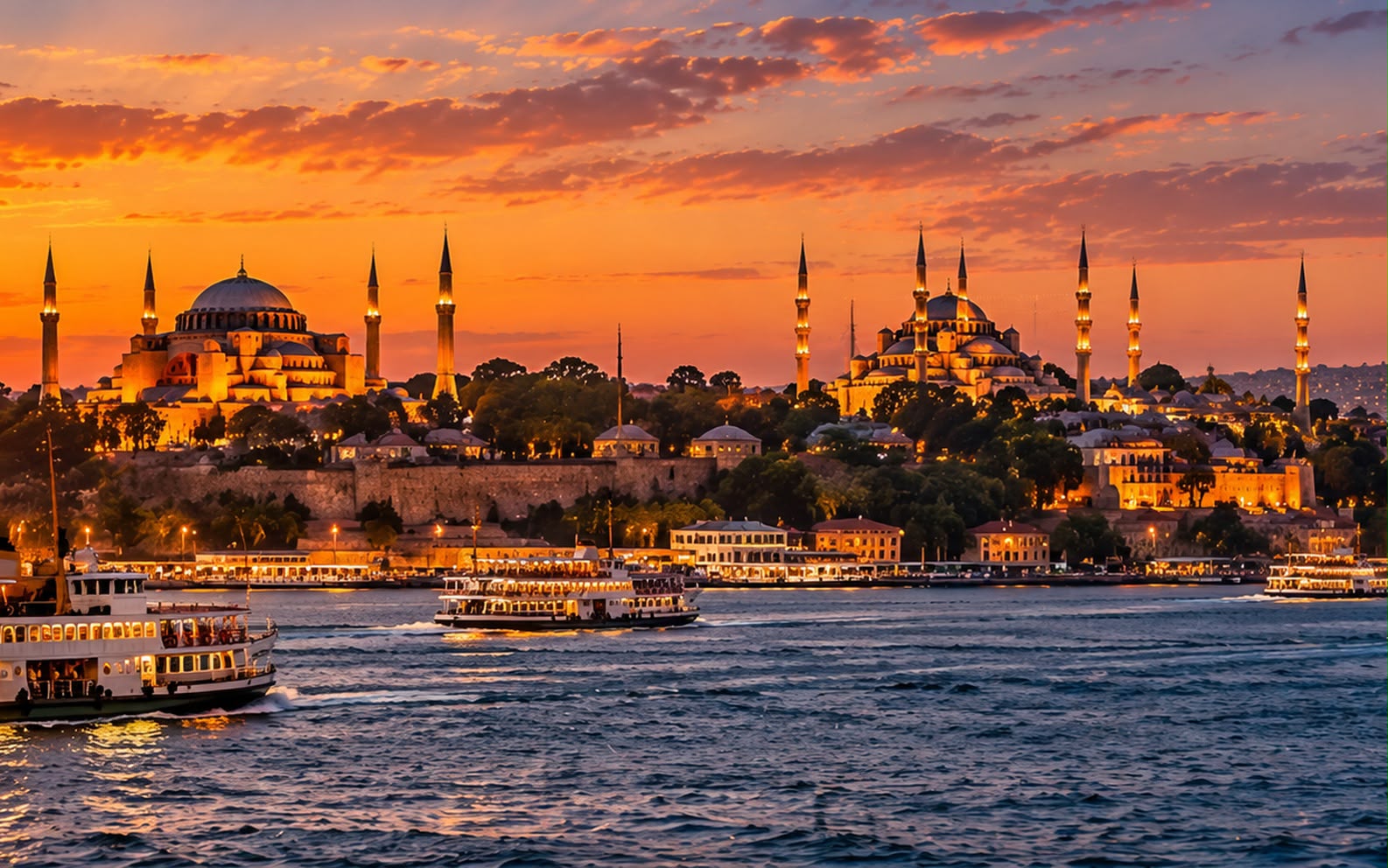
Turkey and Greece in 14 days: Istanbul, Cappadocia, Ephesus and the Aegean islands
A city on two continents, balloons over carved rock valleys, a Roman library facade in Anatolia, and then a ninety-minute boat to the Greek islands — the Aegean crossing almost nobody realises is that easy.
- Southern Europe
- 14 days
- ≈ AED 8,600 / person
- Two countries that have argued over one sea for three thousand years
Before you go
Before you go: the admin
Two entries, one easy crossing
- Greece is in Schengen and the eurozone. Most nationalities enter visa-free for 90 days.
- Turkey issues an e-visa to many nationalities in minutes at evisa.gov.tr, and admits others visa-free. Use only the official site — the lookalikes charge several times the fee.
- The ferry crossing is a proper border. Passports are checked on both sides, and a Schengen entry stamp at Samos or Kos counts against your 90 days even though you arrived by boat.
- Do Turkey first. A Turkish e-visa is quick and a Schengen entry at a small island port is smoother than a Turkish entry would be in reverse.
The crossing, which is the point
- Kuşadası to Samos is about 90 minutes, and Bodrum to Kos an hour. These are scheduled passenger ferries, not excursions.
- They run reliably from April to October and thin out sharply in winter — some routes stop entirely from November to March. Check the current timetable before committing; this is the single biggest planning risk on the route.
- Book the crossing a few days ahead in summer, and note that you check in an hour before with your passport.
- You cannot take a Turkish hire car to Greece, or the reverse.
Flights
- Fly into Istanbul and out of Athens. An open-jaw costs much the same as a return and saves a day.
- Two internal Turkish flights: Istanbul to Kayseri or Nevşehir for Cappadocia, and Cappadocia to Izmir for Ephesus. Both are cheap and frequent.
- Santorini to Athens is a 45-minute flight or a 5-hour fast ferry. The ferry is cheaper and far more weather- dependent.
Money
- Euros in Greece, lira in Turkey. The lira has been volatile for years — expect quoted prices to be out of date and carry small notes.
- Cards work widely in both, and in Greece almost universally since the tax reforms.
- Decline the dynamic currency conversion every terminal will offer you in Turkey.
Day by day
Day 1 — Istanbul, Sultanahmet
- Land, and go straight to Sultanahmet. Everything today is within one square.
- 13:00 — Hagia Sophia, a working mosque again — shoes off, shoulders and knees covered, headscarf for women, and the visitor hours are restricted around prayers, so check the board before you queue.
- 15:00 — The Blue Mosque opposite, closed to visitors during the five prayer times.
- 16:30 — The Basilica Cistern underneath the square, with its Medusa heads — one sideways, one upside down, and nobody knows why.
- 18:00 — Get an Istanbulkart at any kiosk. It works on every ferry, tram, bus and funicular and saves queueing all week.
- 20:00 — Dinner in Sultanahmet or Eminönü, and an early night — the jet lag is worse than you think.
Day 2 — Topkapı and the bazaars
- 09:00 — Topkapı Palace at opening, and the Harem, which is a separate ticket and worth it — 300 tiled rooms where the court actually lived.
- 12:00 — The Archaeological Museum in the palace grounds, included on the ticket and almost empty.
- 14:00 — The Grand Bazaar, closed Sundays, where the carpet routine is practised and persistent. A friendly, firm no works; engaging is the opening move.
- 16:30 — The Spice Bazaar, fifteen minutes downhill, and the hardware and coffee streets around it, which are better than the bazaar itself.
- 19:00 — Karaköy or Galata for dinner.
Day 3 — The Bosphorus, and the Asian side
- 10:00 — A Bosphorus ferry — ordinary public transport, an hour and a half up to Anadolu Kavağı, and the best value in the city. Sit on the right going up.
- 13:00 — Lunch at Anadolu Kavağı, fish by the water, then the ferry back.
- 16:30 — Kadıköy on the Asian side for an evening that is not about monuments — the produce market, the record shops, and the meyhane streets behind them.
- 20:00 — Dinner in Kadıköy, which is where the city actually eats.
- Fly to Cappadocia in the morning — book the first flight tonight.
Day 4 — Cappadocia
- 07:00 — Fly to Kayseri or Nevşehir, 90 minutes, then an hour by road.
- 11:00 — Stay in a cave hotel. It is the obvious thing and it is also genuinely good.
- 13:00 — Göreme Open Air Museum for the rock-cut churches and their frescoes. Pay the extra for the Dark Church, whose colour survived because so little light reached it.
- 16:30 — The Red and Rose valleys on foot at sunset, two hours between them and the best free thing here.
- 19:00 — Book the balloon. They fly at dawn, are cancelled for wind constantly, and the number of flights is capped — build two or three mornings into the stay rather than one, which is exactly why the balloon sits on day five and not on your last morning.
Day 5 — The balloon, and underground
- 04:30 — Collection for the balloon. Roughly 150 lift together at first light over the valleys.
- 08:00 — Breakfast back at the hotel, on a terrace facing the valleys, which every cave hotel does.
- 10:30 — Derinkuyu or Kaymaklı, underground cities eight levels deep that held thousands of people, with ventilation shafts, stables and churches cut into the rock. Not for the claustrophobic — the connecting passages are genuinely tight.
- 14:00 — Devrent and Paşabağ for the fairy chimneys.
- 17:00 — Uçhisar Castle for the whole region from its highest point.
Day 6 — To Ephesus
- 09:00 — Fly to Izmir, then an hour south.
- 14:00 — Settle in Selçuk, which is ten minutes from the site and a fraction of Kuşadası’s prices.
- 16:00 — The Basilica of St John and the Isa Bey Mosque in Selçuk itself, both quiet in the late afternoon.
- 18:30 — Şirince in the hills for the evening, a Greek village of stone houses now famous for its fruit wines.
- Set an early alarm. Tomorrow is the one that rewards it.
Day 7 — Ephesus, and the terrace houses
- 08:00 — Ephesus at opening. By ten the cruise groups from Kuşadası have arrived and there is no shade.
- Among the best-preserved classical cities anywhere — the Library of Celsus, the Great Theatre that held 25,000, and the marble street with its rutted paving.
- 10:00 — The Terrace Houses, a separate ticket and the part most people skip — mosaic floors and painted walls under a modern roof, and the best thing on the site.
- 13:00 — Lunch in Selçuk, out of the sun.
- Or Pamukkale as a long day trip if the travertine terraces appeal — three hours each way, so it replaces this day rather than adding to it.
- 17:00 — To Kuşadası for the morning ferry, and check tomorrow’s sailing tonight — they are reduced out of season.
Day 8 — The ferry to Samos
- 08:30 — Kuşadası to Samos Town or Pythagorio, 90 minutes, with passport control at both ends. Allow an hour before departure for the Turkish exit formalities.
- 11:00 — Samos is green and under-visited. Pythagorio’s harbour, and the Eupalinian aqueduct, tunnelled through a mountain from both ends in the sixth century BC — they met in the middle, which is the whole reason it is famous.
- 15:00 — The Heraion, the sanctuary of Hera, with one standing column of the hundred that were there.
- 18:00 — An evening in Pythagorio. The change of register is immediate, and it is the best argument for doing the two countries together rather than separately.
Day 9 — South through the islands
- The Aegean ferry network runs through Naxos or Mykonos, so a Samos–Santorini leg is usually a connection rather than a direct boat. Check the route before you book the nights — this day is shaped by the timetable, not by you.
- 08:00 — The first leg, typically to Naxos or Mykonos.
- 14:00 — A few hours on the connecting island rather than sitting in the port: Naxos town’s Portara gate, or Mykonos’ windmills.
- 19:00 — Into Santorini, and arrange the transfer in advance — the port road is a switchback and the taxi queue after a ferry is long.
Day 10 — The caldera
- 06:00 — Walk the caldera path from Fira to Oia in the morning — three hours and the best walk in the Cyclades, and there is no shade on any of it.
- 09:30 — Into Oia ahead of the coaches, when the lanes are still empty.
- 11:00 — Breakfast in Oia, then the bus back.
- 14:00 — The afternoon off. You have walked 10km.
- 19:00 — Oia at sunset is famously crowded. Go to Imerovigli or Pyrgos instead — same light, a fraction of the crush.
Day 11 — Akrotiri and the volcano
- 09:00 — Akrotiri, the Bronze Age town buried by the eruption around 1600 BC and preserved under ash, which is Santorini’s real distinction and is indoors and cool — the right thing to do in heat.
- 11:30 — The red and black beaches below it, for a swim. The sand is volcanic and gets hot enough to hurt.
- 15:00 — A boat to the volcano and the hot springs, which is better in the late afternoon when the day boats have gone.
- Santorini has a cruise-ship cap and the old port cable-car queue is long when ships are in. Check the schedule before you plan around the port.
Day 12 — To Athens, and the Acropolis
- 08:00 — Fly or take the fast ferry. The flight is 45 minutes; the ferry is five to eight hours and costs you the day.
- 13:00 — Drop bags in Plaka, Koukaki or Monastiraki, all within fifteen minutes of the rock.
- 16:00 — The Acropolis. It has a daily visitor cap and timed entry — book online, and go in the last two hours, because the midday heat on that rock is serious and there is no shade.
- 19:00 — Plaka and Anafiotika for the evening — the second is a Cycladic village of whitewashed cottages built into the Acropolis slope by island masons in the 1840s.
- 21:00 — Monastiraki and Psyrri for the eating.
Day 13 — The museums, and ancient Athens
- 09:00 — The Acropolis Museum, with the Parthenon frieze laid out at the original spacing and the gap where the Elgin Marbles should be, which the museum makes a point of.
- 12:00 — The Ancient Agora, Hadrian’s Library and the Temple of Olympian Zeus, all on one combined ticket — and the Temple of Hephaestus above the Agora is the best-preserved Doric temple in Greece.
- 15:00 — The National Archaeological Museum, which holds the Antikythera mechanism — a geared bronze computer from the second century BC.
- 19:00 — A rooftop bar facing the Acropolis lit up.
Day 14 — Delphi, Sounion, or home
- A day trip to Delphi or Cape Sounion if there is time. Delphi is three hours each way and needs a full day; Sounion is ninety minutes and works as an afternoon.
- 08:00 — Delphi, if you are going — the stadium above the sanctuary is the part most people are too tired to climb to, and it is the best of it.
- Or 16:00 — The Temple of Poseidon at Sounion at sunset, on a headland with the Aegean on three sides.
- Athens airport is 45 minutes from the centre on the metro, which runs from Syntagma.
Costs and practicalities
Best time to visit
May–June and September–early October, and the ferry timetable sharpens the choice more than the weather does.
- May–June — the best of the year. The sea is swimmable from late May, the archaeology is comfortable to walk, and the Aegean ferries are on full summer schedules.
- July–August — peak. Athens passes 38°C, Santorini is at capacity, Ephesus is unbearable after ten in the morning, and the meltemi blows hardest, which is what cancels ferries.
- September–early October — the sea is at its warmest, the crowds thin after the first week of September, and prices fall. The best single window.
- November–April — the Turkey–Greece ferries thin out sharply and several routes stop entirely. Island tourism largely closes. Istanbul, Cappadocia and Athens all work well in winter — Cappadocia under snow is extraordinary — but this particular route does not.
Ferries are cancelled by wind, not rain. Build a buffer day before any flight home.
Travel tips
- Check the Kuşadası–Samos and Bodrum–Kos timetables before you book anything else. They are seasonal, they thin out from November, and the whole route depends on one of them.
- Do Turkey first. The Turkish e-visa is quick and a Schengen entry at a small island port is smoother than the reverse.
- Your Schengen 90 days starts at the island, not at Athens. People forget the boat is a border.
- Build two or three mornings into Cappadocia for the balloons, which are cancelled for wind constantly and are capped in number.
- Cover shoulders and knees at mosques, remove shoes, and women cover hair — scarves are provided at the door. The Hagia Sophia is a working mosque again and the rules apply.
- Get an Istanbulkart in Istanbul and use the ferries; they are public transport and the best view in the city.
- Lunch is late and dinner later in Greece — 9pm onwards. A taverna at seven will be empty.
What this trip actually costs
Two people, 13 nights, mid-range comfort, international flights excluded:
| Item | Cost |
|---|---|
| Hotels, 13 nights | EUR 1,560 (≈ AED 6,388) |
| Entries, guides and the Cappadocia balloon | EUR 900 (≈ AED 3,685) |
| Food and drink, 14 days | EUR 840 (≈ AED 3,439) |
| Internal flights, two people | EUR 520 (≈ AED 2,129) |
| Ferries, two people | EUR 380 (≈ AED 1,556) |
| Total for two | EUR 4,200 (≈ AED 17,197) |
- Roughly EUR 2,100 (≈ AED 8,599) per person, and Turkey is substantially cheaper than Greece — the Turkish half costs about half the Greek one for the same standard.
- The balloon is around €200 each and is most of the excursions line.
- Santorini in August can double the accommodation figure on its own.
- Hotel picks here are chosen on location, not on commission — always check prices and recent reviews before booking.
What to pack
- Shoes with grip. Ephesus’ marble, the Acropolis rock and Santorini’s caldera steps are all polished and slippery.
- A scarf for mosque entries, and something covering shoulders and knees for both mosques and Greek monasteries.
- A sun hat and SPF 50. Neither Ephesus nor the Acropolis has any shade.
- A warm layer for Cappadocia, which is at 1,000m and cold at dawn in any season.
- Water shoes for the Greek beaches, which are pebble and have sea urchins.
- Cash in both currencies, and small notes in Turkey.
FAQ
How hard is the ferry crossing? Easy — 90 minutes from Kuşadası to Samos with passport control at both ends. The catch is the timetable: it is seasonal and thins out sharply from November.
Which should I do first? Turkey. The e-visa is quick, and entering Schengen at a small island port is smoother than clearing Turkish immigration there would be.
Does the boat count against my Schengen days? Yes. Arriving at Samos or Kos is a Schengen entry and the stamp starts your 90 days, however you got there.
Is Cappadocia worth two nights? Three if the balloon matters. Flights are cancelled for wind constantly and are capped, so one morning is a coin toss.
Can I drive between the two? No. Hire cars cannot cross on the ferries in either direction. Fly or take the boat as a foot passenger.
Prices and entry rules change, and what you need depends on your passport; last checked 29 October 2026, so confirm with the embassy or your airline before booking.


