 The Itinerary
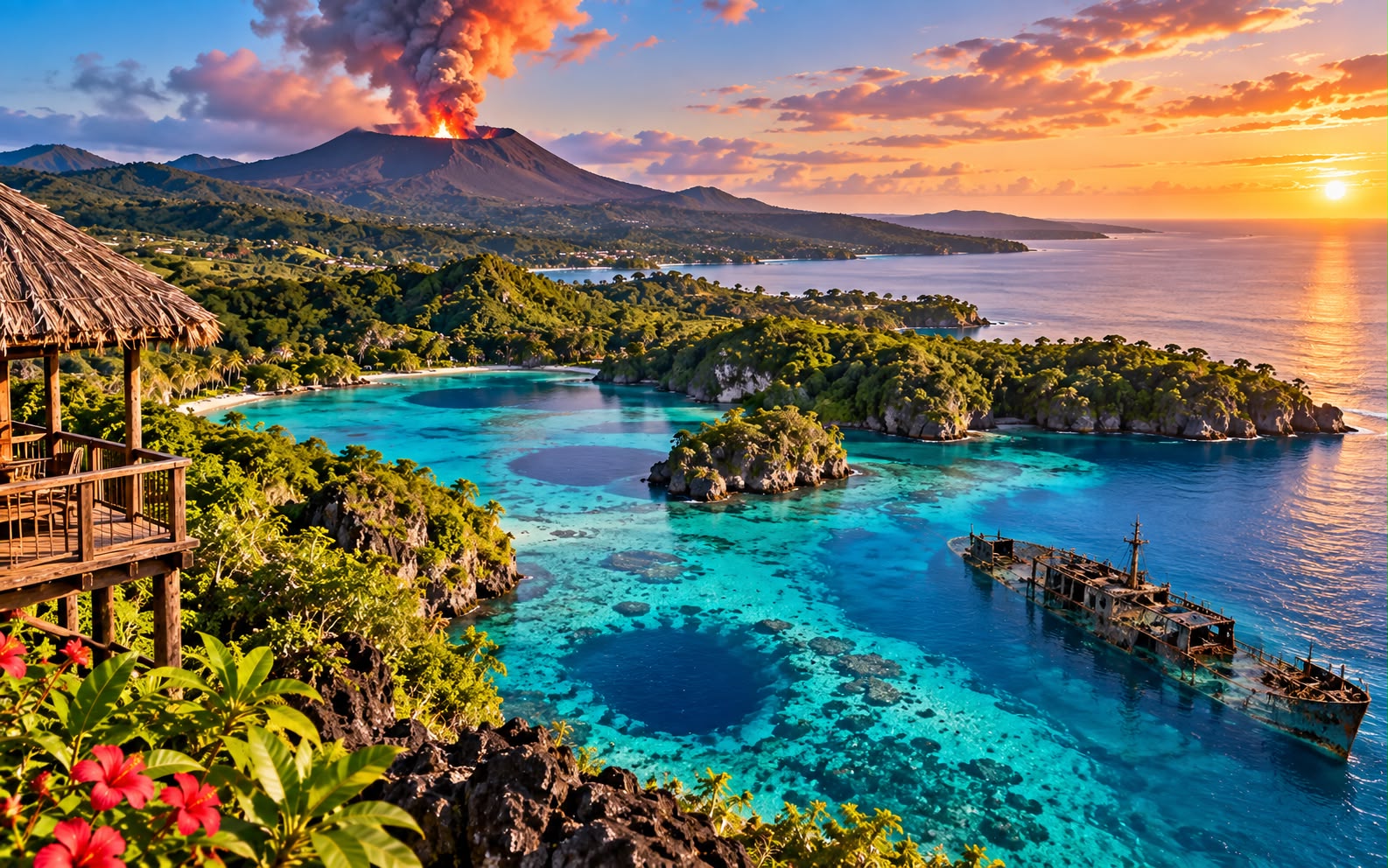
Vanuatu in 9 days: Mount Yasur, blue holes and the Coolidge
The most accessible active volcano on earth, where you walk to the crater rim after dark and watch lava thrown into the sky from a few hundred metres away — plus freshwater blue holes you swim in, a 200-metre liner you can dive inside, and villages where the old ways are not a performance.
- Pacific Islands
- 9 days
- ≈ AED 8,050 / person
- Standing on a volcano rim
Before you go
Mount Yasur on Tanna has been erupting continuously for several hundred years, and a road goes most of the way up it. You walk the last fifteen minutes to a rim with no railing, in the dark, and watch the vents below throw molten rock three hundred metres into the air every few minutes. Captain Cook navigated to Tanna by its glow in 1774.
Nothing else in this guide is quite that, but Vanuatu keeps delivering: Espiritu Santo has freshwater blue holes so clear the trees are reflected from underwater, white-sand beaches nobody is on, and the SS President Coolidge — a 200-metre luxury liner turned troopship that struck a mine in 1942 and sank in the harbour, now one of the most accessible large wreck dives in the world.
It is an archipelago of 83 islands, about 300,000 people, and more than 100 living languages — the highest linguistic density per head anywhere on earth.
Before you go: flights, volcano logistics and cyclones
Entry and money
- Most nationalities enter visa-free for 30 days or more.
- Vanuatu vatu (VUV). Cash dominates everywhere outside Port Vila; on Tanna and in rural Santo there are effectively no card machines and no ATMs. Draw everything you need in Port Vila before you fly out.
- Australian dollars are sometimes accepted in Vila at a poor rate.
Domestic flights are the whole plan
- Air Vanuatu flies Port Vila to Tanna (about 50 minutes) and to Santo (about an hour). There is no practical alternative — the inter-island boats are slow cargo runs.
- Schedules change, and flights are cancelled or retimed with little notice. This is normal and everybody plans for it. Never connect a domestic flight to an international one on the same day.
- Book the domestic legs early and keep the itinerary loose at the edges.
- Baggage allowances on the small aircraft are low.
Mount Yasur, practically
- You go in the late afternoon, arriving for dusk, because the lava only reads as lava once the light has gone.
- Access is through the Yakel-area custom owners and the fee is paid to them. Guides are required and the access road is 4x4 only.
- The volcano has an alert level from 0 to 4. At level 2 you can usually reach the rim; at 3 and above it closes, and that happens with no notice. There is no refund for weather or geology — build a spare day on Tanna.
- It is genuinely loud, the ground moves, and ash and grit fall on you. Standing there is not a mild experience.
Cyclones and seasons
- May to October is the dry season — cooler, lower humidity, best diving visibility, and the time to come.
- November to April is cyclone season, with the peak January to March. Vanuatu is hit regularly and hard; Cyclone Pam in 2015 damaged most of the country. Flights and resorts shut.
- Take travel insurance that covers cyclone disruption, and mean it.
Kastom, and how to behave
- Much of rural Vanuatu runs on kastom — customary law, land ownership and practice. Almost every beach, blue hole and track is owned by a family or village and carries a small fee, which is correct and should be paid cheerfully.
- Ask before photographing anybody, always.
- Nakamal — the kava bar — is a men’s space traditionally, though visitors of both sexes are generally welcome in Vila. Vanuatu kava is considerably stronger than Fijian.
Day by day
Day 1 — Land in Port Vila
- 13:00 — Land at Bauerfield (VLI), ten minutes from town.
- 14:30 — Drop bags. Port Vila wraps around a harbour with Iririki island in the middle of it.
- 16:00 — Draw all the cash you will need for the week. This is the practical priority and there is no second chance once you fly out.
- 17:00 — The seafront market and the harbour walk.
- 18:30 — A nakamal for kava if you want it. The shell is drunk in one, you spit, and then you sit in the dark without talking much, which is the custom. Vanuatu kava is strong — one shell is a reasonable introduction and three is a decision.
- 20:00 — Dinner. Port Vila eats unexpectedly well, a leftover from the Anglo-French condominium that governed the islands jointly until 1980 — the one place in the Pacific with genuinely good French food.
Day 2 — Efate, around the island
- 08:30 — Hire a car or take a tour round Efate, which is a 130 km loop on a sealed road and takes a comfortable day.
- 09:30 — Mele Cascades: a series of limestone pools climbing through forest to a 35 m fall, which you walk up through the water itself holding a rope.
- 11:30 — Blue Lagoon on the east coast — a freshwater swimming hole with rope swings, and the first of the island’s improbable blues.
- 13:00 — Lunch at a roadside stall. Laplap is the national dish: grated root vegetable baked in banana leaf in an earth oven, with coconut cream.
- 15:00 — Eton Beach or Nasama on the east coast, both community-run with a small fee.
- 17:00 — Back round the north, past the cattle country — Vanuatu beef is excellent and exported to Japan.
- 19:30 — Dinner, and repack light for Tanna.
Day 3 — Fly to Tanna, and the volcano
- 09:00 — Fly to Tanna, about 50 minutes, over the reef and into a grass-and-coral airstrip.
- 10:30 — Transfer to your bungalows, 4x4 and slow — the island’s roads are rough volcanic track and the 40 km across can take two hours.
- 12:30 — Lunch, then rest. The afternoon is the volcano.
- 15:30 — Drive to the Yasur access point across the ash plain — a grey moonscape of consolidated ash where nothing grows, which is itself worth the trip.
- 16:30 — The 4x4 climbs to the car park, then a fifteen- minute walk to the rim.
- 17:30 — And then you are standing on the edge. The crater is a few hundred metres across, there is no railing, and the vents below erupt every few minutes — a crack like artillery, then glowing rock thrown clear of the rim and arcing back down. As the light goes it becomes extraordinary, and nobody talks much.
- 19:30 — Down in the dark, covered in grit.
- 20:30 — Dinner at the bungalows, by generator light.
Day 4 — Tanna, the island and the villages
- 08:30 — A kastom village visit, arranged through your accommodation — and this is where to be careful about why you are going. These are communities that chose to keep traditional dress and practice, not a display, and the visits that work are the ones arranged respectfully and paid for properly.
- 11:00 — The Yakel or Louniel area, with a guide who will explain the kastom system of land and exchange, and the banyan trees that serve as village meeting grounds.
- 13:00 — Lunch.
- 14:30 — The hot springs at Port Resolution, where the volcanic heat comes up through the beach and villagers cook in the sand, and Captain Cook’s landing point — he named the bay after his ship in 1774.
- 16:30 — Blue Cave if the sea allows: you swim in through a low opening and surface inside a chamber lit blue from below.
- 18:30 — Back.
- Optional — A second night at Yasur if the alert level was high and you did not get the rim, or simply because it was worth it twice.
Day 5 — Back to Vila, on to Santo
- 09:00 — Fly Tanna to Port Vila, then connect to Espiritu Santo — usually the same day, sometimes not. This is the day the schedule can slip.
- 14:00 — Land at Luganville, Santo’s main town — a wide single street that was an American base of 100,000 troops during the Pacific war and has felt oversized ever since.
- 16:00 — Million Dollar Point: at the end of the war the Americans offered the equipment to the condominium authorities, who declined in the expectation of getting it free, so the US bulldozed bulldozers, jeeps and cranes straight into the sea. You snorkel over the lot of it, rusting in shallow water.
- 18:30 — Dinner in Luganville.
Day 6 — The blue holes, and the beaches
- 08:30 — The blue holes, which are Santo’s own thing: freshwater springs welling up through limestone into pools of a blue that photographs look edited. Nanda (Jackie’s), Riri — reached by canoe up a river through forest — and Matevulu, with a rope swing off a banyan branch.
- 11:30 — The water is cold, startlingly clear, and you can see the tree canopy reflected from several metres down.
- 13:00 — Lunch.
- 14:30 — Champagne Beach, which earns its reputation: white sand, a perfect curve, and volcanic gas bubbling up through it in places at low tide. There is a village fee.
- 16:30 — Port Olry further north, quieter still, with beach restaurants serving coconut crab.
- 19:00 — Back to Luganville.
Day 7 — The SS President Coolidge
- 08:00 — The Coolidge, and it is one of the great dives anywhere. A 200 m luxury liner converted to a troopship, which struck friendly mines entering the harbour in October 1942. The captain beached her and all but two of 5,340 men got off.
- 08:30 — She lies on her port side from 20 m at the bow to 70 m at the stern, and you enter from the shore — you walk into this dive, which is why it is so accessible. Guns, jeeps, a tiled swimming pool, chandeliers, and The Lady, a porcelain relief of a woman and a unicorn, deep inside.
- 11:30 — Surface interval, then a second dive.
- Not a diver? Million Dollar Point and the blue holes cover the day instead, or take a discover-scuba session — the shallow end of the Coolidge is within reach of a first-timer with an instructor.
- 15:00 — Matevulu or a beach afternoon.
- 19:00 — Dinner.
Day 8 — Santo, slow
- 09:00 — Riri Blue Hole by canoe if you missed it, or the Millennium Cave — a full day of jungle walking, ladders, wading a river gorge and floating out through a cave, run by three villages together. It is the hardest and best day on Santo and it is genuinely strenuous.
- 13:00 — Lunch.
- 15:00 — Luganville market for baskets and the fresh produce, then the last beach.
- 18:00 — Sunset.
- 19:30 — Last dinner, and spend the remaining vatu.
Day 9 — Fly home
- Morning — Fly Santo → Port Vila, and connect internationally.
- Leave a full day between the domestic and international legs if you possibly can, or at the very least several hours. Domestic cancellations here are routine and the international flights are few.
- Note — Vatu cannot be changed outside Vanuatu. Spend it.
Costs and practicalities
Best time to visit
May–October is the dry season and the better half of the year for both the volcano and the diving.
- May–October — dry, 20–27°C, lower humidity, and the best visibility on the Coolidge and the reefs. The most reliable for Ambrym and Tanna’s road and boat connections.
- November–April — hot, humid, wettest, and the cyclone season, at its most active January to March. Vanuatu is one of the most cyclone-exposed countries on earth.
- Mount Yasur on Tanna erupts continuously and is visited year-round, but the access road is far worse in the wet.
- The land diving — naghol — on Pentecost runs April to June only, on Saturdays, and is the origin of bungee jumping. It is a sacred ritual, not a show.
Yasur’s alert level changes and the crater rim closes when it rises — check before travelling to Tanna for it.
Travel tips
- Check Mount Yasur’s alert level before booking Tanna. At level 3 or above the rim is closed and the trip is pointless.
- Inter-island flights on Air Vanuatu change frequently. Build buffer days; a cancelled flight can cost two days.
- Much of the land is customary-owned, and visiting a village, beach or volcano involves a fee to the chief or landowner. It is legitimate and arranged by your guide.
- Bislama is the lingua franca — an English-based creole that is often guessable once you tune in. English and French are both official.
- Bring vatu in cash. ATMs are in Port Vila and Luganville; cards work at resorts and dive shops only.
- The SS President Coolidge at Luganville is a world-class wreck dive but it is deep and requires proper qualification.
- Malaria risk exists on the northern islands. Prophylaxis for Espiritu Santo and above.
What this trip actually costs
Two people, 8 nights, mid-range, excluding international flights:
| Item | Cost |
|---|---|
| Accommodation, 8 nights (Vila, Tanna bungalows, Santo) | VUV 168,000 (≈ AED 5,152) |
| Domestic flights, two people, three legs | VUV 126,000 (≈ AED 3,864) |
| Mount Yasur access, guide and 4x4 | VUV 42,000 (≈ AED 1,288) |
| Blue holes, beaches, kastom village, Millennium Cave | VUV 38,000 (≈ AED 1,165) |
| Two Coolidge dives, one person | VUV 34,000 (≈ AED 1,043) |
| Efate car hire and transfers | VUV 32,000 (≈ AED 981) |
| Food and drink, 9 days | VUV 84,000 (≈ AED 2,576) |
| Total for two | VUV 524,000 (≈ AED 16,068) |
- Roughly VUV 262,000 (≈ AED 8,034) per person — about USD 2,150.
- The domestic flights are a quarter of the trip and are not avoidable.
- Tanna is the expensive night — bungalows there cost more than Vila hotels because everything arrives by air or boat.
- Imported food is costly; eating at markets and local stalls rather than resorts changes the food line substantially.
What to pack
- Closed shoes with grip for Yasur — the rim is loose ash and grit, and it will ruin whatever you wear.
- A fleece or windproof layer for the rim after dark, which is cold and exposed.
- A torch, and a spare. Tanna has no street lighting and generators go off.
- All the cash you need, drawn in Port Vila.
- Reef shoes — much of the swimming is over coral and rock.
- Strong repellent. Malaria is present in Vanuatu; check current advice on prophylaxis, and dengue occurs.
- Australian-style Type I plugs, 220V.
- A dry bag for every boat and canoe.
FAQ
How close do you actually get to the lava? You stand on the crater rim, a few hundred metres above and across from the active vents, with no barrier. Eruptions throw glowing rock clear of the rim on a regular cycle. It is the most accessible active volcano on earth and the access is managed by the custom owners with guides — but it is not a viewing platform behind glass, and it should not be treated as one.
What if the volcano is closed? The alert level moves and at 3 or above the rim is shut, with no warning and no refund. Build a spare day into Tanna. People do fly home having not got up it.
Do I need to dive to make Santo worth it? No. The blue holes, Champagne Beach, Million Dollar Point and the Millennium Cave fill the days without a tank. But the Coolidge is one of the best wrecks in the world and you walk into it from the beach, which is rare — if you have ever thought about learning, this is the place.
Is Vanuatu expensive? Yes, by Pacific standards, and the domestic flights are why. Almost everything else — village fees, market food, local transport — is cheap. The resorts are where the money goes if you let it.
When should I go? May to October. Outside that you are in cyclone season, and Vanuatu gets hit properly rather than theoretically.
Prices and entry rules change, and what you need depends on your passport; last checked 8 October 2026, so confirm with the embassy or your airline before booking.


