 The Itinerary
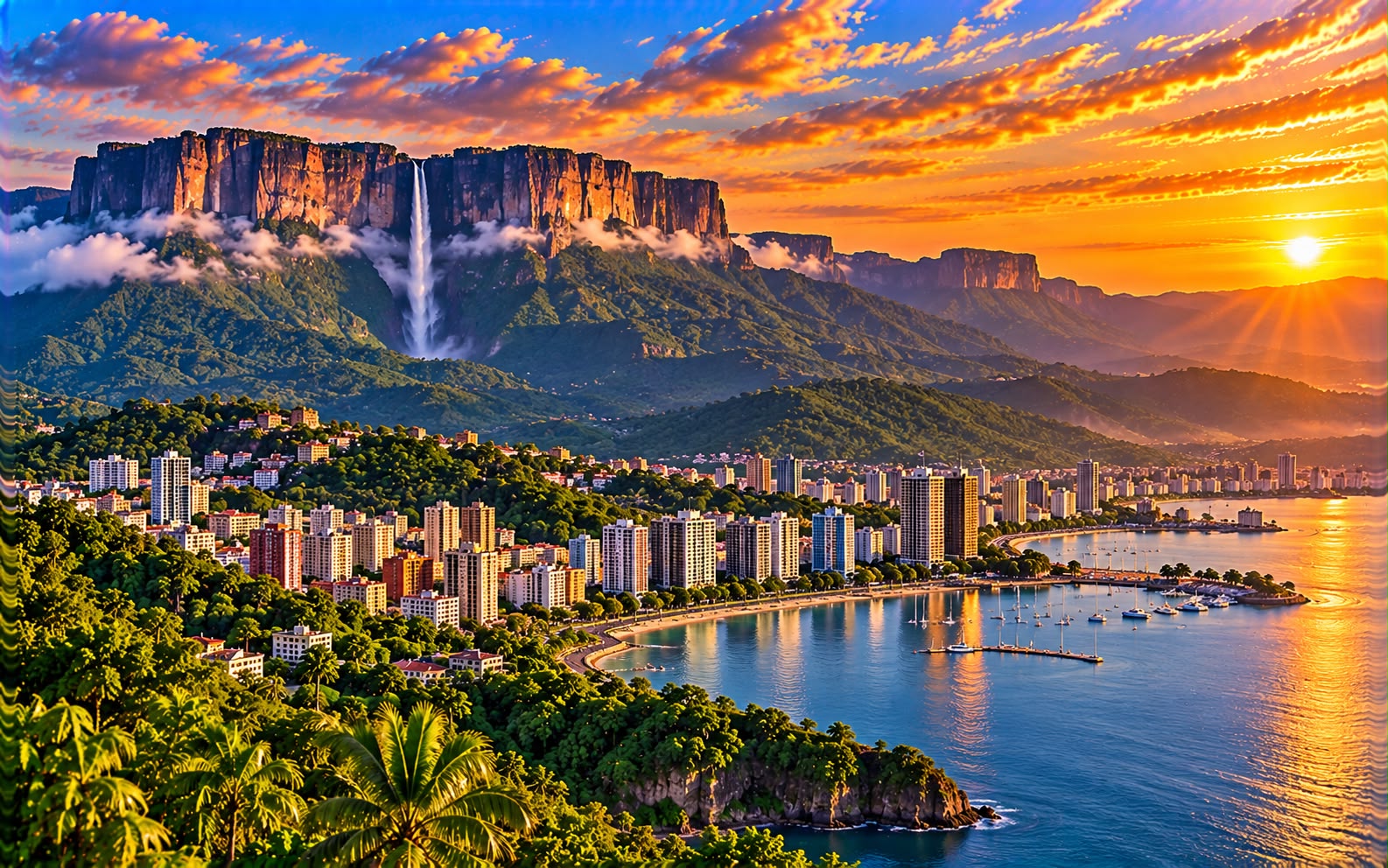
Venezuela in 9 days: Angel Falls, Roraima and Los Roques — and the warnings first
A kilometre of water falling from the rim of a sandstone plateau, flat-topped mountains that inspired The Lost World, and an archipelago of coral cays — in a country most governments advise against visiting at all.
- The Andes
- 9 days
- ≈ AED 5,900 / person
- The highest waterfall on earth, falling off a tabletop mountain
Before you go
Read this first
Most governments advise against all travel to Venezuela, and several specifically warn of wrongful detention of foreign nationals. The reasons:
- Arbitrary arrest and detention. Foreigners, including tourists, have been detained without charge and held for long periods. Some governments warn that their citizens have been used as bargaining chips.
- Violent crime is high, particularly in Caracas, and armed robbery and express kidnapping are common.
- The political situation is unstable and protests can turn violent without warning.
- Consular assistance is severely limited. Several countries have no embassy operating; the United States has none.
- Shortages of fuel, medicine, water and power are routine, and power cuts can last days.
- The land border with Colombia has particular warnings attached, including armed groups operating on both sides.
- Travel insurance will generally not cover you for travel against government advice.
This guide is not an encouragement to go. It describes a country that contains some of the most extraordinary landscape on earth, for people researching it and for whenever conditions allow.
Check your own government’s current advice before anything else.
Angel Falls is the thing. Water drops 979 metres off the rim of Auyán-tepui, the largest of the flat-topped sandstone mountains of the Guiana Shield — the highest uninterrupted waterfall in the world, and so tall that in the dry season much of it atomises into mist before it reaches the ground. It sits inside Canaima National Park, a UNESCO World Heritage site roughly the size of Belgium.
The tepuis themselves are the stranger thing: sheer-sided plateaus standing two kilometres above the savanna, isolated for tens of millions of years, with plant species found on one summit and nowhere else. Mount Roraima — climbable over six days, on a natural ramp discovered in 1884 — is the one Conan Doyle used for The Lost World.
Los Roques is an archipelago of coral cays and sandbars off the central coast, a national park, and among the best-preserved reef systems in the Caribbean.
Nine days, when it is possible. Figure USD 1,600 (≈ AED 5,876) per person excluding international flights. Go June–November for Angel Falls, when there is enough water; December–April for Roraima and Los Roques, which is the opposite.
Before you go: the 15-minute admin
The seasons are opposite, and you must choose
- Angel Falls needs the wet season. The river to the base is only navigable at high water, roughly June to November. In the dry months the falls reduce to a thread and the boats cannot get up.
- Roraima and the Gran Sabana are best dry, roughly December to April.
- Los Roques is good year-round and best in the dry months.
- You cannot do Angel Falls and a dry-season Roraima trek on the same visit. Pick one.
Money, which is genuinely complicated
- The bolívar (VES), after years of hyperinflation and several redenominations. The economy is heavily dollarised — US dollars are accepted and often preferred.
- Bring US dollars in cash, in small, clean notes. ATMs are unreliable and foreign cards frequently do not work.
- There has historically been a large gap between official and parallel exchange rates. Change through your operator or hotel.
- Prices in dollars are low by regional standards; the difficulty is logistics, not cost.
How people actually travel here
- Through an operator. Independent travel is possible in principle and very few people do it. Operators arrange the internal flights, the permits, the guides and the fuel — which is itself a problem to be solved.
- Internal flights to Canaima are by small aircraft and are the only practical access; there is no road.
- Avoid Caracas beyond the airport transfer. Most itineraries connect straight through.
- Do not travel overland at night, anywhere.
- Fuel shortages can strand vehicles for days. This is a routine planning factor, not an exception.
Health
- Malaria is present in Bolívar state, which includes Canaima and the Gran Sabana, and resistance is reported. Take advice and prophylaxis.
- Yellow fever vaccination is recommended and may be required.
- Medical facilities are very poor and medicines are scarce. Bring everything you might need.
Day by day
Day 1 — Arrive, and transfer
- Caracas — Maiquetía airport is on the coast, the city is over the mountain, and the transfer is the only part most itineraries use.
- Connect onward the same day where possible. Do not travel the airport road after dark, and arrange the transfer through your operator rather than taking one at the kerb.
- Bring US dollars in cash. Cards do not work and the bolívar is effectively unusable for visitors; dollars are accepted everywhere in practice.
- 14:00 — If you must overnight, stay airport-side at Catia la Mar rather than crossing into the city.
- 17:00 — Nothing after dark. That is the whole plan for this day.
Day 2 — To Canaima
- 09:00 — Fly to Canaima, a village on a lagoon at the edge of the park, with its own set of falls — Hacha, Sapo, Ucaima — pouring into it. There are no roads in; the flight is the only way.
- 13:00 — The lagoon, and the pink sand beach that the tepui runoff stains.
- 15:00 — Walk behind Salto El Sapo, which is exactly what it sounds like: a path between the rock and the curtain of water, and you will be soaked. Leave everything at the top in a dry bag.
- 18:00 — Sunset over the lagoon with the falls behind it.
- Confirm the upriver trip tonight. It only runs in the wet season. Outside it the rivers are too low and operators do not go.
Day 3 — Upriver to Angel Falls
- 07:00 — The trip to Angel Falls is four to five hours upriver by curiara, a motorised dugout, through rapids and gorges. You sit low, you get wet, and dry bags are not optional.
- 13:00 — Lunch at the river camp.
- 15:00 — Then a ninety-minute walk up through forest to Mirador Laime, the viewpoint facing the drop — slippery roots and a river crossing, and proper shoes matter.
- 17:00 — The falls from the mirador, and swimming in the plunge pool below when the water allows.
- 19:00 — You camp in hammocks under a shelter, with the falls audible all night. Take a light layer; it drops.
- The falls were named after Jimmie Angel, an American pilot who landed on top of Auyán-tepui in 1937 looking for gold and could not get his aircraft off again; it sat there for 33 years.
Day 4 — Back down, and the overflight
- 06:00 — Dawn at the mirador, which is when the cloud is lowest on the tepui and occasionally lifts clean off it.
- 09:00 — Back downriver, which is faster than the way up and rougher through the rapids.
- 14:00 — An overflight of the falls from Canaima if the weather is clear, which is 45 minutes and the only way to see the full 979m drop at once.
- 17:00 — Back in Canaima, and arrange the road south tonight.
Day 5 — Into the Gran Sabana
- 07:00 — South from Canaima by road into the Gran Sabana — open grassland with tepuis standing out of it, waterfalls every few kilometres, and almost no settlement.
- Fuel is scarce and queues are long. Your operator carries jerricans; this is normal here.
- 12:00 — Kamá Merú, which is the roadside one everybody stops at and is still worth it.
- 15:00 — Quebrada de Jaspe, where a stream runs over a bed of solid red jasper — go in the afternoon when the sun is on the stone and the colour comes up.
- 18:00 — Overnight in a Pemón village or a roadside camp.
Day 6 — The Gran Sabana
- 07:00 — Kavac and the cave canyon, swum into against the current to a waterfall in a chamber.
- 12:00 — Salto Aponwao, which takes a curiara and a walk and is 105m straight off the plateau edge.
- The Pemón communities run most of the tourism here and are the reason it works at all — the fees are theirs and the guides are theirs.
- 16:00 — The savanna at the end of the day, which is when the tepuis colour.
- 18:00 — Camp, and the sky out here is as dark as it gets.
Day 7 — Roraima, or onwards
- Mount Roraima, the tepui where Venezuela, Brazil and Guyana meet, is a six-day trek from Paraitepui — two days in, the extraordinary ramp up the cliff, two days on the summit among black rock formations and endemic plants, two days out.
- It is a separate commitment and does not fit inside this itinerary. If Roraima is why you are coming, build the trip around it and come in the dry season.
- 08:00 — Otherwise, return north toward Santa Elena or back to the airstrip.
- 14:00 — Paraitepui viewpoint for Roraima and Kukenán standing together, which is the consolation and is considerable.
- 18:00 — Overnight for the flight out.
Day 8 — Los Roques
- 09:00 — Fly to Los Roques, an archipelago of some 350 cays and islets about 150 kilometres off the coast, protected as a national park since 1972.
- 12:00 — Gran Roque is the only inhabited island — a few sand streets and a scatter of posadas. There are no cars.
- 14:00 — The cays are reached by boat: Francisquí, Madrisquí, Cayo de Agua with its sandbar. The boats drop you and collect you at a fixed time; take water and shade.
- 17:00 — Back to Gran Roque, and the lighthouse hill for sunset.
- It is the one part of this itinerary that feels like a holiday.
Day 9 — The cays, and out
- 08:00 — A last boat out. The reef is in good condition and the bonefishing is internationally known — the flats guides here are among the best anywhere.
- 13:00 — Back, and the flight to Caracas.
- Connect out the same day. As on arrival, the aim is not to overnight in Caracas, and leave margin — the Los Roques flights are small aircraft and weather-dependent.
Costs and practicalities
Best time to visit
June–November for Angel Falls and December–April for everything else, which is the planning tension in any Venezuelan itinerary.
- June–November — the wet season, and the only time the Churún river is high enough for the boats to reach Angel Falls. The fall itself is at full volume and the tepuis are often in cloud.
- December–April — the dry season. Roraima is at its best for trekking, Los Roques is at its clearest for diving, and the Gran Sabana roads are passable — but Angel Falls can slow to a trickle and the boat trip may not run at all.
- The compromise months are June and November, when water levels are workable and the weather is not at its worst.
Los Roques and the Caribbean coast are good year-round, and the Andes around Mérida are coolest and clearest from December to March.
Travel tips
- Check current travel advice carefully. Most governments advise against all or most travel; the political, economic and security situation has been severe for years and changes.
- Bring US dollars in cash, in small denominations. The economy is heavily dollarised after hyperinflation; the bolívar is used for small change and cards are unreliable.
- Nothing here is a self-drive trip. Fuel shortages, roadblocks and crime make arranged transport with a trusted operator the only sensible approach.
- Angel Falls is reached by light aircraft to Canaima and then by boat. Both are weather-dependent and neither is guaranteed.
- Do not display phones, jewellery or cameras in Caracas, and do not walk at night anywhere in the city.
- Power and water cuts are routine. Carry a torch and a power bank.
- Malaria prophylaxis for the Gran Sabana and the south, and a yellow fever certificate is required.
What this trip would cost
Two people, 8 nights, mid-range comfort, international flights excluded:
| Item | Cost |
|---|---|
| Posadas and camps, 8 nights | USD 1,100 (≈ AED 4,040) |
| Internal flights — Canaima and Los Roques | USD 1,200 (≈ AED 4,407) |
| Angel Falls trip, guides, park fees | USD 600 (≈ AED 2,204) |
| Gran Sabana transport and fuel | USD 300 (≈ AED 1,102) |
| Total for two | USD 3,200 (≈ AED 11,752) |
Food is not a separate line because almost everything here is full board — at Canaima, on the river and on Los Roques there is nowhere else to eat.
- Roughly USD 1,600 (≈ AED 5,876) per person. Internal flights are the biggest line and there is no alternative — Canaima has no road.
- Pay your operator in US dollars and agree everything in advance, including fuel, which is the item most likely to change.
- Pemón-run operations in Canaima and the Gran Sabana put the money where it should go. Ask who owns the camp.
- Hotel picks here are chosen on location, not on commission — always check prices and recent reviews before booking.
What to pack
- US dollars in cash, clean and small, for the entire trip.
- Malaria prophylaxis, repellent, and any medicine you might conceivably need.
- A dry bag — the curiara journey soaks everything.
- A hammock liner and a light sleeping bag for the Angel Falls camp.
- Quick-dry clothing and a rain layer. You will be wet either way.
- A torch, for the power cuts as much as the camp.
FAQ
Can I visit Venezuela now? Most governments advise against all travel, and several warn specifically about wrongful detention of foreigners. That is the honest starting point. People do travel to Canaima and Los Roques through operators; it is a decision to make with current advice in front of you.
When can I see Angel Falls properly? June to November, the wet season, when the river is navigable and the falls are full. In the dry months the boats cannot reach the base and the water largely disperses before it lands.
Can I do Angel Falls and Roraima on one trip? Not well — they want opposite seasons, and Roraima is a six-day trek in its own right. Choose.
Is Los Roques safe? It is remote from the mainland’s problems and is the least difficult part of the country to visit. The general advisories still apply to getting there.
What language do they speak? Spanish, with some thirty indigenous languages including Pemón in the Gran Sabana. English is rare.
Prices and entry rules change, and what you need depends on your passport; last checked 29 October 2026, so confirm with the embassy or your airline before booking.


