 The Itinerary
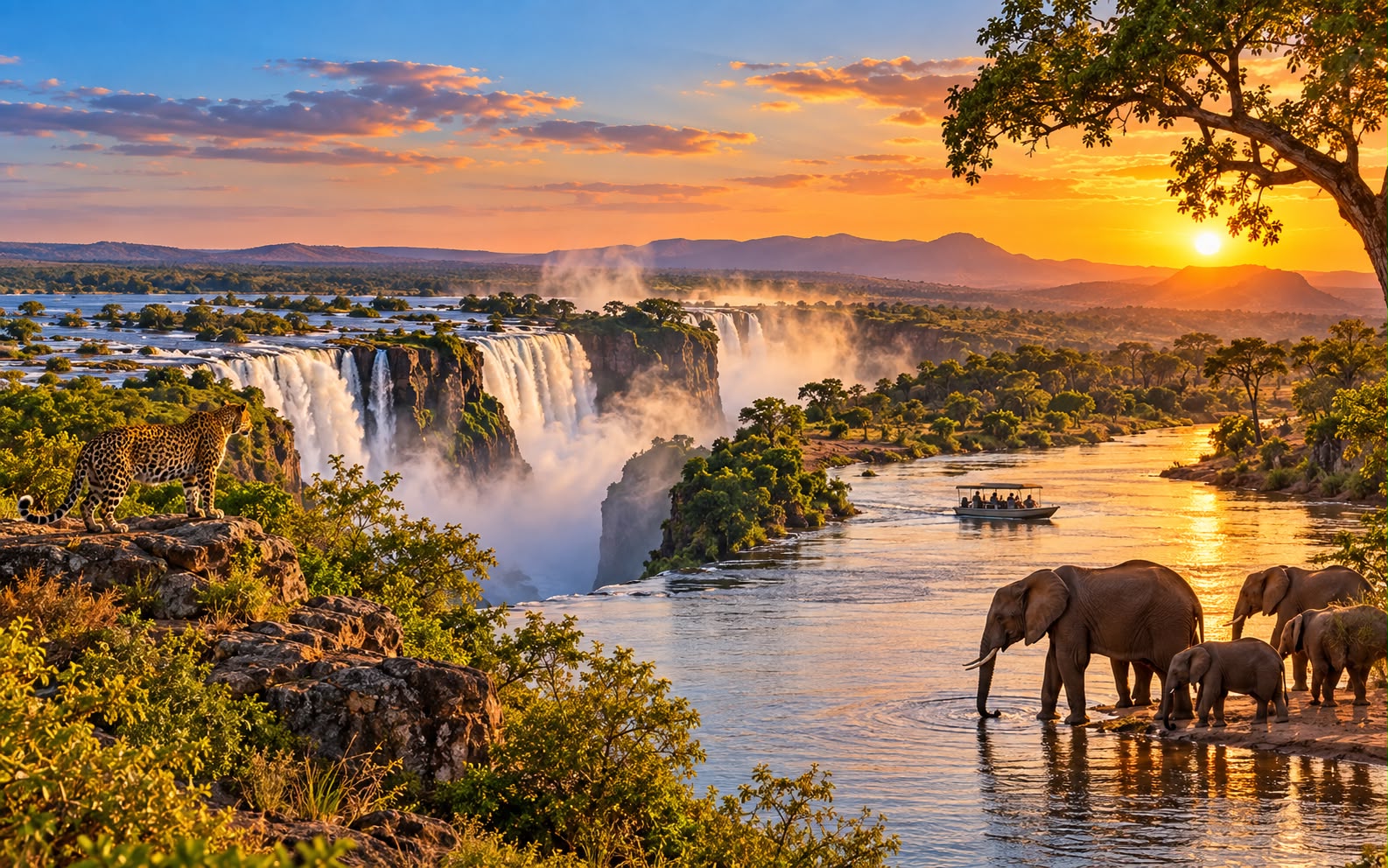
Zambia in 9 days: the Falls, South Luangwa and the Lower Zambezi
The country that invented the walking safari, and still does it better than anywhere: three days in South Luangwa on foot with a guide and a scout, canoeing past elephant on the Lower Zambezi, and Victoria Falls from the side where you can stand on the lip of it.
- Southern Africa
- 9 days
- ≈ AED 13,200 / person
- Walking safari, properly
Before you go
Most safaris are conducted from a vehicle. South Luangwa is where that stopped being the only option — Norman Carr ran the first guided walking safaris here in the 1950s, trained the guides, and the park has done it longer and better than anywhere since.
Walking changes the proportions of everything. You notice tracks, dung, bark stripped at shoulder height, the direction of the wind. A giraffe at eighty metres on foot is a different animal from a giraffe at eighty metres through a windscreen.
Zambia also holds the other side of Victoria Falls — and in low water, a rock pool at the very lip of it that you swim to — and the Lower Zambezi, where you drift past elephant in a canoe at water level.
This is not a cheap country. It is the one where the guiding is the product.
Before you go: walking, seasons and the cost of flying
Entry
- Most nationalities get a visa on arrival or an e-visa. The KAZA UniVisa covers Zambia and Zimbabwe together for 30 days and allows day trips to Botswana through Kazungula — if you plan to cross to the Zimbabwean side of the Falls, this is the one to ask for.
- Yellow fever certificate is required if you are arriving from a country where it is endemic.
Why Zambia is walking country
- Walking safaris run roughly June to October, when the grass is short enough to see through and the ground is dry.
- You walk in single file with an armed scout in front and a guide behind, for three to four hours in the early morning. It is not a hike — you cover perhaps five kilometres and stop constantly.
- Zambian guides are the most rigorously examined in Africa, and in the walking parks the qualification takes years. This is what you are paying for.
- Night drives are permitted in Zambian national parks, which is unusual — and South Luangwa’s leopard density is among the highest anywhere, so the spotlight hour matters.
The season decides everything
- June to October — dry season. The bush thins, animals concentrate on the river, every camp is open, and walking is at its best. September and October are the peak for game and also the hottest — 40°C is normal in October.
- November to April — the emerald season. Spectacular green, dramatic skies, migrant birds, newborn animals, and half the price. But many camps close, roads flood, and walking largely stops. Some camps run boat safaris over ground that was a road in September.
- May is the shoulder — green still, roads drying, few people.
Flights, and why they cost what they do
- The parks are reached by light aircraft, not road. Proflight runs Lusaka–Mfuwe for South Luangwa and Lusaka–Jeki or Royal for the Lower Zambezi.
- Budget USD 600–800 per person for the internal legs. The road alternative to South Luangwa is 10–12 hours from Lusaka on a road that is good until it suddenly is not.
- 20 kg in a soft bag on the light aircraft, and they weigh passengers too.
Money and health
- The kwacha (ZMW) is the currency, but camps, parks and activities are quoted and paid in US dollars, which is why this guide prices in them. Carry clean USD notes; worn or pre-2009 ones are refused.
- Malaria is present year-round. Take prophylaxis and use the repellent; the Luangwa valley is a serious transmission area.
- Tipping is cash, in USD, in the envelopes camps provide — guide and general staff separately.
Day by day
Day 1 — Land at Livingstone
- 13:00 — Land at Harry Mwanga Nkumbula (LVI), 20 minutes from town and ten from the Falls.
- 14:30 — Drop bags. Stay near the river rather than in Livingstone town, which is a functional place with a good museum and not much else.
- 16:00 — You can hear the Falls from several kilometres away. The Lozi name — Mosi-oa-Tunya, the smoke that thunders — is the accurate one, and the spray column is visible from the air on the way in.
- 16:30 — A sunset cruise on the Zambezi above the Falls: two hours, hippo pods, elephant coming down to drink, crocodile on the sandbars, and the river running wide and flat right up to the point where it disappears.
- 19:30 — Dinner. Bream from the river, and Mosi lager, which is named after the Falls.
Day 2 — The Falls, Zambian side
- 07:00 — Into the park at opening, before the coaches and in the best light.
- 07:15 — The Knife-Edge Bridge, and this is what Zambia has that Zimbabwe does not: you walk out onto a spur directly opposite the Eastern Cataract, with the gorge below you on both sides. In high water you are walking through solid spray and you will be soaked in ninety seconds.
- 09:00 — The Boiling Pot trail, down 200 m of steps to the whirlpool where the river turns the corner under the bridge. The climb back out is the morning’s exercise.
- 11:00 — Know the trade-off before you come: Zimbabwe has the panoramic face of the Falls; Zambia puts you on top of them. In low water (roughly October to December) the Zambian side can run nearly dry, which is when Zimbabwe is clearly the better view — and also exactly when Devil’s Pool opens.
- 13:00 — Lunch, then the Victoria Falls Bridge — the 1905 steel arch, with the bungee off the middle and a walkway to the halfway point.
- 16:00 — The craft market, and the Livingstone Museum if the heat has beaten you.
- 19:00 — Dinner.
Day 3 — Devil’s Pool, or the gorge
- Option A — Livingstone Island, 07:00. In low water, roughly mid-August to mid-January, boats run to the island at the lip of the Falls, and from it you swim a few metres to Devil’s Pool — a rock basin at the very edge, with a natural lip holding you, where you lie with your head over a 100 m drop while a guide holds your ankles. It is as alarming as that sounds, it is properly run, and it is unrepeatable.
- Option B — rafting, 08:00. The Zambezi below the Falls is among the best commercial whitewater anywhere — grade V, big warm water, 25 rapids. Low water only, and the 200 m climb out of the gorge at the end is harder than the rapids.
- Option C — Mosi-oa-Tunya National Park, 06:30. Small, on the riverbank, and the only place in Zambia with white rhino — tracked on foot with rangers who guard them around the clock. Two hours, and a gentle introduction to walking before Luangwa.
- 15:00 — The microlight or helicopter over the Falls if you want the shape of the seven gorges, which only makes sense from the air.
- 19:00 — Repack into a soft bag. Tomorrow you fly light.
Day 4 — Fly to South Luangwa
- 09:00 — Fly Livingstone → Lusaka → Mfuwe, usually with a connection and most of the morning gone.
- 13:00 — Land at Mfuwe. The transfer to camp is a game drive in itself — the road crosses the Luangwa and the park boundary is unfenced, so the animals are on it.
- 15:00 — Arrive, settle, and take the briefing seriously: you are escorted between tent and dining area after dark, every time, and hippo walk through camp at night to graze.
- 16:00 — First afternoon drive, running into dusk. South Luangwa holds Thornicroft’s giraffe and Crawshay’s zebra, found nowhere else, along with enormous herds of buffalo and some 400 bird species.
- 19:00 — The drive finishes with a spotlight hour — leopard, genet, civet, porcupine, and the honey badger that nobody ever sees in daylight.
- 20:30 — Dinner, and the Luangwa making noise all night.
Day 5 — The walking safari
- 05:30 — Coffee at the fire, then out on foot. This is the day the trip is built around.
- 06:00 — Single file: scout in front with the rifle, guide behind him, you behind that, and nobody talks above a murmur. You walk into the wind and the guide reads the ground continuously.
- 07:30 — What you actually do is stop, constantly — tracks in dust, a termite mound’s architecture, which tree the elephant stripped and why, the difference between hyena and wild dog scat, a leopard print over last night’s vehicle tyre.
- 09:00 — Big animals at a distance, approached carefully and downwind. Standing on the ground two hundred metres from buffalo, with nothing between you, is an entirely different physiological experience from seeing them from a vehicle. That is the point, and no photograph conveys it.
- 10:00 — Breakfast cooked in the bush, under a tree, at the end of the walk.
- 12:00 — Back to camp. Rest — it will be in the thirties.
- 16:00 — Afternoon drive and a second spotlight hour.
- 20:00 — Dinner.
Day 6 — Luangwa, and the lagoons
- 05:45 — Morning drive, or a second walk if the first one took.
- 07:30 — The oxbow lagoons are where the density is: the Luangwa changes course constantly and leaves horseshoe pools behind, which hold hippo in absurd concentrations and draw everything else to drink. Luangwa has one of the highest hippo densities of any river in the world.
- 10:00 — Back, brunch, and the long middle of the day.
- 15:30 — Tea, then out.
- 16:30 — Leopard. South Luangwa’s population density is among the highest in Africa and the guides know individuals by name and territory. The late afternoon and the spotlight hour are when you find them, often in a sausage tree with a kill.
- 19:30 — Dinner.
- 21:00 — If your camp offers a night drive as a separate activity, take it. Zambia permits them and most countries do not.
Day 7 — Fly to the Lower Zambezi
- 09:00 — Fly Mfuwe → Lusaka → Jeki or Royal, light aircraft both legs, landing on a strip in the valley.
- 13:00 — Arrive at camp on the Zambezi, with the escarpment behind you and Mana Pools in Zimbabwe directly across the water — the same ecosystem, two countries.
- 14:00 — Lunch, and the heat.
- 16:00 — A boat safari, which is this park’s signature. Elephant swim between the islands, and you watch from the water with the engine off — plus hippo, crocodile, skimmers and fish eagles.
- 18:30 — Sundowners on the river with the Zimbabwean escarpment going pink opposite.
- 20:00 — Dinner.
Day 8 — Canoeing the Zambezi
- 06:00 — Canoeing, and it is the reason to come here. Two-person Canadian canoes, a guide leading, drifting down the channels between islands with the current doing most of the work.
- 07:30 — You pass elephant feeding on the banks at eye level, buffalo in the shallows, and you give hippo pods a very wide and carefully briefed berth. The guide reads the water constantly; this is run seriously and safely, and it is still the most exposed you will feel all trip.
- 10:30 — Out, and breakfast.
- 12:00 — Rest.
- 15:30 — A game drive on the floodplain, or tiger fishing if that appeals — the Zambezi is one of the great fisheries and it is catch-and-release.
- 18:00 — Last sundowner.
- 19:30 — Dinner. Settle tips in cash tonight — guide and camp staff separately.
Day 9 — Fly home
- 09:00 — Light aircraft back to Lusaka, then the international connection.
- Leave a long gap in Lusaka. Light aircraft schedules move with weather and passenger loads, and the connection is the only part of this trip with no slack.
- Note — Spend your kwacha before you go. The camps took dollars; the airport shops will take kwacha and nowhere outside Zambia will.
Costs and practicalities
Best time to visit
June–October is the dry season and the best for game, with the Victoria Falls running on its own and opposite calendar.
- June–August — dry, cool, and excellent game viewing as the bush thins. The Falls are at their most spectacular from March to June, when the Zambezi is in flood — though the spray can obscure the view entirely at the peak.
- September–October — hot, very dry, and the best game viewing of the year in South Luangwa and Lower Zambezi as animals crowd the remaining water. October is intense heat.
- August–December — the low-water season at the Falls, when Devil’s Pool on the Zambian side opens — usually roughly mid-August to mid-January.
- November–April — the emerald season. Green, dramatic, excellent birding, and many camps close; the Luangwa roads become impassable.
Walking safaris in South Luangwa — where they were invented — run in the dry season only.
Travel tips
- Zambia is the home of the walking safari and South Luangwa does it better than anywhere. If you only do one thing here, do that rather than another game drive.
- Devil’s Pool is seasonal and depends on water level — generally August to January. Book ahead through Livingstone Island operators.
- A KAZA UniVisa covers Zambia and Zimbabwe and allows day trips to Botswana, which is useful if you want both sides of the Falls. Check current availability.
- Camps are often fly-in with strict soft-bag luggage limits — usually 15–20kg. This is enforced.
- Malaria prophylaxis is essential and the risk is year-round, highest in the wet season.
- Tipping is expected at camps — guide and general staff separately, with guidance given at check-in.
- Bring a waterproof for the Falls, not a jacket. In high water the spray is a vertical downpour and you will be soaked.
What this trip actually costs
Two people, 8 nights, mid-range camps, excluding international flights:
| Item | Cost |
|---|---|
| Livingstone, 3 nights | USD 600 (≈ AED 2,204) |
| South Luangwa, 3 nights all-inclusive, two people | USD 2,400 (≈ AED 8,814) |
| Lower Zambezi, 2 nights all-inclusive, two people | USD 1,800 (≈ AED 6,611) |
| Internal flights, two people | USD 1,300 (≈ AED 4,774) |
| Falls park fees, cruise, Devil’s Pool or rafting | USD 500 (≈ AED 1,836) |
| KAZA visas, tips, extras | USD 600 (≈ AED 2,204) |
| Total for two | USD 7,200 (≈ AED 26,442) |
- Roughly USD 3,600 (≈ AED 13,221) per person, and Zambia is not a cheap safari country. What you are buying is guiding, low vehicle density and the walking.
- The emerald season (November to April) is close to half this, with the trade-offs above.
- The internal flights are the line people underestimate — they are a fifth of the trip and are not optional.
- Top-end camps will double the total; genuine budget options exist in Livingstone but barely in the parks.
What to pack
- Neutral colours for walking — khaki, olive, grey. No blue or black, which attract tsetse flies, and nothing white.
- Closed walking shoes that you have already worn in, plus long trousers for thorns and for the sun.
- Binoculars, and better ones than you think. On foot they are the difference between seeing and looking.
- Malaria prophylaxis and strong repellent.
- A 20 kg soft bag — light aircraft refuse hard cases.
- Clean USD notes in small denominations for tips and park fees; anything torn or pre-2009 is rejected.
- A head torch for camp after dark.
FAQ
Is walking actually safe? It is run with an armed scout in front and a guide who has qualified over years, you walk into the wind, and you are briefed before you leave. The animals are given a wide margin and the guides turn groups around routinely. It demands that you do exactly what you are told, immediately, which is the whole of the safety procedure.
Zambia or Zimbabwe for Victoria Falls? Zimbabwe has the full panoramic face and the better view in low water. Zambia puts you on the lip — the Knife-Edge Bridge and, in season, Devil’s Pool. The KAZA visa lets you do both, and the bridge between them is a twenty-minute walk.
Is South Luangwa better than the Serengeti or Kruger? Different. It has no great migration and fewer rhino. What it has is the walking, far fewer vehicles at a sighting, exceptional leopard, and guiding of a standard that other countries send their guides here to learn.
When exactly should I go? June to October for walking and concentrated game, with September and October the peak and the hottest. Avoid February and March unless you specifically want the emerald season — much of the park is inaccessible and many camps are shut.
Can I do this without the internal flights? Lusaka to Mfuwe by road is 10 to 12 hours and the Lower Zambezi is a long drive plus a boat. It saves real money and costs you two days of the nine. On a trip this short, fly.
Prices and entry rules change, and what you need depends on your passport; last checked 8 October 2026, so confirm with the embassy or your airline before booking.


