 The Itinerary
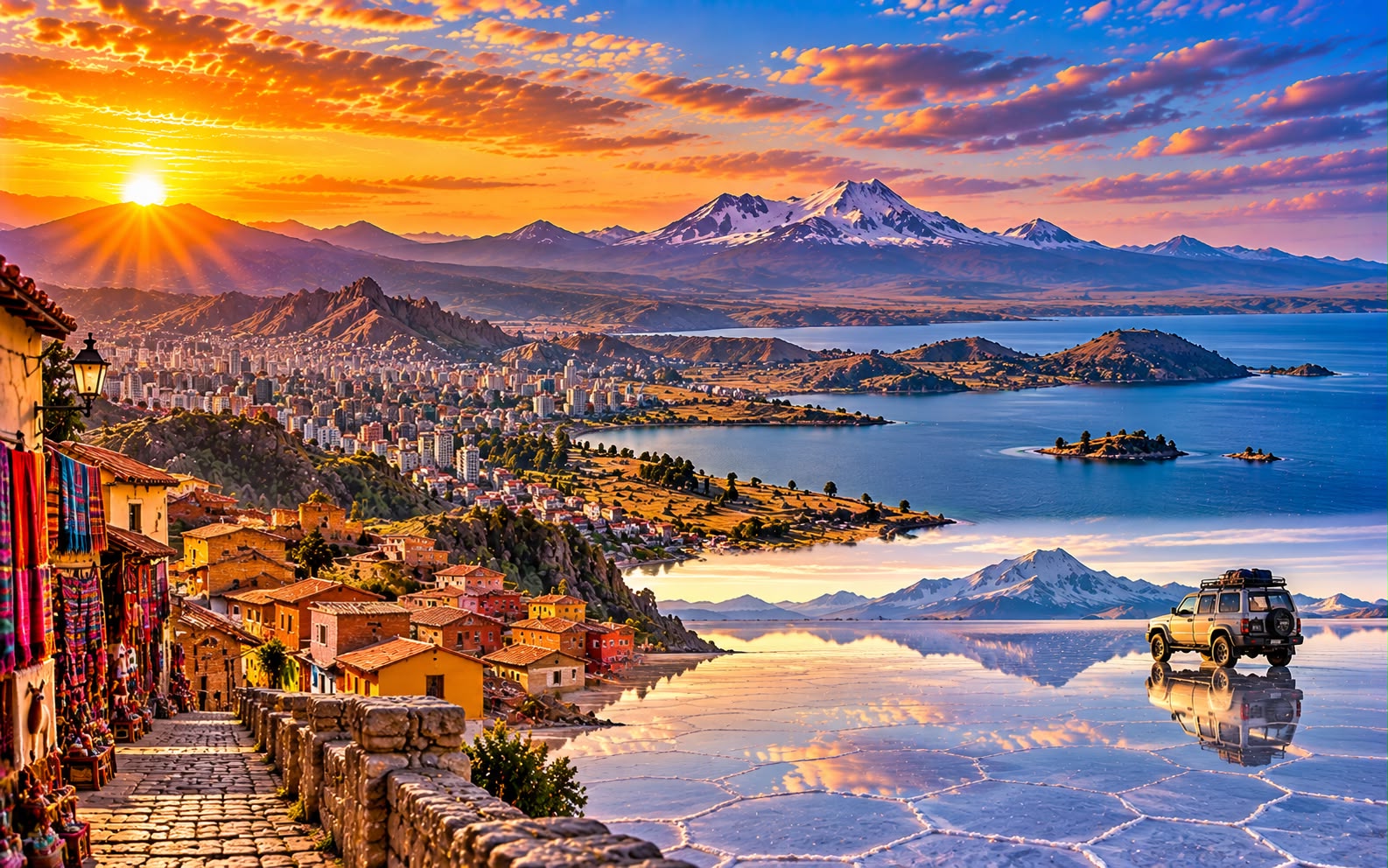
Bolivia in 11 days: La Paz, Uyuni and Lake Titicaca
The highest country in the Andes and the strangest landscape in South America: a salt flat the size of a small country that becomes a mirror when it rains, coloured lagoons full of flamingos at 4,500 metres, and a city built into a canyon where the commuter system is a cable car — with the altitude plan and the honest brief on Uyuni tour operators.
- The Andes
- 11 days
- ≈ AED 3,050 / person
- Salt flats + altiplano
Before you go
Bolivia is the highest, poorest and most indigenous country in South America, and the one that rewards effort most. It is also the one where altitude is not a footnote but the organising fact of the trip. La Paz’s airport sits at 4,061 m — higher than almost any mountain in Europe — and the Uyuni circuit spends days above 4,000.
What you get is a landscape with no equivalent. The Salar de Uyuni is 10,000 km² of salt flat, flat to within a metre across its whole width, blinding white in the dry season and a perfect mirror when a film of water sits on it. South of it, the Eduardo Avaroa reserve has lagoons coloured red and green by minerals and algae, geysers at 4,900 m, and flamingos that somehow live there.
Lake Titicaca at the end is a rest: 3,800 m, blue, and the Andean world’s sacred centre.
Before you go: altitude first, then the tour operators
Altitude is the whole plan
Read this before booking anything.
- El Alto airport serves La Paz at 4,061 m. You will feel it walking to baggage claim. This is not like Cusco or Quito; it is substantially higher.
- Do not fly in and go straight up. Plan the first two days as rest: La Paz’s city centre sits lower than the airport, around 3,600 m, and even that is high.
- The Uyuni circuit sleeps at 4,200–4,500 m for two nights. Do it after you have acclimatised, never at the start.
- Symptoms — headache, breathlessness, poor sleep, nausea — are normal for a day or two and should improve. If they worsen, descend; that is the only reliable treatment.
- Coca tea and coca leaves are legal, ubiquitous and mildly helpful. Talk to a doctor about acetazolamide before you fly.
- Go easy on alcohol for the first three days.
Choosing an Uyuni operator
This matters more here than almost anywhere on this site.
- The standard trip is three days and two nights from Uyuni through the salt flat and south to the lagoons, finishing at the Chilean border or looping back.
- Operators vary enormously. There is a long history of accidents involving fatigue, alcohol and speed on remote tracks, and of vehicles breaking down far from help.
- Do not book on price alone. Ask specifically about the driver’s hours, whether there is a second vehicle in convoy, oxygen on board, and the age of the 4x4. A reputable operator will answer without hesitation.
- Book in Uyuni or La Paz with an established agency, read recent reviews, and be willing to pay more than the cheapest quote.
- Nights are in basic salt hotels and refugios — shared rooms, intermittent electricity, and cold. Bring a sleeping bag liner and a warm layer.
Money and getting around
- The boliviano (BOB). Cards work in La Paz hotels and larger restaurants and almost nowhere else on this route.
- Draw cash in La Paz. ATMs in Uyuni exist and run out.
- Bolivia is the cheapest country in South America by a clear margin.
- Fly La Paz to Uyuni — an hour, against ten or more by bus. The overnight bus is a common choice and a cold one.
- La Paz’s cable car network, Mi Teleférico, is the city’s metro: ten lines up the canyon walls, cheap, and the best view in the city.
Entry
- Most nationalities enter visa-free for 30 to 90 days — the EU, UK, Canada, Australia and most of Latin America. US passports require a visa, obtainable in advance or on arrival with documentation and a fee. Check your own case; Bolivia’s rules change with politics.
- Yellow fever vaccination is required if you are arriving from certain countries and recommended for the lowlands.
Day by day
Day 1 — Land in La Paz, and do nothing
- 11:00 — Land at El Alto (LPB), 4,061 m — the highest international airport in the world. You will feel it walking to baggage claim.
- 12:00 — Drive down into the city. La Paz sits in a canyon, and the descent from El Alto to Sopocachi or the Zona Sur drops 500 m. Sleep as low as your budget allows: every hundred metres helps on the first night.
- 13:30 — Drop bags. Then stop. This is not a rest day being polite about it — altitude sickness on day one ruins day three.
- 15:00 — Mate de coca, and a walk of no more than a few blocks on the flat.
- 18:00 — Eat lightly and early. Alcohol tonight is a bad trade.
- 20:00 — Sleep. If you have a headache, that is normal; if you are breathless at rest or vomiting, go down, not up.
Day 2 — La Paz, gently
- 09:30 — The Mercado de las Brujas (Witches’ Market) on Linares: herbs, amulets and the dried llama foetuses buried under new buildings as an offering to Pachamama. It is not staged for visitors; the builders genuinely buy them.
- 11:00 — Calle Jaén, the one intact colonial street, and its four small museums on a single ticket — the Precious Metals one takes twenty minutes and is the best of them.
- 13:00 — Lunch in Sopocachi.
- 15:00 — Mi Teleférico, the cable-car metro. Ride the red line up to El Alto and change to the yellow and green for the run back down over the canyon — about USD 1 a leg, and the finest public transport view on the continent.
- 17:30 — From the El Alto station, the drop into the bowl with Illimani behind it, at the hour the light goes orange.
- 19:30 — Dinner. If it is Thursday or Sunday, the El Alto market — 16 de Julio — is among the largest in South America and runs for kilometres.
Day 3 — Moon Valley, or Chacaltaya
- Option A — Valle de la Luna, 09:00. Eroded clay spires twenty minutes from the Zona Sur, an hour-long marked circuit, and back by midday. The sensible choice if day two left you tired.
- Option B — Chacaltaya, 07:00. A former ski resort at 5,395 m on a glacier that has entirely gone. The hut is a 20-minute walk from the road and it will take you forty. Only attempt this if you slept well and walked yesterday without trouble — it is 1,300 m above the city.
- 13:00 — Back down, and lunch.
- 16:00 — Repack for the salt: warm layers, sunglasses, sun cream, a power bank. The southwest circuit has no electricity for much of it.
- 19:00 — Fly to Uyuni (one hour, and worth the money) or take the overnight bus (10–12 hours, cama seats, cold). The flight buys you most of a day.
Day 4 — Onto the salt
- 08:00 — The train cemetery outside Uyuni: rusting British locomotives abandoned when the mining line closed, half-buried in salt wind. Twenty minutes, and better than it sounds.
- 09:30 — Colchani, the salt-processing village on the edge, then out onto the Salar de Uyuni — 10,582 km² of salt crust, flat to within one metre across its entire width.
- 11:30 — Incahuasi island: a fossilised coral outcrop covered in Trichocereus cactus up to twelve metres tall, some of them 900 years old, standing in a white sea. Walk the summit loop.
- 13:30 — Lunch on the flat, then the perspective photographs — everyone takes them, everyone enjoys them, and your driver has done this a thousand times and is better at it than you.
- 16:00 — If it is the wet season (January–March), find standing water for the mirror effect — the reason a lot of people come.
- 18:30 — Sunset on the salt, which turns pink.
- 20:00 — A salt hotel on the edge of the flat. The walls, floor, beds and tables are salt blocks. It is colder than you expect.
Day 5 — South into the reserve
- 07:00 — Leave early; today is 300 km of dirt and there is no hurrying it.
- 09:30 — Laguna Cañapa, then Hedionda — mineral lakes with James’s, Chilean and Andean flamingos on them, at 4,100 m. Hedionda means “stinking”, and it does.
- 12:30 — Lunch, usually out of the vehicle at whichever lake is sheltered.
- 14:30 — The Siloli desert and the Árbol de Piedra, a wind-carved rock that balances on a stem the width of a table.
- 16:30 — Laguna Colorada at 4,278 m: red with algae, white with borax islands, and holding the largest breeding colony of James’s flamingo in the world.
- 18:00 — The refugio. Basic, shared, and genuinely cold — −15°C is normal. Sleep in your clothes; everyone does.
Day 6 — Geysers, springs, and back
- 05:00 — Out in the dark for Sol de Mañana at 4,900 m, the highest point of the trip. The mud pools and fumaroles are at their most violent just after dawn, the air is thin, and it is brutally cold. Stay on the paths — the crust gives way.
- 07:30 — Termas de Polques, hot springs at the edge of a lagoon. Getting in is easy; getting out into the wind is the hard part.
- 09:30 — Laguna Verde under the cone of Licancabur, the volcano on the Chilean border. The green only appears when the wind stirs the arsenic and copper sediment, so a still morning shows you a grey lake.
- 11:00 — Two ways out: transfer to the Hito Cajón border for San Pedro de Atacama in Chile, or the long drive back.
- 19:00 — Uyuni, if you came back — about eight hours.
Day 7 — Back to La Paz
- 09:00 — Fly north, or the day bus. After three days of dirt road the flight is the kinder option.
- 13:00 — La Paz. A shower, a real bed, and air that is 700 m thicker than where you have been.
- 16:00 — Nothing demanding. The Mercado Lanza for lunch, or an hour in a café on Sagárnaga.
- 19:30 — Dinner properly — Gustu in the Zona Sur if you want the tasting-menu version of Bolivian produce, and it is worth one evening.
Day 8 — To Lake Titicaca
- 08:00 — Bus to Copacabana, three to four hours. At the Estrecho de Tiquina everyone gets off: passengers cross on a launch, the bus goes separately on a flat barge, and you wait on the far side watching it come.
- 12:00 — Arrive Copacabana on the lake shore at 3,841 m.
- 13:30 — Lunch — trucha from the lake, which is on every menu for good reason.
- 15:00 — The Basílica de Nuestra Señora de Copacabana and its Black Madonna, the most venerated image in Bolivia. Outside, cars are blessed with flowers, beer and confetti.
- 17:30 — Climb Cerro Calvario, 45 minutes of stations of the cross, for sunset over the lake. It is steep at this altitude.
- 19:30 — Dinner on the front.
Day 9 — Isla del Sol
- 08:30 — Boat to Isla del Sol, 90 minutes. In Inca belief this is where the sun was born and Manco Cápac emerged.
- 10:30 — Land at the south end (Yumani) and climb the Escalera del Inca from the jetty — 200-odd steps at 4,000 m, which is the hardest twenty minutes of the trip.
- 12:00 — Walk the ridge trail north if the communities have it open — three hours, no vehicles anywhere on the island, terraces the whole way, and the Cordillera Real across the water.
- 15:00 — Pilko Kaina ruins or the Inca fountain.
- 17:00 — Last boat back — check the time when you land, they are firm about it.
- Better — Stay the night. The island empties after the day boats leave and the stars at 4,000 m over the lake are worth rearranging a day for.
Day 10 — Tiwanaku, and La Paz
- 08:30 — Leave Copacabana, and stop at Tiwanaku on the way in — the pre-Inca capital that peaked around 800 AD, a thousand years before the Incas, who inherited the site and claimed it.
- 11:00 — The Gate of the Sun cut from a single block, the Kalasasaya platform, the sunken temple of carved stone heads, and the Akapana pyramid. Two hours with a guide; the two museums are included.
- 14:00 — Into La Paz, 90 minutes.
- 16:00 — Mercado Rodríguez for produce, or the craft shops on Sagárnaga for alpaca that is actually alpaca.
- 19:30 — Last dinner, and a singani sour.
Day 11 — Fly home
- Allow more time than feels sensible. El Alto is 500 m above the city, the climb takes 45 minutes in traffic, and at 4,061 m everything — including you, and including the queue — moves slower.
- On the plane, the descent to sea level will feel like taking off a rucksack you had stopped noticing.
Costs and practicalities
Best time to visit
The answer depends entirely on whether you want the Uyuni mirror. Dry season is easier for everything else; wet season is the reason most people come.
- May–October (dry) — clear skies, cold nights, reliable roads, and the salt flat is a hard white plain you can drive across. Best for La Paz, Potosí, Sucre and the Altiplano generally.
- December–March (wet) — a shallow film of water turns Uyuni into the mirror, which is the photograph everyone is after. January and February are the most reliable. The trade-off is that the crossing to Isla Incahuasi is often impossible and some lagoon routes close.
- April and November — the shoulders, and genuine gambles either way.
Altitude is the real constraint. La Paz is 3,600m and Potosí over 4,000m. Build two nights at altitude before anything strenuous.
Travel tips
- Take altitude seriously. Arrive, do nothing for 24 hours, drink water, skip alcohol. Coca tea helps a little; acetazolamide helps more if your doctor agrees.
- La Paz’s teleférico is public transport, not a tourist ride — ten lines, cheap, and the fastest way across the city.
- Carry small notes. Nobody has change for a 100-boliviano note, and taxis and markets will refuse one.
- Cards work in La Paz and Santa Cruz hotels and restaurants and almost nowhere else. ATMs run out at weekends.
- Blockades are a normal political instrument and close roads with little notice. Build slack into any overland leg and ask locally that morning.
- Agree taxi fares in advance, and in La Paz use radio taxis rather than street ones at night.
- The Uyuni tours vary enormously in safety. Pay for an operator with a reputation; the cheapest trips have a record of exhausted drivers on long desert stretches.
What this trip actually costs
Two people, 10 nights, mid-range, excluding international flights:
| Item | Cost |
|---|---|
| Hotels, 8 nights, plus 2 nights on the Uyuni circuit | BOB 5,800 (≈ AED 1,778) |
| Uyuni 3-day tour ×2, reputable operator | BOB 5,500 (≈ AED 1,686) |
| La Paz–Uyuni flights ×2 return | BOB 3,000 (≈ AED 920) |
| Titicaca boats, Tiwanaku, cable cars, entries | BOB 1,200 (≈ AED 368) |
| Food and drink, 11 days | BOB 3,000 (≈ AED 920) |
| Buses, transfers, eSIM | BOB 1,500 (≈ AED 460) |
| Total for two | BOB 20,000 (≈ AED 6,132) |
- Roughly BOB 10,000 (≈ AED 3,066) per person — the cheapest country on this site per day, even including the Uyuni tour.
- Do not economise on the Uyuni operator. It is the one line where the cheapest option carries real risk.
- The internal flight is the other worthwhile spend; the bus costs you a night and arrives at dawn in the cold.
What to pack
- A properly warm layer, hat and gloves. Nights on the Uyuni circuit drop well below freezing and the refugios are unheated.
- A sleeping bag liner for the same reason.
- Sunglasses and very high-factor sunscreen. The salt flat reflects everything and the altitude thins the filter.
- Lip balm, which sounds trivial and is not at 4,500 m.
- Cash in bolivianos, drawn in La Paz.
- Type A/C plugs — Bolivia uses both, and voltage varies between 110V and 220V by city. Check your charger.
- A head torch for refugios without reliable power.
FAQ
How bad is the altitude? Real, and manageable if you respect it. La Paz’s airport at 4,061 m is higher than most people have ever been. Two quiet days first, and the Uyuni circuit afterwards rather than before, is the plan that works.
Is the Uyuni tour safe? With a reputable operator, yes. With the cheapest one, not reliably — there is a genuine history of accidents on these remote tracks. Ask about driver hours, convoy vehicles and oxygen, and pay the difference.
Wet season or dry? December to March floods the flat with a few centimetres of water and gives the mirror effect, but can make parts impassable. May to October is dry, gives the white hexagon crust and clear access to the whole circuit. Both are worth it; they are different photographs.
Can I combine it with Chile or Peru? Easily. The southwest circuit ends at the Chilean border two hours from San Pedro de Atacama — see our Chile guide — and Titicaca continues into Peru.
Prices and entry rules change, and what you need depends on your passport; last checked 8 October 2026, so confirm with the embassy or your airline before booking.


