 The Itinerary
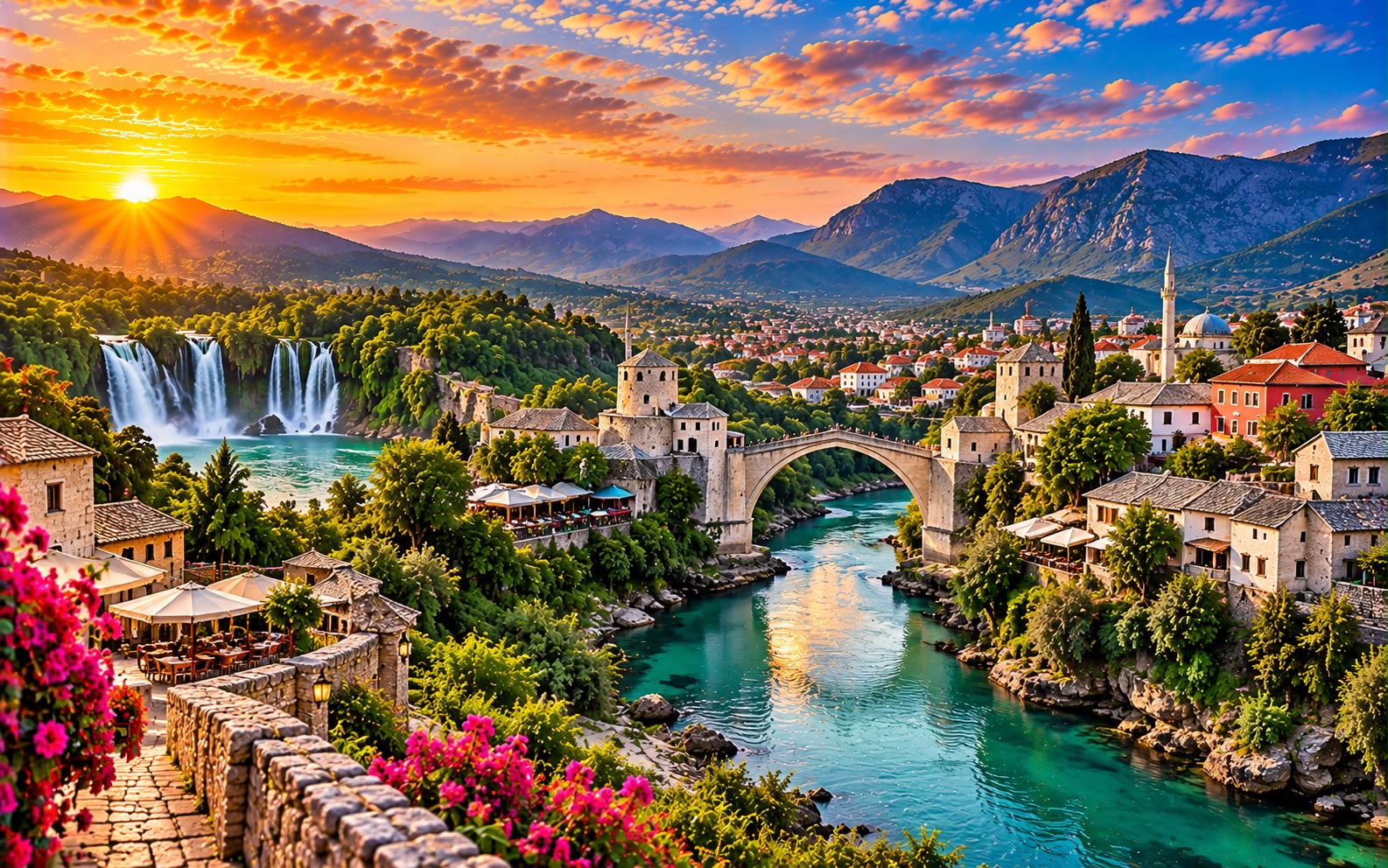
Bosnia and Herzegovina in 7 days: Sarajevo, Mostar and the waterfalls
A city where a mosque, a synagogue, a Catholic and an Orthodox church stand within a few hundred metres, a bridge rebuilt stone by stone after it was destroyed, and a dervish house under a cliff where a river comes out of the rock — with the honest version of the recent history and the one warning that genuinely matters.
- Southern Europe
- 7 days
- ≈ AED 2,250 / person
- Old towns + history
Before you go
Sarajevo has a line in the pavement marking where West met East — Ottoman bazaar on one side, Austro-Hungarian boulevards on the other — and within a few hundred metres a mosque, a synagogue, a Catholic cathedral and an Orthodox church. It is one of the most interesting cities in Europe and one of the least visited.
It is also a city that was besieged for nearly four years in the 1990s, the longest siege of a capital in modern history, and that is visible everywhere once you know what you are looking at: the “Sarajevo roses” where mortar scars in the pavement have been filled with red resin, and the tunnel under the airport that kept the city supplied.
South, Mostar’s bridge was destroyed in 1993 and rebuilt from the original stones raised out of the river. Blagaj has a sixteenth-century dervish house beneath a 200 m cliff where the Buna river emerges fully formed. Kravice is a horseshoe of waterfalls you can swim in.
Seven days, and one warning that is not optional.
Before you go: the history, the landmines, and the money
Entry
- Most nationalities enter visa-free for 90 days — the EU, UK, US, Canada, Australia and many others.
- Bosnia is not in the EU or Schengen, so time here does not count against a Schengen allowance.
- The convertible mark (BAM), pegged to the euro. Euros are sometimes accepted at a poor rate; pay in marks.
The one warning that matters
- Landmines from the 1990s remain in parts of the countryside. Clearance is ongoing and the affected areas are mapped and marked, but they have not all been cleared.
- Stay on marked paths and roads, do not wander into abandoned buildings or unmarked fields, and take any warning sign at face value.
- This does not affect the towns or normal tourist routes at all. Sarajevo, Mostar, Blagaj and Kravice are entirely fine. It is rural hiking and exploring ruins where it applies.
The history, handled honestly
- The war is recent, personal, and talked about openly. Most guides lived through it. Ask respectfully and you will get extraordinary conversations.
- The Siege of Sarajevo ran 1992–96. The Tunnel of Hope museum, dug under the airport runway, is the essential site.
- Srebrenica is three hours from Sarajevo and is a genocide memorial, not a day out. Go if you mean to; go with a guide.
- Do not treat the damage as scenery. Photographing bullet holes is one thing; treating a neighbourhood as a backdrop is another.
- The country has three constituent peoples and a complicated political structure. You will notice different flags and alphabets in different places. It is not your argument to have.
Getting around
- Buses connect Sarajevo and Mostar in about 2.5 hours and are cheap and frequent.
- The train between them is slower and far more scenic, running through the Neretva canyon. Take it in one direction if the timetable allows; the service has been intermittent.
- A car helps for Blagaj, Kravice and Počitelj, which cluster near Mostar and are awkward without one. Day tours from Mostar cover all three cheaply if you would rather not drive.
- Roads are winding. Distances are short and journeys are long.
When to go
- May to June and September to October are ideal: warm, green, and quiet.
- July and August are hot in Mostar — 40°C is normal — and busier with day trips from the Croatian coast.
- Winter is cold; Sarajevo has genuine ski resorts from the 1984 Olympics, twenty minutes from the city and remarkably cheap.
Day by day
Day 1 — Land in Sarajevo
- 14:00 — Land at Sarajevo (SJJ), 12 km out, 20 minutes in.
- 15:00 — Drop bags near Baščaršija, the Ottoman bazaar. Staying inside the old town means everything on this itinerary is on foot.
- 16:30 — First walk through the bazaar: coppersmiths still working in Kazandžiluk street, the Sebilj fountain, and pigeons that are effectively a civic monument.
- 17:30 — Bosnian coffee, properly. It comes in a džezva with a copper cup, a sugar cube you hold in your teeth, and a piece of rahat lokum. It is not Turkish coffee and saying so will get you a short lecture.
- 19:30 — Ćevapi for dinner — small grilled beef sausages in a somun flatbread with raw onion and kajmak. Željo is the institution; order deset (ten) unless you are very hungry.
- 21:00 — The bazaar at night, which empties and goes quiet early.
Day 2 — Sarajevo’s layers
- 09:00 — Stand on the Sarajevo Meeting of Cultures line in the pavement on Ferhadija. Turn one way and the street is Ottoman; turn the other and it is Austro-Hungarian, and the change happens in a single step.
- 09:30 — Within about ten minutes’ walk: Gazi Husrev-bey Mosque (1531, and the courtyard is open), the Old Orthodox Church with its icon museum, the Catholic Sacred Heart Cathedral, and the Ashkenazi synagogue across the river. Four faiths in four hundred metres is the thing Sarajevo is for.
- 12:00 — The Morića Han, the old caravanserai courtyard, for coffee.
- 13:00 — Lunch — burek from a buregdžinica, sold by weight.
- 14:30 — The Latin Bridge, where Gavrilo Princip shot Franz Ferdinand on 28 June 1914 and started the First World War. The museum on the corner is small and does the context well.
- 16:00 — Vijećnica, the City Hall — a Moorish-revival extravagance that served as the National Library until it was shelled in August 1992 and two million books burned. Rebuilt and reopened in 2014.
- 18:30 — The Yellow Fortress for sunset: the whole valley, minarets, and the white gravestones that cover the hillsides — most of them dated 1992 to 1995.
Day 3 — The siege, and the hills
- 09:00 — The Tunnel of Hope, out by the airport. During the longest siege of a capital city in modern warfare — 1,425 days — this 800 m hand-dug tunnel under the runway was the city’s only link to the outside world. A 25 m section survives, with the museum around the house it ran beneath. It explains the siege better than any book, and the family who owned the house still run it.
- 11:30 — Back into town.
- 13:00 — Lunch.
- 14:30 — The cable car up Trebević, the Olympic mountain, rebuilt in 2018 after being destroyed in the war.
- 15:30 — The abandoned 1984 Olympic bobsleigh track near the top: a concrete serpent through the forest, now entirely covered in graffiti, used as an artillery position during the siege and never repaired. You can walk the whole run.
- 18:00 — Back down.
- 20:00 — Last Sarajevo dinner.
Day 4 — South to Mostar
- 09:00 — Take the train, not the bus. It is two and a half hours, runs twice a day, costs very little, and follows the Neretva canyon the whole way — the single best rail journey in the Balkans. Sit on the right going south.
- 11:30 — Mostar. Drop bags; the old town is small.
- 13:00 — Lunch above the river.
- 14:30 — Stari Most, the bridge Suleiman the Magnificent’s architect built in 1566, destroyed by shelling in November 1993 and rebuilt by 2004 using the original technique and stone from the same quarry. The reconstruction is the point as much as the bridge.
- 16:00 — The divers. Members of the Mostar diving club jump 24 m into the Neretva through the summer once a crowd has paid enough. They warm up for a long time; the water is about 10°C.
- 17:00 — The cobbled bazaar either side, which is tourist-heavy and still worth an hour for the coppersmiths.
- 20:00 — Dinner on the riverbank with the bridge lit, which is what you came for.
Day 5 — Blagaj, Počitelj and Kravice
- 09:00 — Blagaj Tekija, 20 minutes out: a 16th-century dervish house built flush against a 200 m cliff, at the point where the Buna river emerges fully formed from a cave mouth. It is one of the most striking places in the Balkans and you need no interest in Sufism to feel it. Remove shoes, cover shoulders.
- 11:00 — Počitelj, an Ottoman village stacked up a hillside above the Neretva — a clock tower, a mosque, a fort at the top, and pomegranates sold at the bottom.
- 13:00 — Lunch at Počitelj or on the road.
- 14:30 — Kravice waterfalls: a 120 m horseshoe of falls dropping 25 m into a pool you can swim in. Busy in August, empty in May, and the walk down from the car park is steeper than it looks coming back up.
- 18:00 — Back to Mostar.
- 20:00 — Dinner.
Day 6 — Mostar, or over the border
- Option A — Mostar slowly, 09:30. The Muslibegović House, an 18th-century Ottoman home you can stay in; the Bišćevića house with its cantilevered room over the river; and the sniper tower — a derelict bank on the former front line, covered in graffiti, which you can walk into if you are careful and which is the harder half of this town’s history.
- Option B — Dubrovnik, 08:00. Two and a half hours each way, and an entirely reasonable day trip. Check the border — it is an EU external frontier and queues can be long in summer.
- Option C — north, 09:00. The Neretva valley toward Jablanica and the bridge from the 1943 battle, with the best roast lamb in the country at the roadside restaurants there.
- 20:00 — Last dinner.
Day 7 — Fly home
- Morning — Sarajevo (SJJ) and Mostar (OMO) are both small, and Mostar’s has very few flights.
- Consider flying from Croatia. Dubrovnik is 2.5 hours from Mostar and Split about 3, and both usually have far better connections and cheaper fares. Build the border crossing into your timing.
- Note — Bosnia uses the convertible mark (BAM), pegged to the euro. Euros are accepted in tourist places at a poor rate; pay in marks and spend them before you leave.
Costs and practicalities
Best time to visit
May–June and September–October. Mostar in August routinely passes 38°C and the Old Bridge area becomes a procession; the shoulder months give you the same country at half the temperature and a third of the crowd.
- May–June — rivers full from the snowmelt, which is when the Neretva and Una are at their best for rafting.
- July–August — hot, busy, and the day-trip coaches from the Croatian coast arrive in Mostar mid-morning and leave by four. The Old Bridge diving competition is in late July.
- September–October — warm, quiet, and the best light on the Drina and in the Sarajevo hills.
- December–March — ski season on Jahorina and Bjelašnica, the 1984 Olympic mountains, at prices well under the Alps.
Travel tips
- Sarajevo and Mostar are an hour apart by road and three by train — but the train ride through the Neretva canyon is one of the best in Europe and worth the extra two hours.
- The convertible mark is pegged to the euro at a fixed rate, and euros are often accepted at a round-number loss. Change properly.
- Landmines remain in marked rural areas. Stay on paths and tracks outside towns, and take the warning signs literally.
- The country has three presidencies and two entities. Flags, alphabets and street names change between them; it is not a tourist curiosity and is best not treated as one.
- Coffee is Bosnian, not Turkish, and it is a sitting-down activity. Served in a džezva with a cube of sugar and rahat lokum.
- Cards are accepted in cities and not in villages. ATMs are common in Sarajevo and Mostar.
- Ask before photographing people, and be careful around war memorials and cemeteries. This is recent history with living participants.
What this trip actually costs
Two people, 6 nights, mid-range, excluding international flights:
| Item | Cost |
|---|---|
| Hotels and guesthouses, 6 nights | BAM 900 (≈ AED 1,884) |
| Buses, train, and a day tour from Mostar | BAM 260 (≈ AED 544) |
| Tunnel museum, cable car, Kravice, houses, guides | BAM 200 (≈ AED 419) |
| Food and drink, 7 days | BAM 700 (≈ AED 1,465) |
| eSIM, extras | BAM 100 (≈ AED 209) |
| Total for two | BAM 2,160 (≈ AED 4,522) |
- Roughly BAM 1,080 (≈ AED 2,261) per person — among the cheapest countries in Europe, comparable to Bulgaria and below Croatia next door.
- A guide in Sarajevo is the best money on this trip. The city’s history needs someone who lived it.
- Ćevapi, burek and coffee cost very little and are the local diet for good reason.
What to pack
- Shoes for cobbles and hills. Both cities are steep.
- Modest cover for mosques — shoulders and knees, and headscarves are lent at the door.
- Layers. Sarajevo sits in a bowl at 500 m and is cool; Mostar is Mediterranean and hot.
- Swimwear for Kravice.
- European Type C/F plugs.
- Cash in marks for markets and small places.
FAQ
Is it safe? Yes, for visitors, entirely so in the towns. The one real caveat is landmines in some rural areas — stay on marked paths and out of abandoned buildings, and it does not affect this itinerary.
Is talking about the war appropriate? Generally yes, if you ask respectfully. Most people are willing and many guides are explicit that they want visitors to understand it. Follow their lead on how much detail they want to give.
Can I do it as a day trip from Croatia? Mostar is done that way by thousands of people and it is a poor version of the country. Sarajevo is the reason to come and needs two nights minimum.
How does it compare to Montenegro or Albania? It has no coastline to speak of and far more history. If you want beaches, go next door. If you want the most interesting city in the Balkans, come here — see our Montenegro guide for the coast, which combines easily.
Prices and entry rules change, and what you need depends on your passport; last checked 8 October 2026, so confirm with the embassy or your airline before booking.


