 The Itinerary
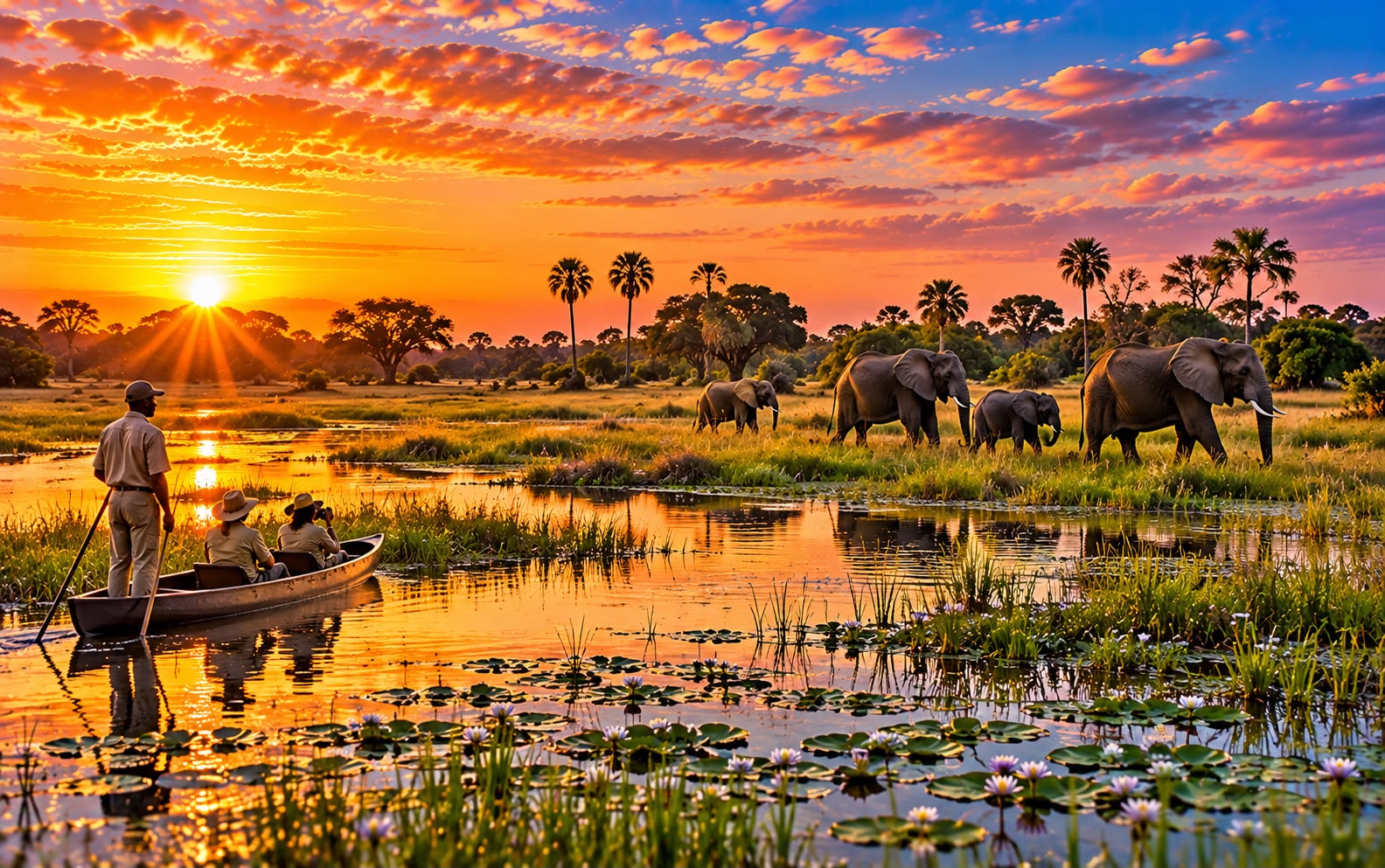
Botswana in 9 days: the Okavango Delta and Chobe
A river that never reaches the sea, and the wildlife that gathers where it spreads out: mokoro channels at water level, Moremi's floodplains, and Chobe's elephant herds coming to drink at dusk — with the honest version of what a Botswana safari costs, why it costs that, and the season that decides everything.
- Southern Africa
- 9 days
- ≈ AED 11,050 / person
- Delta + big game
Before you go
The Okavango is a river that flows inland and dies in the sand. Each year the flood arrives from the Angolan highlands months after the local rains have stopped, spreading across the Kalahari into a 15,000 km² maze of channels and islands — and the animals come to it.
That is the trip. Mokoro — a shallow dugout poled from the stern — takes you through papyrus channels at water level, close enough to hear frogs. Moremi is the reserve on the delta’s eastern edge, with floodplains and some of the best leopard density in Africa. Chobe in the north has elephant herds in the thousands, and a river cruise that puts you level with them at dusk.
You should also know the thing Botswana guides tend to skirt: this is a deliberately expensive country to visit. That is policy, not accident, and it is worth understanding before you plan.
Before you go: the cost model, the season and the camps
Entry
- Most nationalities enter visa-free for up to 90 days — the EU, UK, US, Canada, Australia, South Africa and many others. Indian passports currently need a visa; check your own case.
- Passport valid six months with at least two blank pages, which is enforced.
- A tourism development levy is payable on arrival by most visitors — a small fixed sum, usually payable by card.
Why it costs what it costs
- Botswana runs a “high value, low volume” tourism policy: limited concessions, low visitor numbers, high prices. The result is game viewing without a queue of vehicles, and a bill that reflects it.
- Most delta camps are all-inclusive — accommodation, all meals, drinks, and two game activities a day. Compare camps on that total, not on a room rate.
- Light aircraft transfers between camps are normal and are a meaningful part of the cost. They also have strict soft-bag-only luggage limits, typically around 20 kg including hand luggage.
- Cheaper routes exist: mobile camping safaris, self-drive to Moremi and Chobe with a rooftop tent, and day trips from Maun. They are genuinely good and a fraction of the price.
The season decides the trip
- The flood is out of step with the rain, and this confuses people. Local rains fall December to March; the Angolan floodwater arrives in the delta around May to August.
- June to September is the peak and the best: high water for mokoro, dry land elsewhere so animals concentrate at water, and no rain. Cold nights.
- October is the hottest month and superb for game, brutal by midday.
- December to March is green season — lower prices, newborn animals, dramatic skies, but thick bush, scattered game and some camps closed.
- Mokoro needs water. In low-water years the channels near Maun can be unusable; confirm with your camp rather than assume.
Health and practicalities
- This is a malaria area. Take advice on prophylaxis well before you travel, and use repellent at dawn and dusk regardless.
- The pula (BWP). Cards work in Maun and Kasane; camps bill in advance. Carry cash for tips and markets.
- Tipping is expected at camps, for guides and for general staff separately, and the camp will explain the convention.
- English is an official language and universally used in tourism.
Day by day
Day 1 — Land in Maun
- 13:00 — Land at Maun (MUB), the delta’s gateway — a small airport busier with single-engine Cessnas than with airliners.
- 14:00 — Sleep at a lodge on the Thamalakane River. Maun itself is a supply town rather than a destination, and that is fine for one night.
- 16:00 — Confirm tomorrow’s luggage limit. Light aircraft into the delta allow 20 kg in a soft bag — no wheels, no hard frame, no exceptions, and they weigh you too. Repack now and leave the rest at the lodge.
- 17:00 — Draw cash. The camps are all-inclusive but staff tips are cash and there are no machines where you are going.
- 18:30 — Sundowner on the river, with hippo audible downstream.
- 20:00 — Dinner. An early night; the flight is first thing and the delta runs on dawn.
Day 2 — Into the delta
- 09:00 — The light aircraft transfer, 20 to 40 minutes into a concession. Flying at 500 feet over the channels is the first extraordinary thing that happens: the delta appears as a braided map of water, reed and palm island, with elephant visible from the window.
- 10:00 — Land on a strip of cleared grass. Someone drives the animals off it first. Your guide meets the plane.
- 11:00 — Camp, and the briefing. You do not walk between tents after dark — someone escorts you, every time, and the reason is genuine.
- 12:30 — Brunch, then the heat of the day.
- 16:00 — First game drive. Afternoon drives run into dusk and finish with a sundowner somewhere open.
- 19:30 — Dinner under the stars.
- 21:00 — Listen. Hippo grunting, lion contact-calling, hyena, and the fact that none of it is far away. The delta at night is not quiet and you will not sleep much on the first one.
Day 3 — Mokoro, and walking
- 06:00 — Coffee at the fire, then out.
- 06:30 — Mokoro — a dugout canoe, now fibreglass, poled from behind by a standing guide. You sit at water level, which changes everything: reed frogs on the stems at eye height, jacanas walking on the lilies, and a hippo somewhere that your poler is tracking by sound and will quietly steer around.
- 09:30 — Breakfast back at camp.
- 11:00 — A guided walk on an island, rifle carried and never used. This is the only way to learn the small things — tracks, dung, termite architecture, which trees matter — and it changes how you see the drives.
- 13:00 — Lunch, then rest.
- 16:00 — Afternoon drive.
- 20:00 — Night drive if the concession permits it — private concessions do, the national parks do not, and it is where you find leopard, civet, genet and the cats actually hunting.
Day 4 — A full delta day
- 05:45 — Dawn drive, and the early one is always better: cool air, animals moving, and predators still out from the night.
- 09:30 — Breakfast.
- 11:00 — Rest. The camp will insist and the camp is right — nothing moves between eleven and three, including you.
- 15:30 — Tea, then mokoro or motorboat depending on water levels. The flood arrives from Angola around June to August, which is when the delta is fullest and — counter-intuitively — driest overhead.
- 17:30 — Sundowners on a termite mound or an open pan, with the camp’s folding table and a gin.
- 19:30 — Dinner, and the guides’ stories, which are the other reason to be here.
Day 5 — East to Moremi
- 09:00 — Transfer to Moremi Game Reserve — the delta’s protected eastern third, and the first reserve in Africa created by a local community rather than a government, in 1963.
- 11:00 — Arrive. Moremi mixes floodplain, mopane woodland and dry island in a way the inner delta does not, and that variety is why the game viewing here is the best in the country.
- 12:30 — Lunch, rest.
- 15:30 — The Khwai area drive: elephant and buffalo in numbers, and the best leopard odds in Botswana — the riverine trees along the Khwai are where they sit.
- 18:30 — African wild dog are here too, denning between June and August. There are fewer than 7,000 left in the world and Botswana holds the largest population; if your guide gets a radio call, drop everything.
- 20:00 — Dinner at camp.
Day 6 — Moremi, properly
- 05:45 — The long morning drive, four hours, out to Xakanaxa and the lagoons.
- 10:00 — The heronry at Xakanaxa if it is breeding season (roughly July to November) — one of the largest in southern Africa, with storks, herons and egrets nesting over water.
- 11:30 — Back to camp, brunch, rest.
- 15:30 — The second drive, west toward Third Bridge and the pole crossings — wooden-log bridges that vehicles cross one at a time and that look considerably less reliable than they are.
- 18:00 — Sundowners.
- 19:30 — Last delta dinner.
Day 7 — North to Chobe
- 09:00 — Transfer north to Kasane, by air (an hour) or the long road through Savuti.
- 12:00 — Arrive. Kasane is a town, with shops and signal, and after a week of camps that is a jolt.
- 14:00 — Lunch, check in.
- 15:30 — The Chobe River cruise, and take the afternoon one. Elephant herds cross to the islands to feed — a hundred at a time, swimming with trunks up — plus hippo, crocodile, buffalo on the floodplain, and a density of birds that makes the boat worth it on its own.
- 18:00 — Sunset on the water, with Namibia on the far bank.
- 19:30 — Dinner in Kasane.
Day 8 — Chobe, and the option next door
- 06:00 — Game drive along the Chobe riverfront, which has one of the highest elephant densities in Africa — the park holds perhaps 120,000 and in the dry season most of them are within reach of this river.
- 10:00 — Back for breakfast.
- 12:00 — Victoria Falls is 80 km away across the Zimbabwe border, and a day trip from Kasane is entirely normal — allow two hours for the border on a bad day. It is worth doing badly if the alternative is not at all; see our Zimbabwe guide if you would rather give it the days it deserves.
- 16:00 — Or stay: a second river cruise, or the Sedudu floodplain drive.
- 19:30 — Last night. Tip in cash, in the envelopes the camps provide, and split guide and camp staff separately.
Day 9 — Fly home
- Morning — Kasane (BBK) connects to Johannesburg, and Johannesburg connects to everything. Maun is the alternative if your routing runs that way.
- Note — Botswana’s model is deliberately low-volume and high-cost: fewer beds, fewer vehicles, no self-drive in the concessions. It is why you saw what you saw, and why it cost what it cost.
Costs and practicalities
Best time to visit
June–September. Botswana has an unusual seasonal mechanism: the Okavango flood does not come from local rain at all, but from Angolan highland rain that arrives months later.
- June–September (dry) — peak. Local water dries up, game concentrates on the permanent channels, and the Angolan floodwater is in the delta at the same moment, which is why the mokoro season and the best game viewing coincide.
- October — the hottest month, over 40°C, and the most concentrated game of all before the rains break.
- November–March (green) — the rains. Dispersed game, dramatic skies, newborn antelope, excellent birding, and the Makgadikgadi zebra migration. Rates fall sharply and some camps close.
- April–May — the water recedes, the air clears, and the shoulder prices are the best value of the year.
Travel tips
- This is an expensive country by design. The low-volume, high-value tourism policy means few beds and high rates; the alternative is self-drive camping, which is a completely different trip.
- Camps are reached by light aircraft with a strict luggage limit — usually 20kg in a soft bag, no wheels or frame. This is enforced and not negotiable.
- Self-driving the Central Kalahari or Moremi needs two vehicles, recovery gear and real experience. The sand is deep and there is no recovery service.
- Malaria prophylaxis for the north — the delta, Chobe and the Panhandle — especially in the green season.
- Pula notes are the currency and cards work at lodges, but carry cash for tips and village purchases.
- Tipping is expected at camps: guide and general staff, usually in separate envelopes, with suggested amounts given at check-in.
- Elephants have right of way, always. Chobe has the highest density in Africa and a vehicle is not an argument.
What this trip actually costs
Two people, 8 nights, mid-range camps, excluding international flights:
| Item | Cost |
|---|---|
| Delta and Moremi camps, 6 nights, all-inclusive | BWP 54,000 (≈ AED 14,239) |
| Maun and Kasane lodges, 2 nights | BWP 6,000 (≈ AED 1,582) |
| Light aircraft transfers | BWP 14,000 (≈ AED 3,692) |
| Park fees, Chobe cruise, activities not included | BWP 6,000 (≈ AED 1,582) |
| Tips, drinks, extras | BWP 4,000 (≈ AED 1,055) |
| Total for two | BWP 84,000 (≈ AED 22,150) |
- Roughly BWP 42,000 (≈ AED 11,075) per person, and this is a mid-range figure — the well-known luxury camps cost several times it.
- A mobile camping safari or self-drive to Moremi and Chobe cuts this by more than half, and is a genuinely excellent trip rather than a compromise.
- Camp rates being all-inclusive means the number above is close to final, which is not true of most destinations on this site.
What to pack
- Soft bags only, and under the airline’s limit — usually about 20 kg including hand luggage. Hard suitcases do not fit light aircraft holds.
- Neutral colours. Not for fashion: bright colours and white show at distance, and blue and black attract tsetse flies.
- Warm layers for dawn drives, June to August, when it is close to freezing in an open vehicle at 6am.
- Binoculars, one pair each.
- Malaria prophylaxis and strong repellent.
- Type D/G/M plugs — Botswana uses several; bring a universal adapter.
FAQ
Is Botswana worth the price? If uncrowded game viewing matters to you, yes — the low-volume policy is why you will not share a leopard sighting with eleven vehicles. If budget matters more, Tanzania and Kenya deliver excellent safaris for less.
Can I do it cheaply? Yes, and properly: mobile camping safaris and self-drive with a rooftop tent into Moremi and Chobe cost a fraction of fly-in camps and see the same animals.
Mokoro or game drive? Both, and they are not alternatives. Mokoro is the delta at water level and close to small things; drives cover ground and find the big ones.
When is best? June to September — high floodwater for mokoro, dry land elsewhere concentrating game at water, no rain. Cold at dawn and worth it.
Prices and entry rules change, and what you need depends on your passport; last checked 8 October 2026, so confirm with the embassy or your airline before booking.


