 The Itinerary
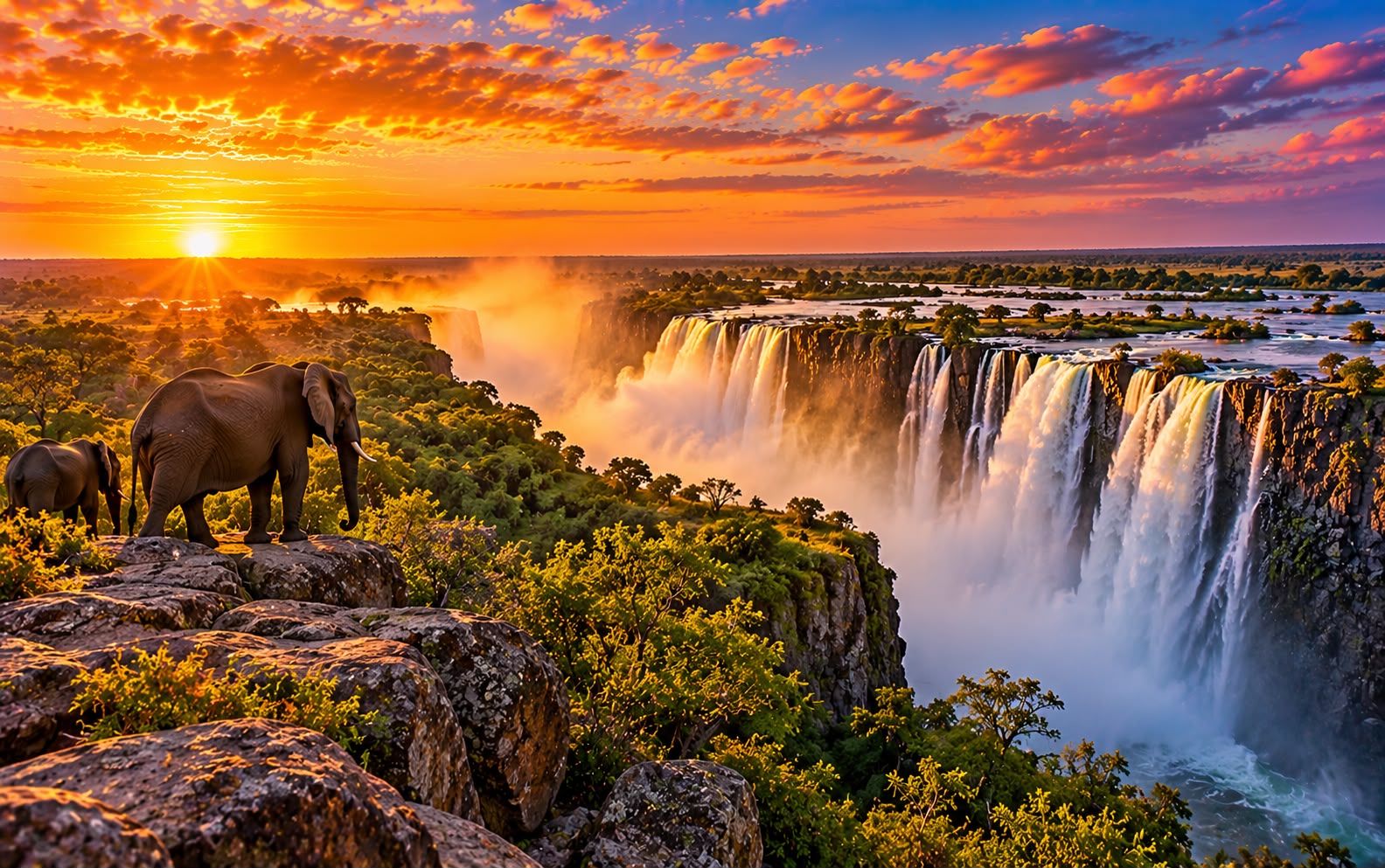
Zimbabwe in 8 days: Victoria Falls, Hwange and Matobo
The largest sheet of falling water on earth, and a country that gets overlooked beside it: a rainforest soaked by permanent spray, elephant herds at Hwange's pumped waterholes, and granite hills full of rock art and rhino — with the season that decides whether the Falls thunder or trickle, and the currency situation stated plainly.
- Southern Africa
- 8 days
- ≈ AED 8,450 / person
- The Falls + safari
Before you go
Victoria Falls is not the highest waterfall or the widest, but it is the largest sheet of falling water anywhere: 1,700 m across, 100 m down, and in full flood pushing enough spray into the air to be seen from 50 km away. The local name, Mosi-oa-Tunya — the smoke that thunders — is the accurate one.
Most people see it in a day and leave. That is a waste, because Zimbabwe behind it is one of Africa’s better safari countries and one of its cheapest. Hwange is the size of Belgium and holds one of the continent’s largest elephant populations. Matobo Hills is a landscape of balancing granite boulders with 13,000-year-old rock paintings and the best rhino tracking in the country.
Eight days does all three properly.
Before you go: the season, the money and the two sides
Entry
- Visas are available on arrival for most nationalities at the airports and land borders, payable in US dollars cash, or in advance as an eVisa.
- The KAZA UniVisa covers Zimbabwe and Zambia together plus day trips into Botswana, and is the right choice if you plan to see both sides of the Falls. Availability has fluctuated — check before relying on it, and carry dollars either way.
- Passport valid six months with blank pages.
The season decides what you see
This matters more at Victoria Falls than at almost any sight.
- High water (roughly February to May, peaking around April) — the Falls at maximum: overwhelming, thunderous, and so much spray that you may not see the far wall of the gorge at all. You will get drenched.
- Low water (roughly September to December) — far less water, clear views of the rock face and the whole structure, and the Devil’s Pool on the Zambian side opens, which is a natural rock pool at the lip of the drop.
- The compromise is June to August: still substantial flow, good visibility, and the best time for the safari half of the trip.
- For game, August to October is peak — dry, and animals concentrated at Hwange’s pumped waterholes.
Which side of the Falls
- Zimbabwe has about 70% of the frontage and the longer rainforest walk with more viewpoints. This guide is based there.
- Zambia has the Knife-Edge Bridge and Devil’s Pool, and gets closer to the water at low flow.
- You can do both in a day. The border at the Victoria Falls Bridge is a short walk; take your passport and check the visa position first.
The money situation, plainly
- Zimbabwe’s own currency has been through repeated redenominations and remains unstable. Tourism runs almost entirely on US dollars, and this guide budgets in them for that reason.
- Bring US dollars in cash, in clean, undamaged notes. Older series notes are sometimes refused. Small denominations are genuinely useful — change is often scarce.
- Cards work at hotels and larger operators and frequently nowhere else. Do not rely on ATMs.
- South African rand and Botswana pula are accepted in border areas.
Day by day
Day 1 — Land at Victoria Falls
- 14:00 — Land at Victoria Falls (VFA), 20 minutes from town. Visas are issued on arrival — the KAZA UniVisa covers Zimbabwe and Zambia and is what you want if you plan to cross.
- 15:00 — Drop bags. The town is small and walkable, and warthogs and baboons wander through it — the latter will take food out of your hand, so do not carry any visibly.
- 16:00 — Listen. You can hear the Falls from the town, which is why the Lozi name is Mosi-oa-Tunya — the smoke that thunders.
- 16:30 — The sunset cruise on the Zambezi above the Falls: two hours, hippo pods surfacing beside the boat, elephant coming down to the banks, and the spray column rising downstream where the river disappears. Gin and tonic included, and it is the correct first evening.
- 19:30 — Dinner in town. Game meat is on every menu — kudu, warthog, crocodile — and it is not a gimmick here.
Day 2 — The Falls, properly
- 07:00 — Into the rainforest at opening, before the tour buses and in the best light.
- 07:15 — Sixteen viewpoints along the Zimbabwean rim, through forest kept permanently green by the spray — this microclimate exists nowhere else for hundreds of kilometres. The Falls are 1.7 km wide and 108 m high, and Zimbabwe holds about three-quarters of the frontage.
- 09:00 — Danger Point and the Knife-Edge view across to Zambia.
- In high water (roughly March–June) you will be soaked regardless of what you wear — hire a poncho at the gate, keep your camera in a bag, and accept that you will see less of the Falls through the spray than you will in October. In low water (September–December) the eastern cataract can run dry and the geology is visible instead. Neither is wrong; they are different visits.
- 11:00 — Out, and dry off.
- 13:00 — Lunch at the Lookout Café, built on the lip of the Batoka Gorge with the zip-line running past the terrace.
- 15:00 — Walk to the bridge — the 1905 steel arch between the two countries, with the bungee jump off the middle. You can walk to the halfway point without a Zambian visa; take your passport.
- 17:00 — The craft market. Pressure is real and good-humoured; haggle, and they will take USD, old clothes or trainers as part-payment and say so.
- 19:30 — High tea or a drink on the Victoria Falls Hotel terrace, with the bridge framed at the end of the lawn.
Day 3 — Activities, or the Zambian side
- Option A — Zambia, 08:00. Cross the bridge for the Knife-Edge Bridge view, which looks back at the full face Zimbabwe cannot show you, and — in low water only, roughly August to December — Devil’s Pool, a rock lip at the very edge of the drop that you swim to and lie in. It is as alarming as it sounds and run with guides.
- Option B — rafting, 08:00. The Zambezi below the Falls is among the best commercial whitewater anywhere — grade V, big water, warm. Low water only (roughly August to December). The climb back out of the gorge at the end is 200 m and genuinely hard.
- Option C — helicopter, any time. The Flight of Angels, 12 or 25 minutes, and the only way to understand the zigzag of gorges — the Falls have cut back through seven previous positions along fault lines, and from the air it is obvious.
- 17:00 — Back, and an early night; tomorrow is a transfer day.
Day 4 — South to Hwange
- 08:30 — Road transfer to Hwange National Park, about two and a half hours.
- 11:00 — Arrive. Hwange is 14,650 km², the size of Belgium, and has no natural permanent surface water — the Kalahari sand swallows it. Every waterhole is pumped, originally by diesel and now largely by solar, and that single fact shapes everything: in the dry season the game concentrates at the pans with total predictability.
- 12:30 — Lunch, then the heat of the day.
- 15:30 — First game drive. Hwange holds around 45,000 elephant, one of the largest populations on the continent, plus the big cats and over 100 mammal species.
- 18:30 — Sundowners.
- 20:00 — A floodlit waterhole hide after dark if your camp has one — several do, and it is worth choosing a camp for. Elephant come in silently, which for an animal that size is the unnerving part.
Day 5 — Hwange
- 05:45 — The long morning drive, out before first light, which is when the predators are still moving and the lion are walking the roads.
- 09:30 — Breakfast in the bush.
- 11:00 — Back to camp, and rest.
- 15:30 — The second drive, working toward a pan for the evening.
- 17:30 — The elephant parade. In the dry season herds arrive at the waterholes in the last hour of light — a hundred or more at a time, families queueing, young ones shoved aside, and bulls taking what they want. It is Hwange’s signature hour.
- 19:30 — Dinner under the stars.
Day 6 — To Matobo
- 08:00 — Drive south-east to the Matobo Hills, around four hours.
- 11:00 — Bulawayo on the way: the Railway Museum for Rhodesian-era locomotives left where they stood, or the Natural History Museum, and lunch.
- 14:30 — Into Matobo, and the landscape is unlike anything else in the region: granite kopjes worn into balancing towers and domes over two billion years, with vegetation in the cracks.
- 16:00 — Check in.
- 17:30 — Sunset from World’s View, on the summit slab where Cecil Rhodes is buried — he chose the spot himself and the grave is cut into the rock. The argument about whether he should still be there is live, ongoing and worth asking your guide about; you will get a straight answer.
- 19:30 — Dinner.
Day 7 — Rhino and rock art
- 06:30 — Rhino tracking on foot, with a guide and an armed ranger. Matobo has one of Africa’s densest white rhino populations, and you approach them walking — downwind, quiet, often to within thirty metres of a group grazing. Standing on the ground near a two-tonne animal that knows you are there is completely unlike seeing one from a vehicle.
- 10:30 — Back, and breakfast.
- 13:00 — Rock art. The Matobo caves hold San paintings up to 13,000 years old — Nswatugi and Pomongwe are the accessible ones, with eland, giraffe and human figures in ochre. The guides explain what is known and are honest about what is guessed.
- 16:00 — The balancing rocks and a last climb onto a whaleback for the view.
- 19:00 — Last night.
Day 8 — Fly home
- Morning — Bulawayo (BUQ) is an hour away and connects to Harare and Johannesburg.
- Alternative — Many visitors drive back to Victoria Falls — about five hours — and fly from there, which usually has better international connections. Decide this when you book, not now.
- Note — Zimbabwe runs largely on US dollars in cash. Bring small denominations, bring more than you expect, and check notes you are given as change — worn or torn US notes are often refused.
Costs and practicalities
Best time to visit
April–October is the dry season, and as in Zambia the Falls and the game pull in opposite directions.
- April–June — the best compromise. The Victoria Falls are at or near peak flow from March to June, the bush is still green, and the temperatures are mild.
- July–October — the dry season proper and the best game viewing in Hwange, where the pumped waterholes concentrate enormous elephant herds. September and October are very hot and the most intense for game.
- August–December — low water at the Falls, which reveals the rock face and makes the gorge swimming and rafting best.
- November–March — the rains. Green, excellent birding, cheaper, and some Hwange roads become difficult. Mana Pools largely closes.
Mana Pools is open roughly April to November and is where Zimbabwe’s walking safaris are at their best.
Travel tips
- Zimbabwe is a US dollar economy in practice. Bring clean, small-denomination dollars; the local currency has been repeatedly reset and is not worth engaging with. Cards work at lodges and in Victoria Falls town.
- Bring more cash than you expect. ATMs are unreliable and often empty, and there is no way to draw more.
- A KAZA UniVisa covers Zimbabwe and Zambia and day trips to Botswana — useful for seeing both sides of the Falls. Check current availability at the border.
- Zimbabwe’s guides are among the best trained in Africa — the professional guide qualification is notoriously hard — and Mana Pools walking safaris are the reason to come.
- Fuel shortages recur. Fill up whenever you pass a station with supply, and carry a jerrycan for long transfers.
- Malaria prophylaxis is essential in the Zambezi valley and Hwange, year-round.
- Bring a waterproof for the Falls in high water — the spray soaks everything, including cameras.
What this trip actually costs
Two people, 7 nights, mid-range, excluding international flights:
| Item | Cost |
|---|---|
| Lodges and safari camps, 7 nights | USD 2,200 (≈ AED 8,080) |
| Transfers, Hwange and Matobo road legs | USD 700 (≈ AED 2,571) |
| Park fees, Falls entry, cruise, rhino tracking, rock art | USD 640 (≈ AED 2,350) |
| Visas ×2, food and drink outside camps | USD 800 (≈ AED 2,938) |
| Tips, eSIM, extras | USD 260 (≈ AED 955) |
| Total for two | USD 4,600 (≈ AED 16,894) |
- Roughly USD 2,300 (≈ AED 8,447) per person — markedly cheaper than Botswana next door for comparable game viewing, which is the quiet argument for Zimbabwe.
- Safari camps are the main line. Self-drive into Hwange and Matobo is possible and cuts it substantially if you are confident on rough tracks.
- Adventure activities at the Falls — rafting, helicopter, bungee — are each a meaningful extra, not rounding.
What to pack
- A waterproof and a dry bag for the Falls. In high water the rainforest walk is a soaking, not a drizzle. Ponchos are rented at the gate and are not enough.
- Neutral safari colours for Hwange and Matobo.
- Warm layers for dawn drives, June to August.
- US dollars in cash, clean and in small denominations.
- Binoculars.
- Type D/G plugs.
- Malaria prophylaxis — advice needed for Hwange and the Zambezi valley.
FAQ
When should I see the Falls? April for maximum power and minimum visibility; September to December for clear views and Devil’s Pool; June to August for the best balance, and the best safari conditions.
Zimbabwe or Zambia side? Zimbabwe has most of the frontage and the better walk. Zambia gets closer at low water and has Devil’s Pool. Both in a day is normal.
Is it safe? For visitors on this route, yes. Zimbabwe’s difficulties are economic rather than a matter of visitor safety, and tourism areas are well run. Carry dollars, since the economy runs on them.
How does it compare with Botswana? Zimbabwe is considerably cheaper for similar game, and it has the Falls. Botswana has the Okavango, which has no equivalent. See our Botswana guide — the two combine easily, since Kasane is 80 km from Victoria Falls.
Prices and entry rules change, and what you need depends on your passport; last checked 8 October 2026, so confirm with the embassy or your airline before booking.


