 The Itinerary
Chiang Mai in 3 days: the old city, the elephants and Doi Suthep
Chiang Mai in three days, with the elephant sanctuary question answered properly — no riding, no bathing shows, and what a genuine place looks like. Plus monk chat, the Sunday walking street, and burning season.
- Southeast Asia
- 3 days
- ≈ AED 800 / person
- Thirty temples inside a moat, and the one elephant question worth getting right
Before you go
Chiang Mai is a square kilometre of old city inside a moat, with about thirty temples in it, and a ring of forested hills around the outside. It is cooler than Bangkok, slower, and the single best place in Thailand to spend three days doing not very much.
One thing on this page matters more than the rest, so it is stated plainly: the elephant question. There are dozens of “sanctuaries” around Chiang Mai and many of them are not sanctuaries. What to look for is below.
Part of a Thailand trip? See Thailand in 14 days, which runs north from Bangkok to here.
Figure the budget below. November to February — and read the burning-season note.
Before you go: the short version
Getting there and around
- Chiang Mai International (CNX) is 15 minutes from the old city. A Grab is THB 150–200; the red songthaew shared trucks are THB 40–60.
- An hour by air from Bangkok, or 12 hours on the overnight sleeper train, which is genuinely comfortable and a good use of a night.
- Red songthaews are the local bus — flag one, say where you are going, and pay a flat THB 40–60 within town.
- Rent a scooter only if you can ride one. Your travel insurance will not cover you without the correct licence, and the road to Doi Suthep is a mountain road.
Burning season — the thing nobody mentions
- From roughly late February to April, agricultural burning fills the valley with smoke. Chiang Mai regularly records some of the worst air quality in the world during March.
- It is not a haze you can ignore — the hills vanish, and people with respiratory conditions suffer.
- Plan for November to February, and check an air-quality index before booking March or April.
Day by day
Day 1 — The old city on foot
Walking order: Wat Chedi Luang → Wat Phra Singh (10 min) → Wat Phan Tao (next to Chedi Luang) → Three Kings Monument (5 min) → the north moat for the evening. About 4km, entirely flat, inside the walls.
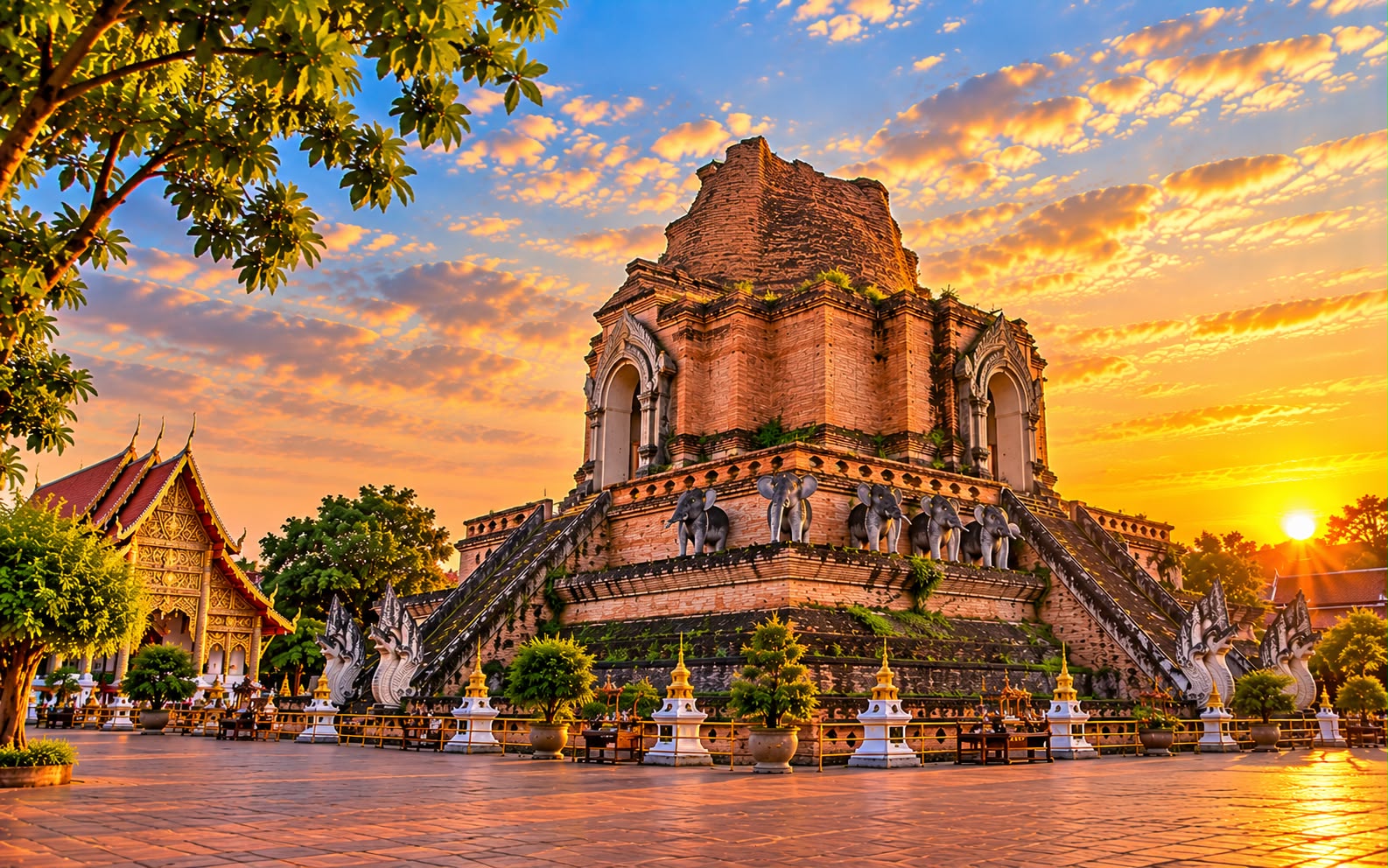
- 09:00 — Wat Chedi Luang, whose enormous brick chedi was partly destroyed by an earthquake in 1545 and never rebuilt — it held the Emerald Buddha for 80 years before it went to Laos and then Bangkok.
- 10:30 — Wat Phra Singh, the city’s most important temple, with a Lanna-style wooden assembly hall at the back that most visitors walk past.
- 11:30 — Wat Phan Tao, next door — all teak, dark and small, and the quietest of the three.
- 13:00 — Khao soi for lunch, the northern curry noodle dish that exists properly only up here.
- 15:00 — Monk chat at Wat Suan Dok or Wat Chedi Luang — novice monks practising English, free, an hour, and the best conversation you will have on the trip. They ask as many questions as you do.
- 18:00 — The Sunday walking street if your dates land on one, which closes Ratchadamnoen road end to end; otherwise the night bazaar or the Saturday walking street on Wualai.
- Temple dress applies: shoulders and knees covered, shoes off, and women should not touch or hand anything directly to a monk.
Day 2 — Elephants, done properly
This is the day to get right.
What a genuine sanctuary looks like
- No riding. No bathing shows. No bullhooks. No performances.
- Elephants kept in a herd, at a distance, doing what they choose — you watch and feed, you do not direct.
- A place that says no to things you ask for is a good sign.
- “Bathing with elephants” has become the new riding — it looks gentle, it means the animal is handled all day by successive groups, and several reputable sanctuaries have stopped it entirely.
- Elephant Nature Park is the best known and genuinely does this; a handful of smaller places meet the same bar. Ask directly about riding, bathing, chains and how the elephants were acquired.
The day
- 07:30 — Collection from your hotel. Most sanctuaries are 60–90 minutes out in the Mae Taeng or Mae Wang valleys.
- 09:30 — Observation and feeding, which is the morning.
- 12:30 — Lunch at the sanctuary, usually included.
- 14:00 — A walk with the herd, at their pace.
- 17:00 — Back in the city.
- 19:00 — A Lanna khantoke dinner if you want the cultural evening, or the Nimmanhaemin cafés and bars, which is where younger Chiang Mai actually goes.
Day 3 — Doi Suthep and the hills
Walking order: 306 steps up the naga staircase, or the funicular. The temple compound is small — about 500m of walking.
- 07:30 — Wat Phra That Doi Suthep at opening, up the mountain road. Early is both the light and the cloud still sitting in the valley below, which is the view.
- 306 steps up the naga staircase, flanked by two enormous serpent balustrades, or the funicular for a small fee.
- The golden chedi is said to hold a shoulder bone of the Buddha, carried up the mountain by a white elephant that is said to have chosen the spot.
- 10:30 — Bhubing Palace further up, the royal winter residence, whose gardens are open when the family is not in residence.
- 13:00 — Back down, and lunch.
- 15:00 — Pick one: Doi Inthanon, Thailand’s highest point at 2,565m with the twin royal chedis and waterfalls — a full day in itself; the Mae Sa valley for waterfalls and gardens; or a cooking class, which in Chiang Mai starts at a market and is among the best in the country.
- 18:00 — A last evening at the moat, or Wat Umong, a forest temple with tunnels, which almost no visitor finds.
Costs and practicalities
Getting around, and what it costs
| Red songthaew within town | THB 40–60 |
| Grab from the airport | THB 150–200 |
| Scooter hire, per day | THB 200–300 |
| Temple entries | THB 20–50 each |
| Doi Suthep entry | THB 50 |
| Ethical elephant sanctuary, full day | THB 2,500–3,000 |
| Cooking class | THB 1,000–1,500 |
- The elephant day is the one significant cost and the one worth paying properly for. A THB 800 “sanctuary” is not one.
Best time to visit
- November to February — 15–28°C, dry, clear, and the best of the year. Loy Krathong and Yi Peng in November fill the sky with lanterns and the river with floats.
- Late February to April — burning season. See above. The air quality is genuinely poor and it is the reason to avoid these months.
- May to October — the rains, green hills, and far fewer people. Afternoon downpours rather than all-day rain.
Travel tips
- Ask the elephant sanctuary directly about riding, bathing, chains and bullhooks. A good one answers without hesitating.
- Check the air quality index before booking March or April.
- Doi Suthep at opening, before the cloud lifts and the coaches arrive.
- Monk chat is free and genuinely good.
- Songthaews are a flat fare in town — agree it as you get in.
- Do not ride a scooter without the correct licence. Your insurance will not pay.
What this trip actually costs
Two people, 2 nights, mid-range comfort, excluding travel to Chiang Mai:
| Item | Cost |
|---|---|
| Hotel, 2 nights | THB 3,000 (≈ AED 328) |
| Food and drink, 3 days | THB 3,000 (≈ AED 328) |
| Ethical elephant sanctuary, two people | THB 5,400 (≈ AED 591) |
| Temples, Doi Suthep, a cooking class | THB 2,600 (≈ AED 285) |
| Songthaews, Grab and the airport | THB 1,000 (≈ AED 109) |
| Total for two | THB 15,000 (≈ AED 1,642) |
- The elephant day is more than a third of this, and it is the one line not to economise on.
- Everything else in Chiang Mai is very cheap — temples are THB 20–50 and a bowl of khao soi is THB 60.
- Hotel picks here are chosen on location, not on commission — always check prices and recent reviews before booking.
What to pack
- Temple-appropriate clothing — covered shoulders and knees.
- Clothes you do not mind ruining for the elephant day.
- A warm layer. The old city is 300m up and December nights drop to 14°C.
- A Type A/B/C adapter, 220V.
Part of a bigger trip?
- Thailand in 14 days runs Bangkok, the north and the islands.
- Thailand in 10 days pairs this with the south.
- Bangkok in 3 days is an hour by air.
- Thailand and Laos in 11 days crosses the Mekong from the north.
FAQ
Which elephant sanctuary should I use? One that offers no riding, no bathing shows, no performances, and keeps the herd at a distance. Ask those four questions directly. Elephant Nature Park is the best-known that meets the bar, and a handful of smaller places do too.
Is bathing with elephants ethical? Increasingly regarded as not. It looks gentle, but it means the animal is handled all day by group after group, and several good sanctuaries have stopped offering it.
When is burning season? Roughly late February to April, worst in March. The valley fills with agricultural smoke and air quality becomes among the worst recorded anywhere. Avoid those months if you can.
Is three days enough for Chiang Mai? Yes — one day in the old city, one with the elephants, one in the hills. A fourth day buys Doi Inthanon or Chiang Rai.
Bangkok or Chiang Mai? Different countries, almost. Bangkok for scale, food and the river; Chiang Mai for temples, hills and a pace you can think in. Most people prefer Chiang Mai and most itineraries give it less time.
Prices and entry rules change, and what you need depends on your passport; last checked 29 October 2026, so confirm with the embassy or your airline before booking.


