 The Itinerary
India in 10 days: Delhi, Agra, Jaipur, Udaipur and Mumbai
Ten days is the Golden Triangle plus Udaipur's lakes and a finish in Mumbai — one coherent region rather than a dash across the country. The flights are the design: one internal hop to Mumbai instead of three, and no backtracking to Delhi.
- South Asia
- 10 days
- ≈ AED 2,400 / person
- A first trip to India that sees one region properly and ends in a city
Before you go
Ten days is one region done properly, not a lap of the country. The Golden Triangle, Udaipur’s lakes, and two nights in Mumbai to finish somewhere that feels like now rather than then.
The great mistake on a first ten-day India trip is trying to add Kerala or Varanasi to this. India is the size of Europe; adding a third region means two more internal flights and most of two days in airports, and you will remember the transfers rather than the places.
If you want the south or the Ganges, take fourteen days. Fourteen does the Golden Triangle, Varanasi and Kerala; twenty-one adds the full Rajasthan loop.
Figure INR 62,000 (≈ AED 2,421) per person, excluding international flights. October to March.
All costs are in rupees. Foreigner ticket prices are quoted; Indian passport and OCI holders pay domestic rates, which cut the monument line by roughly 80%.
Before you go: the 15-minute admin
Visas
- e-Visa at the official indianvisaonline.gov.in/evisa and nowhere else — the copycat sites charge triple. 171 nationalities, about five working days, apply a fortnight out, print it.
- GCC-based readers: eligibility follows your passport, not your residence.
- Six months’ validity, two blank pages.
Flying in from the Gulf
- Delhi (DEL) in, Mumbai (BOM) out. Both take directs from every Gulf hub, and the open jaw is what makes this route work — flying home from Delhi would cost you a day and an extra flight.
- Udaipur → Mumbai is the only internal flight, about 90 minutes, and the single most important booking after the international ones.
- Land in the morning if you can. Delhi’s long-haul arrivals cluster at dawn, which gives you the first day rather than a hotel room.
The one date that matters
- The Taj Mahal is closed on Fridays. Build the whole trip backwards from that. There is no spare morning here to absorb the mistake.
Money and getting around
- UPI QR payments everywhere; UPI One World wallets at airports for G20 passport holders.
- ₹5,000 in small notes for ten days of shoe minders, autos and tips.
- Uber and Ola in Delhi, Jaipur, Udaipur and Mumbai. Delhi’s metro is excellent, with a women’s carriage at the front.
- Delhi → Agra: the Gatimaan Express, Nizamuddin 8:10 to Agra Cantt 9:50. Booking opens 60 days out and sells out; IRCTC foreigner registration takes a day, so do it from home.
- Agra → Jaipur by private car (4–5 hours) so you can take in Fatehpur Sikri, which no train does.
- Jaipur → Udaipur by car (6 hours) or a short flight.
Day by day
Day 1 — Old Delhi
- 10:00 — Jama Masjid, India’s largest mosque, and the tower climb for the view over the rooftops. Modest dress, shoes off, and it closes to visitors during prayers.
- 11:30 — Chandni Chowk on foot or by cycle rickshaw: the spice market at Khari Baoli, the paratha lane, the silver bazaar. Loud, crowded, and the best hour in Delhi.
- 16:00 — Humayun’s Tomb, the prototype the Taj refined and far quieter. The light is gold at about this hour in winter.
- 19:00 — Hazrat Nizamuddin Dargah for qawwali if it is a Thursday. It is the best hour in Delhi and it only happens that night.
Day 2 — New Delhi
- 09:00 — Qutb Minar, 73 metres of twelfth-century brick, with the uncorroded iron pillar beside it.
- 11:30 — Lodhi Gardens, tombs scattered through parkland, and the easiest hour of the trip.
- 14:00 — Gurudwara Bangla Sahib, whose free kitchen feeds tens of thousands a day and will show you how it works. Heads covered, shoes off, and stay to help if you have time.
- 16:30 — India Gate and the Rajpath.
- Sleep near Nizamuddin or central Delhi — you have an 08:10 train.
Day 3 — Gatimaan to Agra
- 07:40 — Hazrat Nizamuddin station for the 08:10 Gatimaan Express. Breakfast comes with the seat.
- 09:50 — Agra Cantt. Drop bags; the Taj is tomorrow.
- 11:00 — Agra Fort, and the octagonal tower where Shah Jahan was imprisoned by his son, with a view downriver to the tomb he built for his wife.
- 15:00 — Itimad-ud-Daulah, the “Baby Taj”: small, intricate, nearly empty.
- 17:15 — Mehtab Bagh, across the river, which closes at sunset.
- Sleep near the East Gate.
Day 4 — The Taj at dawn, then Fatehpur Sikri
- 06:00 — At the East Gate before it opens, half an hour before sunrise. Buy tickets online beforehand; the mausoleum interior needs the extra ₹200. Closed Fridays — check that before you book anything else.
- 06:30 — Two hours, including the interior and the mosque on the west side.
- 10:00 — Check out.
- 11:30 — Fatehpur Sikri on the drive: Akbar’s capital, built 1571, abandoned 1585 for want of water, and almost perfectly preserved because of it. The Buland Darwaza is 54 metres. Shoes off across the courtyard, and the stone gets hot.
- 18:00 — Into Jaipur.
Day 5 — Amber, and the pink city
- 08:00 — Amber Fort at opening: Sheesh Mahal, Ganesh Pol, ramparts up the ridge. Decline the elephant rides.
- 10:00 — Panna Meena ka Kund stepwell below it.
- 11:30 — The City Palace and Jantar Mantar, whose stone instruments still keep time to the minute. Buy the composite ticket.
- 13:00 — Hawa Mahal from the street opposite.
- 17:00 — The bazaars: Johari for gems, Bapu for textiles.
Day 6 — Jaipur, then south
- 09:00 — Albert Hall Museum, or the block-printing workshops at Sanganer.
- 17:45 — Sunset at Nahargarh, over the whole city.
- Drive to Udaipur overnight, or leave at 06:00 tomorrow — it is about six hours.
Day 7 — Udaipur
- 12:00 — Arrive, if you drove this morning.
- 16:30 — A boat on Lake Pichola, the way the city was designed to be seen, with the Lake Palace in the middle.
- 18:15 — Sunset from Ambrai ghat, across the water.
- 19:00 — Bagore ki Haveli for the evening folk dance.
Day 8 — Udaipur, slowly
- 06:30 — The Monsoon Palace for sunrise over the lakes.
- 09:30 — The City Palace at opening, the largest in Rajasthan: four centuries of courtyards, mirror rooms and mosaic peacocks.
- 12:00 — Jagdish Temple, steep steps and brass bells.
- 15:00 — Saheliyon ki Bari and its gravity-fed fountains.
- This is the trip’s rest stop. After five days of forts, Udaipur is where you stop looking at them.
Day 9 — Mumbai
- 09:00 — Fly Udaipur → Mumbai, about 90 minutes.
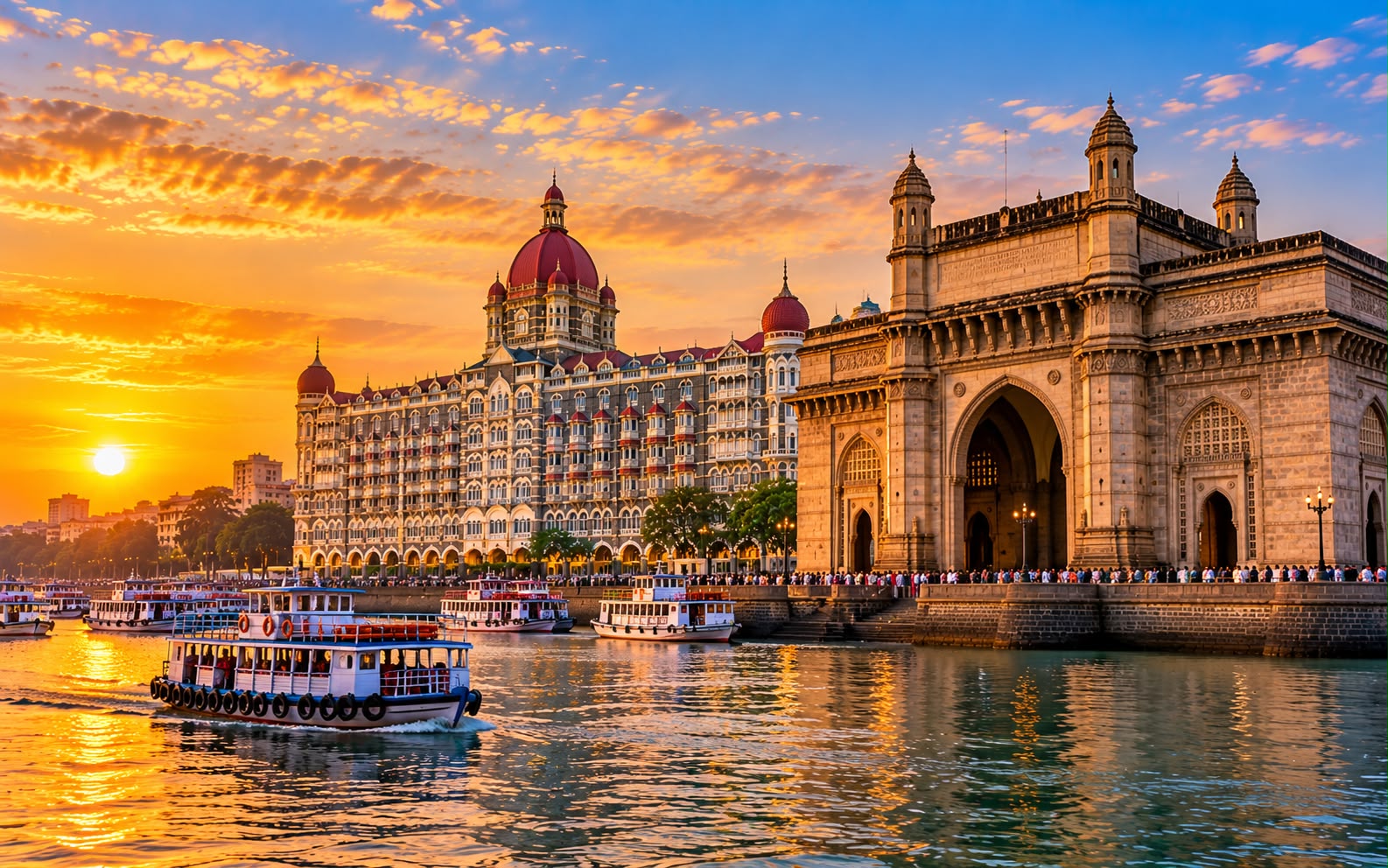
- 14:00 — The Gateway of India and the Taj Mahal Palace Hotel facing it, then the Colaba causeway.
- 16:00 — Chhatrapati Shivaji Terminus: Victorian Gothic crossed with Mughal, and a working station rather than a monument.
- 17:00 — The Kala Ghoda galleries and the Asiatic Society steps.
- 18:30 — Marine Drive at dusk, which curves into the “Queen’s Necklace” when the lights come on.
Day 10 — Elephanta, then home
- 09:00 — The ferry to Elephanta from the Gateway: sixth-century rock-cut Shiva temples on an island an hour out. Closed Mondays, and the last ferry back leaves earlier than you think — check it on arrival.
- Or a Dharavi and Dhobi Ghat walk, with a responsible operator who employs local guides and bans photography of people.
- 15:00 — Back in the city, and time for a last meal.
- Fly home that evening. Mumbai’s long-hauls to the Gulf run late.
Costs and practicalities
Best time to visit
- Late October to November — the best window. The monsoon has gone, Delhi’s fog has not arrived, days are 25–30°C.
- February to mid-March — the second best, warming but clear.
- December to January — clearest in theory, foggiest in practice. Delhi smog and fog delay flights and trains and can hide the Taj until mid-morning. Workable, but do not plan a single sunrise with no spare morning.
- April to June — 40°C+ across the whole route.
- July to September — monsoon. Mumbai gets the full force of it and floods; the rest is humid and green.
Travel tips
- Check no Friday lands on your Taj morning, before anything else.
- Delhi in, Mumbai out. Never fly home from where you landed.
- One internal flight, not three. That restraint is the whole itinerary.
- Gatimaan seats open 60 days out. Register with IRCTC at home.
- Fatehpur Sikri on the Agra–Jaipur drive, which is the only reason to take a car on that leg.
- Elephanta is closed on Mondays and the last ferry back leaves earlier than you think.
- Agree auto fares first, or use the apps. The apps are cheaper and silent.
- Delhi belly is mostly about water. Bottled or filtered only, no ice from unknown kitchens, and eat where there is a queue.
What this trip actually costs
Two people, 9 nights, mid-range comfort, international flights excluded:
| Item | Cost |
|---|---|
| Hotels, 9 nights (2 Delhi + 1 Agra + 2 Jaipur + 2 Udaipur + 2 Mumbai) | INR 58,000 (≈ AED 2,265) |
| Udaipur–Mumbai flight, Gatimaan, cars, Ubers, transfers | INR 32,000 (≈ AED 1,250) |
| Entries at foreigner rates, guides, Elephanta ferry | INR 16,000 (≈ AED 625) |
| Food and drink, 10 days | INR 14,000 (≈ AED 547) |
| SIM, tips, extras | INR 4,000 (≈ AED 156) |
| Total for two | INR 124,000 (≈ AED 4,842) |
- Roughly INR 62,000 (≈ AED 2,421) per person, excluding the international flights.
- Indian and OCI passports cut the entries line by about 80%.
- Mumbai is the expensive night. Hotel rates in Colaba run well above anything in Rajasthan; the two nights there are a meaningful share of the hotel line.
- The hotel line has no ceiling. Amarvilas faces the Taj; the Lake Palace sits in the middle of Pichola. Either will outprice this entire budget in a night.
- Hotel picks here are chosen on location, not on commission — always check prices and recent reviews before booking.
What to pack
- A warm layer. Delhi, Agra and Jaipur are 7–10°C at dawn in December and January and you will be out in it.
- Shoes that come off easily — mosques, temples and the Taj plinth all want them off.
- Modest cover for Jama Masjid, Bangla Sahib and the dargah, including something for your head.
- A day bag that is not a backpack — large bags are refused at the Taj.
- A mask for Delhi in winter if you are sensitive.
- An umbrella if you are travelling anywhere near the monsoon margins; Mumbai does not do drizzle.
FAQ
Is ten days enough for India? For one region, comfortably. For the country, no — and trying to fix that with internal flights is what ruins most first trips.
Why end in Mumbai rather than fly home from Delhi? Because it costs nothing extra and adds a completely different India. Mumbai is modern, coastal and commercial where Rajasthan is historic and inland.
Could I swap Mumbai for Varanasi? You could, and it is a bigger contrast. It is also a harder day: Udaipur to Varanasi needs a connection, and Varanasi rewards two nights minimum. At ten days Mumbai is the easier fit; at fourteen, take Varanasi.
Is this good for a first trip to India? It is close to the ideal one — the most developed tourist infrastructure in the country, manageable distances and the sights everyone comes for.
Do I need a guide? At Amber and the Taj, yes — licensed, from the official counter, price agreed first. Elsewhere optional.
Prices and entry rules change, and what you need depends on your passport; last checked 26 October 2026, so confirm with the embassy or your airline before booking.


