 The Itinerary
India in 14 days: the Golden Triangle, Varanasi and Kerala
Two weeks is the one length at which a first India trip can take in three genuinely different Indias — Mughal north, the Ganges at Varanasi, and Kerala's hills and backwaters. Two internal flights carry the whole structure, and the order matters: north first while you are fresh, Kerala last because it is the rest.
- South Asia
- 14 days
- ≈ AED 3,450 / person
- A first India trip that sees the north, the Ganges and the south
Before you go
Fourteen days is the length at which India stops being one destination. This route takes in three different countries’ worth of difference: the Mughal north, the Ganges at Varanasi, and Kerala’s hills and water.
The order is deliberate. The north is the demanding part and you do it while you are fresh. Varanasi in the middle, because it is the most intense place on the route and you want a few days of India behind you first. Kerala last, because it is the rest — and ending a hard, brilliant fortnight on a houseboat is a far better trip than ending it in Delhi traffic.
Two internal flights hold it together — Jaipur to Varanasi, and Varanasi to Kochi. Both need booking early and both are the difference between this working and not.
Ten days drops Varanasi and Kerala for Udaipur and Mumbai; twenty-one adds the full Rajasthan loop in the middle.
Figure INR 88,000 (≈ AED 3,436) per person, excluding international flights. October to March.
All costs are in rupees. Foreigner ticket prices are quoted; Indian passport and OCI holders pay domestic rates, roughly a fifth of the foreigner ticket across the whole route.
Before you go: the admin
Visas
- e-Visa at the official indianvisaonline.gov.in/evisa and nowhere else. For a fortnight, the one-year multiple-entry option costs barely more than the 30-day.
- GCC-based readers: eligibility follows your passport.
- Six months’ validity, two blank pages.
Flying in from the Gulf
- Delhi (DEL) in, Kochi (COK) out. Kochi is one of the best-connected airports in south India from the Gulf — directs from Dubai, Abu Dhabi, Sharjah, Doha, Muscat, Kuwait and Dammam, all under four hours.
- That open jaw is the single best decision in this itinerary. It saves a domestic flight back to Delhi and a wasted day.
- Two internal flights: Jaipur → Varanasi (often via Delhi) and Varanasi → Kochi (usually via Delhi, Mumbai or Hyderabad). Book both as soon as the international tickets are issued.
The dates that matter
- The Taj Mahal is closed on Fridays. Build the fortnight backwards from that.
- The Alleppey houseboat books out for Christmas, New Year and all of February. Reserve it before any hotel.
- Check for Indian festivals. Diwali (Oct–Nov) and Holi (March) will transform this trip, mostly for the better, but flights and hotels triple and trains vanish.
Money and connectivity
- UPI QR payments everywhere; UPI One World wallets at airports for G20 passport holders.
- ₹6,000–8,000 in small notes across a fortnight.
- A tourist SIM or eSIM on arrival. You will want data for Uber, maps and UPI on every day of this route.
Day by day
Day 1 — Old Delhi
- 10:00 — Jama Masjid and the tower climb. Modest dress, shoes off, and it closes to visitors during prayers.
- 11:30 — Chandni Chowk on foot: Khari Baoli’s spice market, the paratha lane, the silver bazaar.
- 16:00 — Humayun’s Tomb, the prototype the Taj refined, and gold-lit at about this hour in winter.
- 19:00 — Hazrat Nizamuddin Dargah for qawwali if it is a Thursday. It is the best hour in Delhi and it only happens that night.
Day 2 — New Delhi
- 09:00 — Qutb Minar, 73 metres of twelfth-century brick with the uncorroded iron pillar beside it.
- 12:00 — Lodhi Gardens, and the easiest hour of the trip.
- 14:00 — Gurudwara Bangla Sahib and its kitchen, which feeds tens of thousands a day. Heads covered, shoes off, and stay to help if you have time.
- Sleep near Nizamuddin — you have an 08:10 train.
Day 3 — Gatimaan to Agra
- 07:40 — Nizamuddin for the 08:10 Gatimaan, into Agra Cantt at 09:50. Book 60 days out; it sells out.
- 11:00 — Agra Fort, and the octagonal tower where Shah Jahan was imprisoned with a view downriver to his wife’s tomb.
- 15:00 — Itimad-ud-Daulah, the “Baby Taj”: small, intricate, empty.
- 17:15 — Mehtab Bagh across the river, which closes at sunset.
- Sleep near the East Gate.
Day 4 — The Taj at dawn, then Fatehpur Sikri
- 06:00 — At the East Gate before it opens. Closed Fridays — build the fortnight around that. Give it two hours.
- 10:00 — Check out.
- 11:30 — Fatehpur Sikri on the drive: Akbar’s capital, abandoned in 1585 for want of water and preserved almost intact. The Buland Darwaza is 54 metres. Shoes off across the courtyard.
- 18:00 — Into Jaipur.
Day 5 — Amber, and the pink city
- 08:00 — Amber Fort at opening, then Panna Meena ka Kund below it. Decline the elephant rides.
- 11:30 — City Palace and Jantar Mantar; buy the composite ticket at the first site.
- 13:00 — Hawa Mahal from the street opposite.
- 17:30 — The bazaars at dusk, and sunset at Nahargarh.
Day 6 — Jaipur, then east
- 09:00 — Albert Hall Museum, or the block-printing workshops at Sanganer.
- Fly to Varanasi this evening or early tomorrow. The flight usually connects through Delhi — allow for it.
→ Want Rajasthan properly rather than just Jaipur? Seven days adds Jodhpur and Udaipur; the twenty-one-day route builds it into this trip.
Day 7 — Varanasi
- This is the oldest continuously inhabited city on earth, and the most intense place on this route. Two nights is the minimum and the maximum most people want.
- 15:00 — The ghats on foot from Assi, which is the calmer southern end.
- 17:30 — Book a boat for the aarti, price agreed before you step in.
- 18:30 — Ganga Aarti at Dashashwamedh Ghat: fire, bells and choreography. Watch from the boat — you see it properly and you are not in the crush.
Day 8 — Dawn on the river, and Sarnath
- 05:30 — The dawn boat, leaving in the dark. The ghats come awake as the light arrives: bathers, laundry, yoga, prayer. This is the hour people come for.
- 06:30 — Past Manikarnika, a working cremation ghat. Cremations happen in the open, continuously. Photography is forbidden and deeply resented — put the phone away entirely. Anyone offering a “viewing” from a building for a donation is running a scam on the grieving.
- 09:00 — The old lanes between the ghats: medieval, narrow, and best without a destination.
- 11:00 — Sarnath, 10km out, where the Buddha gave his first sermon. The Dhamek Stupa and a very good museum holding the Lion Capital of Ashoka. The museum closes Fridays.
Day 9 — Fly south to Kochi
- A travel day, and an honest one. Varanasi to Kochi usually connects through Delhi, Mumbai or Hyderabad and takes most of the day.
- 18:00 — Into Fort Kochi. The change could not be sharper: Portuguese, Dutch and British in turn, sea air, and a quarter you can walk.
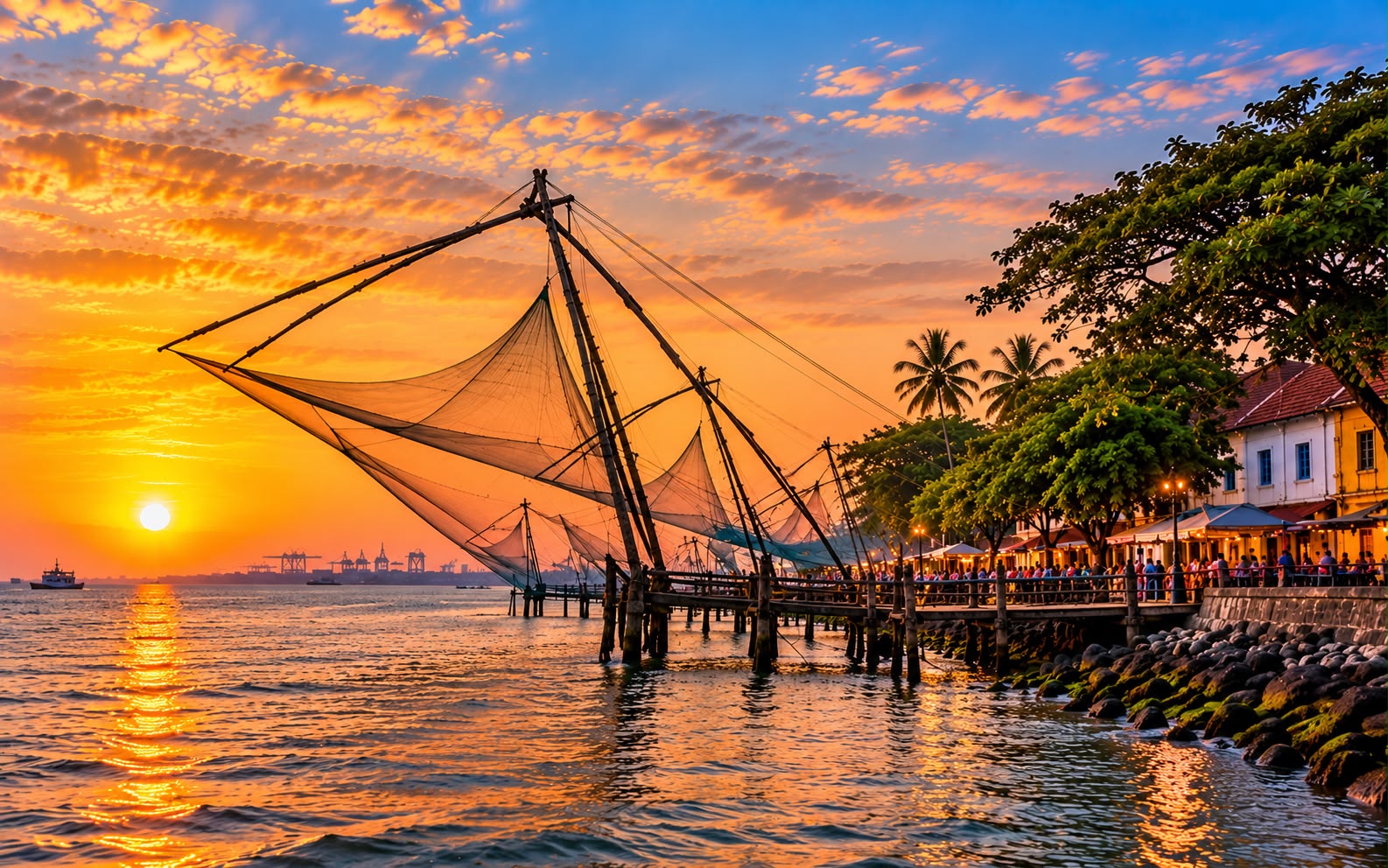
- If you land early, the Chinese fishing nets at sunset.
Day 10 — Kochi
- 10:00 — Mattancherry: the Paradesi Synagogue, floored in hand-painted Cantonese tiles with no two alike, and the Dutch Palace murals. Both shut on Fridays, and the synagogue closes at 17:00.
- 12:00 — St Francis Church, Vasco da Gama’s first grave.
- 17:00 — The Chinese fishing nets, the hour before sunset.
- 18:30 — Kathakali. The make-up starts around 17:00 and is the better half — so it is a straight choice against the nets.
Day 11 — Up into the tea
- 08:00 — Four hours up through the spice hills, with waterfall stops at Cheeyappara and Valara.
- 14:30 — The Tata Tea Museum at Nallathanni. Closed Mondays.
- 17:30 — Sunset from an estate road, not from town.
- Stay on an estate, not in Munnar town.
Day 12 — Eravikulam
- 06:45 — Leave for the park, 13km north.
- 07:30 — Eravikulam at opening, where Nilgiri tahr walk the path with you. By 10:00 the queue is long. Closed February–March for calving — check before fixing dates.
- 14:00 — Top Station for the Tamil Nadu view, before the cloud climbs from about 15:00.
- 17:00 — An estate walk late in the day.
Day 13 — Down to the backwaters
- 08:30 — Four to five hours to Alleppey; boats board at noon.
- 12:30 — Lunch aboard: karimeen, rice, thoran, cooked on deck.
- 14:00 — The afternoon cruise: paddy fields below water level, toddy shops, canals narrowing until the boat barely fits.
- 17:30 — Moor in open water on Vembanad, not against the bank.
Day 14 — Backwater dawn, then home
- 06:00 — Awake for the hour that justifies the booking: mist, cormorants, the bank waking up.
- 09:00 — Disembark.
- 10:30 — Marari beach on the way, if your flight is in the evening — which most Gulf departures are.
- Kochi airport is 90 minutes from Alleppey.
→ Want Kerala at its own pace? Five days or seven go deeper, with Thekkady and the spice country this route has no room for.
Costs and practicalities
Best time to visit
- Late October to November — the best of the year for this route. The north has cleared, Kerala is green from the monsoon, and nothing is at peak price yet.
- February to mid-March — nearly as good. Warm in the north, dry in the south, Holi somewhere in there.
- December to January — peak season in Kerala and fog season in the north. Delhi and Agra flights delay, the Taj can hide until mid-morning, and Kerala costs the most it ever does. It works; just build slack around the internal flights.
- April to June — the north reaches 40–45°C. Kerala is humid. Not the trip you planned.
- July to September — monsoon. Kerala is beautiful and cheap in the rain; the north is hot and wet.
The north and the south are on different calendars, and this route crosses both. Late October to November is where they overlap best.
Travel tips
- Check the Friday before you book anything.
- Book the houseboat before the hotels, and both internal flights as soon as the international ones are issued.
- Delhi in, Kochi out. Never fly home from where you landed.
- Put the camera away at Manikarnika. It is a cremation ground, not a sight.
- Two nights in Varanasi, no more on a first trip.
- One car and driver for the whole Kerala leg beats point-to-point taxis on cost and patience.
- Eravikulam at opening or not at all.
- Build a buffer before the international flight. A fortnight with two internal flights has more failure points than a week.
- Water: bottled or filtered only, no ice from unknown kitchens, and eat where there is a queue.
What this trip actually costs
Two people, 13 nights, mid-range comfort, international flights excluded:
| Item | Cost |
|---|---|
| Hotels, 12 nights, plus 1 night on a private houseboat | INR 76,000 (≈ AED 2,968) |
| Two internal flights, Gatimaan, cars and drivers, transfers | INR 48,000 (≈ AED 1,874) |
| Entries at foreigner rates, guides, boats, Kathakali | INR 18,000 (≈ AED 703) |
| Food and drink, 14 days | INR 24,000 (≈ AED 937) |
| SIM, tips, extras | INR 10,000 (≈ AED 390) |
| Total for two | INR 176,000 (≈ AED 6,873) |
- Roughly INR 88,000 (≈ AED 3,436) per person, excluding international flights.
- The two internal flights are the line people forget. Booked late they can double; booked with the international tickets they are modest.
- Indian and OCI passports cut the entries line by about 80%, which across a fortnight of monuments is substantial.
- The hotel line has no ceiling — Amarvilas at the Taj, a Vembanad heritage house, an estate bungalow above Munnar.
- Hotel picks here are chosen on location, not on commission — always check prices and recent reviews before booking.
What to pack
- For two climates. A warm layer for Delhi, Agra and Jaipur dawns in winter, and light cotton for Kerala.
- A fleece for Munnar, which drops to 10°C at night in January.
- Shoes that come off easily, and socks for cold or hot stone.
- Modest cover for Jama Masjid, Bangla Sahib, the dargah and the ghats.
- Mosquito repellent for the backwaters.
- A day bag that is not a backpack — large bags are refused at the Taj.
- A power bank. The houseboat generator sleeps when you do.
FAQ
Is fourteen days enough to “see India”? No, and nothing is. It is enough to see three genuinely different Indias without spending the trip in airports, which is the realistic goal.
Why Varanasi in the middle rather than at the end? Because it is the most intense place on the route, and it lands better with a few days of India behind you. Ending on the backwaters is also simply a nicer way to finish.
Is Varanasi too much for a first trip? It is confronting, and it is also the most extraordinary city in the country. Two nights, a dawn boat, and no camera at the cremation ghats is the way to do it.
Could I swap Kerala for Goa? You could, and it would be easier and less interesting. Goa is a beach holiday; Kerala is a different India.
Do I need all three regions? No — ten days does the north properly and ends in Mumbai. Take that over a rushed fourteen.
Prices and entry rules change, and what you need depends on your passport; last checked 26 October 2026, so confirm with the embassy or your airline before booking.


