 The Itinerary
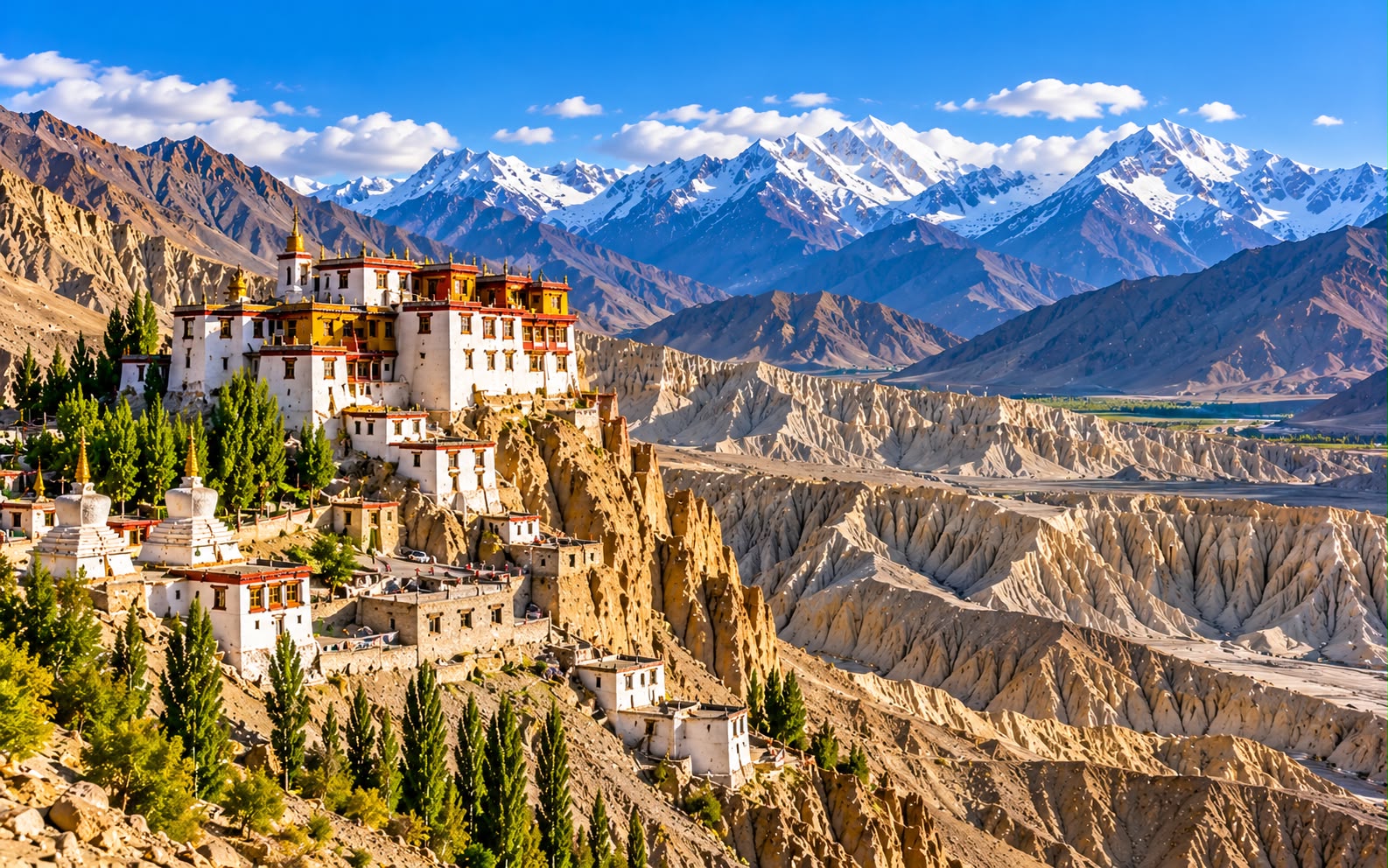
Ladakh in 10 days: Lamayuru, Nubra, Pangong and Tso Moriri
Ten days covers Ladakh properly — the moonscape and 11th-century murals of the western Indus, Nubra over Khardung La, Pangong Tso, and the remote Changthang plateau at Tso Moriri. The extra days are spent on altitude and on the two places seven-day trips always cut.
- South Asia
- 10 days
- ≈ AED 2,500 / person
- The full circuit, with the altitude given proper room
Before you go
Ten days is Ladakh with the altitude given room, and with the two places the standard circuit always drops: Lamayuru in the west and Tso Moriri out on the Changthang.
The extra three days are not extra sights so much as extra safety. Leh is 3,500m, you fly into it, and the route then takes you over three passes above 5,000m and sleeps you at 4,500m. Seven days does that at a brisk pace; ten does it properly.
Seven days is the standard Leh–Nubra–Pangong circuit if you do not have the time.
Figure INR 64,000 (≈ AED 2,499) per person. June to September.
Before you go: altitude first
- Leh 3,500m. Khardung La 5,359m. Chang La 5,360m. Tanglang La 5,328m. Pangong 4,350m. Tso Moriri 4,522m.
- Two full days in Leh before going anywhere higher. This itinerary builds them in and they are the reason it works.
- Acute Mountain Sickness — headache, nausea, breathlessness at rest, poor sleep — is common and usually mild.
- HAPE and HACE kill. Breathlessness while resting, a wet cough, confusion, loss of coordination. The treatment is immediate descent.
- Never ascend with symptoms. Tso Moriri and Pangong are both long drives from help.
- No alcohol for the first three days, far more water than feels necessary, and light food.
- Talk to a doctor about acetazolamide before you travel.
- Oxygen is sold in Leh and most camps have a cylinder. It buys time; it does not replace descending.
Before you go: permits and logistics
Visas and permits
- e-Visa at the official indianvisaonline.gov.in/evisa. Leh is not an e-Visa port of entry — arrive via Delhi.
- Nubra, Pangong, Tso Moriri and the Changthang all need permits: an Inner Line Permit for Indian nationals, a Protected Area Permit for foreign nationals and OCI holders. Arranged in Leh through the LAHDC portal or an agent in an hour.
- Foreign nationals generally need a group of two or more.
- Carry six or more photocopies. Checkposts collect them.
Flying in from the Gulf
- Leh (IXL) via Delhi. Morning flights only — afternoon winds close the airport, and cancellations roll to the next day.
- Leave a buffer night in Delhi before flying home.
- Overland from Srinagar or Manali takes two days each, is spectacular, and acclimatises you properly.
Money and connectivity
- ₹20,000–25,000 in cash for ten days. ATMs are in Leh only.
- Postpaid Indian SIMs only; prepaid from outside the region does not work. No signal at all at Tso Moriri and much of Nubra.
Day by day
Day 1 — Leh, and doing nothing
- 07:00 — Land. Leh’s flights all arrive early, before the wind picks up.
- 09:00 — To the hotel, and rest. Lie down, drink far more water than feels necessary, eat lightly, no alcohol.
- 17:00 — A flat evening walk at most.
- This is not a wasted day. You have gone from sea level to 3,500m in a morning, and this route climbs to 5,360m and sleeps at 4,522m before it is done.
Day 2 — Leh’s own altitude only
- 06:30 — Thiksey Monastery for morning prayers: twelve storeys up a hillside, modelled on the Potala, with a 15m Maitreya. You will be awake anyway.
- 09:00 — Shey Palace and Stakna, both short and both nearby.
- 11:00 — Hemis, the largest and richest in Ladakh, with an excellent museum.
- 15:00 — Leh Palace and the old town.
- 17:30 — Shanti Stupa at sunset, by road rather than the 500 steps — not on day two.
- Collect your permits before the offices shut, and bring six photocopies.
Day 3 — West to Lamayuru
- 08:30 — Along the Indus, the gentlest day of the trip because it stays near Leh’s altitude.
- 09:30 — Basgo’s ruined citadel, crumbling mud-brick above the road.
- 10:30 — Likir and its 23m gold Maitreya.
- 12:00 — Alchi, and this is the great one: 11th-century wall paintings in Kashmiri style, surviving because Alchi was abandoned rather than repainted. Nothing else like it exists. No photography inside, and the lighting is minimal by design.
- 16:00 — Lamayuru, the oldest monastery in Ladakh, above the “moonland” — pale eroded badlands that look nothing like the rest of the Indus valley. Best in late light.
- Stay at Lamayuru. The quietest night of the trip.
Day 4 — Back east, and the lower valley
- 09:00 — Return towards Leh, stopping at what you missed.
- 10:30 — Rafting the Zanskar from Chilling to Nimmu, if you want it: grade II–III, about three hours, and the canyon is the attraction rather than the water.
- 14:00 — Sangam, where the Indus and Zanskar meet and run visibly different colours — brown and green side by side for a kilometre.
- 15:00 — Gurudwara Pathar Sahib, maintained by the army, and Magnetic Hill, the uphill optical illusion, ten minutes apart.
- 17:00 — Night in Leh.
Day 5 — Over Khardung La to Nubra
- 07:30 — Leave Leh.
- 09:00 — Khardung La at 5,359m. Long sold as the world’s highest motorable pass; Umling La in eastern Ladakh is higher at 5,799m. Stop twenty minutes at most — this is no place to linger.
- 12:00 — Down into Nubra, 2,000m lower and startlingly green.
- 14:30 — Diskit Monastery and the 32m Maitreya looking towards Pakistan.
- 17:00 — Hunder’s cold-desert dunes, with double-humped Bactrian camels, descendants of Silk Road caravan stock.
Day 6 — Turtuk
- 08:00 — Turtuk, 80km further west and the reason to take two nights in Nubra. It was part of Pakistan until 1971 and is Balti, not Ladakhi — apricot orchards, a different language, a different cuisine, and only open to visitors since 2010. The most interesting village in Ladakh.
- Give it the middle of the day. Walk the irrigation channels and eat in a village house; this is not a place to tick off in an hour.
- 16:00 — Panamik’s hot springs on the other branch of the valley, on the way back.
Day 7 — Nubra to Pangong
- 07:00 — The Shyok road, about seven hours: rough, dramatic, and it washes out regularly. Confirm it is open — the alternative is back over Khardung La and out via Chang La, which costs most of a day.
- 15:00 — Pangong Tso at 4,350m: 134km long, two-thirds of it in Tibet, saline with no outflow, shifting through blue and turquoise as the light changes.
- Sleep at Spangmik or Lukung. The hardest night of the trip — expect a headache and broken sleep, and descend if it is worse than that.
- 21:00 — Exceptional stars, if the sky is clear.
Day 8 — Pangong to Tso Moriri
- 06:30 — A long day across the Changthang, seven to eight hours, and the emptiest driving in India. Leave early; there is nothing on this road if anything goes wrong.
- The route runs via Chushul and the Tsaga La, through wide high plateau — kiang (wild ass), marmots and, with luck, Tibetan gazelle.
- Confirm the direct route is open. It closes, and the fallback is back via Leh, which costs a day.
- 15:00 — Tso Moriri at 4,522m: higher, smaller and far less visited than Pangong, inside a Ramsar wetland. Bar-headed geese and black-necked cranes breed here.
- Korzok village on the shore is one of the highest permanent settlements in the world. Facilities are minimal — homestays and camps, no reliable power, no signal.
Day 9 — Back to Leh over Tanglang La
- 08:00 — Six to seven hours, over Tanglang La at 5,328m.
- 10:00 — The Puga valley’s sulphur springs, steaming by the roadside.
- 11:30 — Tso Kar, a smaller salt lake, on the way.
- 16:00 — Into Leh, where 3,500m will feel like sea level after two nights above 4,300m.
- 18:00 — A last evening in the bazaar: apricots, pashmina, Tibetan handicraft.
Day 10 — Fly out
- 06:00 — Check in. All departures go before the wind picks up.
- If it cancels it rolls to tomorrow, which is why the Delhi buffer night matters.
Costs and practicalities
Best time to visit
- June to September — the season. Days 15–25°C in Leh, cold nights, and everything open. July and August are busiest.
- Mid-May to early June — Pangong and Tso Moriri may still be partly frozen, which is spectacular, and the Manali road is usually shut.
- September to early October — the best light of the year, thin crowds, hard frosts at night. Passes start closing late October.
- November to April — Leh is reachable only by air, most hotels close, and the high lakes are inaccessible. The Chadar trek on the frozen Zanskar runs in January and February and is a serious expedition, not a holiday.
Travel tips
- Two days acclimatising, then build height gradually. This route is sequenced for that: Leh, then the low western valley, then Nubra, then the high lakes.
- Permits with six photocopies.
- Confirm the Shyok and Chushul roads before relying on them.
- No alcohol in the first three days.
- Cash for ten days, because there is nothing past Leh.
- A driver who knows the Changthang, not a general hire car.
- Carry your rubbish out, especially from Tso Moriri, which is a protected wetland with no waste collection.
- Homestays at Korzok and Turtuk are where the money does most good, and they are the nights you will remember.
- Dress modestly at monasteries, walk clockwise around stupas, and respect photography bans in prayer halls.
What this trip actually costs
Two people, 9 nights, mid-range comfort, international flights excluded:
| Item | Cost |
|---|---|
| Hotels, 9 nights (4 Leh + 1 Lamayuru + 2 Nubra + 1 Pangong + 1 Tso Moriri) | INR 46,000 (≈ AED 1,796) |
| Car and driver, 10 days, including airport runs | INR 52,000 (≈ AED 2,031) |
| Permits, monastery entries, camel ride, oxygen hire | INR 12,000 (≈ AED 469) |
| Food and drink, 10 days | INR 14,000 (≈ AED 547) |
| SIM, cash buffer, tips, extras | INR 4,000 (≈ AED 156) |
| Total for two | INR 128,000 (≈ AED 4,998) |
- Roughly INR 64,000 (≈ AED 2,499) per person, excluding the Delhi connection.
- The vehicle is 40% of the budget and it is the right place to spend it. This route covers well over 1,500km of high-altitude road, and a driver who knows the Changthang is a safety item, not a luxury.
- Tso Moriri and Pangong cost more for less comfort than Leh — remoteness, not quality.
- Homestays at Korzok and Turtuk are cheap and the best value on the route.
- Hotel picks here are chosen on location, not on commission — always check prices and recent reviews before booking.
What to pack
- A down jacket, hat and gloves, even in July. Tso Moriri goes well below freezing at night.
- Serious layers — 25°C at noon, below zero after dark.
- High-factor sun cream and category 3 or 4 sunglasses. Thin dry air at 4,500m, reflecting off snow and water.
- Lip balm and moisturiser.
- A sleeping-bag liner for the camps and homestays.
- Cash, for ten days.
- Altitude medication discussed with a doctor beforehand.
- A refillable bottle and purification tablets.
FAQ
Why ten days rather than seven? Partly Lamayuru and Tso Moriri, mostly altitude. Ten days lets the route climb gradually instead of jumping from Leh to 5,359m on day three.
Is Tso Moriri worth the drive? If you want the emptiest, highest and least-visited part of Ladakh, yes. If you want comfort, no — the facilities at Korzok are minimal.
Do I need a permit? Yes, for everything beyond the Leh valley. Inner Line Permit for Indian nationals, Protected Area Permit for foreign nationals and OCI holders, both arranged in Leh.
Is Turtuk worth the extra Nubra night? It is the most interesting village in Ladakh — Balti, formerly in Pakistan, open to visitors only since 2010. Yes.
What if I get altitude sickness? Stop ascending. If it is mild, rest and hydrate at the same height. If there is breathlessness at rest, a wet cough or any confusion, descend immediately — that is HAPE or HACE and it does not wait.
Prices and entry rules change, and what you need depends on your passport; last checked 26 October 2026, so confirm with the embassy or your airline before booking.


