 The Itinerary
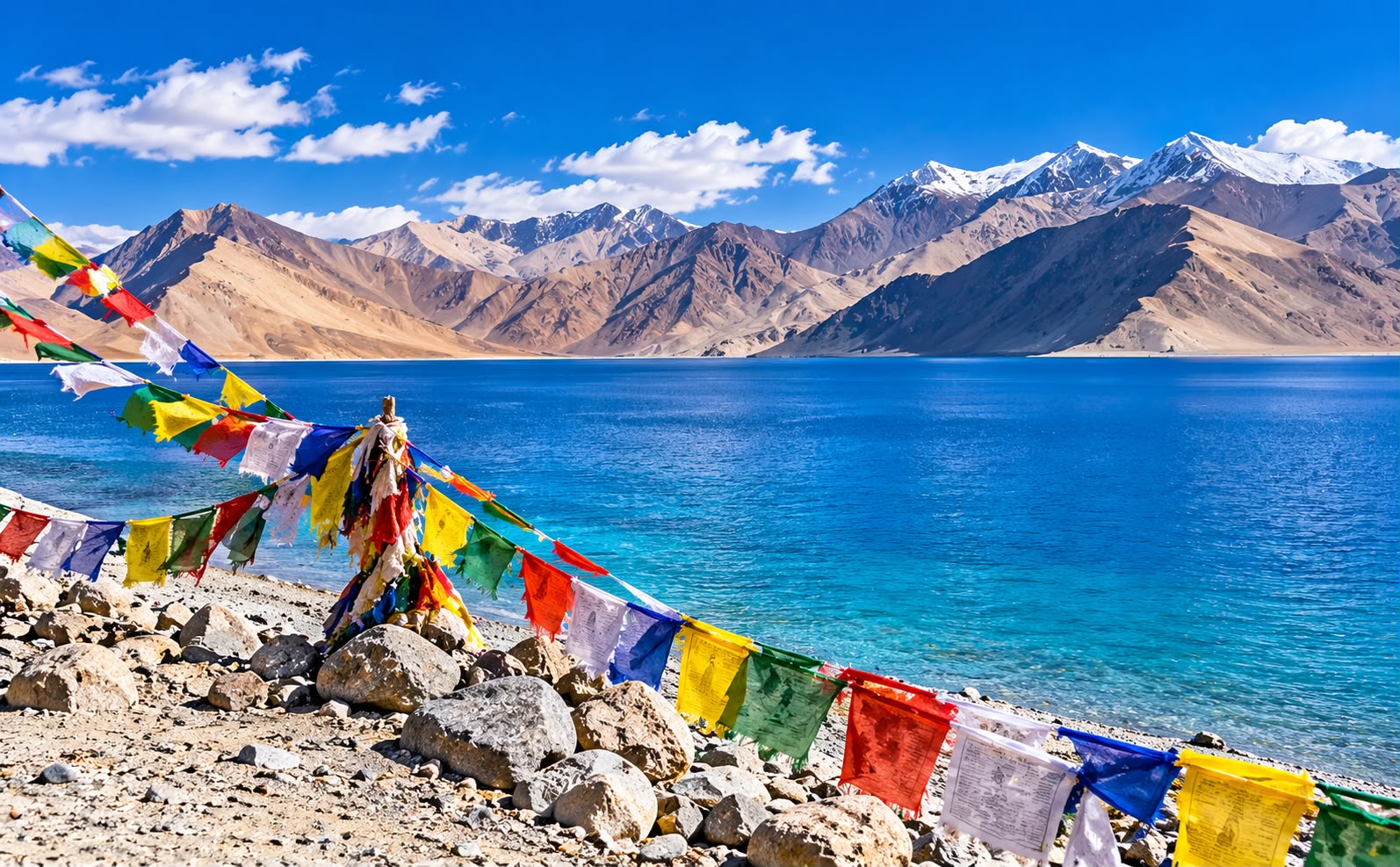
Ladakh in 7 days: Leh, Nubra Valley and Pangong Tso
Seven days is the standard Ladakh circuit done safely — two full days acclimatising in Leh before anything else, then Khardung La into the Nubra valley, and Pangong Tso at 4,350m. The acclimatisation is not padding; people are evacuated from this route every season for ignoring it.
- South Asia
- 7 days
- ≈ AED 1,800 / person
- High-altitude desert, Buddhist monasteries and two days of acclimatisation built in
Before you go
Seven days in Ladakh is Leh, the Nubra valley over Khardung La, and Pangong Tso — the standard circuit, with the two things most itineraries cut built back in: acclimatisation and permits.
Leh sits at 3,500m and you fly into it. That is a jump most bodies do not take well. The first two days of this itinerary are deliberately slow, and they are not padding — people are evacuated from this route every season, and a few die, because they flew in and drove to 5,300m the next morning.
Ten days adds Lamayuru’s moonscape and Tso Moriri, and gives the altitude more room.
Figure INR 46,000 (≈ AED 1,796) per person. May to September, and the overland passes are open roughly June to October.
Before you go: altitude, which comes before everything
- Leh is 3,500m. Khardung La is 5,359m. Pangong is 4,350m. These are serious elevations and the air holds roughly 60% of the oxygen at sea level.
- Spend your first two days in Leh doing very little. No driving to passes, no walking uphill fast, no alcohol. This is the single most important thing on this page.
- Acute Mountain Sickness is headache, nausea, dizziness, breathlessness at rest and poor sleep. It is common and usually mild.
- HAPE and HACE — fluid in the lungs or brain — are the ones that kill. Warning signs are breathlessness while resting, a wet cough, confusion, or loss of coordination. The treatment is immediate descent, not rest and not oxygen alone.
- Never ascend with symptoms, and never leave someone symptomatic alone.
- Talk to a doctor about acetazolamide (Diamox) before you travel if you intend to use it.
- Drink far more water than feels necessary, skip alcohol entirely for the first three days, and eat lightly.
- Oxygen cylinders are sold in Leh and most good hotels have one. They buy time; they do not substitute for descending.
Before you go: the rest of the admin
Visas and permits
- e-Visa at the official indianvisaonline.gov.in/evisa and nowhere else. Leh is not an e-Visa port of entry — arrive through Delhi.
- Nubra, Pangong and the Changthang need a permit: an Inner Line Permit for Indian nationals and a Protected Area Permit for foreign nationals. Both are arranged in Leh, online through the LAHDC portal or in an hour through any travel agent.
- OCI card holders are treated as foreign nationals.
- Foreign nationals generally need to travel in a group of two or more for the Protected Area Permit.
- Carry multiple photocopies. Permits are checked and collected at several checkposts, and you will hand over a copy at each.
Flying in from the Gulf
- Leh (IXL) via Delhi, about 80 minutes, and one of the most spectacular descents in commercial aviation.
- Morning flights only. Leh’s afternoon winds close the airport, so everything lands and leaves before midday, and cancellations roll over to the next day.
- Leave a buffer day before an international connection. This is not optional advice here.
- Overland from Srinagar (via Zojila) or Manila–Manali (via Baralacha La and Tanglang La) takes two days each and is spectacular — and it acclimatises you properly, which flying does not.
Money
- Carry cash. ATMs are in Leh only, and they run out.
- ₹15,000–20,000 in cash for a week is sensible. There is nothing in Nubra or at Pangong.
- Mobile data is Leh-centric; postpaid Indian SIMs only, and prepaid SIMs from outside the region do not work.
Day by day
Day 1 — Leh, and doing nothing
- 07:00 — Land. Leh’s flights all arrive early, before the wind picks up.
- 09:00 — To the hotel, and rest. Lie down for the afternoon, drink far more water than feels necessary, and eat lightly. No alcohol.
- 17:00 — A short flat walk, and that is the most you should do.
- This feels like a wasted day and it is the reason the rest of the trip works. You have gone from sea level to 3,500m in a morning; people are evacuated from this route every season for treating today as a sightseeing day.
Day 2 — Leh’s own altitude, gently
- 06:30 — Thiksey Monastery for morning prayers, 19km out: twelve storeys rising up a hill, modelled on the Potala, with a 15m Maitreya Buddha. You will be awake anyway — broken sleep is normal at this height.
- 09:00 — Shey Palace and Stakna, both nearby and both short.
- 11:00 — Hemis, 45km out: the largest and wealthiest monastery in Ladakh, with an excellent museum and a famous June festival.
- 15:00 — Leh Palace above the old town, a smaller Potala from the 1600s.
- 17:30 — Shanti Stupa at sunset: Japanese-built, white, and the best view over Leh. Take the road up, not the 500 steps — not today.
- Early night, and collect your Inner Line or Protected Area Permit before the offices shut.
Day 3 — Over Khardung La to Nubra
- 07:30 — Leave Leh, about 40km to the pass.
- 09:00 — Khardung La at 5,359m, long marketed as the highest motorable pass in the world. It is not — Umling La in eastern Ladakh is higher at 5,799m — but it is still extraordinary. Stop twenty minutes at most. The tea shop at the top is a bad place to linger; you are at 5,359m and the body is working hard.
- 12:00 — Down into the Nubra valley, green, open, and roughly 2,000m lower.
- 14:30 — Diskit Monastery and the 32m Maitreya Buddha above the valley, facing towards Pakistan.
- 17:00 — Hunder’s sand dunes: a cold desert at 3,000m, with double-humped Bactrian camels, descendants of Silk Road caravan stock. The short ride is touristy and the setting is genuinely surreal.
- Stay in Hunder or Diskit.
Day 4 — Nubra to Pangong
- 07:00 — The Shyok road, about seven hours direct from Nubra to Pangong. Rough, dramatic, and it washes out regularly — confirm it is open before committing, because the alternative is back over Khardung La and out via Chang La, which is longer.
- 15:00 — Pangong Tso at 4,350m: 134km long, only about a third of it in India, running east into Tibet. The colour is the thing — a saline lake with no outflow, shifting through blue, turquoise and grey as the light moves.
- Stay at Spangmik or Lukung in a camp or homestay. Sleeping at 4,350m is the hardest night of the trip — expect broken sleep and a headache, and descend if it is worse than that.
- 21:00 — The stars, which are exceptional, cloud permitting.
Day 5 — Pangong back to Leh
- 08:00 — Via Chang La at 5,360m, the third-highest motorable pass. Five to six hours in total.
- 13:00 — Druk White Lotus School at Shey on the way back, which appeared in 3 Idiots and funds itself partly on that.
- 15:00 — Into Leh, which will feel oxygen-rich after Pangong.
- 17:00 — The old town and the bazaar for apricots, pashmina and Tibetan handicraft.
Day 6 — The lower Indus and the old monasteries
- 08:30 — West along the Indus, the gentlest day and in many ways the best.
- 09:15 — Magnetic Hill, where the road appears to run uphill. An optical illusion, enjoyably done.
- 09:45 — Gurudwara Pathar Sahib, maintained by the Indian Army.
- 10:30 — Sangam, the confluence of the Indus and Zanskar, where the two rivers run visibly different colours for a kilometre.
- 12:00 — Alchi Monastery, 70km out and the one to see: 11th-century wall paintings in Kashmiri style that survive nowhere else, because Alchi was abandoned rather than renovated. No photography inside, and the lighting is deliberately minimal. Worth the drive on its own.
- 14:00 — Likir and its 23m gold Maitreya on the way back.
- 17:00 — Back in Leh.
Day 7 — Fly out
- 06:00 — Check in early. Leh’s departures all go before the wind picks up, and if the flight cancels it rolls to the next day — which is why the buffer night in Delhi matters.
Costs and practicalities
Best time to visit
- June to September — the season. Days 15–25°C in Leh, nights cold, and everything open. July and August are the busiest and the warmest.
- Mid-May to early June — Pangong may still be partly frozen, which is beautiful, and the Manali road is usually still closed.
- September to early October — the best light of the year, thin crowds, and very cold nights. Passes start closing from late October.
- November to April — Leh is cut off by road and reachable only by air. Most hotels close. The Chadar trek on the frozen Zanskar runs in January and February and is a serious undertaking, not a holiday.
The overland passes decide the season. Srinagar–Leh usually opens in May or June; Manali–Leh in June. Both close by late October.
Travel tips
- Two days of acclimatisation, non-negotiable.
- Permits before you leave Leh, with multiple photocopies.
- No alcohol for the first three days, and preferably none at Pangong.
- Morning flights only — and a buffer day at the end.
- Carry cash; there are no ATMs past Leh.
- Confirm the Shyok road is open before planning Nubra to Pangong directly.
- Hire a driver who knows the route. Self-drive on these passes with no altitude experience is a bad idea.
- Take altitude symptoms seriously in other people, who may not report them.
- Carry out your rubbish. Ladakh’s waste infrastructure is minimal and the damage is visible.
- Dress modestly at monasteries, walk clockwise around stupas, and do not photograph inside prayer halls where signs forbid it.
What this trip actually costs
Two people, 6 nights, mid-range comfort, international flights excluded:
| Item | Cost |
|---|---|
| Hotels, 6 nights (4 Leh + 1 Nubra + 1 Pangong camp) | INR 32,000 (≈ AED 1,250) |
| Car and driver, 7 days, including airport runs | INR 36,000 (≈ AED 1,406) |
| Permits, monastery entries, camel ride, oxygen hire | INR 10,000 (≈ AED 390) |
| Food and drink, 7 days | INR 10,000 (≈ AED 390) |
| SIM, cash buffer, tips, extras | INR 4,000 (≈ AED 156) |
| Total for two | INR 92,000 (≈ AED 3,593) |
- Roughly INR 46,000 (≈ AED 1,796) per person, excluding the Delhi connection.
- The car is the largest line by far, and it is unavoidable: the distances are vast, there is no public transport worth the name, and a driver who knows the passes is worth paying for.
- Pangong’s camps charge more than Leh’s hotels for far less comfort, because of where they are.
- Leh’s season is short, so July and August prices are high and shoulder months are noticeably cheaper.
- Hotel picks here are chosen on location, not on commission — always check prices and recent reviews before booking.
What to pack
- Serious layers. Leh can be 25°C at noon and 5°C at night; Pangong goes below freezing.
- A down jacket, hat and gloves, even in July.
- High-factor sun cream and proper sunglasses. At 4,000m in thin dry air the sun is brutal, and snow and water double it.
- Lip balm and moisturiser — the air is extremely dry.
- A refillable bottle and purification, to avoid adding to the plastic problem.
- Cash.
- Any altitude medication, discussed with a doctor first.
- A headache remedy you know works for you.
FAQ
How long do I need to acclimatise? Two full days in Leh before going higher, minimum. Flying in and driving to Khardung La the next day is what puts people in hospital.
Do I need a permit? Yes, for Nubra, Pangong and the Changthang — an Inner Line Permit for Indian nationals, a Protected Area Permit for foreign nationals and OCI holders. Both are arranged in Leh in about an hour.
Is seven days enough? For Leh, Nubra and Pangong, yes, with the acclimatisation built in. Ten days adds Lamayuru and Tso Moriri and is gentler on the body.
Can I fly in and go straight to Pangong? You can, and you should not. It is the single most common mistake made here and it is the one with real consequences.
Is the overland route better? For acclimatisation, considerably — two days climbing from Srinagar or Manali prepares you properly. It costs four days of the trip and the passes are only open June to October.
Prices and entry rules change, and what you need depends on your passport; last checked 26 October 2026, so confirm with the embassy or your airline before booking.


