 The Itinerary
South India in 14 days: Tamil Nadu's temples and the Kerala coast
Two weeks across the bottom of India — the Pallava rock carvings, French Pondicherry, the Chola temple country, Madurai's Meenakshi, then over the Western Ghats into Kerala's spice hills and backwaters. One road, two states, and nothing repeated.
- South Asia
- 14 days
- ≈ AED 3,050 / person
- Crossing the peninsula coast to coast, temples first and water last
Before you go
Fourteen days across the south is a single line from one coast to the other: Chennai on the Bay of Bengal, down through the Tamil temple towns, over the Western Ghats, and out at Kochi on the Arabian Sea.
It is two completely different states and the contrast is the trip. Tamil Nadu is dry, Dravidian and architectural — temples that have been working continuously for a thousand years. Kerala is wet, green and almost entirely about water and hills. They share a border and very little else.
Temples first, water last, because the Tamil leg is the demanding half and the backwaters are the rest.
Seven days in Tamil Nadu is the first half alone; seven in Kerala is the second. This route is both, with Trichy added in the middle.
Figure INR 78,000 (≈ AED 3,046) per person. November to March.
All costs are in rupees. Indian passport and OCI holders pay domestic rates where separate rates apply.
Before you go: the admin
Visas
- e-Visa at the official indianvisaonline.gov.in/evisa. Both Chennai and Kochi are e-Visa ports of entry.
- Six months’ validity, two blank pages.
Flying in from the Gulf
- Chennai (MAA) in, Kochi (COK) out. Both take directs from Dubai, Abu Dhabi, Sharjah, Doha, Muscat and Kuwait, and the open jaw is what makes this route a line rather than a loop.
- Do not fly home from Chennai. Backtracking across the peninsula costs two days.
- Kochi’s Gulf departures mostly leave in the evening, which gives you the last day.
Temple etiquette, which matters on the Tamil leg
- Shoes off well before the entrance, and often socks too.
- Men are frequently asked to remove shirts in the inner areas of older temples. Normal, not negotiable.
- Many inner sanctums are closed to non-Hindus, posted at the gate. The architecture is in the outer precincts anyway.
- Temples shut roughly 12:30–4pm. This is the most common way visitors waste an afternoon.
The one booking that will not wait
- The Alleppey houseboat. Private boats go for Christmas, New Year and all of February. Book it before any hotel on this route.
Money
- UPI QR payments across both states.
- ₹6,000–8,000 in small notes over a fortnight.
- Cards at hotels and bigger restaurants; everything else QR or cash.
Day by day
Day 1 — Chennai
- 10:00 — The Government Museum for the Chola bronzes, the best collection anywhere. See them now, not after Thanjavur — they explain what you are about to look at for the next week. Closed Fridays, which matters because the whole Tamil leg is built on them.
- 16:00 — San Thome Basilica, over the tomb of St Thomas the Apostle.
- 17:30 — Kapaleeshwarar Temple at Mylapore, in the early evening when it fills — and after the midday closure that every temple on this route keeps.
- 18:30 — Marina Beach at sunset. Do not swim — the currents kill people every year.
Day 2 — Mahabalipuram
- 08:00 — Two hours south down the East Coast Road.
- 10:00 — The Shore Temple on the beach, losing its carving to salt wind. Seventh-century Pallava work, carved out of the granite rather than built on it.
- 11:00 — Arjuna’s Penance, a 30-metre relief and the largest bas-relief in the world, and Krishna’s Butter Ball, balanced on its slope for a thousand years.
- 16:00 — The Five Rathas, five monolithic temples each in a different style — effectively a catalogue of what Dravidian architecture became. Late afternoon: there is no shade here.
- Stay here, not back in Chennai.
Day 3 — Pondicherry
- 09:00 — Two hours south, and French until 1954 in a way that still shows.
- 16:00 — The French Quarter: mustard walls, bougainvillea, bilingual street signs, and a seafront promenade closed to cars in the evening.
- 17:30 — The Tamil Quarter inland, a different architecture entirely. The two grids meet at a canal.
- 20:00 — Eat well. This is the best food town in Tamil Nadu.
Day 4 — Auroville, and the beaches
- 09:00 — Auroville and the Matrimandir. Book the viewing in advance — walk-ups are turned away.
- 12:00 — Sri Aurobindo Ashram, quiet and central.
- 15:00 — The beaches north of town, or Paradise Beach by boat.
Day 5 — Thanjavur
- 08:00 — Four hours inland through the Cauvery delta.
- 13:00 — Lunch, and wait out the temple closure.
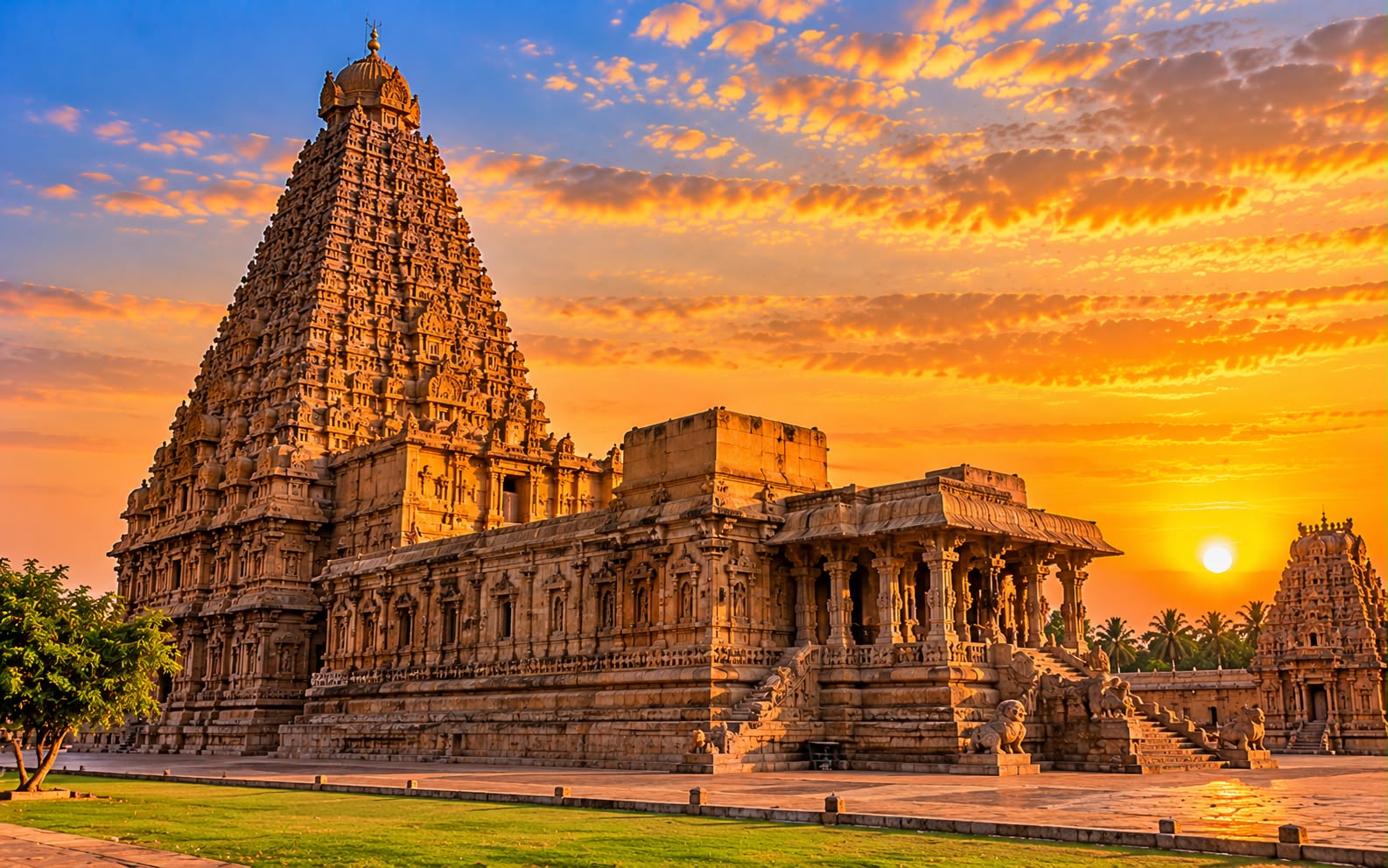
- 16:00 — The Brihadisvara Temple, finished 1010 AD by Rajaraja Chola: a 66-metre vimana topped with a single 80-tonne capstone, the tallest structure in India for centuries. The finest building in south India, and still a working temple.
- 18:30 — Go back at dusk, when it is lit. It is a different building.
- Or the Palace art gallery for more bronzes, before the temple reopens.
Day 6 — Trichy, then Madurai
- 08:00 — An hour and a half to Tiruchirappalli.
- 09:30 — Srirangam: the largest working temple complex in the world, seven concentric enclosures with a town living inside the outer ones, and 21 gopurams.
- 11:30 — The Rock Fort Temple: 417 steps and the delta spread out below. Go before the stone gets hot — you climb it barefoot.
- 14:00 — Two hours on to Madurai.
Day 7 — Madurai
- 06:00 — The flower market at dawn: jasmine by the kilo, and the best photograph of the trip.
- 08:00 — The Meenakshi Amman Temple, which is what the Tamil half has been building towards. Fourteen gopurams, the tallest nearly 52 metres, every one covered in thousands of painted figures. The Hall of a Thousand Pillars, no two carved alike. Perhaps 15,000 visitors on an ordinary day.
- 11:00 — Thirumalai Nayak Palace, before the afternoon closure.
- 21:00 — Go back at night. The ceremony when Sundareswarar is carried to Meenakshi’s chamber is the better visit of the two.
Day 8 — Over the Ghats
- 09:00 — A last morning in Madurai, or the temple again if last night was crowded.
- 13:00 — Four hours west and up, and the landscape changes completely: cardamom, pepper and rain. The most dramatic drive on the route.
- 17:30 — Into Kumily, the town at the Periyar gate.
Day 9 — Thekkady and the spice country
- 09:00 — A working spice plantation tour: cardamom, pepper vines, vanilla, nutmeg, clove. Ninety minutes and nobody regrets it. The “ayurvedic oil” counter at the end is where the margin lives.
- 18:00 — Kalaripayattu: Kerala’s martial art, older than most of what it influenced, and startling in a small hall.
- Book tomorrow’s Periyar boat tonight, or send someone to the counter at 06:00 — only a limited number of seats go on the first sailing.
Day 10 — Periyar at dawn, then north
- 07:00 — The boat on Periyar lake: mist, drowned trees, and a fair chance of elephant and gaur on the bank. The later boats are busier and emptier of animals. The Forest Department’s guided walks and bamboo rafting see far more, in groups of six, booked the day before.
- 11:00 — Three and a half hours north into the tea.
- 15:00 — The Tata Tea Museum at Nallathanni: working rollers, a good film, tea worth drinking. Closed Mondays.
- Stay on an estate, not in Munnar town.
Day 11 — Eravikulam and the high tea
- 06:45 — Leave for Eravikulam, 13km north.
- 07:30 — The park at opening, where Nilgiri tahr walk the path with you. By 10:00 the queue is long. Closed February–March for calving — check before fixing dates.
- 14:00 — Top Station for the view back into Tamil Nadu you crossed three days ago, before the cloud climbs from about 15:00.
- 17:00 — An estate walk, which is Munnar’s real pleasure.
Day 12 — A spare day in the hills
- 04:00 — Kolukkumalai by jeep for sunrise over the highest tea estate in the world, if a rough hour each way appeals.
- 10:00 — Lakkam falls, or simply a slow morning on the estate.
- This is the only slack in fourteen days and you will have earned it after eight days of temples.
Day 13 — Down to the backwaters
- 08:30 — Four to five hours to Alleppey; boats board at noon.
- 12:30 — Lunch aboard: karimeen, rice, thoran, cooked on deck.
- 14:00 — The afternoon cruise: paddy below water level, toddy shops, canals narrowing until the boat barely fits.
- 17:30 — Moor in open water on Vembanad, not against the bank. Boats stop cruising around now by law.
Day 14 — Backwater dawn, Kochi, and home
- 06:00 — Awake for mist, cormorants and the bank waking up.
- 09:00 — Disembark.
- 11:00 — Fort Kochi if your flight is late: the Chinese fishing nets, the Paradesi Synagogue with its hand-painted Cantonese floor tiles, and St Francis Church, Vasco da Gama’s first grave. The synagogue and Dutch Palace shut on Fridays.
- Kochi airport is 90 minutes from Alleppey, 45 from the fort.
Costs and practicalities
Best time to visit
- December to February — the best of both states at once. Tamil Nadu dry and bearable, Kerala dry and green.
- November — the tail of Tamil Nadu’s northeast monsoon. Chennai can flood; Kerala is lovely. A gamble on the first three days only.
- March — still good, warming fast on the Tamil leg.
- April to June — 40°C in the temple towns, barefoot on hot stone. Munnar and Thekkady stay pleasant, which is no help on days 1 to 8.
- July to September — the southwest monsoon soaks Kerala and largely misses Tamil Nadu. Cheap, green, and the backwaters turn grey.
The two states are on opposite rain calendars — Tamil Nadu gets the October–December northeast monsoon, Kerala the June–September southwest. December to February is where both are dry.
Travel tips
- Chennai in, Kochi out. Never backtrack across the peninsula.
- Houseboat before hotels.
- Chola bronzes in Chennai before Thanjavur, not after.
- Temples shut 12:30–4pm. Build every Tamil day around it.
- Meenakshi at night.
- Eravikulam at opening or not at all.
- One car and driver for all fourteen days — ₹2,800–3,500 a day, and far better than changing vehicle at the state line.
- Carry socks for the Tamil leg and a fleece for the Kerala hills. You will need both in the same fortnight.
- Water: bottled or filtered only, and eat where there is a queue.
What this trip actually costs
Two people, 13 nights, mid-range comfort, international flights excluded:
| Item | Cost |
|---|---|
| Hotels, 12 nights, plus 1 night on a private houseboat | INR 72,000 (≈ AED 2,812) |
| Car and driver, 14 days, including both airport runs | INR 48,000 (≈ AED 1,874) |
| Entries, temple guides, Auroville, Periyar boat, Eravikulam | INR 12,000 (≈ AED 469) |
| Food and drink, 14 days | INR 18,000 (≈ AED 703) |
| SIM, tips, extras | INR 6,000 (≈ AED 234) |
| Total for two | INR 156,000 (≈ AED 6,092) |
- Roughly INR 78,000 (≈ AED 3,046) per person for a fortnight, which is noticeably cheaper than the equivalent north India route — temple entry here is free or nominal where Mughal monuments charge foreigners heavily.
- The car is the biggest line and the one worth paying for. The distances are long, the roads are good, and changing vehicles at the state border is a false economy.
- The houseboat is a quarter of the hotel line on its own.
- Pondicherry and the Munnar estates are the expensive nights.
- Hotel picks here are chosen on location, not on commission — always check prices and recent reviews before booking.
What to pack
- For two climates in one trip: light cotton for the Tamil plains, a fleece for Munnar, which drops to 10°C at night in January.
- Socks, repeatedly, for hot temple stone.
- Shoulders and knees covered for every temple.
- Slip-on shoes — off and on a dozen times a day.
- Mosquito repellent for the backwaters and the plantation.
- A small bag; many temples ban large bags and cameras.
- A power bank — the houseboat generator sleeps when you do.
FAQ
Is fourteen days enough for south India? For this line across it, comfortably. It leaves out Karnataka, Hampi, the Nilgiris and the far south, each of which needs its own week.
Tamil Nadu or Kerala, if I only had one? Kerala is easier and prettier; Tamil Nadu is more extraordinary. If you have seen north India’s Mughal architecture and want the other tradition, go to Tamil Nadu.
Could I do this by train? Most of the Tamil leg, yes, and well. The Ghats crossing and the Kerala hills effectively need a car, and that is half the trip.
Is the Tamil half too temple-heavy? It is seven days of temples, and they are among the greatest buildings in Asia. If that does not appeal, take Kerala on its own.
How hard is the Ghats crossing? Four hours of winding road from Madurai to Thekkady, and the single most dramatic drive on the route. Not difficult, just slow.
Prices and entry rules change, and what you need depends on your passport; last checked 26 October 2026, so confirm with the embassy or your airline before booking.


