 The Itinerary
Tamil Nadu in 7 days: Chennai, Mahabalipuram, Pondicherry and the temple towns
Seven days down the Coromandel coast and inland to the temple towns — Mahabalipuram's rock carvings, Pondicherry's French quarter, the Chola bronze country at Thanjavur, and Madurai's Meenakshi temple, which is the reason the whole route exists.
- South Asia
- 7 days
- ≈ AED 1,500 / person
- Dravidian temple architecture, a French colonial detour, and no hill stations
Before you go
Seven days in Tamil Nadu is a straight line down the coast and then inland: Chennai, the rock-cut shore temples at Mahabalipuram, French Pondicherry, Chola country at Thanjavur, and Madurai, which is where this trip is going the whole time.
This is a temple trip, and that is the point. Tamil Nadu has the oldest continuous temple tradition in India — not ruins but working buildings, some of them 1,300 years old and still full of people every morning. If you have seen north India’s Mughal monuments, this is the other half of the country’s architecture and it looks nothing like them.
Fourteen days carries this route on into Kerala, which is the natural extension — the two states share a border and nothing else.
Figure INR 38,000 (≈ AED 1,484) per person. November to February; April to June is brutal on this coast.
All costs are in rupees. Indian passport and OCI holders pay domestic rates where separate rates apply.
Before you go: the short version of the admin
Visas
- e-Visa at the official indianvisaonline.gov.in/evisa and nowhere else. Chennai is an e-Visa port of entry.
- Six months’ validity, two blank pages.
Flying in from the Gulf
- Chennai (MAA) takes directs from Dubai, Abu Dhabi, Sharjah, Doha, Muscat, Kuwait and Bahrain — around four hours.
- Fly into Chennai and out of Madurai (IXM) via a domestic connection, or loop back. Madurai–Chennai is an hour by air against eight by road, so the open jaw is worth arranging.
- This route is almost entirely by road, and the roads in Tamil Nadu are among the best in India.
Temple etiquette, which matters more here than anywhere
- Shoes off, always, well before the entrance — and often socks too. The stone gets genuinely hot by midday.
- Men are frequently asked to remove shirts in the inner areas of the older temples. This is normal and not negotiable.
- Many inner sanctums are closed to non-Hindus. The rule varies temple to temple and is posted. Accept it without arguing; the outer precincts are where the architecture is anyway.
- Temples shut in the middle of the day, roughly 12:30 to 4pm. Plan around it — this is the single most common way visitors waste an afternoon.
- Cameras are often banned inside, phones included.
Money
- UPI QR payments everywhere.
- ₹4,000 in small notes for shoe minders, offerings and autos.
- Cards at hotels and larger restaurants only.
Day by day
Day 1 — Chennai
- Arrive and go gently. Chennai is hot, flat and sprawling, and it is a city to sample rather than tour.
- 10:00 — The Government Museum for the Chola bronzes, the single best collection anywhere. See them now, not after Thanjavur — they explain what you are about to look at all week. Closed Fridays.
- 16:00 — San Thome Basilica, built over the tomb of St Thomas the Apostle, who tradition says died here in AD 72.
- 17:30 — Kapaleeshwarar Temple at Mylapore: a classic Dravidian gopuram covered in painted figures, with a tank beside it. Best in the early evening when it fills — and note it shuts through the middle of the day like every temple on this route.
- 18:30 — Marina Beach at sunset, a social event rather than a swimming one. Do not swim — the currents kill people every year.
- 20:00 — A proper Tamil meal on a banana leaf.
Day 2 — Mahabalipuram
- 08:00 — Two hours south down the East Coast Road.
- 10:00 — The Shore Temple, standing on the beach and slowly losing its carving to salt wind. One of the oldest stone temples in south India. This is a seventh-century Pallava site — monuments carved directly out of the granite rather than built on it.
- 11:00 — Arjuna’s Penance, a 30-metre relief on a rock face with a natural cleft used as a river in the composition. The largest bas-relief in the world, and extraordinary.
- 12:00 — Krishna’s Butter Ball, a boulder balanced on a slope that has refused to roll for a thousand years.
- 16:00 — The Five Rathas, five monolithic temples each carved from a single boulder in a different architectural style — effectively a sampler of what Dravidian temples would become. Late afternoon, because there is no shade here at all.
- Stay the night, not back in Chennai.
Day 3 — Pondicherry
- 09:00 — Two hours further south, and an abrupt change: Puducherry was French until 1954 and the old town still is, in a way Goa’s Portuguese quarter is not quite.
- 16:00 — The French Quarter (White Town): mustard-yellow walls, bougainvillea, street names in two languages, and a seafront promenade closed to traffic in the evenings.
- 17:30 — The Tamil Quarter immediately inland, with its own very different architecture. The two grids meet at a canal.
- 20:00 — Eat well. Pondicherry is the best food town on this route — the Franco-Tamil cooking exists nowhere else.
- Book the Matrimandir viewing tonight for tomorrow; see below.
Day 4 — Auroville, and the beaches
- 09:00 — Auroville, 12km out: an experimental township founded in 1968, with the Matrimandir at its centre. Book the viewing in advance — casual visitors see it from a distance and walk-ups are turned away.
- 12:00 — Sri Aurobindo Ashram, quiet and central.
- 15:00 — Paradise Beach by boat, or the quieter beaches north.
- 18:00 — The promenade once it closes to traffic, which is when the whole town comes out onto it.
Day 5 — Thanjavur, and the Chola country
- 08:00 — Four hours inland through the Cauvery delta, which is rice country and green in a way the coast is not.
- 13:00 — Lunch, and wait out the temple closure.
- 16:00 — The Brihadisvara Temple, finished in 1010 AD by Rajaraja Chola. The vimana over the sanctum is 66 metres and was the tallest structure in India for centuries; the capstone is a single 80-tonne block. The finest building in south India, and a working temple rather than a monument.
- 18:30 — Go back at dusk, when it is lit. It is a different building.
- Or Darasuram and Gangaikondacholapuram, the other two Great Living Chola Temples, both within an hour and both nearly empty.
Day 6 — Trichy, then on to Madurai
- 08:00 — An hour and a half to Tiruchirappalli.
- 09:30 — Srirangam, on an island in the Cauvery: the largest working temple complex in the world, seven concentric walled enclosures with a town living inside the outer ones, and 21 gopurams including a 72-metre one.
- 11:30 — The Rock Fort Temple above the town: 417 steps cut into the rock, and the delta spread out below. Go before the stone gets hot, because you climb it barefoot.
- 14:00 — Two hours on to Madurai.
Day 7 — Madurai, and home
- 06:00 — The flower market at dawn — jasmine by the kilo, and the best photograph of the trip.
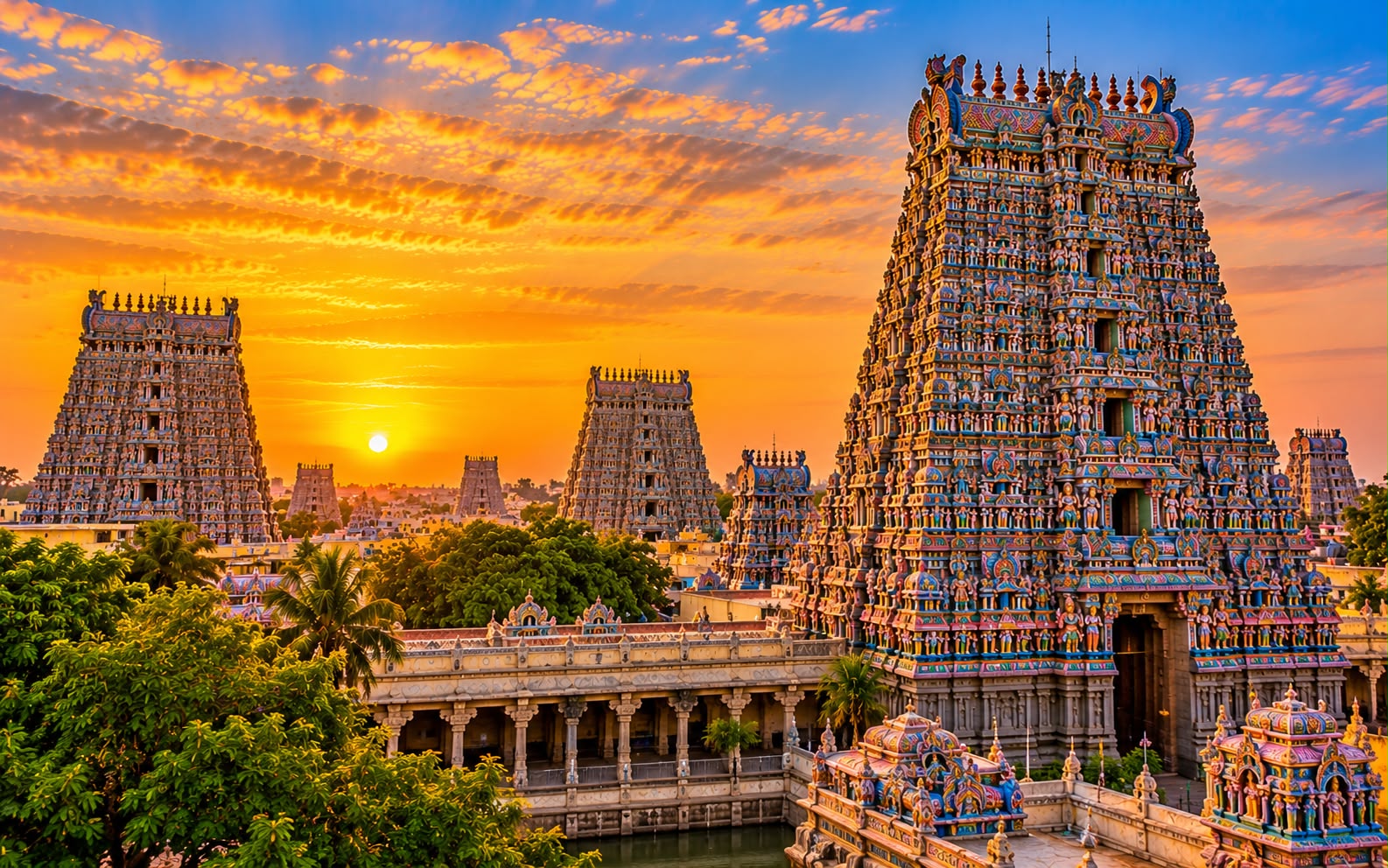
- 08:00 — The Meenakshi Amman Temple, and this is what the week has been building to. Fourteen gopurams, the tallest nearly 52 metres, every one covered in thousands of painted stucco figures. The Hall of a Thousand Pillars, no two carved alike. Perhaps 15,000 people come through on an ordinary day.
- 11:00 — Thirumalai Nayak Palace, before the afternoon closure.
- 21:00 — Go back at night. The evening ceremony, when an image of Sundareswarar is carried to Meenakshi’s chamber, is the better visit of the two.
- Fly out of Madurai to Chennai or Bangalore and connect.
Costs and practicalities
Best time to visit
- December to February — the best of it. Days 26–30°C, dry, and the temple towns are bearable at midday.
- November — the tail of the northeast monsoon, which is the one that matters on this coast. Chennai floods in a bad year. Green, cheap and a gamble.
- March — still fine, warming quickly.
- April to June — 40°C and humid. Walking barefoot on temple stone in May is genuinely painful and the inland towns are worse than the coast.
- July to September — the southwest monsoon largely misses Tamil Nadu, so this is drier than you expect, and hot.
Tamil Nadu’s rain comes in October–December, not in the summer monsoon. That is the opposite of most of India and catches people out.
Travel tips
- Temples close 12:30–4pm. Build the day around it.
- Carry socks — hot stone, shoes off, long walks inside compounds.
- See the Chennai bronzes first. Thanjavur makes far more sense afterwards.
- Book Auroville’s Matrimandir viewing in advance or do not bother going.
- Meenakshi at night is better than Meenakshi in the morning.
- A car and driver for all seven days — ₹2,800–3,500 a day. The trains are good but the temple towns are spread out.
- Eat on banana leaves and with your right hand; the food here is the best argument for the trip after the architecture.
- Alcohol is state-controlled and low-key in Tamil Nadu, sold through TASMAC shops and licensed hotels.
What this trip actually costs
Two people, 6 nights, mid-range comfort, international flights excluded:
| Item | Cost |
|---|---|
| Hotels, 6 nights (1 Chennai + 1 Mahabalipuram + 2 Pondicherry + 1 Thanjavur + 1 Madurai) | INR 30,000 (≈ AED 1,171) |
| Car and driver, 7 days, including airport runs | INR 24,000 (≈ AED 937) |
| Entries, temple guides, Auroville, palace | INR 7,000 (≈ AED 273) |
| Food and drink, 7 days | INR 11,000 (≈ AED 430) |
| SIM, tips, extras | INR 4,000 (≈ AED 156) |
| Total for two | INR 76,000 (≈ AED 2,968) |
- Roughly INR 38,000 (≈ AED 1,484) per person, which makes this one of the cheaper weeks on this site. Tamil Nadu is excellent value — temple entry is usually free or nominal, and the food is inexpensive and very good.
- The car is the largest line and the one worth paying for; the temple towns are 2–4 hours apart and the state’s roads are good.
- Pondicherry is the expensive night, with heritage hotels in the French Quarter priced well above the rest of the route.
- Hotel picks here are chosen on location, not on commission — always check prices and recent reviews before booking.
What to pack
- Socks, repeatedly, for hot temple stone.
- Shoulders and knees covered for every temple; a long skirt or trousers rather than shorts.
- A sarong or dhoti is useful for men at the stricter temples.
- Sun cream, hat, and more water than you think.
- Slip-on shoes. You will take them off a dozen times a day.
- A small bag — many temples ban large bags and cameras.
FAQ
Is seven days enough for Tamil Nadu? For the coast and the main temple towns, yes. It leaves out Kanyakumari, the Nilgiris and Rameswaram, which need another week.
Can non-Hindus enter these temples? The compounds, almost always. The inner sanctums, often not — it varies by temple and is clearly posted. The architecture you came for is in the outer precincts.
Meenakshi or Brihadisvara, if I only saw one? Brihadisvara at Thanjavur is the greater building; Meenakshi is the greater experience. Most people remember Meenakshi.
Is Pondicherry worth two nights? Yes — it is the only place on this route to slow down, and the food and the seafront justify it.
Is this a good trip in summer? No. April to June on this route is genuinely punishing, and much of it is spent barefoot on hot stone.
Prices and entry rules change, and what you need depends on your passport; last checked 29 October 2026, so confirm with the embassy or your airline before booking.


