 The Itinerary
Japan in 21 days: the Golden Route, the Alps, Hiroshima and Kyushu
Three weeks is enough to add the Japan Alps and the whole of Kyushu — hot-spring towns, an active volcano across the bay from a city of 600,000, and the oldest onsen in the country. The 21-day rail pass, the Alps bus route that closes in winter, and where to break the journey south.
- East Asia
- 21 days
- ≈ AED 11,000 / person
- Three weeks and a southern island most visitors never reach
Before you go
Three weeks is the point at which Japan stops being an itinerary and becomes a journey. The fourteen-day route covers the Golden Route plus Kanazawa and Hiroshima. This adds two things: the Japan Alps, and Kyushu.
Takayama and the Hida valley are mountain Japan — wooden merchant houses, morning markets and the thatched villages of Shirakawa-go under deep snow in winter.
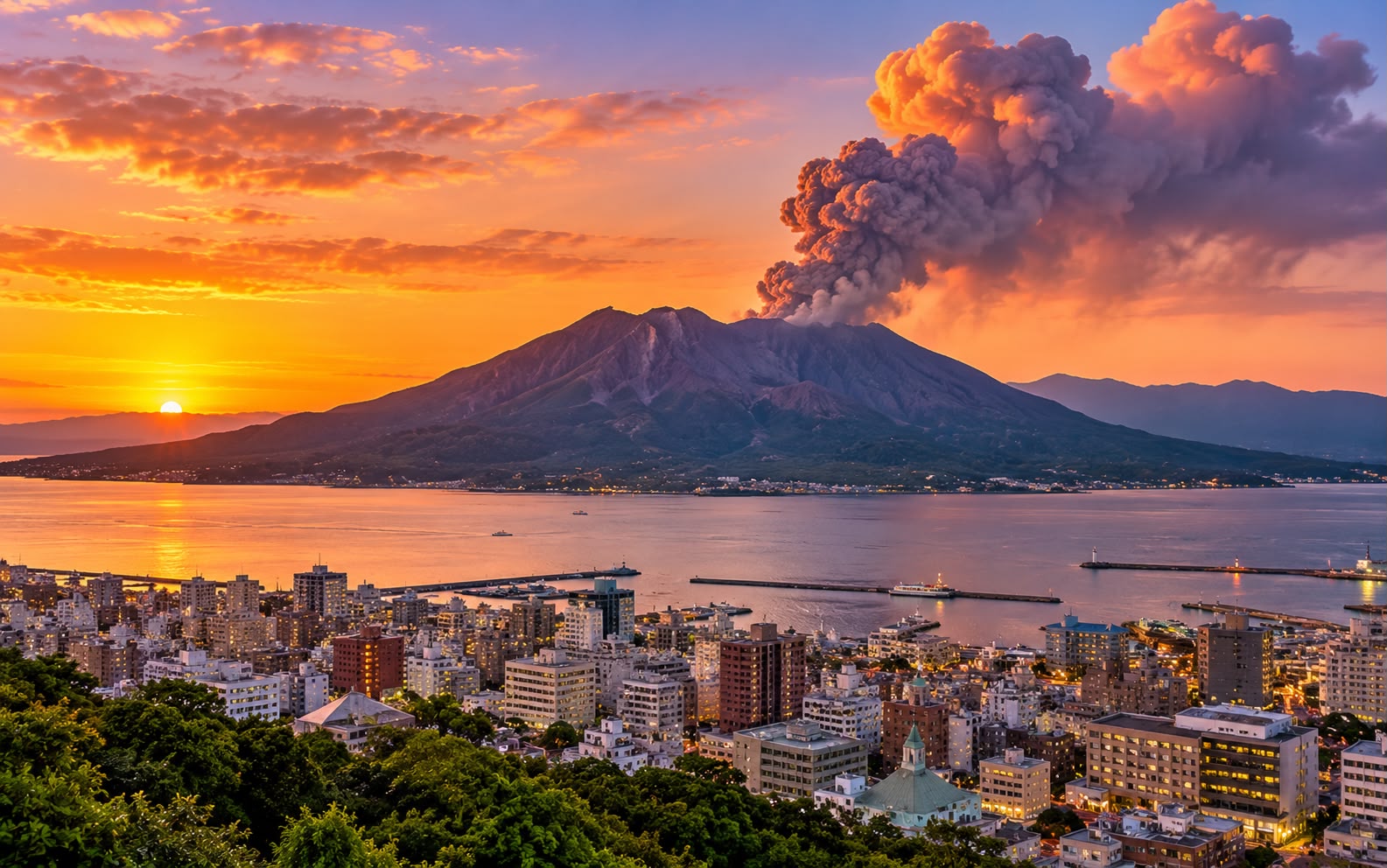
Kyushu is the southern island and it is where almost nobody goes. Beppu produces more hot-spring water than anywhere on earth except Yellowstone. Kagoshima sits across a bay from Sakurajima, an active volcano that showers the city with ash and which everyone simply lives with. Fukuoka has the best street-food stalls in the country.
A 21-day rail pass pays decisively here — this route covers most of the length of the country.
Figure JPY 475,000 (≈ AED 11,018) per person. Late March to early April and late October to November.
Before you go: the admin
Entry
- Most nationalities enter visa-free for 90 days. Indian passport holders need a visa arranged before travel.
- Visit Japan Web for arrival registration.
- Six months’ validity.
The rail pass
- Buy the 21-day ordinary pass. This route runs Tokyo to Kagoshima and back north, and the individual fares comfortably exceed it.
- It does not cover Nozomi or Mizuho — take Hikari and Sakura, which are ten to twenty minutes slower.
- Reserve seats free at any JR office, and do so for the Kyushu legs, which have fewer services.
- The Tateyama Kurobe Alpine Route is not covered and is a separate, expensive ticket.
Luggage
- Use takkyubin forwarding throughout. Three weeks with a suitcase on Japanese station stairs is a different trip from three weeks with a daypack, and it costs about ¥2,000 a leg.
Money
- Carry ¥20,000–30,000. Rural Kyushu and mountain towns are far more cash-dependent than Tokyo.
- 7-Eleven and Japan Post ATMs take foreign cards.
Day by day
Day 1 — Tokyo: Asakusa and the east
- 14:00 — Drop bags. Shinjuku or Shibuya for transport, Asakusa for atmosphere and lower prices.
- 16:00 — Senso-ji and Nakamise-dori, the approach lined with stalls. Come back at eight tomorrow when the gate is empty — it is a different place.
- 18:00 — The Tokyo Skytree from the far bank, or Sumida Park along the river.
- 20:00 — Dinner in a Yokocho alley — Ameya-Yokocho or Omoide Yokocho, both standing-room and both excellent.
Day 2 — Shibuya, Meiji and the west
- 08:00 — Meiji Jingu, in forest, before the crowds. The trees were planted — 100,000 of them, donated from across Japan in the 1920s, grown into what looks like ancient woodland.
- 10:30 — Harajuku and Omotesando, which run from teenage to Prada in about ten minutes.
- 14:00 — Shibuya Crossing, and the free view from Shibuya Sky or the Starbucks above it.
- 17:00 — The Metropolitan Government Building observatory in Shinjuku — free, 202m, and on a clear evening Fuji is on the horizon.
- 20:00 — Golden Gai or Shinjuku for the night.
Day 3 — Tsukiji, Yanaka and the old city
- 07:00 — Tsukiji Outer Market, which is where the food still is — the inner wholesale market moved to Toyosu, the stalls and knife shops stayed.
- 10:00 — Yanaka, which the war and the developers both missed: wooden houses, a cemetery full of cherry trees, and Tokyo as it was.
- 14:00 — The Tokyo National Museum in Ueno, or teamLab if you have booked it.
- 18:00 — An early night. Nikko is a long day.
Day 4 — Nikko
- 07:30 — Two hours north by train.
- 10:00 — Toshogu Shrine, where Tokugawa Ieyasu is buried under carving by 15,000 craftsmen — the sleeping cat, the three monkeys, and a gate so ornate it was deliberately left with one pillar upside down to avoid the jealousy of the gods.
- 13:00 — The Shinkyo bridge, red lacquer over the river.
- 14:30 — Kanmangafuchi Abyss and its rows of stone jizo, which are said to be uncountable — nobody gets the same number twice.
- 18:00 — Back in Tokyo.
Day 5 — Hakone
- 08:00 — Out to Hakone, and do the loop anticlockwise: it is the way the timetables are built and you will not queue against the flow.
- 10:30 — Gora, then the funicular, then the ropeway over Owakudani — a sulphur valley still venting, where they boil eggs black in the springs.
- 13:30 — The boat across Lake Ashi, and Fuji from the water on a clear morning.
- 16:00 — A ryokan with an onsen, which is the point of stopping here. Tattoos are still refused at many — ask when booking rather than at the door.
Day 6 — Into the Alps to Takayama
- 09:00 — North through the mountains, about four hours with a change at Nagoya.
- 14:00 — Sanmachi Suji, three streets of Edo-period merchant houses, dark timber and sake breweries with cedar balls hung outside.
- 16:30 — Hida Folk Village, open-air, with thatched gassho farmhouses moved here and rebuilt.
- 19:00 — Hida beef, which is the local argument against Kobe.
Day 7 — Shirakawa-go
- 08:00 — The morning markets along the Miyagawa, which run from seven and are gone by noon.
- 10:00 — Shirakawa-go, an hour by bus: UNESCO-listed thatched villages in a valley that takes several metres of snow, which is why the roofs are pitched at sixty degrees.
- 13:00 — The Ogimachi viewpoint above the village.
- Winter illuminations are ticketed and sell out months ahead — if your dates are in January or February, book before anything else.
- 17:00 — Back to Takayama.
Day 8 — The Alpine Route, or over to Kanazawa
- If your dates are right: the Tateyama Kurobe Alpine Route — cable cars, trolleybuses and a road cut through snow walls up to 20m high in April and May. Closed late November to mid-April, and not covered by the rail pass. It takes a full day and it is worth one.
- Otherwise, 09:00 — west to Kanazawa, about two and a half hours.
- 14:00 — Omicho Market for lunch — crab, sea urchin, and the best market meal of the trip.
- 16:00 — Higashi Chaya, the teahouse quarter, which is Gion without the crowds.
Day 9 — Kanazawa
- 08:00 — Kenrokuen at opening, one of the three great gardens of Japan, and empty for the first hour.
- 10:30 — Kanazawa Castle beside it.
- 13:00 — Nagamachi, the samurai district, with earthen walls kept wrapped in straw through winter.
- 15:00 — The 21st Century Museum, circular, glass, and free to walk around even without a ticket.
Day 10 — South to Kyoto
- 09:00 — Two and a quarter hours by limited express and Shinkansen.
- 13:00 — Drop bags, and Nishiki Market for lunch — five blocks of covered food stalls.
- 16:00 — Kiyomizu-dera in late light, and the lanes of Sannenzaka and Ninenzaka below it.
- 18:00 — Gion at dusk. Do not chase or photograph geiko and maiko — there are fines for it now, and it was always rude.
Day 11 — Fushimi Inari and the east
- 07:00 — Fushimi Inari, and walk the whole mountain loop rather than turning back at the photogenic bit. Two to three hours, and the crowds thin entirely after the first ten minutes.
- 11:00 — Tofuku-ji for the gardens and, in November, the maples.
- 15:00 — The Philosopher’s Path north, and Ginkaku-ji at the end of it.
Day 12 — Arashiyama and the north-west
- 08:00 — Arashiyama early: the bamboo grove is a corridor of people by nine and genuinely beautiful at eight.
- 09:30 — Okochi Sanso, the villa garden the crowds skip, with tea included in the ticket and a view back over the city.
- 11:00 — Tenryu-ji and the monkey park if you have the legs for the climb.
- 14:30 — Kinkaku-ji, Ryoan-ji and Ninna-ji in one north-western afternoon — they are on the same bus route and twenty minutes apart.
Day 13 — Nara
- 08:30 — Forty minutes south.
- 09:30 — Todai-ji, whose great bronze Buddha sits in the largest wooden building in the world — and the current hall is two-thirds the size of the original.
- 11:00 — The deer, which bow for crackers and will mug you if you hold out. They are wild animals and the bowing is learned.
- 13:00 — Kasuga Taisha and its three thousand lanterns, through the forest.
- 17:00 — Back to Kyoto.
Day 14 — Kyoto, loose
- A spare day, and you will want it. Options: Nijo Castle and its nightingale floors; the Imperial Palace; a tea ceremony; Uji for matcha and Byodo-in, which is on the ¥10 coin; or simply the quieter temples north.
- 18:00 — Pontocho for dinner, the narrow lane along the river.
Day 15 — Osaka
- 10:00 — Thirty minutes south.
- 12:00 — Osaka Castle and its park.
- 15:00 — Shinsekai and the Tsutenkaku tower, which is the old, scruffy, better half of Osaka.
- 19:00 — Dotonbori for the neon and the street food. Takoyaki, okonomiyaki and kushikatsu — and do not double-dip the kushikatsu sauce, which is a rule everyone enforces.
Day 16 — Himeji
- 08:30 — Forty minutes west by Shinkansen.
- 09:30 — Himeji Castle, the finest surviving Japanese castle — never besieged, never burned, and white as the heron it is named for. The main keep is six storeys of steep wooden stairs and queues inside on weekends.
- 13:00 — Koko-en, the garden beside it, on a combined ticket.
- 16:00 — On to Hiroshima, about an hour.
Day 17 — Hiroshima
- 09:00 — The Peace Memorial Museum, which is unflinching. Allow two hours and plan nothing demanding after it.
- 11:30 — The A-Bomb Dome, left as it stood, and the Children’s Peace Monument with its paper cranes.
- 14:00 — Shukkei-en garden, which is the right thing to do afterwards.
- 19:00 — Okonomiyaki, Hiroshima-style — layered rather than mixed, with noodles.
Day 18 — Miyajima
- 09:00 — The ferry across, about ten minutes.
- The Itsukushima torii stands in the sea at high tide and is walkable at low. Check the tide table and choose — they are completely different photographs and you cannot have both in one visit.
- 11:00 — Mount Misen, by ropeway and then a thirty-minute climb, for the Inland Sea.
- 17:00 — Stay the night on the island. The day visitors leave at five, and the shrine lit after dark with nobody there is the reason to stay.
Day 19 — To Fukuoka
- 09:00 — Two hours by Shinkansen.
- 13:00 — Ohori Park and the castle ruins.
- 15:00 — Tocho-ji and its 10.8m wooden Buddha.
- 19:00 — The yatai, open-air food stalls along the Naka river. The best street eating in Japan, and they only appear after dark — tonkotsu ramen, motsunabe, and a dozen people per stall.
Day 20 — Beppu
- 09:00 — Two hours south-east.
- 11:00 — The jigoku, the “hells”: eight districts of boiling, cobalt-blue and blood-red mineral pools. These are for looking at, not bathing — they run to 98°C.
- 15:00 — Sand baths at Beppu Beach, where you are buried to the neck in volcanically heated sand by someone with a shovel. Ten minutes is the limit and it is plenty.
- 18:00 — An onsen ryokan, properly, on the last full night.
Day 21 — Kagoshima, and home
- 08:00 — Two hours south by Shinkansen, if you are going on; otherwise fly from Fukuoka.
- 11:00 — Sengan-en garden, with Sakurajima framed as borrowed scenery across the bay — the oldest trick in Japanese garden design, done at its largest scale.
- 13:00 — The ferry to Sakurajima, which crosses every fifteen minutes. The volcano erupts routinely and dusts the city with ash; the observatories are open when the alert level allows and closed when it does not.
- Fly home from Fukuoka or Kagoshima, or take the Shinkansen back to Tokyo in about seven hours.
Costs and practicalities
Best time to visit
- Late March–early April — blossom, and over three weeks the front moves north so you have a genuine chance of catching it somewhere.
- Late October–November — autumn colour, longer-lasting and almost as beautiful. Kyoto’s last week of November is the best week of the Japanese year.
- May — green and mild, and the Alpine Route’s snow walls are open, which is a specific reason to choose it.
- June–August — rainy season then heat. Kyushu is subtropical and August there is punishing.
- December–February — Shirakawa-go under snow is the reason to come, and the Alpine Route is closed. Kyushu’s onsen towns are at their best in cold weather.
Avoid Golden Week (29 April–5 May) and Obon (mid-August).
Travel tips
- Buy the 21-day rail pass; on this route it is not close.
- Reserve Kyushu seats — fewer services than the main line.
- Forward your luggage between every city.
- The Alpine Route closes late November to mid-April and is a separate ticket.
- Check the Miyajima tide table before choosing a ferry.
- Sakurajima’s alert level changes what is open; check on the day.
- Beppu’s “hells” are for viewing, not bathing.
- Carry more cash in Kyushu and the Alps than you need in Tokyo.
What this trip actually costs
Two people, 20 nights, mid-range comfort, international flights excluded:
| Item | Cost |
|---|---|
| Hotels, 20 nights including three ryokan | JPY 460,000 (≈ AED 10,670) |
| Food and drink, 21 days | JPY 189,000 (≈ AED 4,384) |
| Two 21-day rail passes | JPY 200,000 (≈ AED 4,639) |
| Temples, castles, museums and the Alpine Route | JPY 60,000 (≈ AED 1,392) |
| Local transport, luggage forwarding and transfers | JPY 41,000 (≈ AED 951) |
| Total for two | JPY 950,000 (≈ AED 22,036) |
- Roughly JPY 475,000 (≈ AED 11,018) per person for three weeks.
- The rail pass is the line that justifies itself — this route is most of the length of Japan.
- Kyushu is noticeably cheaper than the Golden Route for accommodation and food.
- Hotel picks here are chosen on location, not on commission — always check prices and recent reviews before booking.
What to pack
- Shoes for 20,000 steps a day that come off easily, and spares.
- Socks without holes, in quantity.
- A daypack, since your case will often be a day ahead.
- A warm layer and waterproof — the Alps and Kyushu’s highlands are far colder than Tokyo.
- A coin purse.
- A Type A adapter, 100V.
FAQ
Is three weeks too long in one country? Not in Japan. Twenty-one days gets you two regions that almost no first-time visitor reaches, and the rail network makes the distance painless.
Is Kyushu worth the last three days? Yes — Beppu’s hot springs, Sakurajima’s active volcano and Fukuoka’s yatai are unlike anything on the main route, and you will share them with almost no other foreign visitors.
Can I see the snow walls on the Alpine Route? Only from mid-April to late June, with the walls highest in late April and May. The route is closed entirely from late November.
Should I fly home from Kyushu? If your airline allows it, yes — Fukuoka and Kagoshima both have international connections, and it saves seven hours of backtracking.
Is the 21-day pass really worth it? On this route, comfortably. Tokyo to Kagoshima one way alone is a large fraction of the pass price, and this does it and more.
Prices and entry rules change, and what you need depends on your passport; last checked 30 October 2026, so confirm with the embassy or your airline before booking.


