 The Itinerary
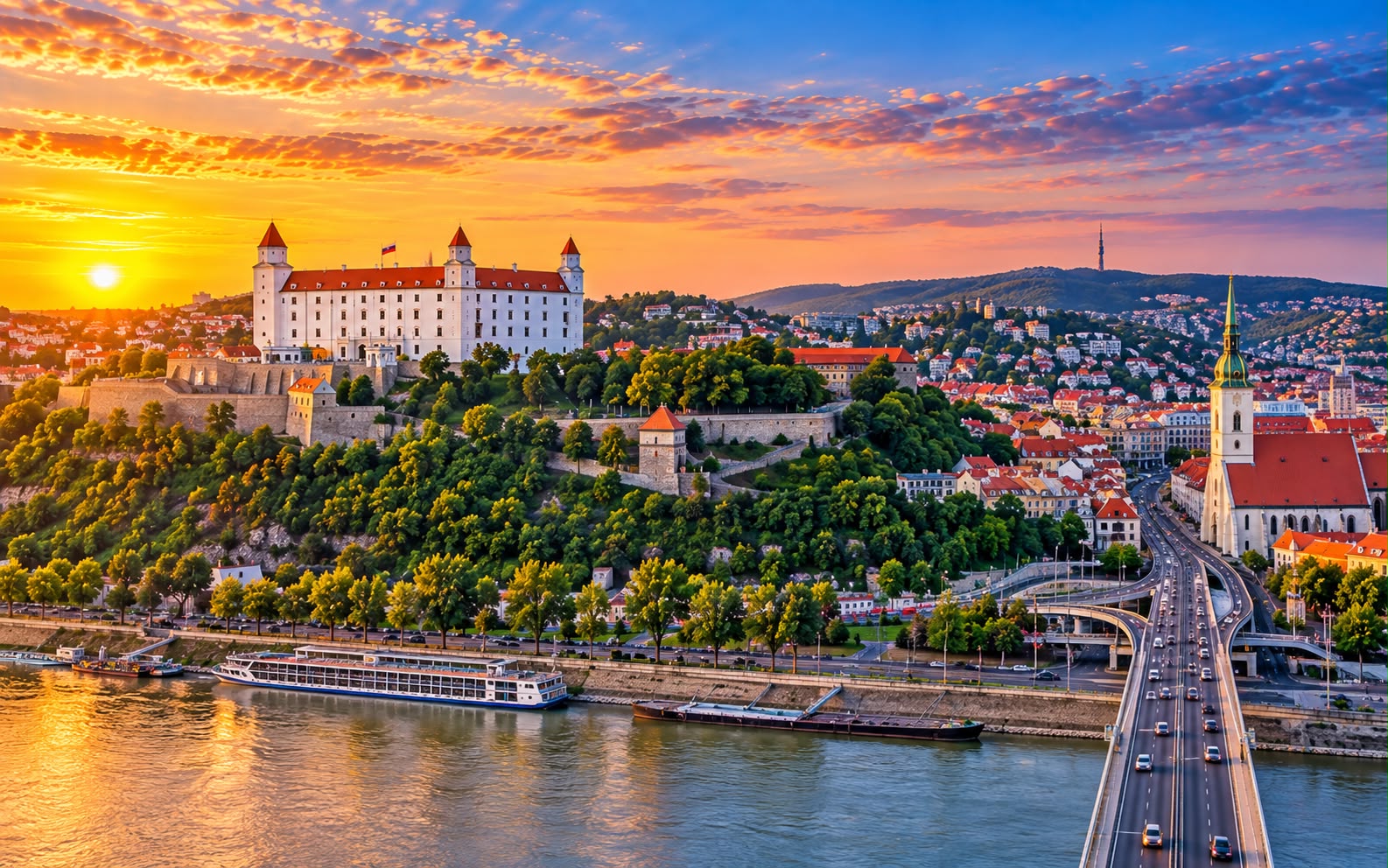
Slovakia in 7 days: Bratislava, the High Tatras and Spiš
The smallest high-mountain range in the world, a silver-mining town that funded an empire, one of the largest castle complexes in Europe, and the tallest wooden Gothic altar anywhere — in a country most people only see from a Danube cruise deck.
- Central Europe
- 7 days
- ≈ AED 3,650 / person
- Mountains without the alpine price
Before you go
Slovakia is the country people pass through. Vienna is an hour west, Budapest two hours south, and the Danube cruise boats stop in Bratislava for an afternoon before moving on. That afternoon gets you a compact old town and a white castle on a rock — and misses everything the country is actually for.
What it is for is mountains. The High Tatras are the smallest high-alpine range on earth: a 26km ridge where peaks pass 2,600 metres, glacial lakes sit under them, and a cable car gets you to 2,634m in about fifteen minutes. The scale means you can be above the treeline before lunch without being a mountaineer.
Then there is the east, which almost nobody reaches. Spiš Castle sprawls over four hectares of a limestone hill. Levoča holds the tallest wooden Gothic altar in the world, 18.6 metres of carved lime. Banská Štiavnica is a silver town built into a volcanic caldera that once financed the Habsburgs.
The shape: Bratislava (2 nights) → Banská Štiavnica (1) → High Tatras (2) → Košice (1), flying open-jaw. Figure EUR 895 (≈ AED 3,665) per person excluding flights. Go June–September for the mountains, or January–March if you ski — the Tatras cost a fraction of the Alps.
Before you go: the 15-minute admin
Visas
- Slovakia is in Schengen. One visa covers it and 28 other countries, and many nationalities enter visa-free — check yours against the current list before booking.
- It pairs naturally with Austria, Hungary, Czechia and Poland on the same visa. The Central Europe route stitches several of them together.
Money
- Euro. Cards are accepted in cities and at the main mountain stations; carry €30 in cash for rural huts, castle entries and the odd chairlift.
- One of the cheapest countries in the eurozone. Mains €9–16 outside Bratislava, €12–22 in it.
- Tipping: round up, or 5–10% if the service was good.
SIM and data
- EU roaming at home rates. From outside the EU, a prepaid SIM or eSIM costs a few euro for the week.
- Coverage is good in the valleys and patchy on the ridges. Download offline maps before any hike.
Getting around
- Bratislava airport is 20 minutes from the centre by bus 61 (€1.10). Vienna airport is often cheaper to fly into and is 50 minutes away by direct coach — check both before booking.
- Trains are cheap and reasonable. Bratislava–Poprad, the Tatras gateway, is about four hours.
- The Tatras have their own electric railway (TEŽ) linking Štrbské Pleso, Starý Smokovec and Tatranská Lomnica every 30–60 minutes. You do not need a car once you are up there.
- A car helps days 3 to 6 for Banská Štiavnica and Spiš. Hire from €35–50/day — among the cheapest in the EU.
- Motorway vignette is required and usually included in a hire car. Confirm it is before you drive off.
Travelling with kids?
- The Tatras do most of the work: the Hrebienok funicular and the Tatranská Lomnica cable car both deliver big views for no effort.
- Spiš Castle is a ruin you can run around, which beats a furnished palace at most ages.
- Skip the Slovak Paradise gorge ladders with small children — they are one-way, exposed and genuinely strenuous.
- Mountain weather turns fast. Pack the warm layer even in August.
Day by day
Day 1 — Land in Bratislava, the old town
- Afternoon — Land, bus 61 or taxi in, check in. The old town is small and almost entirely pedestrian.
- 16:30 — Michael’s Gate, the only one of the four medieval gates still standing, then down Michalská into the Main Square — the town hall, the Roland fountain, and the Napoleonic soldier leaning on a bench.
- 17:30 — St Martin’s Cathedral. Eleven kings and eight queens of Hungary were crowned here between 1563 and 1830, when Bratislava — Pressburg then — was the Hungarian capital and Buda was under Ottoman rule. The gilded crown on the spire weighs 300kg.
- 19:00 — Dinner in the old town. Bryndzové halušky — potato dumplings with sheep’s cheese and bacon — is the national dish and arrives heavier than it sounds.
Where to stay in Bratislava (two nights — the old town is walkable to everything and not expensive)
- Luxury: hotels on and around Hviezdoslavovo námestie, the tree-lined square by the opera house.
- Mid-range: the streets between Michalská and the cathedral put you inside the old town for mid-range money.
- Value: apartments across the river in Petržalka, five minutes over the bridge, materially cheaper.
Day 2 — The castle, Devín, and the blue church
- 09:30 — Bratislava Castle, white and four-towered on its rock. Burnt out in 1811 and left a ruin for 140 years before reconstruction; the terrace looks over the Danube into Austria.
- 11:30 — The Blue Church (St Elizabeth’s), a 1913 art-nouveau chapel painted entirely in pale blue, ten minutes east of the old town and quite unlike anything else in the city.
- 13:00 — Lunch, then bus or boat to Devín Castle, 10km west where the Morava meets the Danube. A fortress since the Romans, blown up by Napoleon’s army in 1809, and during the Cold War the Iron Curtain ran directly below it — the memorial by the water marks those shot trying to swim out.
- 17:30 — Back in town, up the UFO deck on the SNP Bridge for sunset: a 1970s flying saucer on a single pylon, 95 metres up.
Day 3 — East to the silver town
- 09:00 — Collect the car and drive north-east to Banská Štiavnica, about 2h30.
- 12:00 — Lunch on the sloping main square. The town sits inside a collapsed volcanic caldera and nothing in it is level.
- 13:30 — The Old Castle and the New Castle, built against the Ottomans, and the Open-Air Mining Museum where you put on a helmet and lamp and walk a real adit into the hill.
- 16:00 — The Calvary, a baroque pilgrimage complex climbing a conical hill in 25 stations — twenty minutes up, and the view back over the town is the one the UNESCO listing is really about.
- Evening — Stay in town. It empties of day-trippers and the square is yours.
Day 4 — North into the High Tatras
- 09:00 — Drive north to the Tatras, about 2h30, and check in around Starý Smokovec or Tatranská Lomnica.
- 13:00 — Ride the funicular to Hrebienok (1,285m) and walk 20 minutes to the Cold Stream waterfalls (Studenovodské vodopády) — an easy, well-made path and a first proper look at the range.
- 15:30 — Continue up the valley toward Zamkovského chata if the weather holds, or drop back down for the Tatranská Lomnica afternoon.
- Evening — Mountain food: garlic soup in a hollowed loaf, and Tatratea, which is stronger than it tastes.
Where to stay in the Tatras (two nights)
- Mid-range: Starý Smokovec and Tatranská Lomnica are the two best bases, both on the TEŽ railway.
- Value: Poprad, 15km down the valley, is noticeably cheaper and still 25 minutes by train from the slopes.
Day 5 — Štrbské Pleso and the big cable car
- 08:30 — TEŽ train to Štrbské Pleso, the glacial lake at 1,346m with the ski jumps above it. Walk the lakeshore loop first, before the coaches arrive.
- 10:00 — Hike up to Popradské pleso — about 1h15 on a good path, and the most rewarding easy walk in the range. Strong walkers carry on to Rysy, 2,503m, on the Polish border, which is a full and serious day.
- 14:00 — Back down, train to Tatranská Lomnica for the Lomnický štít cable car: 2,634m, the second highest peak in Slovakia, in two stages. Book the timed slot ahead in summer — it sells out, and it closes in wind.
- 17:30 — Back down. The observation deck at the top has a 15–50 minute limit depending on the ticket, which is plenty.
Day 6 — Spiš Castle, Levoča, and on to Košice
- 09:00 — Drive east about an hour to Spiš Castle. One of the largest castle complexes in central Europe — four hectares of ruin on a limestone ridge, visible from twenty kilometres away. Allow two hours and wear something with grip; the upper courtyard is exposed.
- 12:30 — Levoča, 15 minutes away. St James’s Church holds the tallest wooden Gothic altar in the world — 18.6 metres, carved by Master Pavol around 1510 without a single nail. Entry is by timed tour; it is worth planning the day around.
- 15:00 — Drive on to Košice, about 1h15, and return the car.
- 17:00 — Hlavná ulica, the long spindle-shaped main square, and St Elisabeth Cathedral — the largest church in Slovakia and the easternmost Gothic cathedral in Europe.
- 19:30 — Dinner on the square. Košice is a university city and eats late.
Day 7 — Košice, fly home
- Morning — The singing fountain and the state theatre on the square, or the Lower Gate underground archaeological site beneath it.
- Afternoon — Košice airport is 15 minutes out. Direct flights are limited, so check whether returning to Bratislava or flying via Vienna works better — the train back west takes about five hours.
Costs and practicalities
Best time to visit
June–September for the mountains, which are the reason to come, and the High Tatras have a short usable season.
- June–September — the High Tatras hiking season, with the highest trails open roughly late June to October. Below that, snow and ice persist into early summer.
- July–August — warmest and busiest, with Slovak and Polish walkers filling the Tatra huts. Book mountain huts months ahead.
- September–October — the best of the year: clear air, autumn colour in the Tatras and the Slovak Paradise, and far fewer people.
- December–March — skiing at Jasná and Tatranská Lomnica, and the Christmas markets in Bratislava and Košice.
- April–May — the gap. Snow melting, high trails closed, and the gorges of Slovak Paradise often shut for safety.
Several Tatra trails close from 1 November to 15 June by law, for wildlife and avalanche reasons.
Travel tips
- Check the Tatra trail closures before planning a route — the seasonal ban is legal, signposted and enforced by park wardens.
- The Slovak Paradise gorges use ladders and chains and are one-way only. They are genuinely exposed in places and close after heavy rain.
- Slovakia is in the eurozone and Schengen. Cards work widely; carry cash for mountain huts, which are often cash-only.
- Trains and buses are cheap and cover the country; Bratislava to Košice takes about five hours.
- Bratislava is an hour from Vienna by train or boat, which makes a day trip in either direction easy.
- Bears are present in the Tatras. Make noise on the trails and never leave food outside a hut.
- Slovak and Czech are mutually intelligible; English is common among the young and in Bratislava.
What this trip actually costs
Two people, 6 nights, mid-range comfort, flights excluded:
| Item | Cost |
|---|---|
| Hotels, 6 nights (2 Bratislava + 1 Štiavnica + 2 Tatras + 1 Košice) | EUR 680 (≈ AED 2,784) |
| Car hire, 4 days + fuel and vignette | EUR 280 (≈ AED 1,146) |
| Trains, buses and transfers | EUR 50 (≈ AED 205) |
| Food and drink, 7 days | EUR 560 (≈ AED 2,293) |
| Castles, museums, funicular and cable car | EUR 220 (≈ AED 901) |
| Total for two | EUR 1,790 (≈ AED 7,329) |
- Roughly EUR 895 (≈ AED 3,665) per person, and there is room under it: Poprad instead of a Tatras resort and self-catering pull it below EUR 650 (≈ AED 2,661).
- The Lomnický štít cable car is the single biggest ticket at about EUR 30 (≈ AED 123) each. Hrebienok funicular plus a walk gets you most of the view for a tenth of it.
- No car? Bratislava, Poprad and Košice are all on the main railway, and the Tatras have their own. You would lose Banská Štiavnica and Spiš Castle, which is most of the character — consider two Tatras nights and a Spiš day tour from Poprad instead.
- Hotel picks here are chosen on location, not on commission — always check prices and recent reviews before booking.
What to pack
- A warm layer and a rain shell, in every month. The Tatras make their own weather and it changes in an hour.
- Boots with ankle support for anything above Hrebienok. The paths are rocky rather than groomed.
- Sun protection. At 2,600m the sun is fierce even when the air is cold.
- Cash in small notes for mountain huts, which often do not take cards.
FAQ
Is Bratislava worth two nights? Two is right. One gets the old town; the second buys the castle, Devín and the Blue Church, and Devín is the one people remember.
Tatras or the Alps? The Tatras are smaller, far cheaper and much less crowded, and the cable car gets you to 2,634m without any mountaineering. The Alps are bigger and better served. For a week at this budget, the Tatras win easily.
Can I do this as a side trip from Vienna? Bratislava, yes — it is an hour by train or boat, and a very good day trip. The Tatras are four hours further east and need their own trip.
Is Slovak Paradise worth adding? Only if you have a spare day and like ladders. The gorge routes are one-way, use fixed chains and ladders over waterfalls, and are genuinely strenuous. Spectacular, but not a casual afternoon.
Prices and entry rules change, and what you need depends on your passport; last checked 8 October 2026, so confirm with the embassy or your airline before booking.


