 The Itinerary
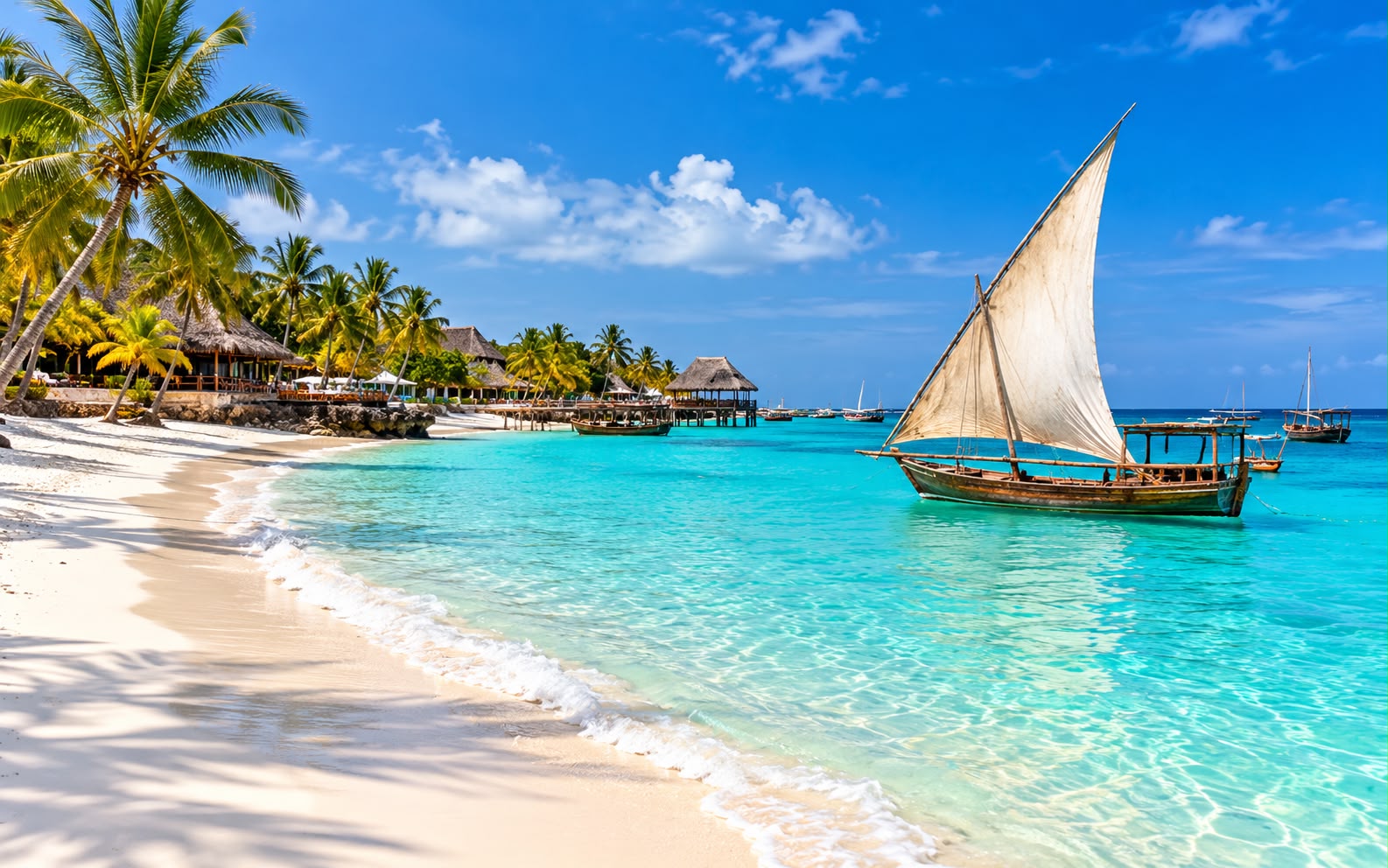
Tanzania in 9 days: Serengeti safari and Zanzibar
The bush-and-beach original: lion country that rolls to every horizon, a wildlife-packed volcanic crater, then a spice island of carved doors and blue-white beaches — with the migration's monthly map, the crater-fee maths and Zanzibar's mandatory $44 insurance decoded.
- East Africa
- 9 days
- ≈ AED 9,750 / person
- Safari + beach
Before you go
Tanzania is the safari superlative country: the Serengeti is where the word “endless plain” was coined (that’s what Siringet means in Maasai), the Ngorongoro Crater packs 25,000 large animals into a collapsed volcano’s grass floor, and when the dust settles you can be on Zanzibar — a Swahili spice island of carved doors, dhows and bath-warm turquoise — by lunchtime.
That pairing is this guide: five safari days on the northern circuit (Tarangire → Serengeti → the Crater), then three nights on Zanzibar, flying home on flydubai’s Zanzibar–Dubai non-stop. It’s the priciest kind of trip this site covers — Tanzania’s park fees run higher than Kenya’s — so the fee maths is laid out plainly, along with the migration’s month-by-month location so you book the right corner of an ecosystem the size of a small country.
Safari economics run in dollars: figure USD 2,650 (≈ AED 9,732) per person excluding international flights. June–October is prime (dry season, river crossings in the north); December–March is calving season in the south and superb; April–May is the green, cheap, wet gamble.
Before you go: the admin
The eVisa, and Zanzibar insurance
- One eVisa covers mainland + Zanzibar: US$50 at the official visa.immigration.go.tz — passport scan + photo, allow up to 10 days (approvals can cut it fine; apply 3+ weeks out). Visa-on-arrival ($50, cash) exists at Kilimanjaro, Dar and Zanzibar airports as the backup queue.
- Zanzibar’s mandatory insurance: since late 2024 every visitor to Zanzibar must buy the island’s own policy — US$44, valid up to three months, bought online at inbound.visitzanzibar.go.tz before you land (your own travel insurance doesn’t replace it). Screenshot the QR; it’s checked with immigration.
Park fees, and the open-jaw
- The park-fee reality (why quotes look high): per-day, per-person conservation fees for non-residents run Serengeti ~$83, Ngorongoro ~$83, Tarangire ~$60, plus vehicle fees — and the Ngorongoro Crater adds a famous ~$295 per-vehicle “crater service fee” for the descent. With 18% VAT folded in, two people’s five park days carry ~$1,000 of fees before a single bed or guide — which is why packages are priced the way they are, and why any suspiciously cheap quote is leaving something out. Get fees itemised in writing.
- Flights: open-jaw is the move — into Kilimanjaro (JRO) one-stop (Qatar, Ethiopian, Kenya Airways combos, ~US$600–950), home from Zanzibar on flydubai’s direct (~5½ h). Book the Arusha→Zanzibar hop (~$150–220) with the safari operator so delays stay their problem.
Health and money
- Health: the whole route is a malaria area — travel-clinic prophylaxis, DEET at dusk. Yellow fever certificate only if you transit an endemic country (a Nairobi/Addis connection can count — carry it if you have it).
- Money & tips: USD cash in crisp post-2009 notes is safari currency; cards work at lodges with fees. Budget $15–20/day per couple for the driver-guide, $10/day for camp staff boxes — handed over on the last morning.
Day by day
Day 1 — Land at Kilimanjaro, breathe in Arusha
- Afternoon — Land at JRO with Kilimanjaro (weather willing) filling the left windows; transfer to Arusha (45 min), meet the safari operator, gear check, early dinner.
- Sleep: a garden lodge in Arusha’s coffee-farm belt (~$90–120 — usually bundled in the package).
Day 2 — Tarangire: the elephant river
- 08:00 — Into Tarangire (2 h): baobabs like upturned trees, and elephants by the hundred digging the dry river for water — the park’s signature scene — plus lion prides that climb trees when the mood takes them.
- Full afternoon game drive; sundowner light through baobab silhouettes is the day’s postcard.
- Overnight: tented camp near the park (full board; the canvas-walls-and-hyena-whoops initiation).
Day 3 — Up the Rift, into the Serengeti
- 07:00 — The long, spectacular drive up the Rift wall and across Ngorongoro’s highlands (Maasai bomas, crater-rim viewpoint pause) then down into the endless plain.
- The migration map, honestly: the herds move in a giant annual circle, so where in the Serengeti matters — Dec–Mar: south (Ndutu; February = calving, cheetah-and-newborn drama); Jun–Jul: west/central; Jul–Sep: far north at the Mara river (the crossings); Oct–Nov: heading back south. Central Seronera works year-round (resident lions, leopards along the river) — tell your operator which spectacle you’re buying and make camp location match the month.
- 15:00 — Game-driving your way to camp by sunset, which is the best use of the arrival afternoon.
- 19:00 — Overnights: tented camps positioned by season (full board).
Day 4 — Dawn to dusk on the plain
- 05:30 — Optional splurge at first light: the balloon safari (~$599 pp here — pricier than Kenya, and the Serengeti’s version of it).
- 06:30 — Kopjes — Lion King rocks, occupied by actual lions — which is where the cats lie up at dawn.
- 10:00 — Hippo pools, and the smell arrives before the view does.
- 13:00 — Through the heat in camp.
- 16:00 — Cheetah scanning the shimmer, which is the late-afternoon speciality out on the open grass.
- 18:30 — Sundowner, and the Serengeti’s horizon is the point of the whole day.
Day 5 — Ngorongoro Crater, then the rim
- 06:30 — Descend 600 m into the crater — a 260 km² grass bowl where the Big Five commute: the highest predator density in Africa, the last easily-seen black rhinos in the north, flamingo smudge on the soda lake, all ringed by 2,300-metre walls. Five hours is the permit rhythm; picnic by the hippo pool (kites dive-bomb — eat inside the vehicle, guides will insist).
- Afternoon — Up and out to the rim or back to Karatu’s coffee farms for the night; farewell bush dinner with the crew (tips morning is tomorrow).
Safari camps by tier (packages assign the exact camp — these are the verified benchmarks to ask for):
- Luxury: Meliá Serengeti Lodge — 4.9/5 on TripAdvisor (~700 reviews), infinity-edge views over the Mbalageti valley. (Four Seasons Safari Lodge is the brand-name splurge.)
- Mid-range: Kubu Kubu Tented Lodge — 4.9/5 (~1,250 reviews), the stylish permanent-tent standard.
- Value: the mobile/seasonal tented camps your operator runs (Kati Kati-style, ~$180–220 pp full board) — bucket showers, lantern paths, and the lions sound exactly the same.
Day 6 — Fly to the spice island: Stone Town
- Morning — Arusha → Zanzibar (1 h 20; ~$150–220). Land, buy nothing at the airport except the taxi ($15 fixed-ish into town).
- 14:00 — Stone Town on foot: carved brass-studded doors, the House of Wonders facade, the old fort, Freddie Mercury’s birthplace (small museum, ~$10 — yes, really, Zanzibar’s most famous son), and the sobering slave-market memorial at the Anglican cathedral (~$8 with guide) — the island’s history has both spice and shadow, and an hour here honours it.
- 18:00 — Sunset from a rooftop tea house, then Forodhani Gardens’ night grill market — Zanzibar pizza, sugarcane juice, seafood skewers (haggle gently; $8–12 feeds two well).
Stone Town night: Zanzibar Palace Hotel — 4.7/5 (~890 reviews), antique-carved boutique (~$140–190); or seafront Tembo House — 4.1/5 (~2,100 reviews), ~$90–120.
Day 7 — The beach: Nungwi
- 09:00 — Transfer north to Nungwi (1 h 15, ~$40): the island’s swim-all-day coast — minimal tide swing, dhows moored on gin-clear water.
- (Trade-off note: the east coast — Paje/Jambiani — is prettier-wilder and kitesurf-central, but the lagoon walks out hundreds of metres at low tide and seaweed seasons visit; Nungwi/Kendwa is the reliable-swimming answer.)
- 12:00 — Beach, swim — and the one local friction, named: “papasi” beach touts work the sand; a firm, smiled “hapana asante” (no thanks) on repeat is the entire technique.
- 17:00 — Sunset dhow cruise (~$25–35 pp).
Beach nights: The Z Hotel, Nungwi — 4.7/5 (~2,600 reviews), adultish boutique on the best sand (~$220–300); Hotel Riu Palace — 4.7/5 (~5,600 reviews) for the all-inclusive route; Makofi Guest House — 4.9/5 (~700 reviews, the island’s #1 Best Value) at ~$60–90.
Day 8 — Pick the classic day
- 08:30 — Safari Blue (full-day dhow, sandbank, snorkelling, seafood feast — ~$70–90 pp from the southwest), which is the better of the two if you want a whole day on the water.
- Or 09:00 — The spice-farm tour (~$30–35 with transfer: vanilla vines, clove trees, fruit-tasting overload — Zanzibar was the world’s clove kingdom).
- 14:00 — Prison Island’s giant tortoises (~$45 by boat), which pairs with the spice farm rather than Safari Blue.
- 18:00 — Last sundowner: Kendwa’s beach bars do the island’s best.
Day 9 — Fly home direct
- Slow breakfast, one last swim, airport by noon (allow padding — island time is a real timezone), and flydubai’s non-stop to Dubai (~5½ h). Vanilla pods and clove packets in the bag; the insurance QR never asked for again.
Costs and practicalities
Best time to visit
June–October is prime for the northern circuit, with the migration’s river crossings the thing most itineraries are built around.
- June–October — the dry season and peak. The Mara River crossings in the northern Serengeti usually happen July to September, and the game is concentrated everywhere.
- January–February — the calving season in the southern Serengeti and Ndutu, when around half a million wildebeest are born in a few weeks and the predator action is extraordinary. Arguably the best wildlife weeks of the year.
- March–May — the long rains. Green, cheap, and some camps close; the Ndutu roads become difficult.
- November–December — the short rains, brief and usually afternoon only, and the migration moves south.
- Kilimanjaro is best climbed January–March and June–October; Zanzibar is driest June–October and December–February.
Travel tips
- The migration is a year-round circuit, not an event. Where it is depends on the month, so pick the camp for the season rather than the other way round.
- Park fees are a large and fixed part of the cost and are charged per person per 24 hours. Understand how your itinerary counts them.
- Kilimanjaro needs a longer route, not a cheaper one. Six to eight days gives far better acclimatisation and a much higher summit rate than five.
- Tipping is expected and structured — guides, cooks and porters on Kilimanjaro have recommended rates, and camps give guidance at check-in.
- Malaria prophylaxis is essential and a yellow fever certificate is required if arriving from an endemic country.
- Zanzibar is conservative outside the beach resorts. Cover shoulders and knees in Stone Town, and more during Ramadan.
- Carry US dollars in cash for tips and park extras; cards work at lodges and in Arusha.
What this trip actually costs
Two people, 8 nights, mid-range safari + beach, excluding international flights (JRO one-stops ~US$600–950 in; flydubai ZNZ–DXB ~US$380–650 home):
| Item | Cost |
|---|---|
| eVisas + mandatory Zanzibar insurance ×2 | USD 190 (≈ AED 698) |
| 5-day northern-circuit safari package ×2 (park fees, crater fee, camps, full board, 4x4 + guide) | USD 3,500 (≈ AED 12,854) |
| Arusha arrival night | USD 100 (≈ AED 367) |
| Flight Arusha→Zanzibar ×2 | USD 380 (≈ AED 1,396) |
| Zanzibar hotels: Stone Town 1N + Nungwi 2N | USD 410 (≈ AED 1,506) |
| Zanzibar days: Safari Blue + spice farm ×2 | USD 230 (≈ AED 845) |
| Island transfers + taxis | USD 80 (≈ AED 294) |
| Food on Zanzibar, 3 days | USD 200 (≈ AED 735) |
| Safari tips (guide + camp staff) | USD 130 (≈ AED 477) |
| eSIM | USD 15 (≈ AED 55.09) |
| Buffer: dhow sunset, tinga-tinga art | USD 65 (≈ AED 239) |
| Total for two | USD 5,300 (≈ AED 19,464) |
- USD 2,650 (≈ AED 9,732) per person — the site’s biggest safari number, and the fee table above is why. The honest levers: group-camping safaris cut ~$550 pp (bucket showers, same lions); April–May green season cuts lodge rates 30–40% (rain showers, emerald plains, some mud); and Zanzibar guesthouses halve the beach leg.
- Book in this order: safari operator with itemised fees in writing (migration-season camps fill 4–8 months out) → international open-jaw flights → eVisa (3+ weeks out) → Arusha→Zanzibar hop → Zanzibar hotels → $44 insurance the week before → Safari Blue on the ground.
- Camp and hotel picks are unsponsored — no affiliate links in this article. Chosen on location and current TripAdvisor ratings; check recent reviews and prices before booking.
What to pack
- Safari neutrals (khaki/olive; no dark blue/black — tsetse bait — and no camouflage, illegal for civilians), fleece for 6 am crater rim cold, dust buff.
- Binoculars + zoom lens + double memory cards; soft duffel only (4x4s and small planes).
- DEET, prophylaxis, SPF 50, basic meds kit (pharmacies vanish after Arusha).
- Crisp USD notes (2009+ series) split between bags; the $44 insurance QR and eVisa PDFs offline.
- Zanzibar leg: reef shoes, modest wear for Stone Town (it’s a conservative Muslim old town — shoulders/knees off the beach), swimwear for the sand.
- Power: Tanzania uses UK-style Type G — UK and Gulf plugs just work.
FAQ
Tanzania or Kenya for the safari — the site now has both? Honest split: Kenya (guide) is cheaper, shorter-drive, and unbeatable July–October when the herds are in the Mara. Tanzania owns the migration the other nine months, adds the crater — the single most reliable Big Five morning in Africa — and feels emptier per vehicle. First safari on a budget: Kenya. The full epic, or any trip December–June: Tanzania.
Halal and vegetarian food? The trip’s easy half is Zanzibar: a ~99% Muslim island where halal is simply the default — eat anywhere, Forodhani included. Safari camps cater halal/veg smoothly with advance notice (say it at booking; the kitchens are used to it), and Indian-veg requests are routine thanks to Tanzania’s old Gujarati community — Arusha even does a proper thali.
Is Zanzibar just a beach, or worth real time? Worth it as a place, not just a pool: Stone Town is a UNESCO Swahili-Arab-Indian palimpsest, the spice farms explain three centuries of world trade, and the slave-market memorial grounds the paradise in its history. Three nights is the right minimum; a week is a different (lovely) trip.
When exactly for the river crossings / calving? Crossings: late July–September at the northern Kogatende sector (book those camps 6+ months out). Calving: late January– February around Ndutu — 8,000 wildebeest born a DAY at peak, with cheetahs working the nursery. Both are nature’s scheduling, not a show: build two-plus Serengeti nights so patience can do its work.
Can we skip the crater to save the $295? You can — and shouldn’t, first time. The fee is per VEHICLE (split it), the five permitted hours deliver more guaranteed sightings than any other morning in Africa, and it’s the only realistic black-rhino card in the north. Skip Tarangire before you skip the crater.
What’s Tanzania guide #2? Zanzibar solo, done properly — a full week of Stone Town, Paje kites and Pemba-side diving on the flydubai direct — or the Kilimanjaro trek for the summit-minded. Votes welcome; both on the list.
Prices and entry rules change, and what you need depends on your passport; last checked 9 November 2026, so confirm with the embassy or your airline before booking.


