 The Itinerary
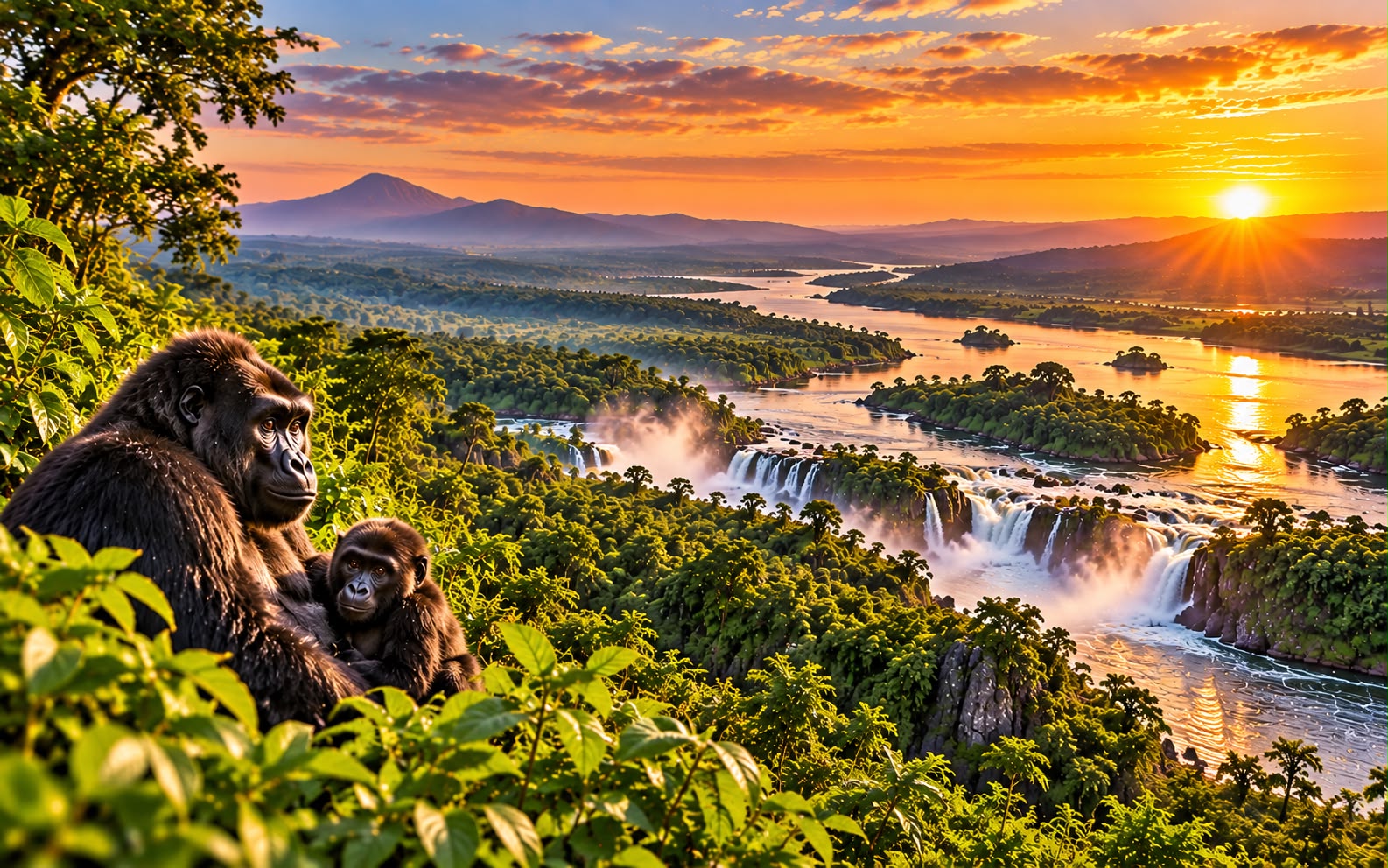
Uganda in 10 days: gorillas, chimps and the Nile
The same mountain gorillas as Rwanda at roughly half the permit price, plus chimpanzees in a rainforest, tree-climbing lions on a savanna crater floor, and a lake with no bilharzia at the end of it — with the honest trade-off, which is a much longer drive.
- East Africa
- 10 days
- ≈ AED 9,600 / person
- Gorillas, for less
Before you go
Uganda has the gorillas, the chimpanzees and the savanna, and it is the country people choose when they have looked at Rwanda’s permit price and looked again.
That is the real comparison, so here it is up front: a gorilla permit in Uganda costs USD 800, against Rwanda’s USD 1,500. The animals are the same species in the same mountain range. What you pay for in Rwanda is the short, excellent road from Kigali — under three hours. In Uganda, Bwindi is eight to ten hours by road from Entebbe, and that is the trade.
What you get in return is a much fuller trip. Kibale has the best chimpanzee tracking in Africa. Queen Elizabeth has the Kazinga channel and tree-climbing lions in the Ishasha sector. Lake Bunyonyi is deep, cold, bilharzia-free and the right place to end.
Before you go: permits, driving and the two primates
Entry
- Uganda requires a visa for most nationalities, applied for online in advance through the official eVisa portal. Print the approval; it is checked.
- The East Africa Tourist Visa covers Uganda, Kenya and Rwanda together and is the right choice if you are combining them.
- Yellow fever vaccination is mandatory and the certificate is checked on arrival.
Permits, and how they differ
- Gorilla permits: USD 800 for foreign non-residents, issued by the Uganda Wildlife Authority. Rwanda’s are USD 1,500.
- Book months ahead, through UWA or an operator. Peak months — June to September, December to February — sell out.
- Gorilla habituation experience: a separate, more expensive permit that gives four hours with a semi-habituated group instead of one. Limited numbers daily.
- Chimpanzee permits at Kibale are far cheaper and near-certain for sightings.
- Minimum age 15 for gorillas, as in Rwanda.
- You will not be allowed to trek with a cold. Gorillas catch human respiratory infections and it kills them. No refunds, and the rule is right.
The driving is the trade-off
- Entebbe to Bwindi is 8–10 hours, on a mix of good tarmac and rough murram track. Most itineraries break it with Kibale and Queen Elizabeth on the way, which this one does.
- A 4x4 with a driver-guide is the standard arrangement and is how almost everyone does it. Self-drive is possible and slow.
- Domestic flights from Entebbe to Kihihi or Kisoro cut the Bwindi leg to about ninety minutes and cost considerably more. Worth it if your time is short.
- Do not drive at night. Unlit vehicles, pedestrians and potholes.
On the trek itself
- Treks run from one to six hours each way, on steep, muddy, nettle-covered ground. Bwindi is called the Impenetrable Forest for a reason.
- Hire a porter. It is cheap, genuinely helpful, and direct local income — often to former poachers now employed by the park.
- Gaiters and gardening gloves are not excessive here.
Money and the practicalities
- The shilling (UGX), with large numbers. Cards work in Kampala and Entebbe and at some lodges; carry cash elsewhere.
- US dollars are used for permits — clean, post-2009 notes.
- Malaria is present countrywide. Prophylaxis and repellent.
- English is an official language and widely spoken.
Day by day
Day 1 — Land at Entebbe
- 13:00 — Land at Entebbe (EBB), on a peninsula in Lake Victoria. Stay in Entebbe, not Kampala: it is ten minutes from the terminal against ninety in Kampala traffic, and you fly out from here too.
- 15:00 — Entebbe Botanical Gardens, 40 hectares on the lakeshore, free to walk and full of black-and-white colobus, vervets and about 200 bird species. An hour is enough.
- 17:00 — Uganda Wildlife Conservation Education Centre, the old zoo, now a rescue centre — worth it only if you want a first look at what you are about to see properly.
- 19:00 — Dinner on the lake. Tilapia, and the first of many Nile Specials.
- 20:30 — Meet your driver-guide if they are here tonight. On a trip with this much road, the guide matters more than the lodges.
- Alternative — With a spare day, Ngamba Island chimp sanctuary is a 45-minute boat ride and a genuinely good half-day.
Day 2 — West to Kibale
- 07:00 — Leave early. The road west is 350 km and takes six hours, and the first two out of Kampala are the worst of it.
- 10:00 — Cross the equator at Kayabwe — a painted circle, a coffee stop, and the water-swirling demonstration that is entirely a trick. Ten minutes, and everybody stops.
- 13:00 — Lunch at Mbarara or on the Fort Portal road.
- 15:30 — The Fort Portal crater lakes: thirty-odd volcanic craters filled with water, tea estates in between, and the Rwenzoris on the horizon if the cloud lifts.
- 17:00 — Arrive Kibale. Settle in, and walk the lodge grounds before dark.
- 19:30 — Dinner, and then listen. The forest at night here is the loudest place on the itinerary — tree hyrax screaming, and nothing else sounds like it.
Day 3 — Chimpanzees
- 07:00 — Briefing at Kanyanchu, then into Kibale. Thirteen primate species live here, the highest density in Africa, and the chimp community is habituated: sightings run at roughly 90%.
- 08:30 — Tracking. Anything from forty minutes to three hours of walking, then one hour with the group. They are loud, fast, and entirely unbothered by you — a different experience from gorillas in every way.
- 12:00 — Out, and lunch.
- 14:30 — Bigodi Wetland Sanctuary, run by the community next door: a boardwalk circuit for red colobus, grey-cheeked mangabey and about 130 bird species. Two to three hours, and the fee stays in the village.
- 18:00 — Back at the lodge.
- Upgrade — The chimpanzee habituation experience puts you with researchers from dawn to dusk instead of one hour. It costs roughly double and is the better day if you only do one primate trek.
Day 4 — South to Queen Elizabeth
- 08:00 — Drive south, about three hours, past more crater lakes and down the escarpment into the rift.
- 11:00 — Arrive Queen Elizabeth National Park. The temperature climbs as you descend; this is 900 m, not 1,500.
- 12:30 — Lunch at the lodge, and the afternoon off — the animals are asleep and so should you be.
- 15:00 — The Kazinga Channel boat, two hours on the 32 km waterway between Lakes Edward and George. Hippo in the hundreds, buffalo shoulder-deep, elephant coming down to drink, and one of the densest concentrations of water birds anywhere. Take the afternoon departure, not the morning one.
- 18:30 — Sundowner on the escarpment, with the Rwenzoris behind you.
- 19:30 — Dinner. Early start again.
Day 5 — Game drives, and the Ishasha lions
- 06:00 — Game drive on the Kasenyi plains at first light: lion on the kob breeding grounds, elephant, buffalo, and warthog in absurd numbers. Three hours.
- 09:30 — Back for breakfast.
- 12:00 — Drive south to the Ishasha sector, two hours through the park.
- 15:30 — The tree-climbing lions: a population here lies along the branches of fig trees through the afternoon. The best guess is tsetse flies and cooler air, and no one is certain. They are not guaranteed — reckon on a 50/50 afternoon, which is part of why the guide matters.
- 18:30 — Ishasha camp, on the river, with hippo audible all night.
Day 6 — Into Bwindi
- 08:00 — The climb into Bwindi Impenetrable Forest: three to four hours, rough road, and steeply uphill for the last of it. You go from 900 m to over 2,000 m.
- 12:30 — Arrive your sector — Buhoma, Ruhija, Rushaga or Nkuringo. This is set by which gorilla family you were allocated when the permit was bought, and it decides where you sleep.
- 14:00 — Lunch, then a short waterfall walk or the village trail to get your legs moving at altitude.
- 17:00 — The briefing. Listen to the porter conversation properly: hiring one costs about USD 20, is the single best money on this trip, and directly employs people from the villages that gave up the forest.
- 19:00 — Dinner, kit laid out, early night.
Day 7 — Gorillas
- 06:30 — Report to the park headquarters. Registration, group allocation by fitness, and a briefing you should actually listen to.
- 08:00 — Drive to the trailhead and start walking. The trek is anything from one to six hours each way, through nettles, mud and vines, mostly uphill. Guides cut the trail with machetes.
- 11:00 — The trackers radio in, you leave your bags, and the hour begins. One hour with the family, seven metres back, masks on, no flash. The hour goes in what feels like ten minutes.
- 14:30 — Back down. Certificates at headquarters, and most people are finished for the day.
- 16:30 — Rest. Do not plan anything.
- 18:00 — A Batwa community visit if your lodge arranges one properly — the forest’s original inhabitants, evicted when it became a park in 1991, and the least comfortable and most necessary hour of the trip.
Day 8 — To Lake Bunyonyi
- 08:30 — Drive to Lake Bunyonyi, about three hours, through terraced hillsides farmed to the summit.
- 11:30 — Arrive. The lake is 29 islands, up to 44 m deep, at 1,960 m — and it is free of bilharzia, crocodiles and hippo, which makes it the one lake in the region you can actually swim in.
- 13:00 — Lunch on the terrace.
- 15:00 — Dugout canoe between the islands. Ask about Akampene — Punishment Island — where unmarried pregnant girls were once abandoned, and the story of the men who rowed out to fetch them.
- 18:00 — Sunset from the water. After Bwindi this is the recovery day, and it is well placed.
Day 9 — The long road back
- 07:00 — The drive to Entebbe is 8 to 9 hours and there is no way to make it shorter. Leave early.
- 11:00 — Mbarara for lunch and fuel.
- 14:00 — The equator at Kayabwe again, for the photograph you did not take on the way out.
- 17:00 — Kampala traffic. This is the part that adds an hour.
- 19:00 — Entebbe. Dinner on the lake, and a proper shower.
- Alternative — A charter flight from Kihihi or Kisoro back to Entebbe turns this day into 90 minutes. It costs roughly USD 300–400 and if your budget stretches, it buys you a day.
Day 10 — Fly home
- Morning — Entebbe’s hotels are fifteen minutes from the terminal, so a late-morning start is fine.
- Afternoon — Most long-haul departures leave in the evening; the craft market on the Kampala road is a better last hour than the airport.
- Note — Keep your gorilla certificate somewhere it will not get bent. It is a better souvenir than anything in the market.
Costs and practicalities
Best time to visit
June–September and December–February are the two dry seasons, and gorilla trekking is the thing they are judged by.
- June–September — the long dry season and the best trekking conditions in Bwindi. The busiest and most expensive.
- December–February — the short dry season, also good, and generally quieter.
- March–May — the long rains. Bwindi’s trails become deep mud, but permits are easier and the forest is at its most beautiful.
- October–November — the short rains, with afternoon storms.
Gorillas and chimpanzees are tracked year-round and permit prices do not change by season. Queen Elizabeth and Murchison Falls are best in the dry, when game concentrates on the water; the shoebill in the Mabamba swamp is year-round.
Travel tips
- Uganda’s gorilla permits cost substantially less than Rwanda’s and the trekking is generally harder — Bwindi is steep and dense. Book months ahead.
- The minimum age is 15 and you will be turned away with a cold or flu; the rule protects the gorillas.
- Hire a porter. It is cheap, the trek is genuinely tough, and it is the main route for trekking money into the surrounding villages.
- Distances are long and roads are slow. Kampala to Bwindi is 8–10 hours. Domestic flights to Kihihi or Kisoro save a day each way.
- Kampala’s traffic is severe and boda-boda motorcycle taxis are the fast option and the main cause of visitor injuries. Use SafeBoda if you use one at all.
- Malaria prophylaxis is essential and a yellow fever certificate is required and checked.
- Mobile money runs everyday payments; cards work in Kampala and at lodges only.
What this trip actually costs
Two people, 9 nights, mid-range, excluding international flights:
| Item | Cost |
|---|---|
| Gorilla permits ×2 | UGX 6,200,000 (≈ AED 5,659) |
| Lodges, 9 nights | UGX 7,000,000 (≈ AED 6,389) |
| 4x4 with driver-guide, 9 days, and fuel | UGX 4,600,000 (≈ AED 4,199) |
| Chimp permits, park fees, Kazinga boat, community walks | UGX 1,900,000 (≈ AED 1,734) |
| Food, drink, porters and tips | UGX 1,300,000 (≈ AED 1,187) |
| Total for two | UGX 21,000,000 (≈ AED 19,168) |
- Roughly UGX 10,500,000 (≈ AED 9,584) per person. The gorilla permits are the single biggest line, as in Rwanda, but at roughly half the price.
- Compare like for like: Uganda’s total is meaningfully lower than the same trip in Rwanda, and you get chimps and savanna in the same ten days.
- Flying to Kihihi instead of driving adds cost and saves the best part of two days.
What to pack
- Gaiters and thick gloves for Bwindi’s nettles and thorns.
- Waterproofs. It is a rainforest, in every month.
- Boots with grip for steep mud.
- Long sleeves and trousers for forest and mosquitoes.
- US dollars in clean notes for permits and tips.
- Binoculars for Queen Elizabeth.
- Type G plugs, UK-style, 240V.
FAQ
Uganda or Rwanda for gorillas? Uganda if the permit price matters and you want a fuller trip — USD 800 against USD 1,500, plus chimps and savanna. Rwanda if you have limited days and want the short drive from Kigali. Our Rwanda guide covers that side.
How hard is the trek? Anywhere from one to six hours each way on steep, muddy ground at altitude. Tell the briefing honestly and you will be matched to a suitable family. A porter makes a genuine difference.
Is the habituation experience worth the extra? Four hours instead of one, with a group still being habituated, so behaviour is more natural and less settled. It costs substantially more and numbers are very limited. For most people the standard hour is enough.
When should I go? June to September and December to February are the drier seasons and the easier treks. The wet months are green, quieter and considerably muddier.
Prices and entry rules change, and what you need depends on your passport; last checked 8 October 2026, so confirm with the embassy or your airline before booking.


